

Super Voodoo
John Jo
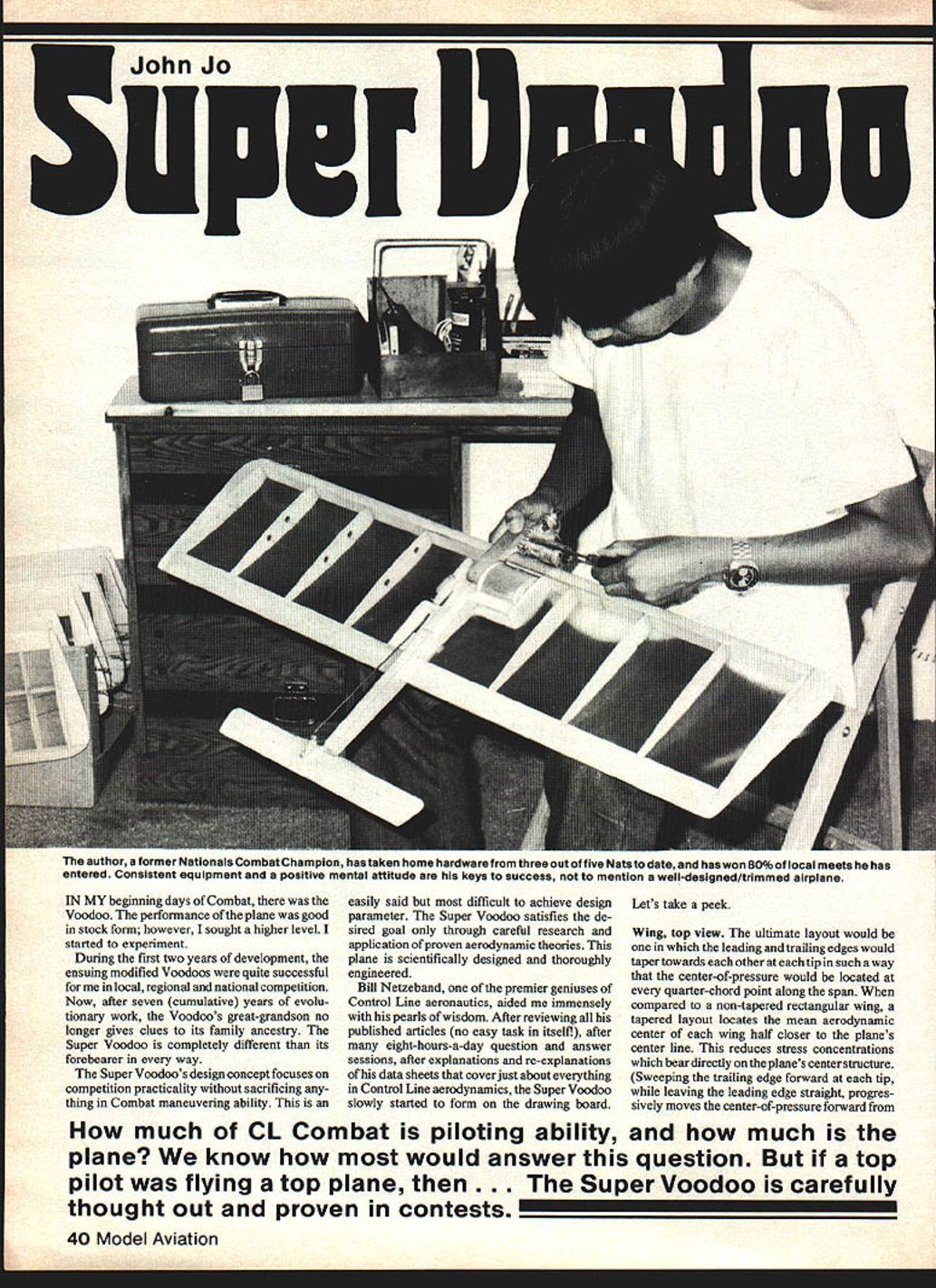
The author, a former Nationals Combat Champion, has taken home hardware from three out of five Nats to date, and has won 80% of local meets he has entered. Consistent equipment and a positive mental attitude are his keys to success, not to mention a well-designed, well-trimmed airplane.
Background
In my beginning days of Combat, there was the Voodoo. The performance of the plane was good in stock form; however, I sought a higher level and began to experiment.
During the first two years of development, the ensuing modified Voodoos were quite successful for me in local, regional and national competition. Now, after seven cumulative years of evolutionary work, the Voodoo's great-grandson no longer gives clues to its family ancestry. The Super Voodoo is completely different than its forbearer in every way.
The Super Voodoo's design concept focuses on competition practicality without sacrificing anything in Combat maneuvering ability. This is an easy statement but a difficult design parameter to achieve. The Super Voodoo satisfies the desired goal only through careful research and application of proven aerodynamic theories. This plane is scientifically designed and thoroughly engineered.
Bill Netzeband, one of the premier geniuses of Control Line aeronautics, aided me immensely with his pearls of wisdom. After reviewing all his published articles, after many eight-hours-a-day question-and-answer sessions, and after explanations and re-explanations of his data sheets that cover just about everything in Control Line aerodynamics, the Super Voodoo slowly started to form on the drawing board.
Let's take a peek.
Wing — top view
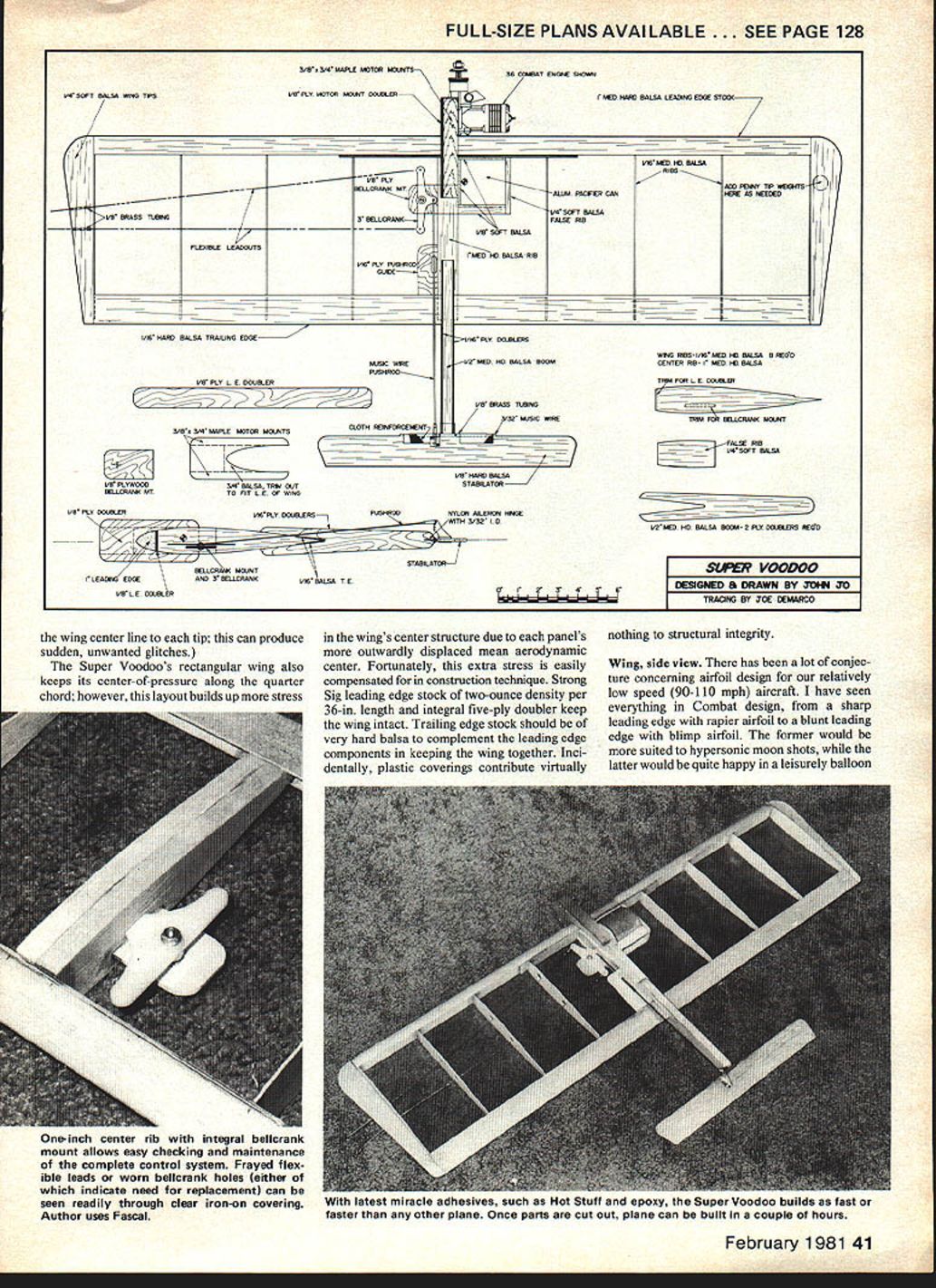
The ultimate layout would taper the leading and trailing edges toward each tip so the center of pressure would be located at the quarter-chord point along the span. When compared to a non-tapered rectangular wing, a tapered layout locates the mean aerodynamic center of each wing half closer to the plane's centerline. This reduces stress concentrations which bear directly on the plane's center structure. Sweeping the trailing edge forward at each tip, while leaving the leading edge straight, progressively moves the center of pressure forward from the tip and can produce sudden unwanted glitches.
A rectangular wing also keeps its center of pressure along the quarter-chord; however, this layout builds up stress in the wing's center structure because panels outwardly displace the mean aerodynamic center. Fortunately, the extra stress is easily compensated by construction technique. A strong leading edge stock (two-ounce density per 36‑in. length) and an integral five-ply doubler help keep the wing intact. The trailing edge stock should be very hard balsa to complement the leading edge components in keeping the wing together. Incidentally, plastic coverings contribute virtually nothing to structural integrity.
Wing — side view and airfoil
There is a lot of conjecture concerning airfoil design. Relatively low-speed (90–110 mph) aircraft have seen everything. In Combat design there is the sharp leading-edge, rapier airfoil and the blunt leading-edge, blimp airfoil. The former would be suited to hypersonic moon shots; the latter would be quite happy for a leisurely balloon.
Through unprejudiced testing, it has been found that airfoil selection for our speed and type of aircraft is not really all that critical. Just remember this: if an airfoil is neither too blunt nor too sharp at the leading edge, and it has a 12–18% maximum thickness with the high point located between 20–30% of the chord, the airfoil has more than enough potential for the job at hand. The airfoil on the Super Voodoo is not a magical one. It is a modified St. Cyr 172, which has a 13.5% maximum thickness at 30% of the chord.
A model of 38.74‑in. span by 6.46‑in. chord and the St. Cyr 172 airfoil was tested in a wind tunnel at a 90 mph velocity. The results showed a lift coefficient approaching 1.0 with a 20:1 lift/drag ratio. The airfoil's center of pressure stayed at 25% of the chord throughout the lift curve. The St. Cyr 172 displayed non-violent stall characteristics. An interesting fact: the St. Cyr airfoils were designed and tested in 1925 — as the saying goes, "New news is only reintroduced old news."
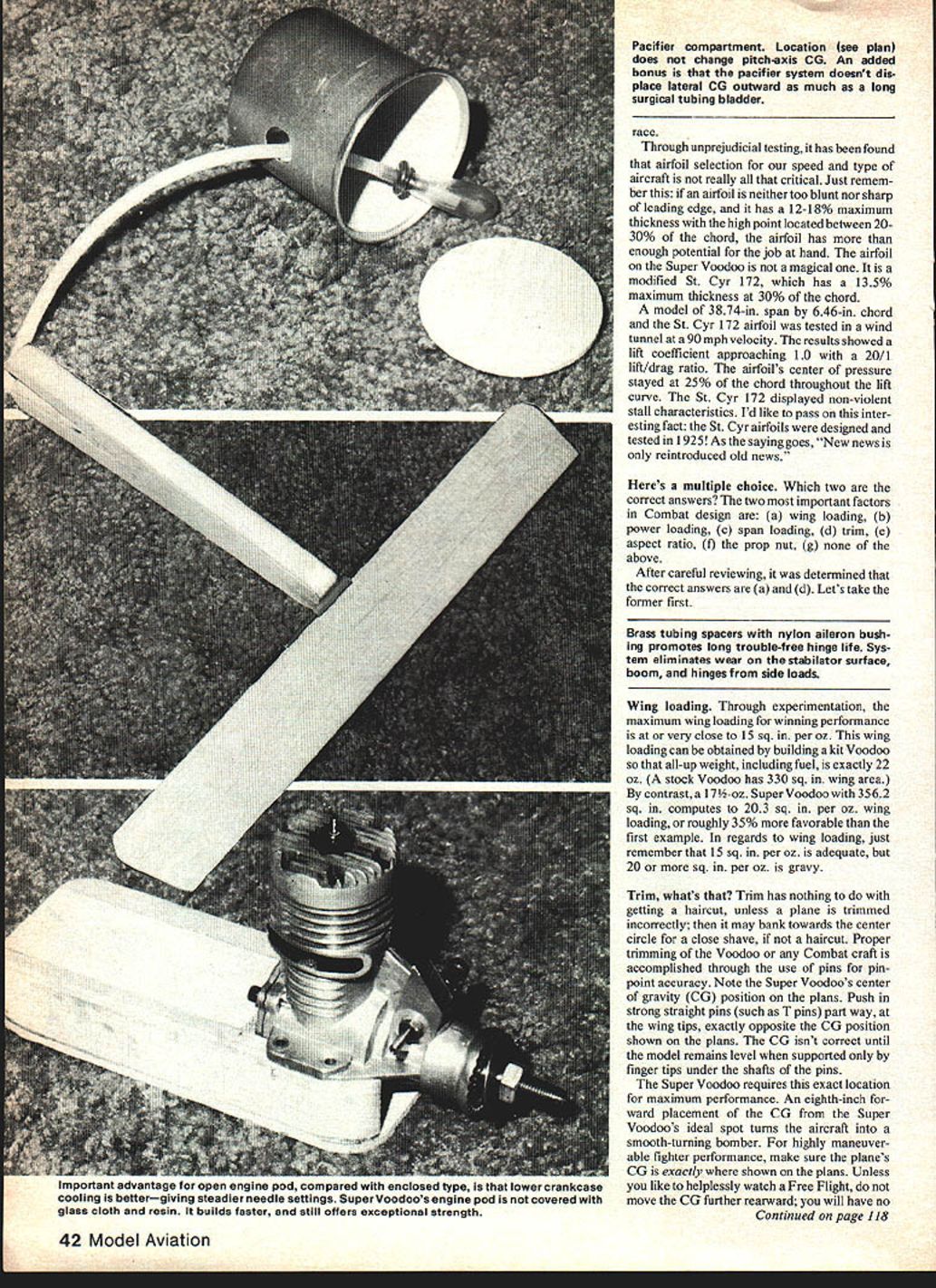
Pacifier compartment
Location (see plan) does not change pitch-axis CG. An added bonus is that the pacifier system doesn't displace lateral CG outward as much as a long surgical-tubing bladder.
Key factors in Combat design
Which two are the correct answers? The two most important factors in Combat design are:
- (a) wing loading
- (b) power loading
- (c) span loading
- (d) trim
- (e) aspect ratio
- (f) the prop nut
- (g) none of the above
After careful review, the correct answers are (a) wing loading and (d) trim.
Wing loading
Through experimentation, the maximum wing loading for winning performance is at or very close to 15 sq. in. per oz. This wing loading can be obtained by building a kit Voodoo so that all-up weight, including fuel, is exactly 22 oz. (A stock Voodoo has 330 sq. in. wing area.)
By contrast, a 17½‑oz. Super Voodoo with 356.2 sq. in. computes to 20.3 sq. in. per oz. wing loading, or roughly 35% more favorable than the first example. In regards to wing loading, remember that 15 sq. in. per oz. is adequate, but 20 or more sq. in. per oz. is gravy.
Trim — general
What is trim? Proper trimming of the Voodoo or any Combat craft is accomplished through the use of pins for pinpoint accuracy. Note the Super Voodoo's center of gravity (CG) position on the plans. Push in strong straight pins (such as T pins) partway, at the wing tips, exactly opposite the CG position shown on the plans. The CG isn't correct until the model remains level when supported only by fingertips under the shafts of the pins.
The Super Voodoo requires this exact location for maximum performance. An eighth-inch forward placement of the CG from the Super Voodoo's ideal spot turns the aircraft into a smooth-turning bomber. For highly maneuverable fighter performance, make sure the plane's CG is exactly where shown on the plans. Unless you like to helplessly watch a free flight, do not move the CG further rearward; you will have no control.
Trim — line rake
Proper line rake has been computed via formula and flight-adjusted for a minimum aircraft speed of 90 mph. Those who build in line rake for 120‑mph speeds will suffer decreased line tension as soon as the plane lifts off with the streamer. (A full streamer can slow down a Fast Combat plane almost 10 mph.) Those who build in excessive line rake will waste engine efficiency by directing the power outwards.
Proper line rake was computed to a 90 mph minimum Combat speed because of observations at five Nationals. Under average atmospheric conditions the top Combat fliers were usually turning 90–100 mph. Under ideal atmospheric conditions these same fliers upped their speeds to the 100–110 mph region. Poor atmospheric conditions dropped their speeds to the 80–90 mph range. All flights were with full streamer and accurately timed. With this data and a little interpolation, 90 mph was selected as the minimum Combat speed to compute line rake.
#### Tip: finding true airspeed when the plane is not level
- Note the angle between the lines and the ground.
- Look up the cosine of this angle and multiply it by the apparent speed of the plane to get true speed.
Example: A plane flying at 45° with an apparent speed of 100 mph has true speed = 100 × cos(45°) = 100 × 0.707 = 70.7 mph. At 25°, true speed = 100 × cos(25°) ≈ 100 × 0.906 = 90.6 mph.
The cosine values for 45° and 25° can be rounded to 0.7 and 0.9, respectively, for easy multiplication with less than 1% error. Memorize these two angles and values for quick use at the contest field.
Trim — wing offset
Because the outboard wing travels faster than the inboard wing, the wing lift center on a Control Line aircraft is not the same as its geometric center. The proper amount of wing offset trim needed on the Super Voodoo was precisely calculated. The Super Voodoo's wing lift center is laterally located 0.312 in. outboard from the geometric center of the wing. The plans show the wing lift center's lateral reference point as the engine thrust line.
Trim — CG offset from thrust line
The plans show that the lateral CG is displaced 0.250 in. outboard from the engine thrust line. This CG-offset-from-thrust-line distance was also precisely calculated.
Trim — stabilator
Most Combat pilots would probably prefer the exact amount of stabilator movement to produce minimum-radius turns without speed loss. On the Super Voodoo, this figure is 16° in each direction. Personally, I prefer 24° up and down movement on my stabilator (50% more movement than needed if CG is per plan). In certain situations I use this extra movement to sacrifice a little speed to gain a tighter turn.
Trim — control system
Use your favorite method to suit your timing. I prefer to set up my control system so each degree of bellcrank movement produces one degree of stabilator movement. This is an extremely fast-reacting setup within the wing; however, I adjust the plane's internal control system externally by reducing the line spacing at the handle until the plane flies perfectly to my eye-mind-hand rhythm.
What happens when all this extensive trimming is done? If done properly, the Super Voodoo will have its drag center in line with the wing lift center and thrust line; hence, the plane will react positively to every command, giving no surprises to the pilot. This allows full concentration on winning the match.
Performance
With 50% nitro-methane, an 8‑in. pitch epoxy-fiber prop, and flying a couple of feet off the deck on a speed pylon, the Super Voodoo has attained:
- 126 mph with a Fox Combat Special
- 121 mph with a Fox 36XBB
Both engines had been retired, freed, and fitted with special rear bearings. Timing was for seven level laps on exactly 60‑ft lines.
Combat tip: 50% nitro, 8‑in. pitch props, flying level, and 60‑ft lines have lost many more matches than they have won. If you want to win more, try this combination:
- 10–15% nitro-methane (I recommend 12.5%)
- 9‑6 Rev‑Up or 9‑6 Top Flite prop
- Do not ever fly level unless attacking
- Use 60‑ft, 5/8‑in. lines for added reach
Using 12.5% nitro and a 9‑6 prop, the Super Voodoo's Combat speed without streamer is:
- 114 mph with Fox Combat Special
- 109 mph with Fox 36XBB
This is more than enough performance to consistently win.
Building outline
- Epoxy the plywood doubler to the leading edge. Pin down the trailing edge on a flat building board.
- Instant-glue (Hot Stuff, etc.) the tip ribs to the trailing and leading edges, then finish instant-gluing the other ribs in place, except for the center rib.
- With plywood bellcrank mount installed, epoxy the center rib to the trailing and leading edges.
- Go over all instant-glue joints with epoxy, then epoxy the upper trailing edge in place. Glue wing tips on.
- Build up the motor mount as a single unit, then cut out appropriately for leading edge and center rib clearance. Epoxy motor mount unit to wing.
- Epoxy plywood doublers to both sides of a 1‑1/2 × 9‑in. boom blank. Cut out the monocoque from this sandwich.
- Cut out the stabilator from very hard balsa. Using a Klett aileron hinge, 3/32‑in. wire, 1/8‑in. brass tubing and cloth, join the stabilator to the boom, then epoxy the boom unit to the wing.
- After pushrod and leadout guides are epoxied in, install controls. Install fuel system. Cover wing using Fascal. Fuel-proof exposed wood parts.
- Drill holes for engine and streamer (move engine fore and aft to achieve correct CG placement). Using wing-tip weight, balance for correct lateral CG.
The Super Voodoo is ready for flight!
Final note
Whether you're new to Combat or an expert flier, I sincerely hope that you have learned something of use from this article. Have fun in the Combat circle!
SAFE FLYING IS NO ACCIDENT
Transcribed from original scans by AI. Minor OCR errors may remain.

