
Support Your Local Engine - 2004/11
by Frank Granelli
Onboard fuel tanks
Last month I wrote about four-stroke model engines and compared their many design, but few operational, differences from two-stroke engines. Throughout this series I have covered starting, maintaining, and getting the most from your engine as you run it, but in the real world model engines require support equipment to operate. I took this for granted in previous installments, but this month I’ll cover onboard and fueling equipment.
The most basic piece of engine-support equipment is the onboard fuel tank. Without someplace to store fuel in the aircraft, flight times tend to be short. Fuel tanks designed for RC models are usually blow-molded using fuel-resistant synthetic materials — not metal. Metal fuel tanks are usually designed for and used in CL (control-line) aircraft, although many CL modelers also use plastic tanks.
In RC’s early days metal tanks could sometimes interfere with radio reception. They can also be dangerous if they come into contact with an electrical charge from the receiver battery.
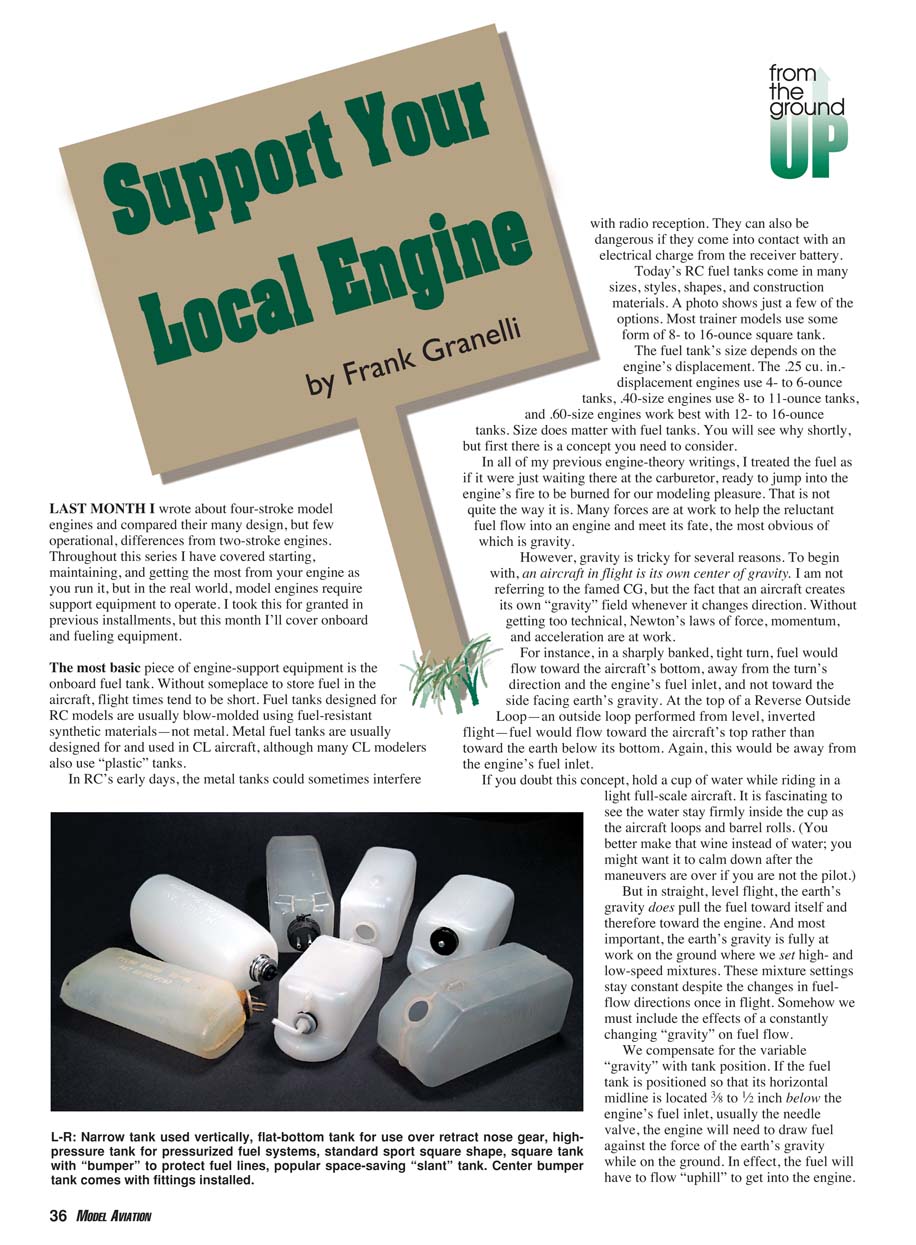
Today’s RC fuel tanks come in many sizes, styles, shapes, and construction materials. Most trainer models use some form of 8- to 16-ounce square tank.
The fuel tank’s size depends on the engine’s displacement:
- .25 cu. in. engines: 4–6 ounce tanks
- .40-size engines: 8–11 ounce tanks
- .60-size engines: 12–16 ounce tanks
Size does matter with fuel tanks. You will see why shortly, but first there is a concept you need to consider.
Forces affecting fuel flow
Fuel does not simply sit at the carburetor waiting to be burned. Several forces are at work to get the fuel into the engine:
- Gravity (including the aircraft’s changing effective “gravity” during maneuvers)
- Head pressure (weight of the fuel in the tank)
- Muffler pressure (pressure from the engine/muffler venting into the tank)
Gravity is tricky because an aircraft in flight creates its own “gravity” field whenever it changes direction. Newton’s laws of force, momentum, and acceleration apply. For instance, in a sharply banked, tight turn fuel will flow toward the aircraft’s bottom — away from the turn’s direction and possibly away from the engine’s fuel inlet. At the top of a Reverse Outside Loop, fuel will flow toward the aircraft’s top rather than toward the earth below, again possibly away from the inlet. If you doubt this concept, hold a cup of water while riding in a light full-scale airplane and watch how the water stays inside the cup as the aircraft loops and rolls.
On the ground and in straight, level flight, earth’s gravity pulls fuel down toward the engine. Mixture settings are typically made on the ground and remain constant despite the changing fuel-flow directions in flight. To compensate for variable “gravity” in flight we use tank position.
Tank position
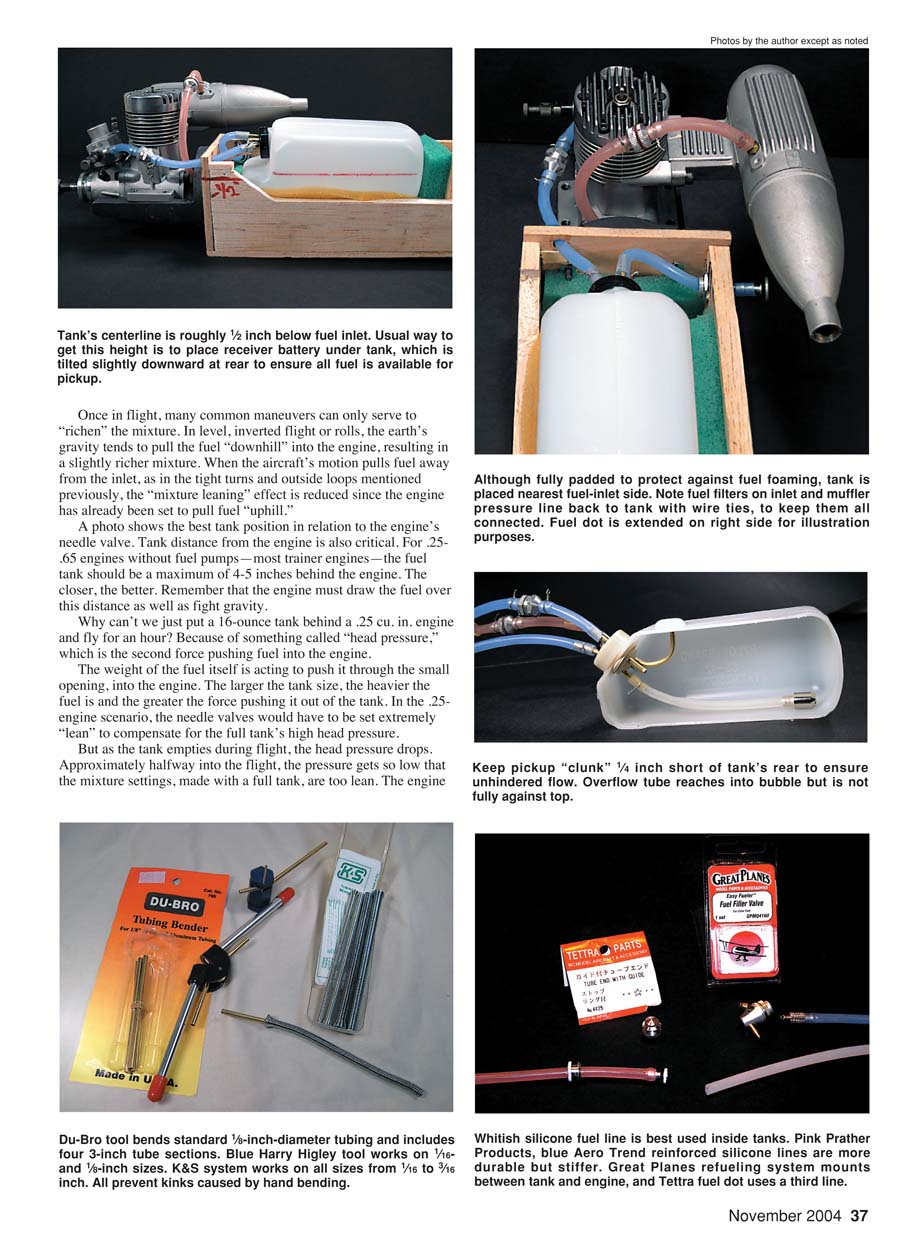
If the fuel tank is positioned so that its horizontal midline is located about 3/8 to 1/2 inch below the engine’s fuel inlet (usually the needle valve), the engine will need to draw fuel against earth’s gravity while on the ground — in effect the fuel must flow “uphill” to get into the engine. Once in flight, many common maneuvers will only serve to “richen” the mixture because earth’s gravity tends to pull the fuel “downhill” into the engine in inverted flight or rolls, and the engine was set to pull fuel uphill on the ground. When an aircraft’s motion pulls fuel away from the inlet, such as in tight turns and outside loops, the engine’s mixture leaning effect is reduced because the engine had been adjusted to draw “uphill.”
A photo (not shown here) demonstrates the best tank position relative to the engine’s needle valve. Tank distance from the engine is also critical. For .25–.65 engines without fuel pumps — most trainer engines — the fuel tank should be a maximum of 4–5 inches behind the engine. The closer, the better. Remember that the engine must draw the fuel over this distance as well as fight gravity.
Head pressure and tank size
Why not put a 16-ounce tank behind a .25 cu. in. engine and fly for an hour? Because of head pressure — the weight of the fuel itself pushing it through the small opening into the engine. The larger the tank, the more head pressure, and the more fuel pushed into the carburetor. A .25 engine with a full 16-ounce tank would require extremely lean needle-valve settings to compensate for the high head pressure.
As the tank empties during flight, head pressure drops. Approximately halfway through the flight the pressure may be low enough that the mixture settings made with a full tank are too lean; the engine will begin to run rough and lose power, possibly dying in the next vertical climb or high-G maneuver. Making the initial mixture extra rich to compensate produces underpowered flight early on, so that’s not an ideal fix.
Muffler pressure
Muffler pressure (the third force) helps compensate for varying head pressure. The engine pumps pressure into the tank while you set mixtures on the ground. In flight, muffler pressure remains relatively constant based on engine speed, but as head pressure drops, the engine won’t automatically increase muffler pressure to compensate for long-term flow reductions.
Muffler pressure is effective for short-term events like steep climbs and high-G maneuvers that momentarily reduce fuel flow, but it is less effective for compensating gradual head-pressure drops as the tank empties. That’s why recommended tank sizes are given as ranges rather than a single “best” size.
Designers factor muffler pressure into carburetor sizing. Because muffler pressure increases fuel pressure, designers can increase the carburetor air inlet size for more power, and much of that muffler pressure is effectively “used” to feed additional fuel into the carburetor. There’s not much left over to counteract tank-size and maneuver effects.
Plumbing and tank installation
On a typical installation:
- Run the fuel-outlet line roughly the same height as the engine’s fuel inlet.
- Try to run the fuel line directly to the inlet without going far downhill and then way back up. If there’s too much “uphill” in the line, the engine could quit as fuel levels reach the last few ounces and head pressure vanishes. If your engine always quits before the tank is empty, check for a roller-coaster line run.
- Position the tank outlet slightly toward the side with the needle valve. This reduces uphill/downhill effects no matter which direction the aircraft banks or rolls and helps keep fuel flow more constant.
- If possible, mount the tank inside a thin foam layer to reduce possible bubbling from engine vibration.
If the engine is tightly cowled or the fuel line can’t be easily disconnected for refueling, you’ll need a third line to the fuel tank — a “fill line.” This fill line must be blocked off after filling to prevent muffler-pressure loss during operation. A “fuel dot” is a simple and popular cap for this purpose. Other systems, such as a filler valve, block the fuel flow into the engine while filling to prevent accidental flooding. Sometimes those systems require longer fuel-line runs to the engine; in such cases using a third line is often a good idea.
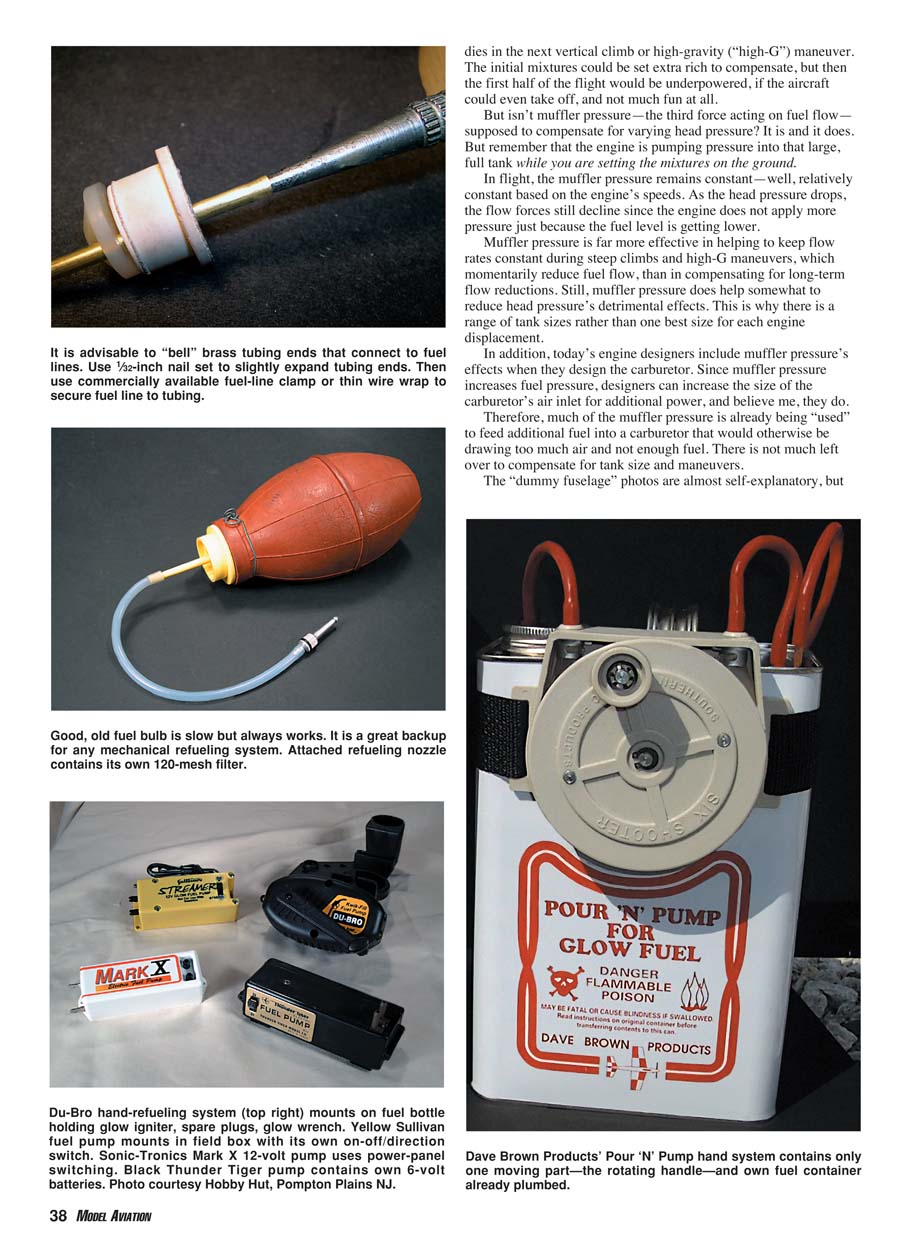
Hooking lines inside the tank is simple. In a three-line system, if the tank has a bubble section position the muffler pressure/overflow brass tubing inside the bubble for maximum capacity. Try to run the brass tubing into the bubble as straight as possible to prevent the pickup line from wrapping around the vent tubing and getting stuck in a forward position, which could cause the engine to quit during vertical maneuvers.
Some modelers prefer to use rigid plastic tubing on the pickup line to prevent fouling, but rigid tubing can prevent the engine from receiving fuel during long vertical dives or spins. That is a modeler’s choice.
To reduce pickup-line fouling:
- Make the fuel-inlet tubing (the fill line) a straight run into the tank.
- Most fuel pumps can fill the tank against any slight uphill that causes.
- Squeeze the filling line while installing the fuel-dot cap or quickly close whatever fueling system you’re using to prevent spills when removing the pump line.
Bending brass tubing is easy if you avoid kinks. Use a tubing bender to prevent kinks while getting the right angles. If you accidentally kink the tubing, carefully apply pressure on the sides of the kink with pliers to restore roundness, allowing operation until a spare tube can be installed.
Fuel line types and sizes
Some flexible tubing — fuel line — is required to connect the tank’s brass tubing to the engine, muffler, and fill port. Today, two types are commonly used:
- Pure silicone fuel line: used inside the tank. Semi-clear, extremely flexible, fuelproof, unaffected by model fuel, and long-lasting. It’s not ideal for outside runs because it can crack from rubbing wear and can slip off brass tubing if not secured.
- Viton or Buna-N fuel line: used for outside runs between the tank and engine. These resist deterioration from constant fuel exposure. Viton is preferred by the author for durability; Buna-N is softer and more flexible, favored by some modelers.
A reinforced silicone line combines fuelproof properties of silicone with improved resistance to cracking and vibration wear. Modern fuel lines are nearly trouble-free for years; just ensure there is no firm contact between the fuel line and the fuselage to prevent vibration wear.
Fuel line diameter:
- Small-diameter line: good up to .25 cu. in. engines
- Medium-diameter line: up to .65 cu. in. engines
- Large-diameter line: engines larger than .65 cu. in.
Match the fuel-line inside diameter to the engine’s inlet diameter (inside measurement) at the high-speed needle valve as closely as possible. A slightly larger line is preferable to a smaller one if a perfect match isn’t possible. Ensure the fuel line has a firm grip on the engine’s inlet and will not slip off. In emergencies, medium-diameter line on a small (.140 cu. in.) engine can work without noticeable difference.
Filters and maintenance
The last part of tank installation is the fuel filter — and this is not optional. Use a good filter or have problems. Competition fliers have proven this many times. Despite triple-filtering fuel during refueling (from a 100-mesh screen down to 250-mesh), onboard filters must be cleaned regularly.
- Clean onboard filters every 200–300 flights for non-pumped engines.
- Clean onboard filters every ~200 flights for pump-equipped engines.
- Clean refueling-system filters more often because they may serve multiple aircraft.
Alcohol-insoluble material builds up inside filters and must be removed using paint thinner. If filters don’t catch this material, it will clog small carburetor sections or fuel-pump parts. Install a second filter in the muffler pressure line (between the muffler and the fuel tank) to limit debris blown back into the tank. Make sure filter connections are tight to prevent air leaks.
Refueling systems
Once the tank is installed and positioned, it needs fuel. Several refueling methods are used:
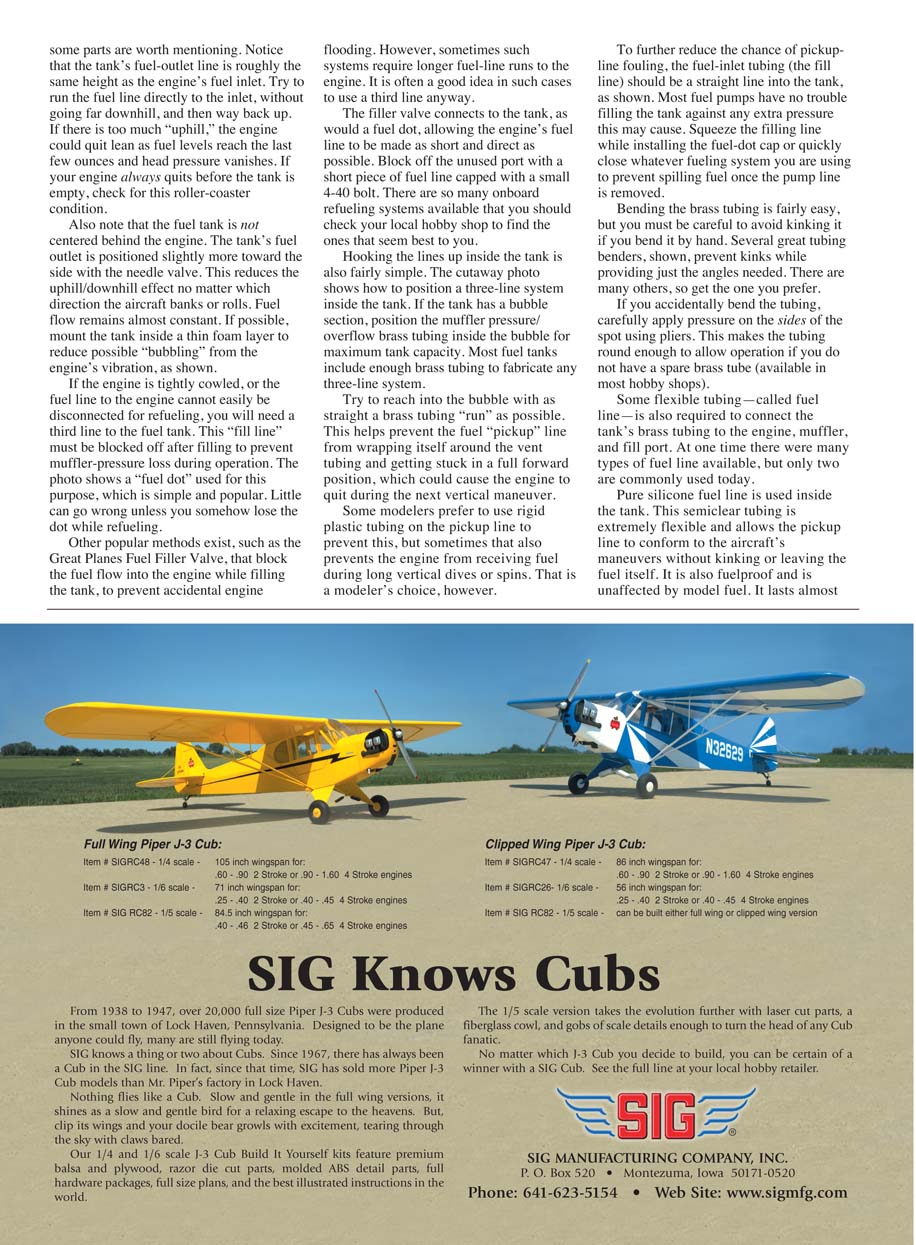
- Squeeze bulbs / turkey basters
- Simple, slow, reliable backups for the field box.
- Hand pumps
- Fit on plastic fuel jugs and use a hand crank. Some allow directional pumping to fill aircraft or pump fuel back out after flying. Some hand-pump systems also hold the glow-plug igniter and spare parts.
- Electric pumps attached to the fuel container
- Resemble hand systems but use electric pumps and batteries. These often include their own batteries, or they use the 12-volt field-box battery.
- Field-box fuel pumps / standalone electric pumps
- May have their own on-off/directional switches or use the field-box power panel switch. Electric pumps often recommend using larger-diameter fuel line to reduce wear; sometimes this requires a short medium-diameter section over the filling nozzle with a larger line over it.
Refueling system filters must be cleaned more often than onboard filters because they may be used for multiple aircraft.
What’s next
Now that the aircraft is fueled and ready, we need to turn it over and light the glow plug to get it started and hold it safely during run-up and settings. Next month, the last installment of the engine segment, will cover field boxes, batteries, starters, glow-plug igniters, and chicken sticks.
Frank Granelli 24 Old Middletown Rd. Rockaway, NJ 07866
Transcribed from original scans by AI. Minor OCR errors may remain.

