

SVETLANA'S RC COMBAT PLANE
Svetlana Filippova
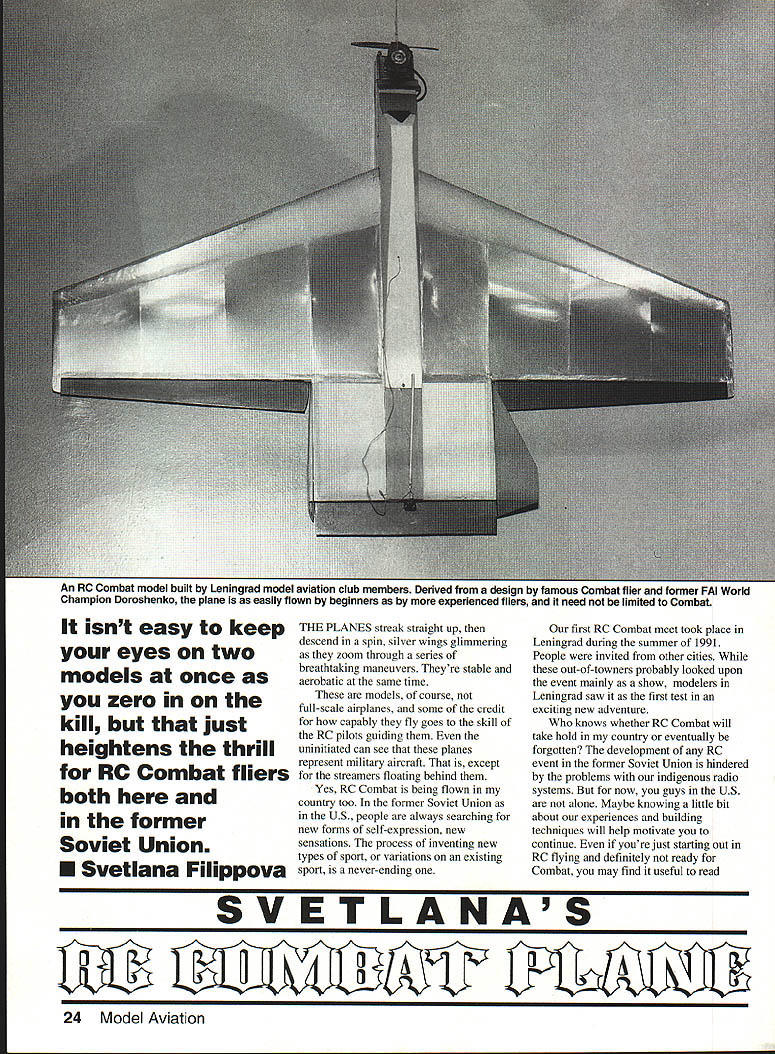
The planes streak straight up, then descend in a spin, silver wings glimmering as they zoom through a series of breathtaking maneuvers. They're stable and aerobatic at the same time.
These are models, of course, not full-scale airplanes, and some of the credit for how capably they fly goes to the skill of the RC pilots guiding them. Even the uninitiated can see that these planes represent military aircraft — that is, except for the streamers floating behind them.
Yes, RC Combat is being flown in my country too. In the former Soviet Union, as in the U.S., people are always searching for new forms of self-expression and new sensations. The process of inventing new types of sport, or variations on an existing sport, is a never-ending one.
Our first RC Combat meet took place in Leningrad during the summer of 1991. People were invited from other cities. While these out-of-towners probably looked upon the event mainly as a show, modelers in Leningrad saw it as the first test in an exciting new adventure.
Who knows whether RC Combat will take hold in my country or eventually be forgotten? The development of any RC event in the former Soviet Union is hindered by problems with our indigenous radio systems. But for now, you guys in the U.S. are not alone. Maybe knowing a little about our experiences and building techniques will help motivate you to continue. Even if you're just starting out in RC flying and not ready for Combat, you may find it useful to read about the model featured here. It's very easy to build and fun to fly.
FOUNDERS AND RULES
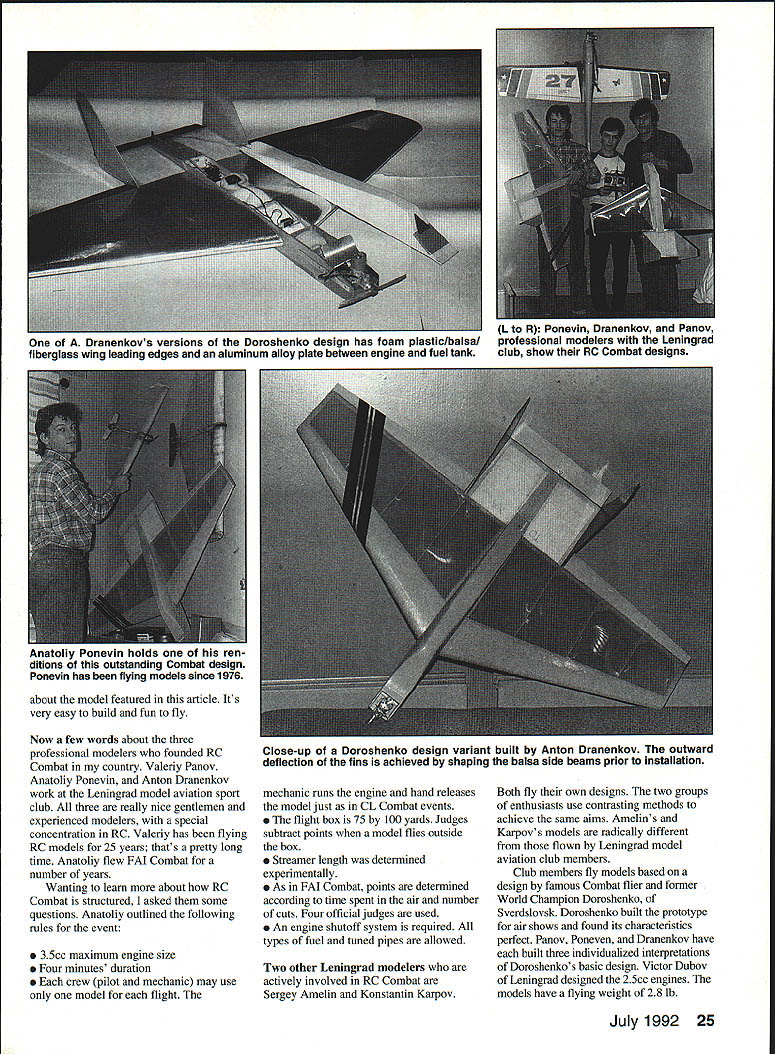
Now a few words about three modelers who founded RC Combat in our country: Valeriy Panov, Anatoliy Ponevin, and Anton Dranenkov. They work in the Leningrad model aviation sport club. All three are experienced modelers with a special concentration on RC. Valeriy has been flying RC models for 25 years. Anatoliy flew FAI Combat for many years.
Wanting to learn about RC Combat in a structured way, I asked some questions. Anatoliy outlined the following rules of the event:
- 3.5 cc maximum engine size (.21 cu in)
- Four minutes' duration
- Each crew (pilot and mechanic) may use only one model for each flight. The mechanic runs the engine and hand-releases the model, just like CL Combat events.
- Flight box: 75 by 100 yards. Judges subtract points when a model flies outside the box.
- Streamer length determined experimentally.
- As in FAI Combat, points are determined according to time spent in the air and the number of cuts. Four official judges are used.
- An engine shutoff system is required. All types of fuel and tuned pipes are allowed.
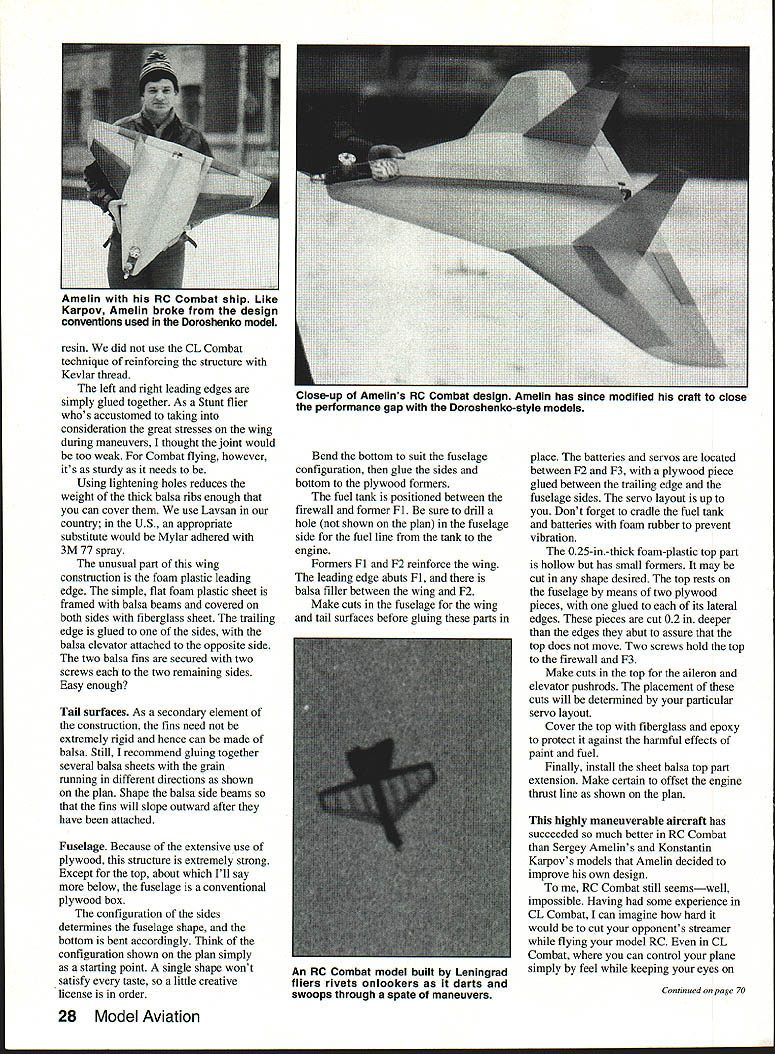
Two other Leningrad modelers actively involved in RC Combat are Sergey Amelin and Konstantin Karpov. Both fly their own designs. The two groups of enthusiasts use contrasting methods to achieve the same aims; Amelin's and Karpov's models are radically different from those flown by the Leningrad model aviation club.
Club members fly models based on a design by famous Combat flier and former World Champion Doroshenko of Sverdlovsk. Doroshenko built the prototype and found its characteristics perfect for air shows. Panov, Ponevin, and Dranenkov have each built individualized interpretations of Doroshenko's basic design. Victor Dubov of Leningrad designed the 2.5 cc engines used on some models. The models have a flying weight of about 2.8 lb.
V. Sokolov (left) and K. Karpov designed an original RC Combat model, which was later built by Karpov and Sergey Amelin.
COMBAT MODEL
Svetlana's RC Combat Plane
- Type: Combat
- Wingspan: 47-1/2 inches
- Recommended engine size and type: 3.5 cc (.21 cu in)
- Number of RC channels recommended: three
- Expected flying weight: about 2.8 lb
- Type of construction: foam / ply / balsa / fiberglass
- Type of covering/finish recommended: film / paint
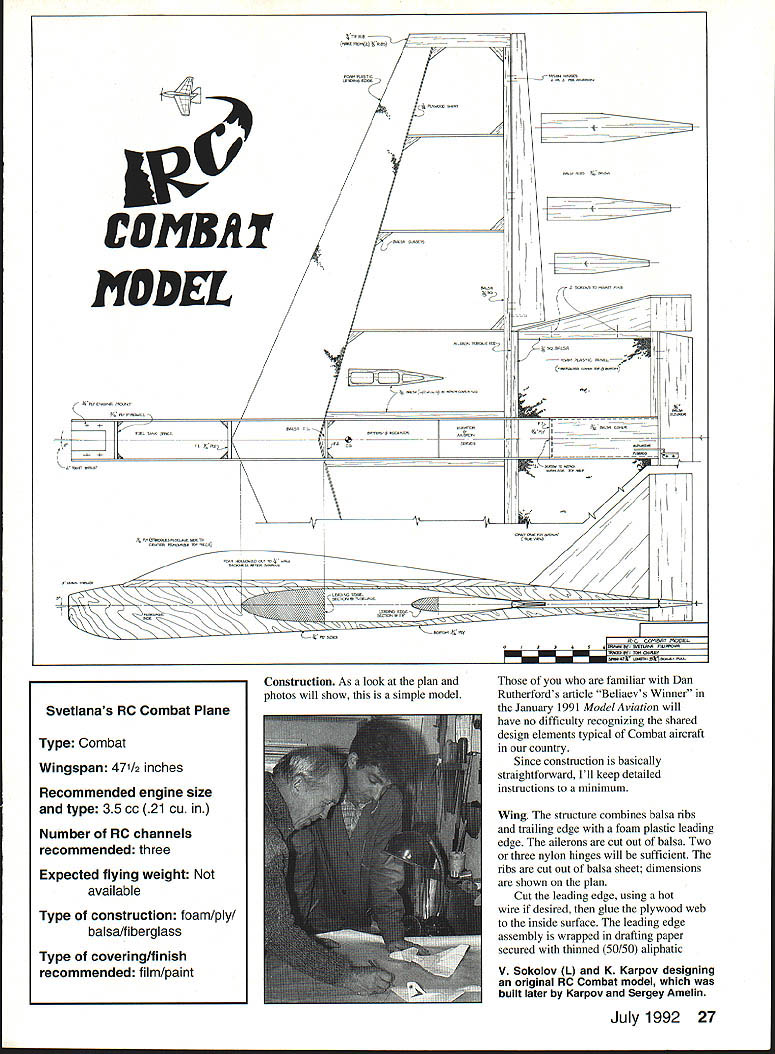
Construction: As a look at the plan and photos will show, this is a simple model. Those familiar with Dan Rutherford's article "Beliaev's Winner" (January 1991 Model Aviation) will recognize shared design elements typical of Combat aircraft in our country. Since construction is basically straightforward, detailed instructions are kept to a minimum.
Wing
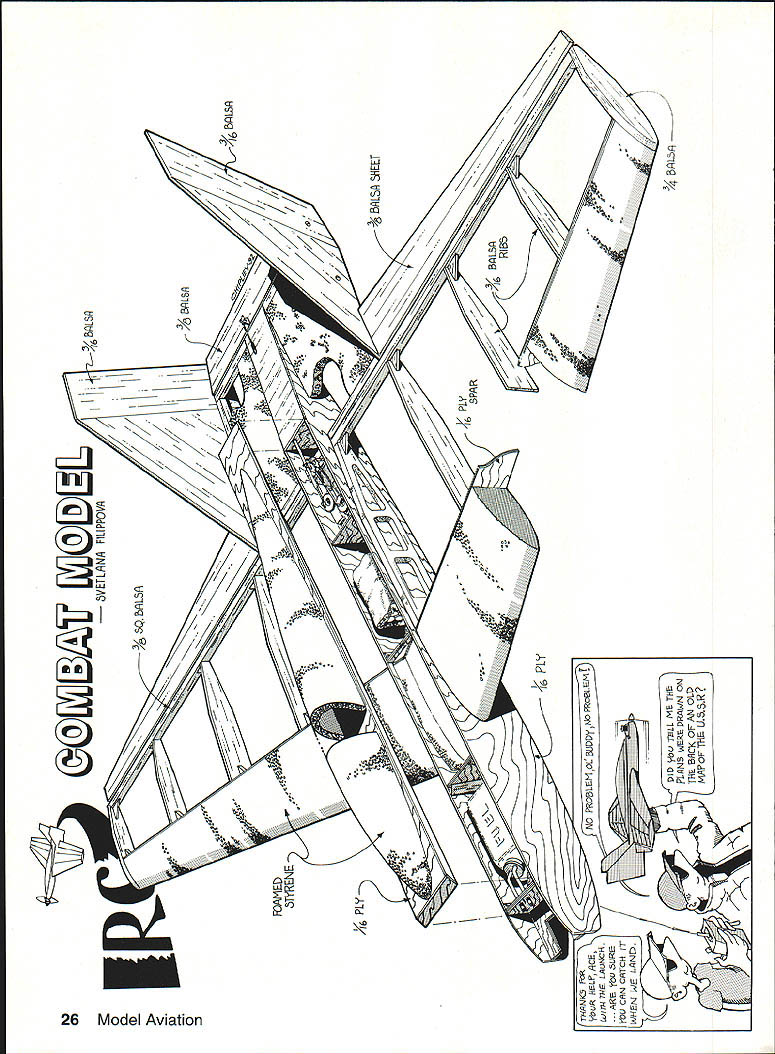
The structure combines balsa ribs and trailing edge with a foam-plastic leading edge. The ailerons are cut out of balsa; two or three nylon hinges are sufficient. The ribs are cut from balsa sheet — dimensions are shown on the plan.
Cut the leading edge from foam (a hot wire may be used), then glue the plywood web to the inside surface. Wrap the leading edge assembly in drafting paper secured with thinned (50/50) aliphatic glue.
Lightening holes in the thick balsa ribs reduce weight enough to allow covering. In our country we use Lavsan; in the U.S., an appropriate substitute would be Mylar adhered with 3M 77 spray.
The unusual part of this wing construction is the foam-plastic leading edge. The flat foam-plastic sheet is framed with balsa beams and covered on both sides with fiberglass sheet. The trailing edge is glued to one side, with the balsa elevator attached to the opposite side. The two balsa fins are secured with two screws each to the remaining sides.
We did not use the CL Combat technique of reinforcing the structure with Kevlar thread. The left and right leading edges are simply glued together; for Combat flying this joint is sufficiently sturdy.
Tail surfaces
The fins need not be extremely rigid and can be made of balsa. I recommend gluing together several balsa sheets with the grain running in different directions as shown on the plan. Shape the balsa side beams so that the fins will slope outward after attachment.
Fuselage
Because of the extensive use of plywood, the fuselage structure is extremely strong. Except for the top (described below), the fuselage is a conventional plywood box.
The configuration of the sides determines the fuselage shape; think of the plan as a starting point and use a little creative license to suit your taste. Bend the bottom to suit the chosen configuration, then glue the sides and bottom to the plywood formers.
The fuel tank is positioned between the firewall and former F1. Be sure to drill a hole in the fuselage side for the fuel line from the tank to the engine.
Formers F1 and F2 reinforce the wing. The leading edge abuts F1, and there is balsa filler between the wing and F2. Make cuts in the fuselage for the wing and tail surfaces before gluing these parts in place.
Batteries and servos are located between F2 and F3, with a plywood piece glued between the trailing edge and the fuselage sides. The servo layout is up to you. Cradle the fuel tank and batteries with foam rubber to prevent vibration.
The 0.25-in.-thick foam-plastic top part is hollow but has small formers and may be cut in any shape desired. The top rests on the fuselage by means of two plywood pieces glued to its lateral edges; these pieces are cut 0.2 in. deeper than the edges they abut to ensure the top does not move. Two screws hold the top to the firewall and F3.
Make cuts in the top for the aileron and elevator pushrods; placement depends on your servo layout. Cover the top with fiberglass and epoxy to protect it from paint and fuel. Finally, install the sheet-balsa top-part extension and offset the engine thrust line as shown on the plan.
We recommend drilling holes and planning servo/pushrod runs before final assembly, and securing removable parts with screws where access is required.
This highly maneuverable aircraft has succeeded so much better in RC Combat than Sergey Amelin's and Konstantin Karpov's models that Amelin decided to improve his own design.
RC Combat still seems, well, impossible to me. Having had some experience in CL Combat, I can imagine how hard it is to cut your opponent's streamer while flying your model RC. Even in CL Combat, where you can control your plane simply by feel while keeping your eyes on your adversary's model, all too often it's your airplane's wing, not the prop, that touches your opponent's streamer. Think how much harder it must be to try to cut your opponent's streamer while keeping your eyes on two models at once. These RC Combat pilots say it can be done, but it certainly can't be easy.
I hope some of you will consider building this simple RC model. Even if you never try it in RC Combat, you'll find it plain fun to fly.
Transcribed from original scans by AI. Minor OCR errors may remain.

