
Swashplate: Advantage Hobby Beam E4
Michael Ramsey
HOLY COW!
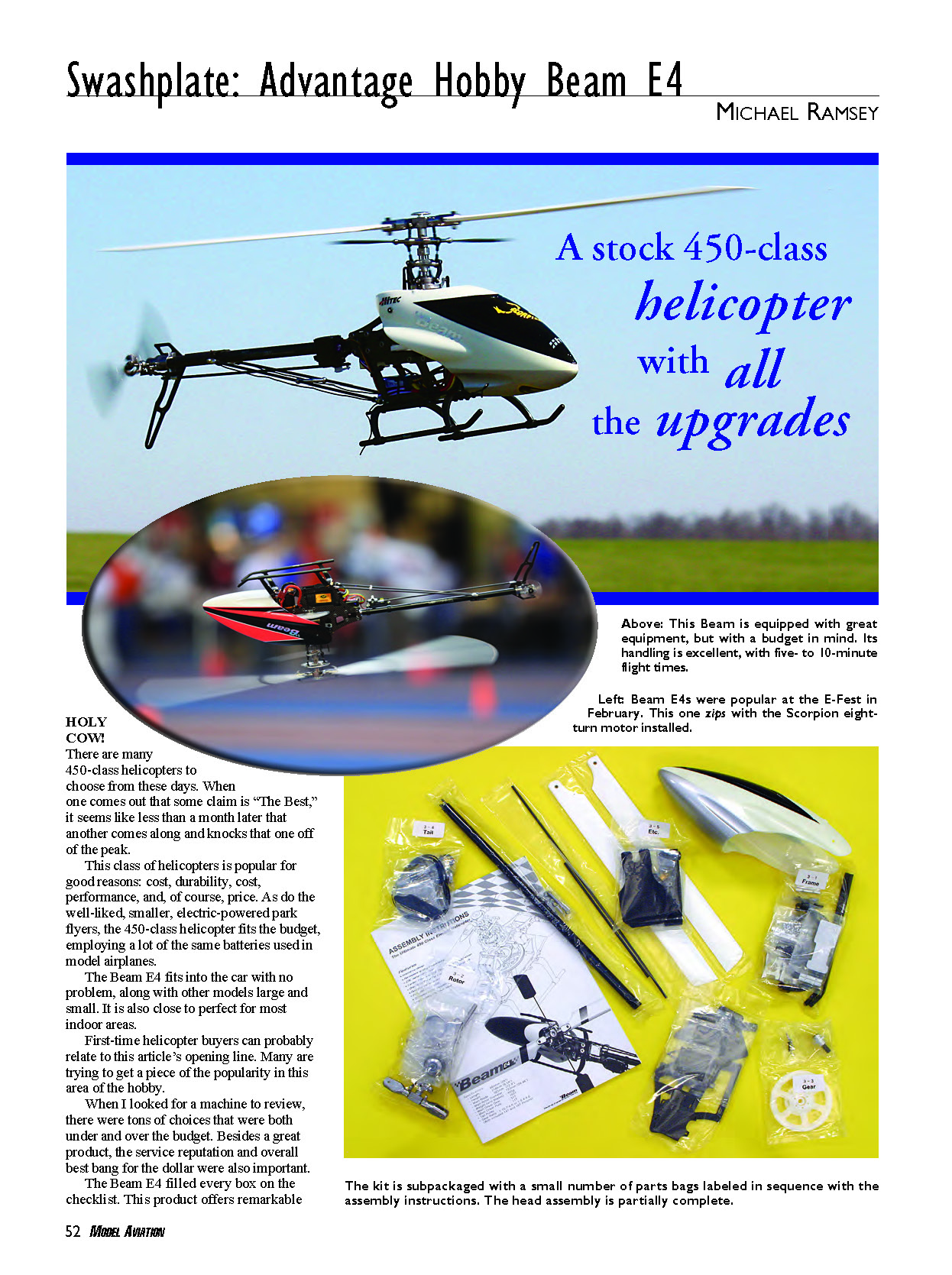
There are many 450-class helicopters to choose from these days. When one comes out that some claim is "the best," it seems like less than a month later that another comes along and knocks that one off the peak.
This class of helicopters is popular for good reasons: cost, durability, performance, and, of course, price. As with well-liked smaller electric-powered park flyers, the 450-class helicopter fits the budget and often uses the same batteries found in model airplanes.
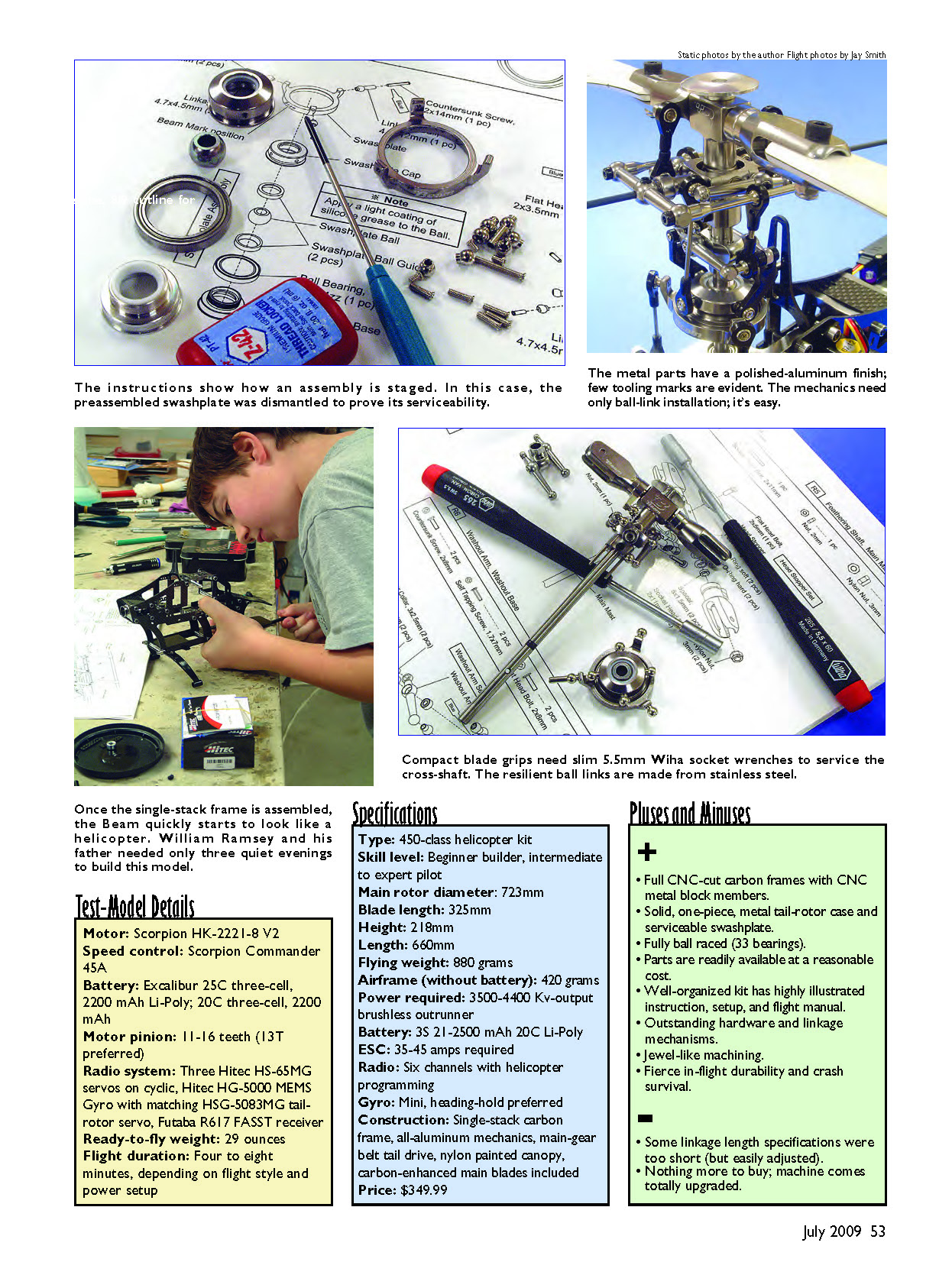
The Beam E4 fits into the car with no problem, along with other models large and small. It is also close to perfect for most indoor areas. First-time helicopter buyers can probably relate to this article's opening line; many are trying to get a piece of the popularity in this area of the hobby.
When I looked for a machine to review, there were tons of choices both under and over the budget. Besides a great product, the service reputation and overall best bang for the dollar were also important. The Beam E4 filled every box on the checklist. This product offers remarkable quality for the money. And even though it was formally released a year ago, it is still among the most competitive 450-class helicopters at the performance peak.
Moreover, the vendors I sought out for accessories such as a motor, batteries, and radio equipment were familiar with the Beam, which indicated that a good thing was happening here. Not only would I be buying from a good distributor—Advantage Hobby—but it is also connected with other reputable manufacturers.
The first thing that attracted me to the Beam E4 was the all-metal head's fine machining. Like platinum jewelry, the workmanship simply beamed at me. Looking further into this model's mechanics revealed how precise and smooth the linkages and mixing controls operated. With elements including an all-metal flybar cage and serviceable swashplate, the Beam had me convinced that I was investing in a serious helicopter; it had all of the giant glow-powered models' performance goodies.
The Beam E4 is designed to take the wearing forces of 3-D flying. This attention to long life and strength benefits the machine in every other way. When I picked up the model at the Toledo Show that year, staring me in the face was the full-house complement of spare parts. The cost of replacement parts is extremely reasonable. Not only that, but when you order a replacement main shaft, you get three in a package; that is the case with several other popular replacements for the machine. The people at Advantage Hobby seem to know how I fly.
Once the single-stack frame is assembled, the Beam quickly starts to look like a helicopter. My son William and I needed only three quiet evenings to build this model.
Test-Model Details
- Motor: Scorpion HK-2221-8 V2
- Speed control: Scorpion Commander 45A
- Battery: Excalibur 25C 3S 2200 mAh Li-Poly; also used a 20C 3S 2200 mAh pack
- Motor pinion: 11–16 teeth (13T preferred)
- Radio system: Three Hitec HS-65MG servos on cyclic, Hitec HG-5000 MEMS gyro with matching HSG-5083MG tail-rotor servo, Futaba R617 FASST receiver
- Ready-to-fly weight: 29 ounces
- Flight duration: 4–8 minutes, depending on flight style and power setup
Specifications
- Type: 450-class helicopter kit
- Skill level: Beginner builder; intermediate to expert pilot
- Main rotor diameter: 723 mm
- Blade length: 325 mm
- Height: 218 mm
- Length: 660 mm
- Flying weight: 880 grams
- Airframe (without battery): 420 grams
- Power required: 3500–4400 kV-output brushless outrunner
- Battery: 3S 2200–2500 mAh 20C Li-Poly
- ESC: 35–45 amps required
- Radio: Six channels with helicopter programming
- Gyro: Mini, heading-hold preferred
- Construction: Single-stack carbon frame, all-aluminum mechanics, main-gear belt tail drive, nylon painted canopy, carbon-enhanced main blades included
- Price: $349.99
Pluses and Minuses
- Full CNC-cut carbon frames with CNC metal block members
- Solid, one-piece metal tail-rotor case and serviceable swashplate
- Fully ball-raced (33 bearings)
- Parts are readily available at a reasonable cost
- Well-organized kit with highly illustrated instruction, setup, and flight manual
- Outstanding hardware and linkage mechanisms
- Jewel-like machining
- Fierce in-flight durability and crash survival
- Some linkage length specifications were slightly short (but easily adjusted)
- Nothing more to buy; machine comes totally upgraded
Construction
The best way to know your helicopter is to build it from the bag of screws up. An ARF will get you flying roughly an evening sooner, but the aircraft is going to come apart sometime, no matter how good the pilot is. That is much less disconcerting when you put it together in the first place.
The Beam's construction is fun. I'll repeat that: building is fun! My oldest son William and I assembled this machine, and the experience was great for both of us. Now I don't have to be the mechanic all the time; William can do it!
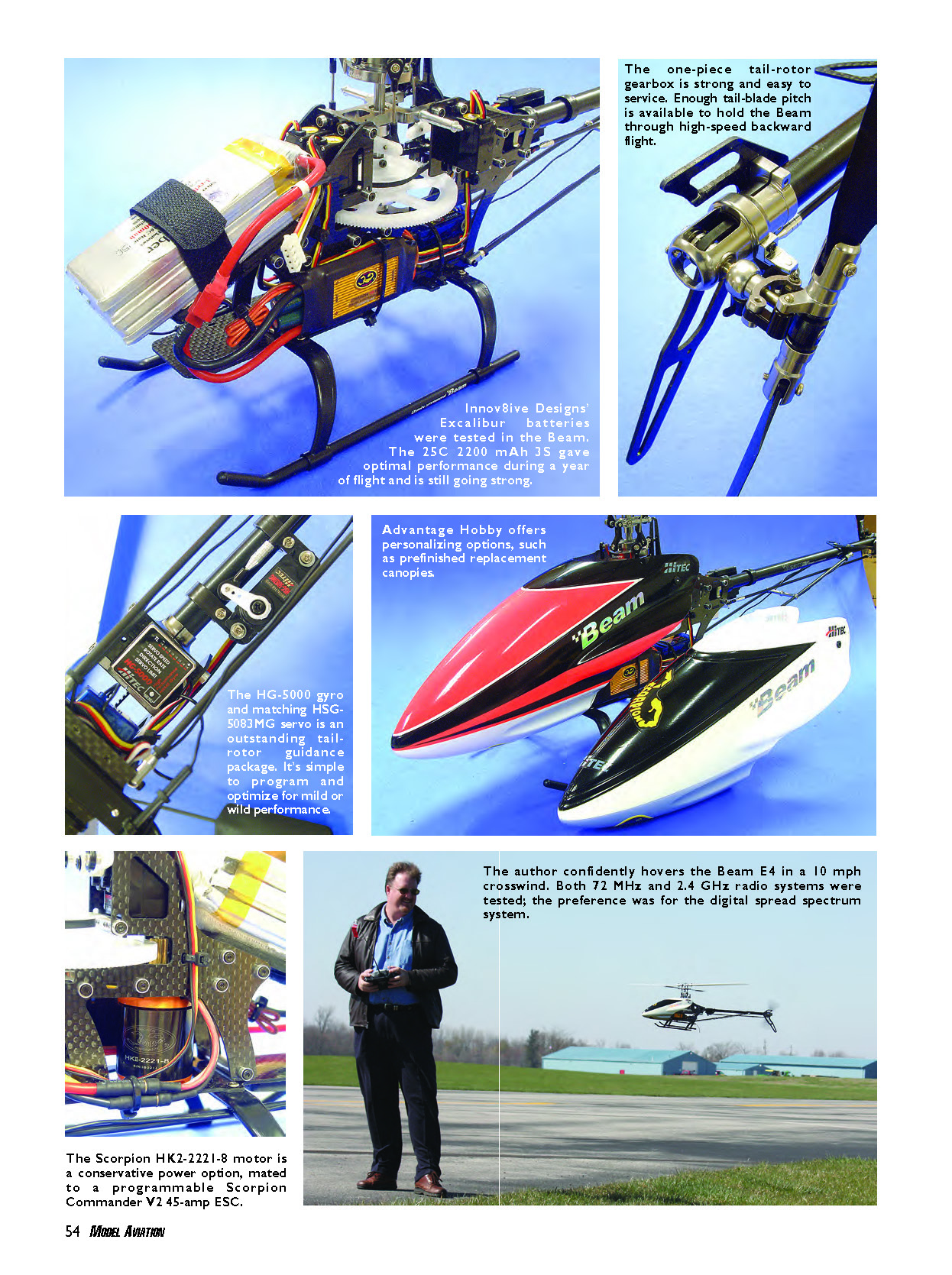
This helicopter requires minimal tools to assemble. Everything comes neatly packaged and organized; each step requires a bag of parts that is clearly depicted in the exquisitely illustrated instruction manual. The drawings are isometric. Although they don't include lengthy written assembly instructions, with a little study it's simple to see how the parts fit and in what order they should be installed.
The instructions show how every part needs to be installed. Thankfully, all parts except the bearings in the tail case are factory-pressed into position. The swashplate is provided assembled, even though it's completely serviceable. As with the mixing arms and other mechanical parts, only the ball links need to be fastened.
At the center collective-stick position, there is zero pitch in the main blades. To achieve this, I found that the final lengths of the pushrods were slightly longer than specified in the manual. There's plenty of thread and length in the rods for this kind of adjustment, and the threads are finely rolled so that precise changes can be made.
To get equal pitch ratio on my machine, the washout-to-flybar arm links were 30.0 mm, the seesaw mixing-arm-to-swashplate links were 47.5 mm, and the swashplate-to-servo-arm rods worked best at 40.0 mm.
Although the blade grips were assembled on the head block, at some point the head will need to be taken apart to replace a reshaped feathering shaft (spindle). I've found only one tool that accommodates the Beam's compact blade grips: the Wiha 5.5 mm socket driver (item 265), available from Advantage Hobby. Two are needed to correctly remove the connecting 3 mm nylon lock nuts.
Equipment selection for this helicopter deserves careful thought—even though the manual spells it out clearly with excellent recommendations. To go along with my Futaba 6EX FASST radio, I matched a Futaba R617 receiver.
For cyclic control, I selected three Hitec HS-65MG servos. Their capability was a pleasant surprise, marking them as an excellent value to the aerobatic-flying, precision-conscious pilot. I saved a few bucks by not going all-digital, and I don't regret it one bit.
For tail-rotor control, I used the Hitec HG-5000 gyro matched with the recommended HSG-5083MG high-speed digital servo. I’ll explain why I'm happy with that choice later.
The machined-aluminum motor mount will accept almost any 22–28 mm outrunner or inrunner design. A 3400–4400 kV motor is required for optimal performance. Scorpion motors from Innov8tive Designs are rated high in output and efficiency. I chose the Scorpion HK-2221-8, the recommended aerobatic setup for this class of helicopter, and the matching Scorpion 45A speed controller with built-in helicopter programming options.
Carbon and aluminum parts are employed throughout the Beam. Two kinds of plastic are used sparingly, and the landing-gear struts and tail-servo mount are made from a flexible material. The tail-rotor control arm and flybar paddles are made with a rigid nylon-reinforced plastic; it's incredibly stiff. The use of materials impressed me.
The single-stack carbon-fiber side frames and mounting spreader plates lock into each other's tabs and slots; therefore they require no additional hardware to install, yet they add beauty and strength. When it was time to organize and route the wiring, I especially liked the milled openings in the frame that were perfectly sized for nylon zip ties. That was extremely thoughtful.
A few spare screws and nuts accompany the Beam. I learned that, in addition to Advantage Hobby being the exclusive importer, full kits and accessories for the model, as well as spare parts, are also available through Horizon Hobby dealers. This company often works with hobby shops, so if you need anything for the machine, satisfaction might be as convenient as a fun trip to the local dealer. Sounds like a great partnership.
Flight Impressions
My model first lifted off the ground needing only a slight tail-rotor trim adjustment and right aileron trim. The balance was right on with a Scorpion 2200 mAh 3S Li-Poly battery strapped to the cushioned carbon-fiber tray. The Scorpion’s power is unbelievable, and I went with the lower gear ratio (13T motor pinion).
The Beam’s high head speed permits the included carbon-enhanced fiberglass blades to run solidly. Pirouettes are amazingly stable; as the helicopter rotates, almost no cyclic correction is needed. I felt confident flying the helicopter quickly.
Before attempting 3-D action, I consulted the manual to confirm my favorite radio-programming starting points with those recommended. There are good tips in the instructions, so make sure not to skip the last pages.
I set up my flight modes so that Normal accommodates smooth hover performance: a good head speed with a flat pitch curve in the center. Idle-up One includes a more aggressive pitch curve and takes advantage of the 70% power setting. The third flight mode includes a throttle midpoint of 85% that quickly curves up to full.
The rate settings are on one switch, where everything is at 100% rate on the high side with 30% exponential (expo) on the aileron and elevator. The low rate drops everything to 60% except the tail rotor, which feels smooth at 75%; no expo is used on low rate. The swashplate mixing is set with 75% aileron and elevator, while pitch is set to 65% to keep from overdriving the main blades and stressing the mechanics.
William and I happily fly the Beam, but we’re at different skill levels. Our model is extremely friendly on the low-rate settings. This is where we do a lot of hovering and orientation practice. Watching William fly the machine nose-in is a thing of beauty.
We can get roughly eight to 10 minutes out of a 2200 mAh Excalibur pack when flying around and hovering on low rates. Idle-up One works best for loops and rolls. In Idle-up Two the Beam becomes an animal that has power to spare; flight times drop to four to six minutes. This is one key area where we fully appreciated the Hitec HG-5000 gyro system’s performance.
No matter how much pitch, how much power, or how fast we wanted the pirouette rate, the Hitec gyro did not disappoint. It was also a cinch to program once the transmitter was correctly calibrated to the gyro’s sensors. The Beam’s pirouette rate, both right and left, is blindingly quick.
The Beam’s tail-rotor control power and authority make it more capable of maneuvers that demand rotational control. Without that authority, high-speed tailslides and sideways flight would be limited, and flying advanced maneuvers would be more hazardous. Having crisp tail-rotor control, as on the Beam, helps pilots feel more confident overall.
One of the things you’ll eventually want to do with many helis is upgrade them as your skills grow. I’m happy to report that there are no necessary upgrades for the Beam E4—every kit is sold fully upgraded and made from the strongest materials possible. If you want cosmetic or blade options, painted canopies and main and tail blades are available. If more power is your thing, the higher-kV Scorpion HK-2221-6 motor can be used for even more thrilling aerobatics.
“Beam me another battery, Scotty; we want to fly some more!”
Michael Ramsey michaelr@modelaircraft.org
Manufacturer/Distributor:
Beam / Advantage Hobby Box 6988 Champaign, IL 61826 (217) 398-2700 www.advantagehobby.com
Sources:
- Innov8tive Designs — (760) 468-8838 — www.innov8tivedesigns.com
- Hitec RCD — (858) 748-6948 — www.hitecrcd.com
- Futaba RC — (800) 637-7660 — www.futaba-rc.com
Other Printed Reviews:
- RC Heli: April 2008
- Fly RC: September 2008
Transcribed from original scans by AI. Minor OCR errors may remain.

