
SWG..The Magic Letters....and What They Mean
Warren D. Shipp
Friend, there's a really big model contest coming soon, and being an eager model builder, you're gonna build four models at one time for this contest. You've collected dozens of model airplane drawings from all over the world, and you have painstakingly and finally sorted out four beautiful scale models to build in your spare time. They're really knockouts, and will dazzle the judges and wow the other contestants. They are all good-looking models, have good flight proportions, plenty of details, and should fly well. The adrenaline has got your enthusiasm to fever pitch.
The next step is to assemble the required supplies, and no long-time modeler like yourself who is worth his salt is ever low on supplies. But somehow, brother, this time you are, and how! So you grab all your favorite local hobby-shop and mail-order catalogs and start making up a good-size list. You've got down the strip and sheet wood, metal parts, paper, dope, cements, rubber, wire. Wire? Hah! There's where...
Music Wire Equivalents
From a Brown & Sharpe Mfg. Co., Providence, R.I., steel wire gauge, over 70 years old. From a table "Decimal & Metric Equivalents of Common Fractions of an Inch."
- SWG 5: Approximate Decimal .182; Actual Decimal .18750; Nearest Fraction 3/16; MM 4.763
- SWG 6: Approximate Decimal .162; Actual Decimal .15625; Nearest Fraction 5/32; MM 3.969
- SWG 7: Approximate Decimal .144; Actual Decimal .14062; Nearest Fraction 9/64; MM 3.572
- SWG 8: Approximate Decimal .128; Actual Decimal .12500; Nearest Fraction 1/8; MM 3.175
- SWG 9: Approximate Decimal .114; Actual Decimal .10938; Nearest Fraction 7/64; MM 2.778
- SWG 10: Approximate Decimal .102
- SWG 11: Approximate Decimal .091; Actual Decimal .09375; Nearest Fraction 3/32; MM 2.381
- SWG 12: Approximate Decimal .081; Actual Decimal .07812; Nearest Fraction 5/64; MM 1.984
- SWG 13: Approximate Decimal .072
- SWG 14: Approximate Decimal .064; Actual Decimal .06250; Nearest Fraction 1/16; MM 1.588
- SWG 15: Approximate Decimal .057
- SWG 16: Approximate Decimal .051
- SWG 17: Approximate Decimal .045; Actual Decimal .04688; Nearest Fraction 3/64; MM 1.191
- SWG 18: Approximate Decimal .040
- SWG 19: Approximate Decimal .036
- SWG 20: Approximate Decimal .032; Actual Decimal .03125; Nearest Fraction 1/32; MM .794
- SWG 21: Approximate Decimal .028
- SWG 22: Approximate Decimal .025
- SWG 23: Approximate Decimal .022
- SWG 24: Approximate Decimal .020
- SWG 25: Approximate Decimal .018
- SWG 26: Approximate Decimal .016; Actual Decimal .01562; Nearest Fraction 1/64; MM .397
- SWG 27: Approximate Decimal .014; Actual Decimal .01562; Nearest Fraction 1/64; MM .397
- SWG 28: Approximate Decimal .012
- SWG 29: Approximate Decimal .011
- SWG 30: Approximate Decimal .010
- SWG 31: Approximate Decimal .009
- SWG 32: Approximate Decimal .008; Nearest Fraction 1/128
- SWG 33: Approximate Decimal .007
- SWG 34: Approximate Decimal .0063
- SWG 35: Approximate Decimal .0056
- SWG 36: Approximate Decimal .005
Decimals and Fractions of an Inch Listed in Catalogs
Decimals and fractions of an inch listed in catalogs taken at random include:
- SIG: .015, .020, .025, 1/32, 3/64, 1/16, 3/32, 1/8, 5/32, 3/16
- OLD TIMER: .015, .020, .025, .032, .047, .062
- MICRO-X: .010, .012, .013, .014, .015, .016, .020, .025
- PECK: .016, .025, .031, .046, .062
Magic Letters / Shipp
Well, friend, fret no more — your problem is solved by the accompanying table. You will find to your relief that all you have to do is ask for the 1/16-inch or .064-inch size; they are one and the same, and #14 SWG and 1.588 mm are all identical sizes. If you get plans with other sizes you can always figure out the nearest size to fit your needs from the table.
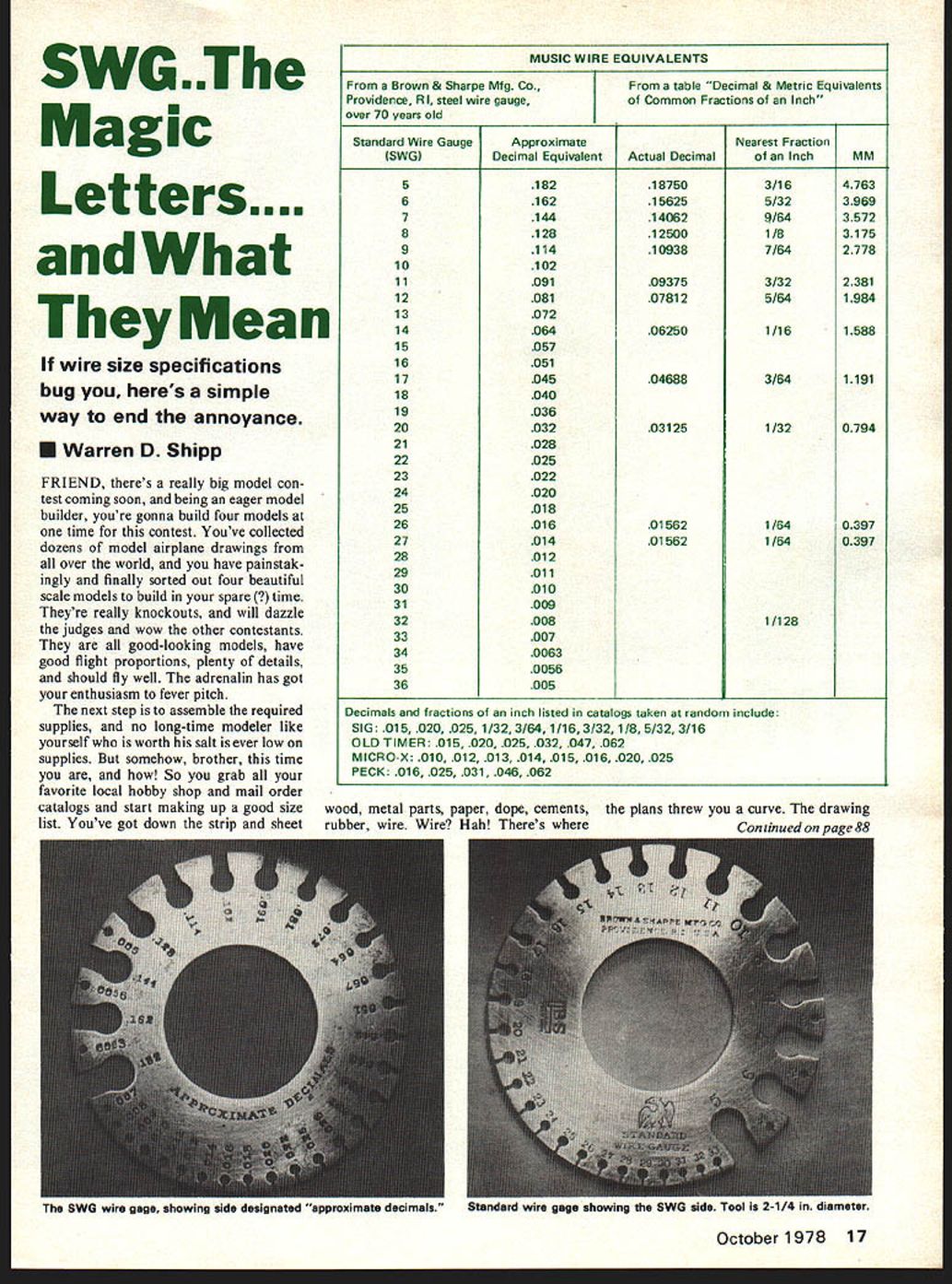
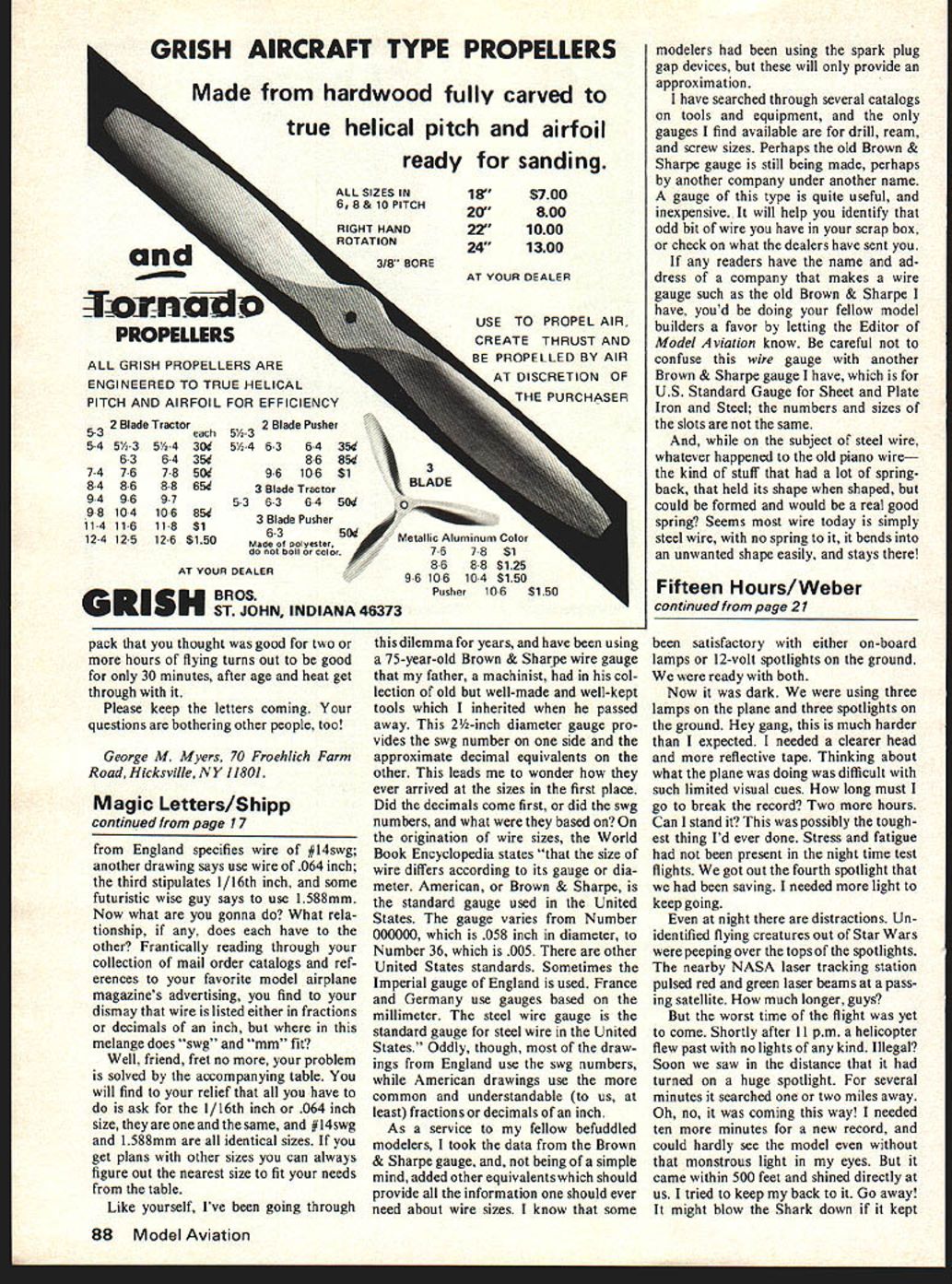
Like yourself, I've been going through this dilemma for years, and have been using a 75-year-old Brown & Sharpe wire gauge that my father, a machinist, had in his collection of old but well-made and well-kept tools which I inherited when he passed away. This 2-1/2-inch diameter gauge provides the SWG number on one side and the approximate decimal equivalents on the other. This leads me to wonder how they ever arrived at the sizes in the first place. Did the decimals come first, or did the SWG numbers, and what were they based on? On the origination of wire sizes, the World Book Encyclopedia states that "the size of wire differs according to its gauge or diameter. American, or Brown & Sharpe, is the standard gauge used in the United States. The gauge varies from Number 000000, which is .058 inch in diameter, to Number 36, which is .005. There are other United States standards. Sometimes the Imperial gauge of England is used. France and Germany use gauges based on the millimeter. The steel wire gauge is the standard gauge for steel wire in the United States." Oddly, though, most of the drawings from England use the SWG numbers, while American drawings use the more common and understandable (to us, at least) fractions or decimals of an inch.
As a service to my fellow befuddled modelers, I took the data from the Brown & Sharpe gauge and, not being of a simple mind, added other equivalents which should provide all the information one should ever need about wire sizes. I know that some modelers had been using the spark-plug gap devices, but these will only provide an approximation.
I have searched through several catalogs on tools and equipment, and the only gauges I find available are for drill, ream, and screw sizes. Perhaps the old Brown & Sharpe gauge is still being made, perhaps by another company under another name. A gauge of this type is quite useful, and inexpensive. It will help you identify that odd bit of wire you have in your scrap box, or check on what the dealers have sent you.
If any readers have the name and address of a company that makes a wire gauge such as the old Brown & Sharpe I have, you'd be doing your fellow model builders a favor by letting the Editor of Model Aviation know. Be careful not to confuse this wire gauge with another Brown & Sharpe gauge I have, which is for U.S. Standard Gauge for Sheet and Plate Iron and Steel; the numbers and sizes of the slots are not the same.
And, while on the subject of steel wire, whatever happened to the old piano wire — the kind of stuff that had a lot of springback, that held its shape when shaped, but could be formed and would be a real good spring? Seems most wire today is simply steel wire, with no spring to it; it bends into an unwanted shape easily, and stays there!
Transcribed from original scans by AI. Minor OCR errors may remain.

