
in the Swiss Alps
Dan Pruss
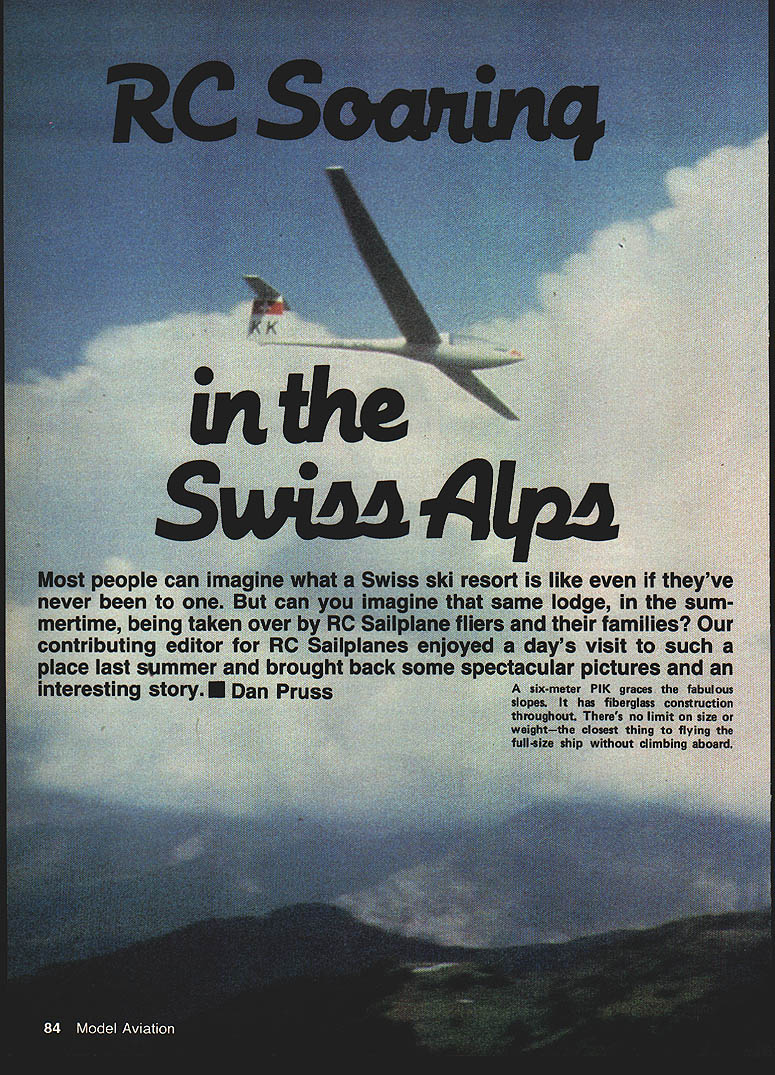
Most people can imagine what a Swiss ski resort is like even if they've never been to one. But can you imagine that same lodge, in the summertime, being taken over by RC sailplane fliers and their families? Our contributing editor for RC sailplanes enjoyed a day's visit to such a place last summer and brought back some spectacular pictures and an interesting story.
A different kind of RC soaring
There's a type of RC soaring that has received very little press. Maybe it's because the events don't get posted on anyone's contest calendar. Maybe it's because the flying takes place over an hour away from the nearest paved highway, and the site is tucked away in the mountains 6,500 feet above sea level.
If you're tired of reading about contest reports and how six-minute flights are a big challenge for some fliers, or if you can't stand the regimentation of a three-day contest, you are among the majority of sailplaners who fly for fun and who have been generically categorized as Sunday fliers. If you're more concerned about challenging the wind than a rule book when you fly, or more content in outflying a hawk than a stopwatch, and you fly only when the mood suits you, read on.
The photograph that looked fake
About six years earlier a photo had appeared on the cover of a South African soaring publication showing a scale sailplane being flown in the Swiss Alps. It looked impressive, but few people believed it wasn't trick photography. If the scene were real, the sailplane would have to be about 18 to 20 feet in span and, if properly proportioned, would weigh over 20 pounds — a spectacular model, but hard to accept at first glance.
The photo was real. Back in the Swiss Alps, planes like that are flown with the same regularity as smaller ships at your club's Saturday fun-fly.
An invitation to visit
Shortly after that picture was first published I talked with Hansruedi Schlapfer, a good friend and then manager of the Swiss F3B team, about the model in question. He shrugged and said that type of model had been flown in the Alps for years, and if I was ever in Switzerland in the summertime he would show me where they flew.
Last summer, right after the F3B World Championships in York, England, an old flying buddy, Neil Liptak, and I were invited to visit Hansruedi. Included in the itinerary was a visit to where the "grosssegler" are flown.
The trip to Hahnenmoospass
We met in Bern with Helmut Wehren, an organizer of the annual Swiss modeling forum, and drove to a small village about 30 miles south‑southeast of Adelboden. The short distance still took over an hour—not just because of winding roads but because about the last 15 minutes are single‑lane roads that posed problems with oncoming traffic.
Somewhere along the drive it was mentioned that it was too bad this wasn't a weekend, because that's when most of the flying takes place. However, Martin Keller, a young modeler, and Hans Stoll were both on the trip; Martin had brought along a small three‑meter ship just in case the winds were right.
The ride continued out of Adelboden about 15 more minutes until we came to the lower station for cable cars that ran up the mountain to Hahnenmoospass. Very few cars were parked at the station and no tourists were seen, so it was a surprise to see the cable cars in operation. Helmut figured the lodge might be open for lunch, so our group spread out in three cable cars—and up to Hahnenmoospass we went.
The lodge and the models
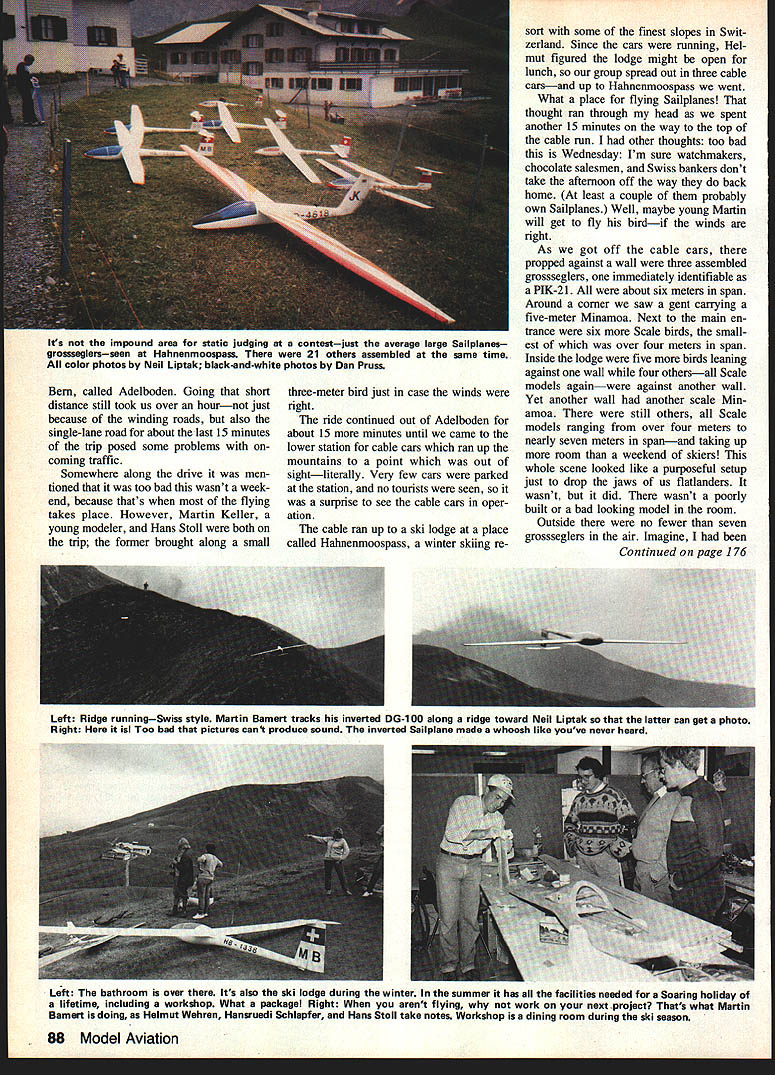
As we got off the cable cars there were three assembled grosssegler propped against a wall, one immediately identifiable as a PIK‑21. All were about six meters in span. Around the corner we saw a man carrying a five‑meter Minimoa. Next to the main entrance were six more scale birds, the smallest over four meters in span. Inside the lodge five birds leaned against one wall while four others—also scale models—were against another wall. Yet another wall had another scale Minimoa. Models ranged from over four meters to nearly seven meters in span, taking up more room than a weekend of skiers.
Outside there were no fewer than seven grosssegler in the air. The aeroclub from Helmut’s hometown (Bern) had come up for a one‑week holiday: twenty‑eight fliers and their families had arrived the day before and were now spread across the slopes. They were flying, picnicking, and enjoying the mountain.
Models of every type were present:
- PIK‑21s
- Minimoas
- DG‑100s
- Many scratch‑built ships ranging from small 1.5–2 meter trainers to large seven‑meter grosssegler
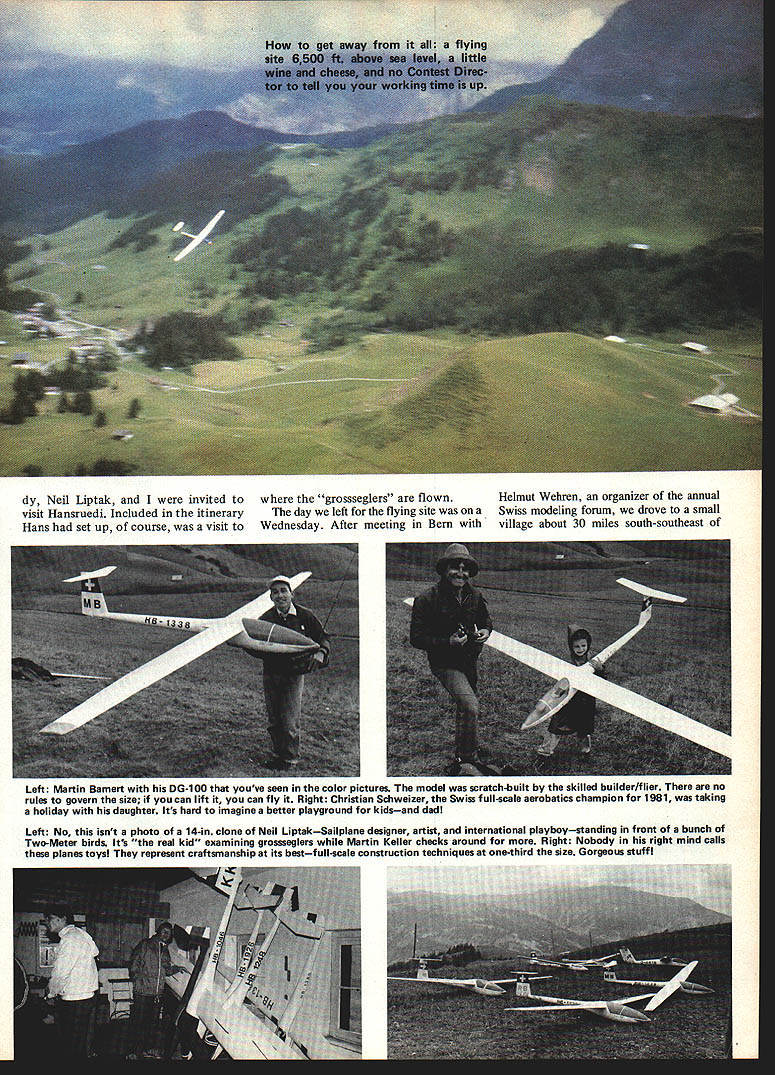
Everything was well built and beautifully finished. These were not toys; they represented craftsmanship at its best, often using full‑scale construction techniques at roughly one‑third size.
The flying
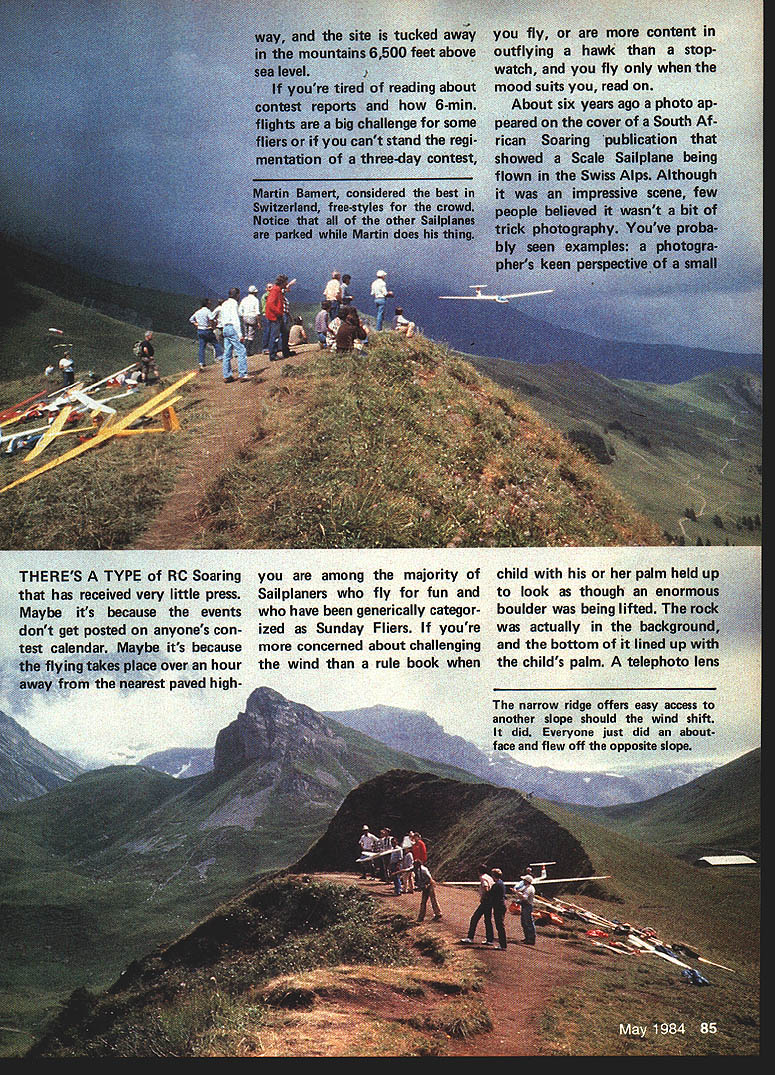
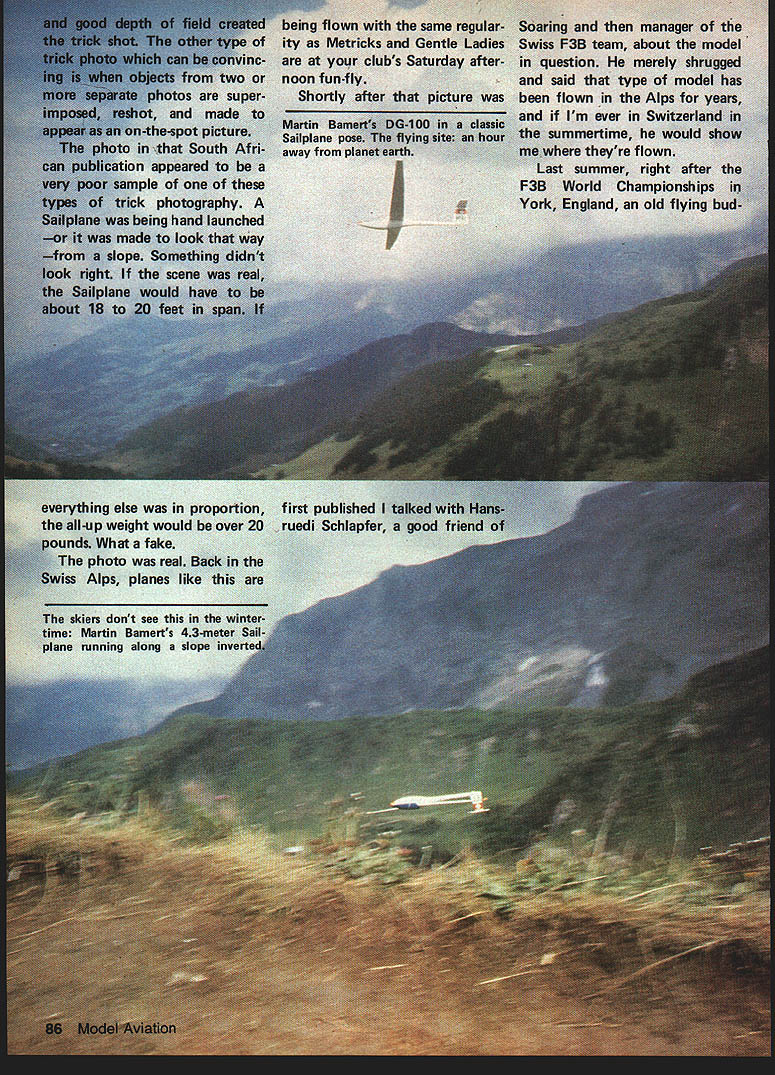
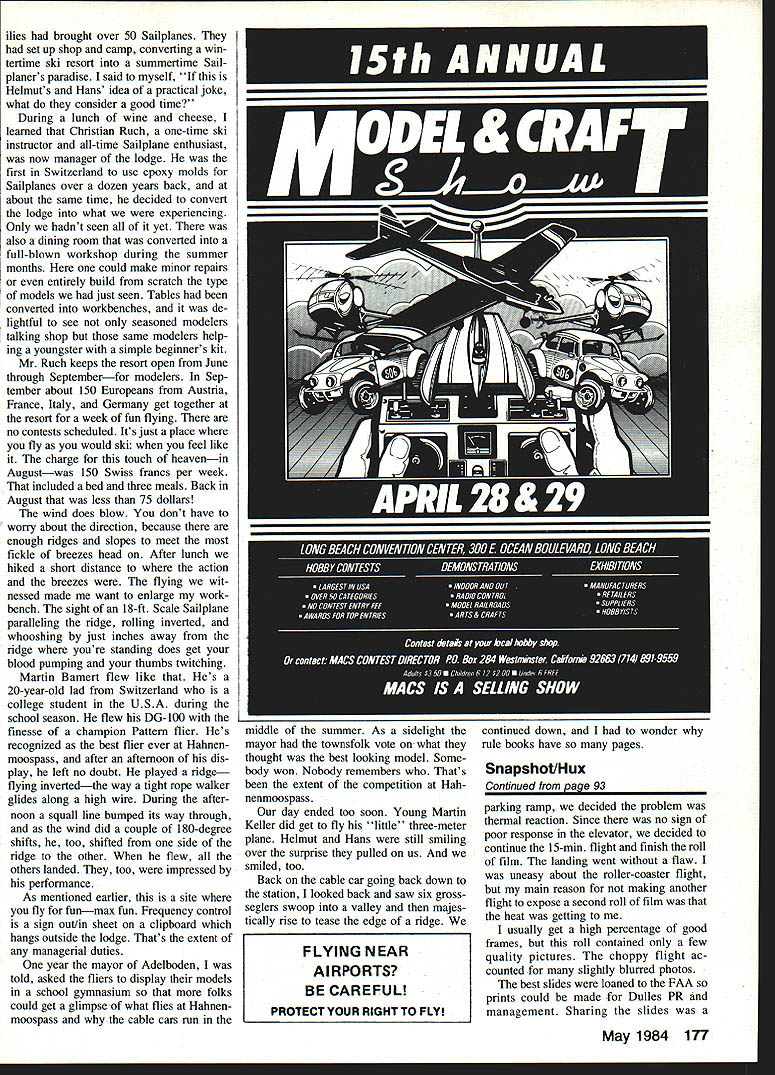
The ridge offered easy access and a variety of wind directions; one tine the wind would shift and the whole lot could come alive. An 18‑ft. scale sailplane paralleling the ridge, rolling inverted, and whooshing by just inches from the rock does get your blood pumping and your thumbs twitching.
Martin Bamert’s DG‑100, a scratch‑built model shown in the color pictures, appeared tracking the ridge an hour away from planet Earth. Martin is a 20‑year‑old Swiss college student who flies with the finesse of a champion pattern flier. He is recognized as the best flier at Hahnenmoospass and left no doubt after an afternoon display that included inverted ridge flying and precise transitions as a squall line forced wind shifts. When he flew, others often landed to watch.
The Swiss F3B team members were present and confirmed that the proportions and wing loadings they use in competition are similar to the heavy ships for speed runs and lighter ships for duration that we saw here.
The lodge in summer
Christian Ruch, a one‑time ski instructor and lifelong sailplane enthusiast, manages the lodge. He was one of the first in Switzerland to use epoxy molds for sailplanes more than a dozen years earlier and had decided to convert the lodge into a summer haven for modelers. The dining room becomes a full‑blown workshop during summer months where minor repairs or even entire builds can be completed. Tables turn into workbenches, and seasoned modelers are often found helping youngsters with beginner kits.
Mr. Ruch keeps the resort open from June through September for modelers. In September about 150 Europeans from Austria, France, Italy, and Germany gather at the resort for a week of fun flying. There are no formal contests—just flying whenever you feel like it. The charge in August was about 150 Swiss francs per week (which at the time was roughly $75), including a bed and three meals.
Frequency control is managed simply: a sign‑out/in sheet on a clipboard hanging outside the lodge. That's the extent of managerial duties.
Community and local interest
One year the mayor of Adelboden asked the fliers to display their models in the local school gymnasium so townsfolk could see what flies at Hahnenmoospass and understand why the cable cars run in mid‑summer. The townspeople voted for the best‑looking model; somebody won, though nobody remembers who—that has been the extent of competition at Hahnenmoospass.
A day to remember
Our day ended too soon. Young Martin Keller did get to fly his three‑meter plane. Helmut and Hansruedi were still smiling over the surprise they had pulled on us, and we smiled too. Back on the cable car going down, I looked back and saw six grosssegler swoop into a valley and then majestically rise to tease the edge of a ridge. I had to wonder why rule books have so many pages.
Transcribed from original scans by AI. Minor OCR errors may remain.

