
Richard L. Perry
Tachometer Modifications
Background
By changing the low range on the Heath and Ace tachometers, the low range can be used for accurate rpm measurement of slower-running chainsaw and geared engines without affecting the high-scale operation for higher-revving glow engines.
When Heath first introduced the Thumb Tach tachometer, its relatively low cost and ease of operation made it quite popular. As more modelers recognized the utility of having a tachometer in their tool boxes, demand increased and a variety of tachometers became available. Relative cost has decreased over the years with the lower cost of transistors and integrated circuits.
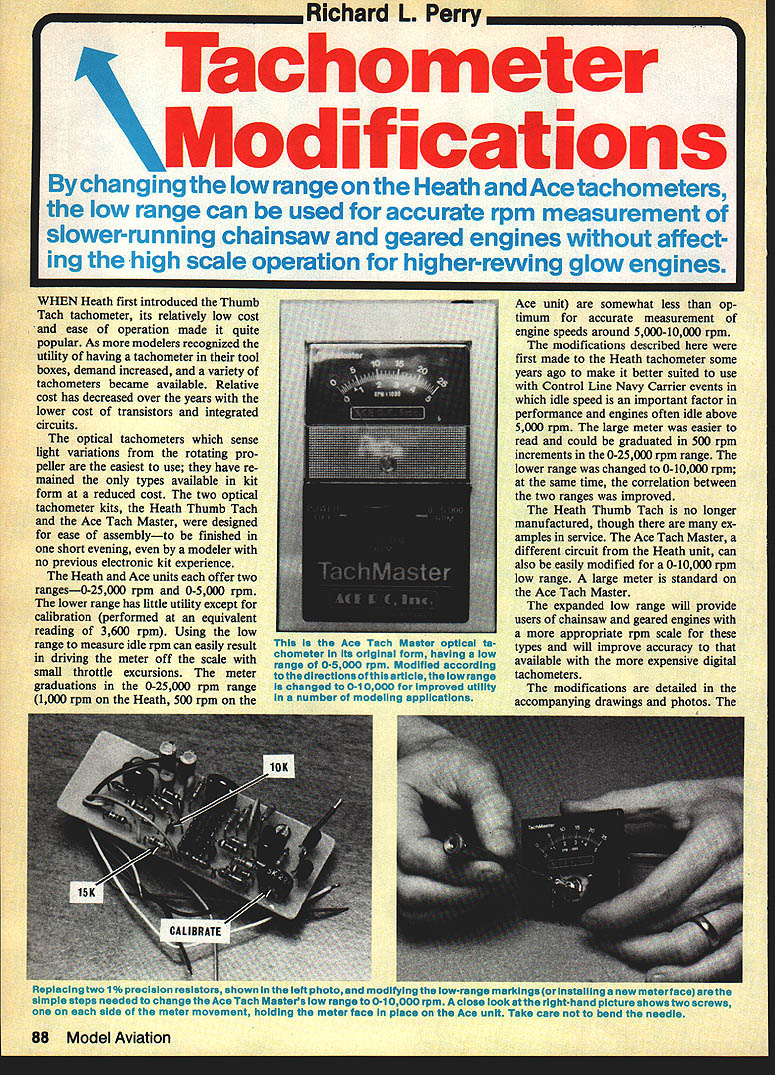
The optical tachometers, which sense light variations from the rotating propeller, are the easiest to use; they have remained the only types available in kit form at a reduced cost. The two optical tachometer kits, the Heath Thumb Tach and the Ace Tach Master, were designed for ease of assembly—to be finished in one short evening, even by a modeler with no previous electronic kit experience.
The Heath and Ace units each offer two ranges—0–25,000 rpm and 0–5,000 rpm. The lower range has little utility except for calibration (performed at an equivalent reading of 3,600 rpm). Using the low range to measure idle rpm can easily result in driving the meter off scale with small throttle excursions. The meter graduations in the 0–25,000 rpm range (1,000 rpm on the Heath, 500 rpm on the Ace unit) are somewhat less than optimum for accurate measurement of engine speeds around 5,000–10,000 rpm.
Purpose of the Modifications
The modifications described here were first made to the Heath tachometer to make it better suited for Control Line Navy Carrier events, in which idle speed is an important factor and engines often idle above 5,000 rpm. A larger meter was easier to read and could be graduated in 500 rpm increments in the 0–25,000 rpm range. The lower range was changed to 0–10,000 rpm; at the same time, the correlation between the two ranges was improved.
The Heath Thumb Tach is no longer manufactured, though many remain in service. The Ace Tach Master, which uses a different circuit than the Heath unit, can also be easily modified for a 0–10,000 rpm low range. A large meter is standard on the Ace Tach Master.
The expanded low range provides users of chainsaw and geared engines with a more appropriate rpm scale and improves accuracy to a level comparable with more expensive digital tachometers.
Meter and Case Modifications
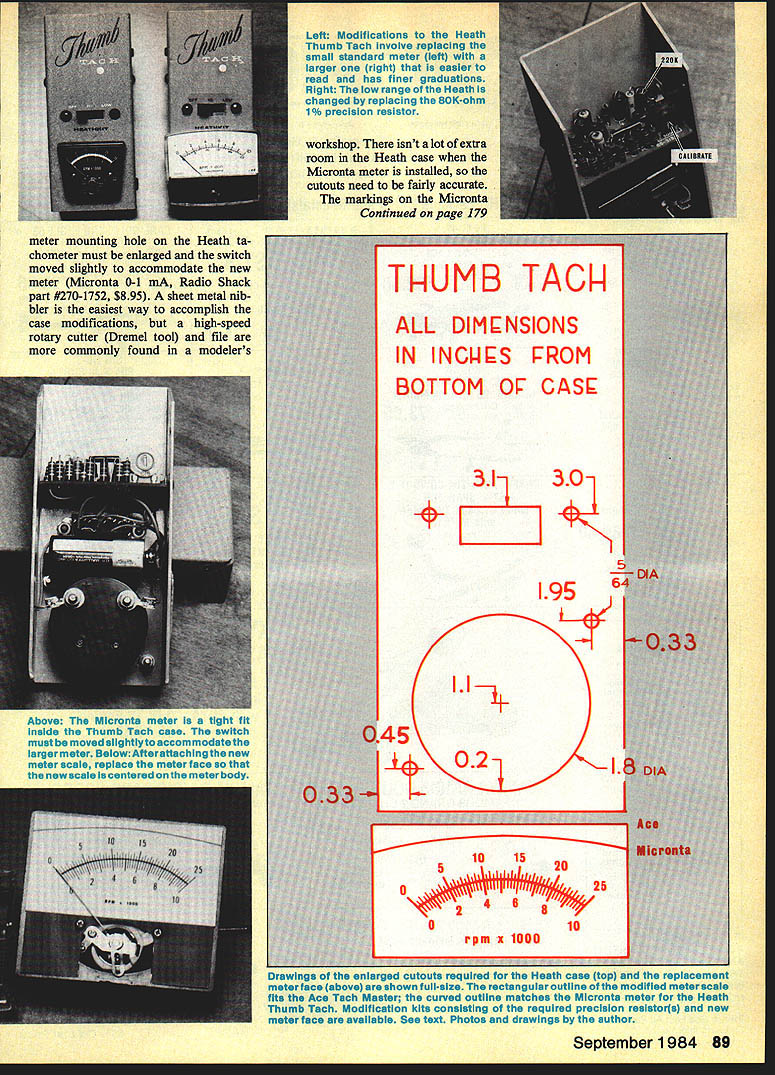
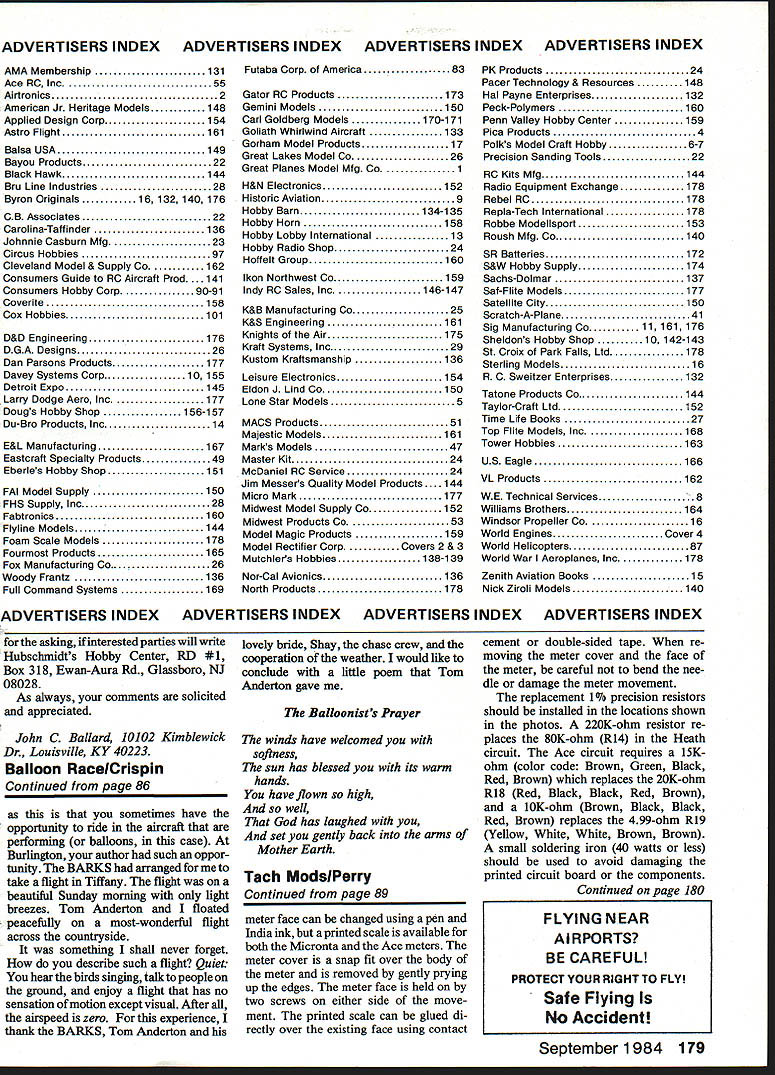
The meter mounting hole on the Heath tachometer must be enlarged and the switch moved slightly to accommodate the new meter (Micronta 0–1 mA, Radio Shack part #270-1752, $8.95). Recommended tools:
- Sheet metal nibbler (easiest)
- High-speed rotary cutter (Dremel tool) and file (more commonly available)
There isn't a lot of extra room in the Heath case when the Micronta meter is installed, so the cutouts need to be fairly accurate.
Meter Face and Scale
The markings on the Micronta meter face can be changed using a pen and India ink, but a printed scale is available for both the Micronta and the Ace meters.
- The meter cover is a snap fit over the body of the meter and is removed by gently prying up the edge.
- The meter face is held on by two screws on either side of the movement.
- The printed scale can be glued directly over the existing face using contact cement or double-sided tape.
- When removing the meter cover and the face of the meter, be careful not to bend the needle or damage the meter movement.
Resistor Replacements
Use 1% precision resistors installed in the locations shown in the photos (or as noted below).
- Heath circuit:
- Replace R14 (80K-ohm) with 220K-ohm.
- Ace circuit:
- Replace R18 (20K-ohm; original color code Red, Black, Black, Red, Brown) with 15K-ohm (color code Brown, Green, Black, Red, Brown).
- Replace R19 (4.99K-ohm; original color code Yellow, White, White, Brown, Brown) with 10K-ohm (color code Brown, Black, Red, Brown).
Soldering notes:
- Use a small soldering iron (40 watts or less) to avoid damaging the printed circuit board or components.
- Use resin-core solder.
- Do not use acid-core solder or soldering flux.
Calibration
When the modifications are complete:
- Assemble the tachometer and adjust the meter to zero using the screw on the cover.
- Recalibrate the tachometer to 3,600 rpm on the low scale by adjusting the internal potentiometer.
- Use an incandescent or fluorescent light as the calibration light source.
- Hold the tachometer in the same attitude in which it will be used to measure engine rpm.
Modification Kits
Modification kits, consisting of the required resistors and a new meter scale (printed on card stock), may be obtained by sending $2.50 to:
Richard Perry 7578 Vogels Way Springfield, VA 22153
Be sure to specify whether the tachometer to be modified is a Heath or Ace unit.
Transcribed from original scans by AI. Minor OCR errors may remain.

