
Tandem Fan
There is little doubt that ducted fans are rapidly becoming a standard and accepted part of model aviation. The WRAMS and Toledo shows earlier this year saw the introduction of a number of aircraft kits designed around ducted fan powerplants of various sizes and types. Scratch builders haven't been forgotten, as more fan projects are showing up in the model press.
Ducted fans will not be every modeler's choice—not only is there some complexity, but good engine-operation knowledge is required, and attention must be paid to mechanical details. For those who are willing to do this, the rewards can be great: a scale jet model flying across the sky without a non-scale prop in the nose is a glorious sight.
Ducted Fan Characteristics
One factor that must be taken into account when flying a ducted-fan model is the amount of thrust available from the fan. The models can and do fly well, but in general takeoff runs are longer, acceleration slower, and climb-outs shallower than traditional prop-driven aircraft. The ducted-fan manufacturers have expended a tremendous amount of research and development effort, which has resulted in the fans now available to us.
Tandem Fan Concept — first impressions
What's the latest in ducted-fan technology? I had the rare opportunity to test Bob Kress' prototype tandem fan in my Mini F-16 (as presented in the July 1980 issue). The tandem allows an .09 engine in an .049-size package—and really puts out the thrust. It is not yet commercially available.
This is not a product review—the tandem fan concept is not yet available commercially. Mr. Kress is obtaining patent coverage on this development, and at a later date double-fan units will be produced. Don't look for them right now.
- Dick Sarpolus
Bob Kress and the Axiflo series
The designer of Midwest Products' Axiflo series of ducted fans, Bob Kress, continues to press the state of the art in ducted-fan design. Several of Kress' ducted-fan articles have appeared in RCM and MB magazines. His product progression includes:
- The .40-size Axiflo (construction kit),
- The .049 Axiflo (construction kit), and
- The Axiflo RK-20B, a more advanced unit made up of completely molded subassemblies requiring only bolting together to be ready to use.
In the quest for improved performance, Kress' latest innovation is the tandem fan presented here.
Tandem fan prototype details
With his tandem-fan concept, Kress appears to have been able to "stuff" a larger, and therefore more powerful, engine into a given diameter, resulting in more thrust. His prototype tandem fan uses an .09 engine in the overall package size of his existing .049 conventional unit. Looking ahead, he forecasts a .40-powered double-fan in the .20-size package, and even .60 power in the .40-size package. The resultant higher thrust-to-size ratio would give designers better-performing aircraft.
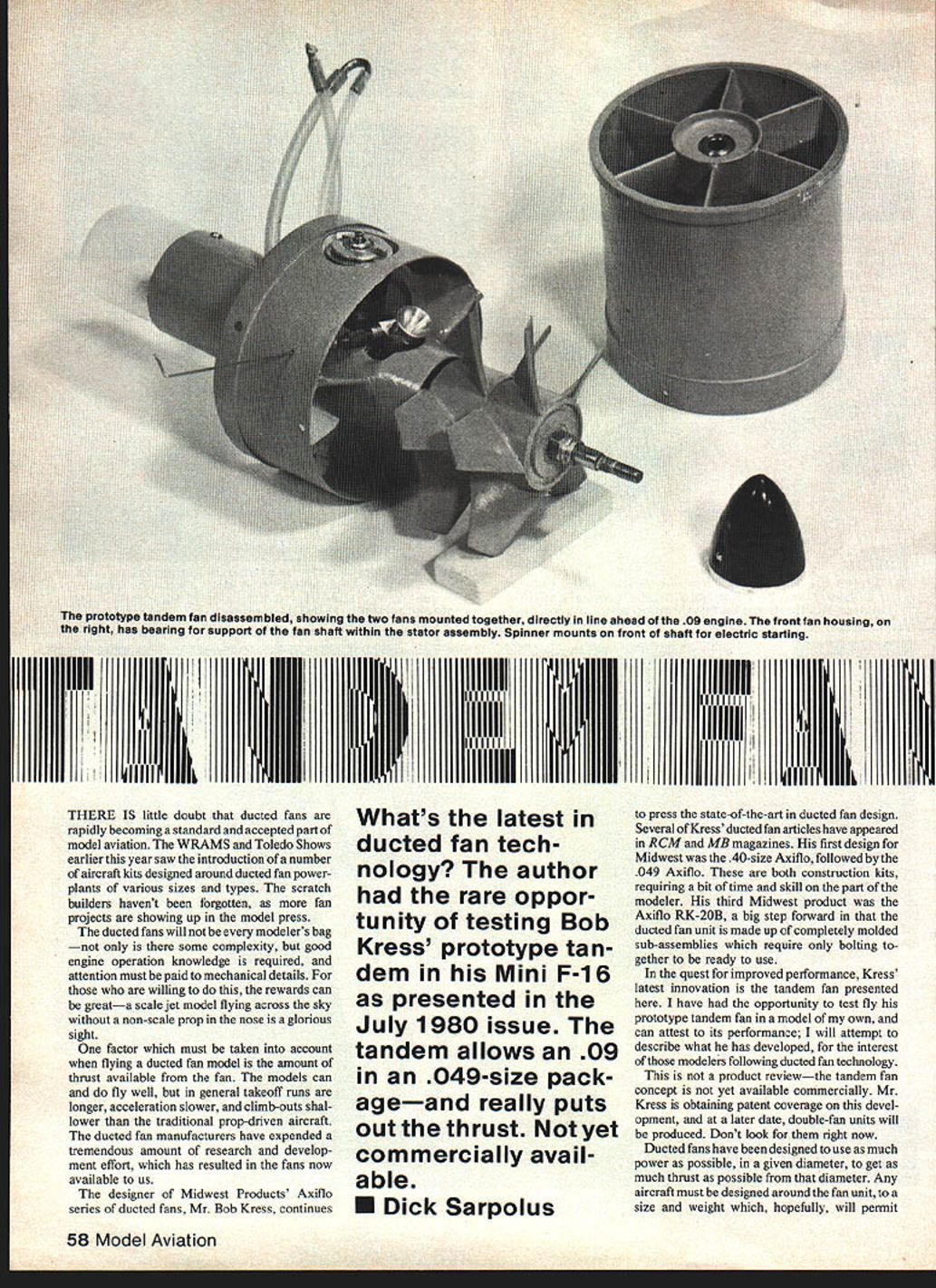
The two fans are mounted together, directly in line, with the front end of the fan shaft supported by a bearing located in a fixed stator assembly in the front of the fan housing. The spinner mounts on the front of the shaft, and the engine is started normally with an electric starter. The entire package disassembles similarly to the Axiflo RK-20B and looks as though it could be easily molded in plastic. The prototype is built up, and the workmanship is excellent. I added a small fuel tank, approximately two ounces, behind the engine-mount assembly for flight testing.
Flight testing in the Mini F-16
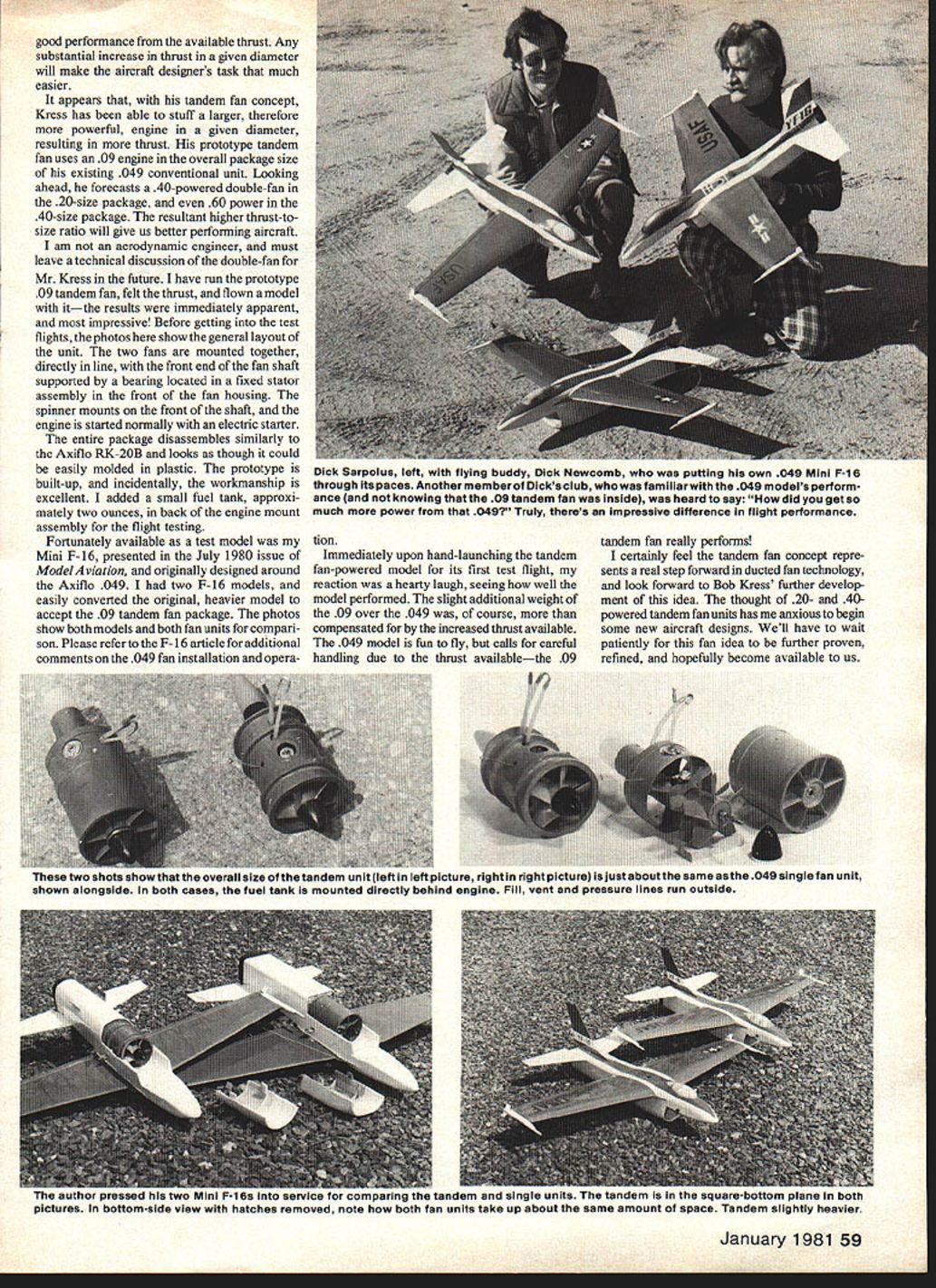
Fortunately available as a test model was my Mini F-16 (presented in the July 1980 issue of Model Aviation), originally designed around the Axiflo .049. I had two F-16 models and easily converted the original, heavier model to accept the .09 tandem-fan package. The photos show both models and both fan units for comparison. (Refer to the F-16 article for additional comments on the .049 fan installation and operation.)
Immediately upon hand-launching the tandem-fan-powered model for its first test flight, my reaction was a hearty laugh, seeing how well the model performed. The slight additional weight of the .09 over the .049 was more than compensated for by the increased thrust available. The .049 model is fun to fly but calls for careful handling due to the thrust available—the .09 tandem fan really performs!
Conclusion
I feel the tandem-fan concept represents a real step forward in ducted-fan technology, and I look forward to Bob Kress' further development of this idea. The thought of .20- and .40-powered tandem-fan units has me anxious to begin some new aircraft designs. We'll have to wait patiently for this fan idea to be further proven, refined, and—hopefully—made available to us.
Transcribed from original scans by AI. Minor OCR errors may remain.

