
Team Flying
by Eric Henderson
Form the skills to entertain and enjoy flying with your fellow pilots
After you learn to fly an RC model, you have a large number of wonderful options to pursue. For some, the pull of competition will take you into events such as Scale, Speed, or Aerobatics. I think I am safe in asserting that most RC pilots fly for the pure joy of keeping and controlling a model in the air.
There are a myriad of designs available these days that might catch your eye. That big warbird or multiengine beastie you dreamed of awaits your wallet and your guidance through the air. The thing that all of the preceding has in common is that they are individual activities. In competition, there is some interaction with your helpers but not much with your competitors or fellow club fliers.
A good analogy might be running. Many of us have the ability to run. You can run as fast and as far as you like. You can become, by definition, a "runner." However, running is largely a solo activity and does not reflect our general nature as humans. We are gregarious and like to do things together. Team flying, as an activity, has many components of a team sport. You "buddy up" with people, have common goals, practice with each other, and share the highs and lows—literally as well as figuratively.
Many people feel that full-scale air-show formation flying is the pinnacle of aviation skill. It is a bit more difficult to do when you are not actually in the airplane, but with planning, sensible safety rules, and a bunch of practice, you can achieve a high level of performance.
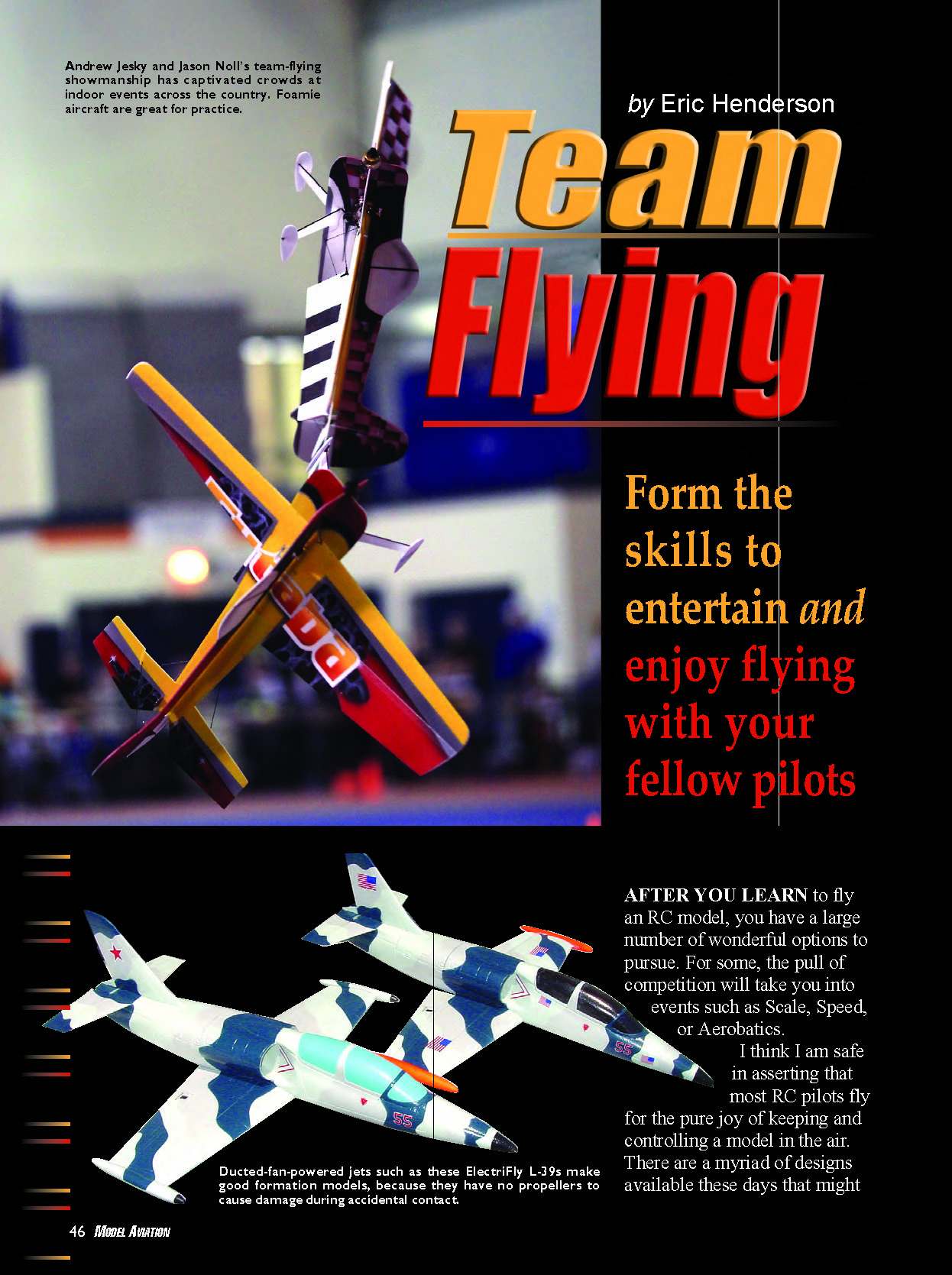
Team flying comes in many forms and can be as outgoing as doing demonstrations at a local RC air show or as neat as flying your models tightly together on a calm summer's evening. It can be a choreographed reenactment of a World War II scenario or pulling a few loops side by side at the same time. The result might be that you are putting on a show, but the primary goal is to have some fun beyond flying in a circle.
Most aspects of RC flying make you into a solo pilot at first—similar to the running analogy. Then flying with someone adds a huge new dimension to your RC fun. It engages friends and adds a new level of interest for the spectators. Be ready for lots of oohs, aahs, and occasional laughter.
To be successful with team flying and, more important, be welcomed at your club field, you need to establish good ground rules for all concerned. What you do with an RC model must be as safe as possible. It has to be acceptable to other club members. You need to negotiate for airspace and time slots. Make sure you are not all crowding the air while a beginner pilot is learning or a new Scale beauty is being tested. Midweek evenings have proven to be good for formation flying at our local club, the New Jersey Pine Barons. (The "Barons" part of the name is a play on words; the nearby South Jersey Pine Barrens lead to the southeast New Jersey shoreline.)
Choosing aircraft and cost considerations
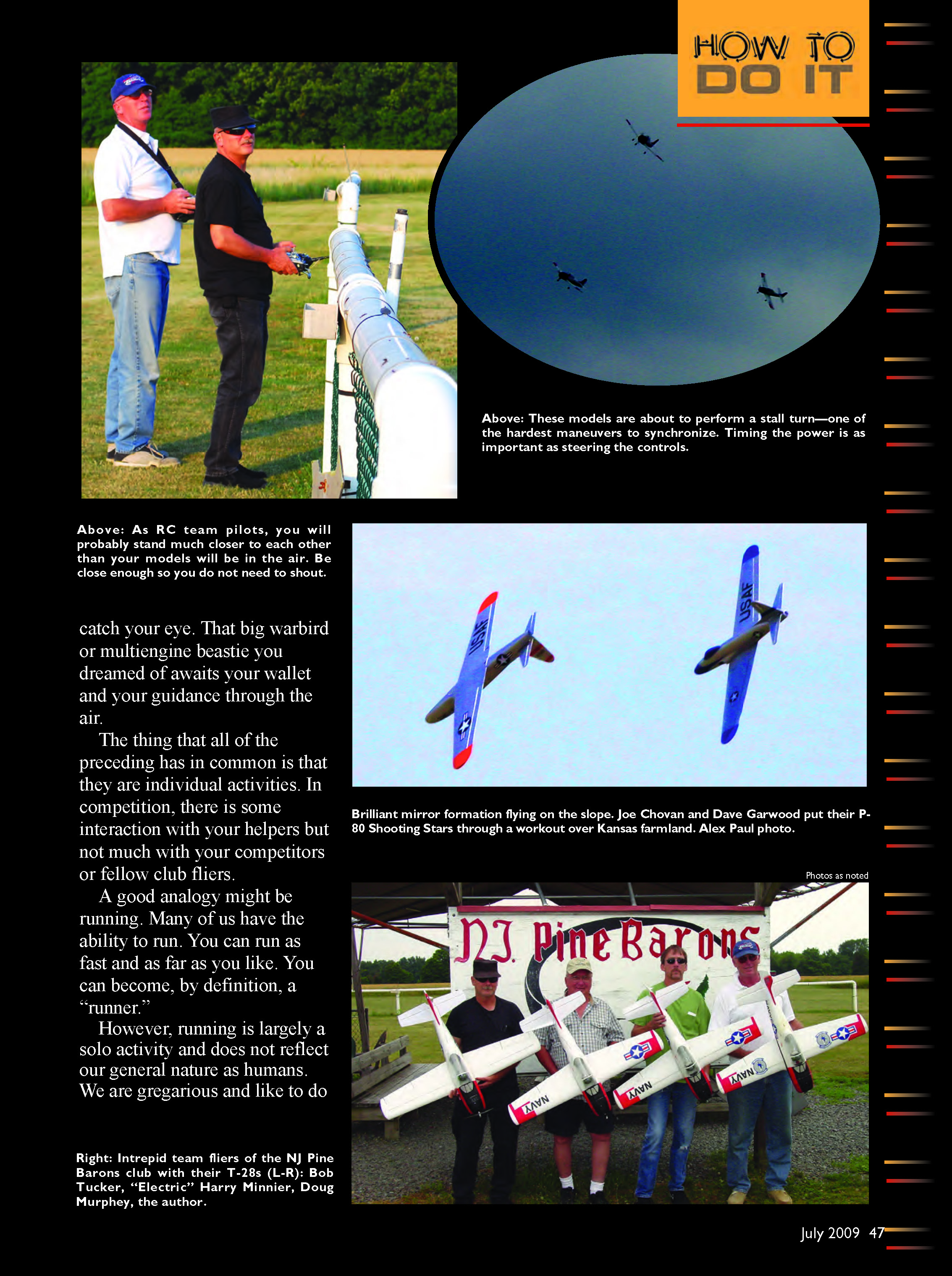
If you decide to try formation flying, the next issue is what airplane(s) to use. Many types of models lend themselves to this activity, but nobody said it was going to be easy. Cost is a major consideration. To be realistic, you have to accept that flying close to one another can lead to "unplanned landings."
There is currently a big selection of inexpensive, electric-powered ARFs and RTFs. A good choice for beginners is rear-motor pusher designs; Zagis from Trick R/C and ParkZone Strykers fit into this group. These models have no propellers on the front, are made from tough and light foam construction, and cost far less than what it would take to fill an SUV's gas tank.
The ParkZone T-28 (RTF and Plug-N-Play versions) is made from molded foam construction. It is tough, easy to get spare parts for, flies well, and is stable at lower speeds. As you get good, you can advance to any type of aircraft. When you see RC turbine-powered jets flying in smooth formation, you might find it hard not to be thrilled. I have been in awe since I saw three large B-17s in formation, "bombing" down the runway at the Lums Pond Warbirds Over Delaware event.
A final word about cost: until you are excellent at formation flying and landing, I strongly advise you to use a low-cost model that will not break the bank if it is destroyed. Choose an aircraft that is easy to repair at the field or even have a backup available. It is no fun to be the only one who is not flying.
Recommended starter considerations:
- Use inexpensive, durable foam models (rear-motor pusher types are forgiving).
- Prefer models with easy-to-get spare parts.
- Have a backup or field-repairable airframe until your skills are solid.
Building team skills and procedures
Whatever aircraft you choose, you need a process to build your team skills. You and your friends can fly your airplanes around at the same time and gradually build up to doing passes together. More likely, you will initially want to fly as closely together as is practical. In no time, it becomes a choreographed event.
One of you has to become the leader and the caller of what you will all be doing. The lead pilot does not necessarily have to be the caller; the caller could be a nonflier or a spotter. Soon you will hear such commands as:
- "Form up!"
- "Low pass at half throttle!"
- "Roll or loop—now!"
I can't stress enough that there should be basic rules to which all pilots agree. You must accept that any midair among yourselves is "blame-free," no matter what happens. It is also a good idea to establish proximity rules. How close is appropriate or too close? Plan to use altitude as a separator when models are farthest away from the pilots. You cannot have a collision if there is height between the airplanes.
A basic error that most fledgling formation pilots make is flying too far out or too close to the flightline. We are not inside the aircraft, as our full-scale counterparts are, so the only sure things are the sky above and below your model and your formation teammate's airplane. When your aircraft are coming toward you, it is nearly impossible to see who is leading, catching up, or going too slowly until it is too late. Keep a couple of wingspans between all models—even if you are sure that your model is in front or behind.
Flying technique and setup
One important thing to practice is flying in a straight line, parallel to the runway. If you don't do it already, it will soon show up and your flying buddy will insist that you learn to use your rudder. Bank-and-yank course corrections are clumsy, ugly, and disruptive to formation flying. If you can adjust positionally with your rudder, your routine becomes smooth and seamless to the spectator.
With good rudder control, you can slip into position with grace. It may be that your airplane has some roll coupled with rudder application. In that case, it is worth spending time programming antiroll correction with rudder before you get serious about formation flying.
Flying in formation will teach you many things about your flying, your buddy’s flying, and how to set up a model. When you have developed a good flying relationship and skill level with one pilot, you should invite more to join. Sometimes the “freshmen” tag along and get it right away; sometimes a session or two with the new pilots will work best. There is no limit to how many airplanes you put in the air.
My favorite demonstration flight was eight Gremlin flying wings pulling into a loop. Half of them did full loops and the other four did Immelmanns and went back the way they came. At the end, they all did Split S turnarounds and came back toward each other. At center stage, the first four pulled into loops again while the opposing four pulled up earlier into 45° climbs. Then they did half reverse Cuban 8s that placed all eight Gremlins on the same back radius of the loop in progress. All eight airplanes then headed off together. It looked and felt fabulous!
Planning routines and using solos
To get formation flying working right, plan the whole flight routine from takeoff to landing. Schedule the circuits to reflect the wind direction. Design a series of simple then more complicated maneuvers. Do simple racetrack circuits at different speeds and heights. Intersperse passes with loops, rolls, stall turns, spins, inverted passes, mirror passes (some airplanes inverted, some right-side up), loops with breakaways, and rejoining.
Crowd-pleasers are the lowest, slowest passes you all can do. Low looks great to the casual observer. You could also throw in a touch-and-go or two for grins.
One problem with racetrack formation flying is that the downwind leg is "out there" and boring unless you are the one flying. This is where you might employ a solo pilot or two. They can do spins, snaps, fancy four- or eight-point rolls, and even opposing passes if planned right. A solo pilot may be a member of the formation team or perhaps the pilot you could not get to stay long in formation. Use that "skill" to your team's advantage.
Slope soaring and other venues
A great place to fly in formation is on the slopes. Slope-soaring sailplanes lend themselves well to being flown closely together. The more robust the glider, the better. You almost have to fly the same design on the slope, because you do not have a speed control as in electric- or gas-powered models. Dave Garwood supplied some great photographs of EPP-foam gliders being flown closely. The thing with slope soarers is that the same design at the same weight, especially when flown closely, will fly the same way. RC pilots who fly slope "foamies" have been doing this activity for many years. I have had the pleasure of seeing a dozen foam flying wings executing airborne formations.
Team flying will generate friendships and levels of trust among fellow club members. Your flying will probably improve, and this activity will add a new dimension of interest for all concerned. There are many means of doing formation flying; please don't limit your choices to only the ones I have mentioned. You can fly indoors or outdoors. The airplanes can be gliders or have electric, gas, or glow power. You can fly any size, shape, or type of design over land or sea, cliff or runway.
Go out and find someone with whom to team up and have fun. You never know; one day you could be an AMA demonstration team.
MA
Eric Henderson eric.henderson@comcast.net
Sources:
- New Jersey Pine Barons RC Club — www.njpinebarons.com
- Trick R/C — (360) 275-6853 — www.zagi.com
- ParkZone — (800) 338-4639 — www.parkzone.com
- Leading Edge Gliders (EPP-foam warbird, slope jet kits) — (785) 525-6263 — www.leadingedgegliders.com
- Dan Sampson (fiberglass warbird, slope jet kits) — flybyu@dslextreme.com
Transcribed from original scans by AI. Minor OCR errors may remain.

