
The Teaneck Armory Story
Most modeling newsletters and magazines these days comment on the lack of young fliers and the loss of flying sites. These problems are important, and we should be looking for ways to improve present conditions.
With Joe Beshar’s (AMA Flying Site Coordinator, Eastern Region) invaluable help last year, the Metropolitan Sport Squadron developed a two-pronged approach that may help solve both problems and should be useful to other clubs.
Indoor/RC collaboration
Not many radio-control (RC) clubs have members experienced with flying indoor models, but the recent advent of micro RC models may go a long way toward changing that. Many local RC club members have begun showing up at our indoor site with their micro RC electrics. These same RC fliers find themselves building Bostonians and Peanut Scale models when they realize they can fly indoors no matter what the weather is outside.
The combination of gossamer, slow-flying indoor free-flight models and some of the new electric micro RC “indoor flyers” provides great entertainment for spectators and the kids we most want to interest in our hobby.
As one friend who builds quarter-scale RC models once said, “You indoor guys cut your balsa with a razor. I cut mine with a chain saw.” He was partially kidding, but that is beginning to change. With receivers weighing only a few grams, batteries that can provide 30-minute flights on a single charge, and tiny servos, models in the Peanut range and even smaller are practical to build and simple to fly. The equipment is close to foolproof, and so many ARFs (Almost Ready to Fly) are available now that you can have a model in the air an hour after the kit arrives.
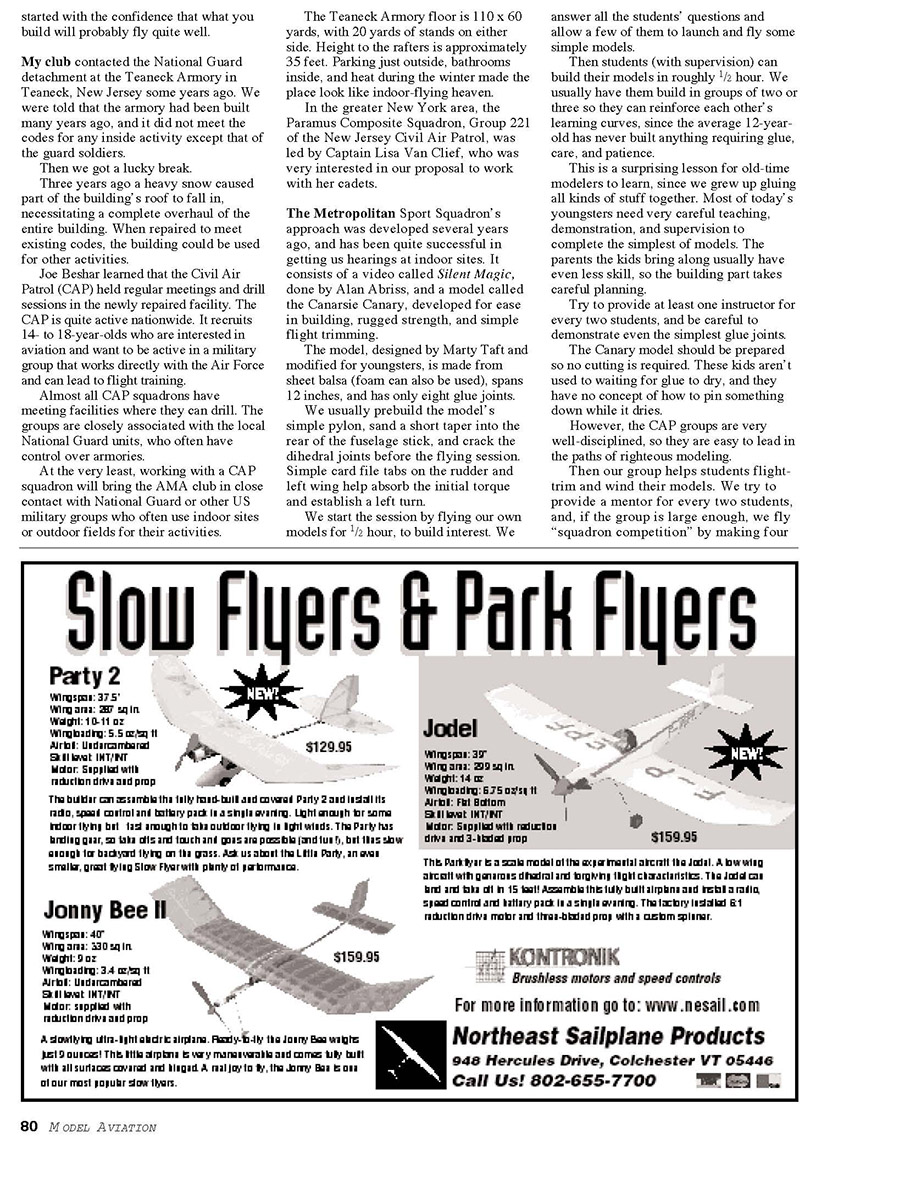
At the Teaneck Armory on any flying morning you will see the air shared by EZB, Pennyplane, Peanut Scale, and an assortment of scratch-built, kit, and ARF RC electric models. The floor is big enough to provide decent separation, and accidents are rare. The interesting thing about this arrangement is that we are all learning from each other.
In the past many RC clubs have shunned free-flight fliers, perhaps because RCers fear an uncontrolled airplane might wander off their field and cause damage or complaints. At Teaneck, though, these guys are on our turf and are beginning to acquire a healthy respect for the kind of flight trimming we must do to keep a model from hitting walls or the ceiling.
RC fliers are picking up hints about flight trimming while the indoor free-flight guys are learning about electric motors, building for strength, and new materials. Altogether, the experience has been illuminating for all concerned.
Types of indoor RC models
Indoor RC models at our sessions range widely:
- Original designs or significantly modified kits that span 12 inches or less and weigh one ounce or less.
- Scaled-down old-time gas models of roughly 30 inches and six ounces.
- New indoor kits with spans up to 40 inches and weights as heavy as 10 ounces.
Many are rebuilt rubber or gas models with radio control added. Power is usually electric, but there are a few CO2 specimens and even a rare rubber-powered entry. This is a swell opportunity to take an old, beat-up gas or rubber model off the shelf and convert it to something that will provide many more hours of flying pleasure. There are enough kits, articles, and publications available that even if you have never built an electric model, you can get started.
Background: how we got the Armory
My club contacted the National Guard detachment at the Teaneck Armory in Teaneck, New Jersey, some years ago. We were told the armory had been built long ago and did not meet codes for any inside activity except that of the Guard soldiers. Then we got a lucky break.
Three years ago a heavy snow caused part of the building’s roof to fall in, necessitating a complete overhaul. When repaired to meet existing codes, the building could be used for other activities. Joe Beshar learned that the Civil Air Patrol (CAP) held regular meetings and drill sessions in the newly repaired facility.
The CAP recruits 14- to 18-year-olds interested in aviation and active participation in a military-associated organization that works with the Air Force and can lead to flight training. Almost all CAP squadrons have meeting facilities where they drill; the groups are closely associated with local National Guard units, who often have control over armories. Working with a CAP squadron will bring the AMA club in close contact with National Guard or other U.S. military groups who often use indoor sites or outdoor fields for their activities.
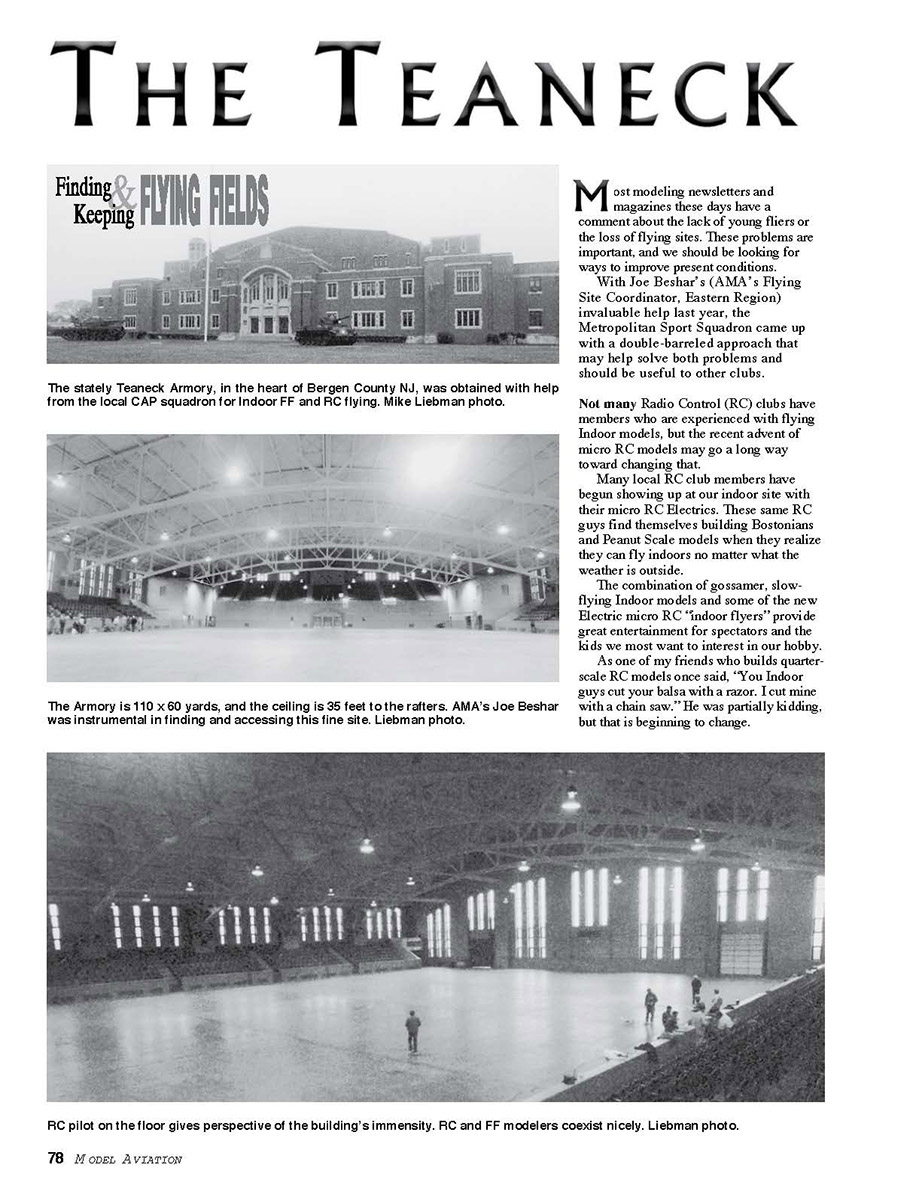
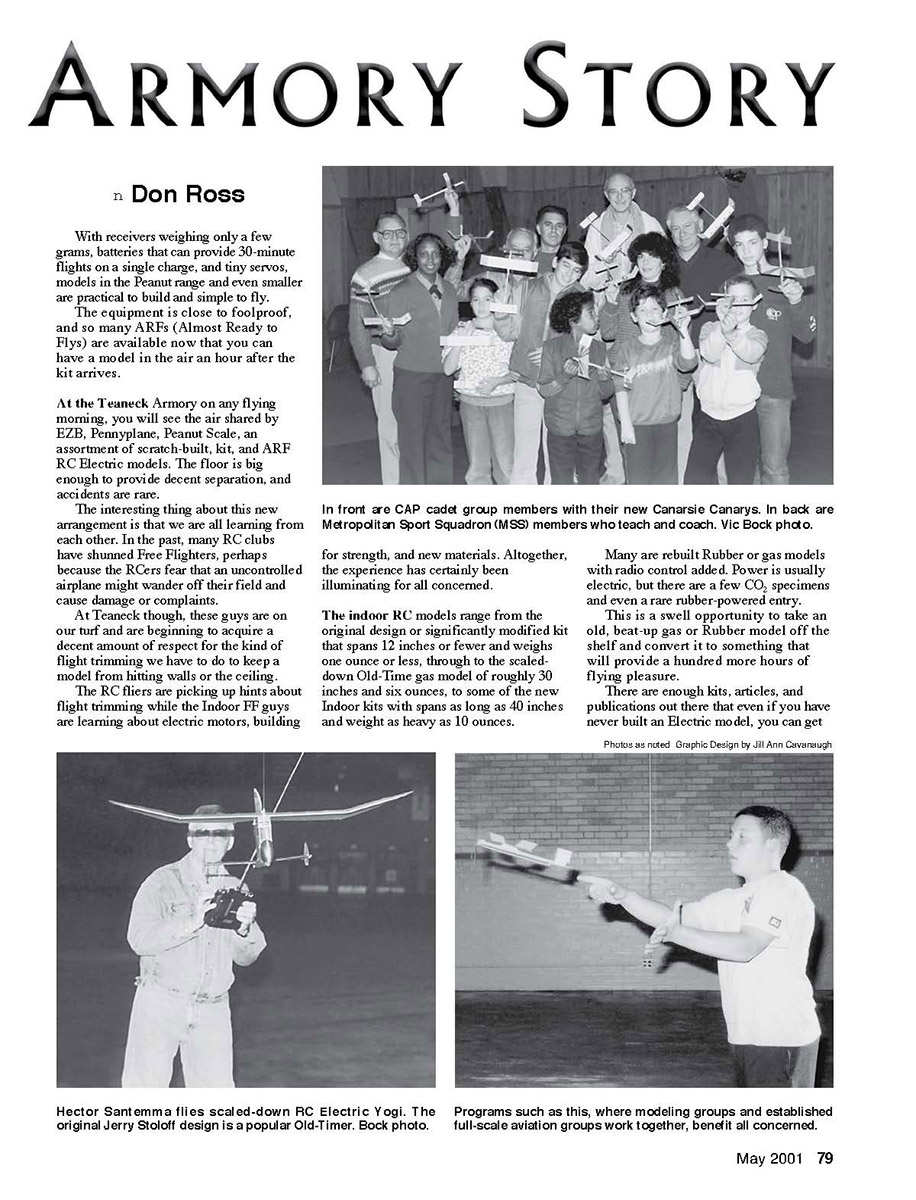
The Teaneck Armory floor is 110 x 60 yards, with 20 yards of stands on either side. Height to the rafters is approximately 35 feet. Parking is just outside, bathrooms are inside, and the building is heated during the winter—making the place look like indoor-flying heaven.
In the greater New York area, the Paramus Composite Squadron, Group 221 of the New Jersey Civil Air Patrol, was led by Captain Lisa Van Cleef, who was very interested in our proposal to work with her cadets. Captain Pitersky (now a major), the battalion training officer, was also receptive. Mr. Charles Parsons, the chief armorer in charge of the physical plant, has been gracious and helpful. Joe Beshar’s persistence got us permission to use the armory whenever soccer wasn’t on the schedule, giving us one morning a week for fun-flying and a weekend each year for a building session.
The Canarsie Canary program
The Metropolitan Sport Squadron’s approach was developed several years ago and has been quite successful in gaining access to indoor sites. It consists of:
- A video called Silent Magic, by Alan Abriss.
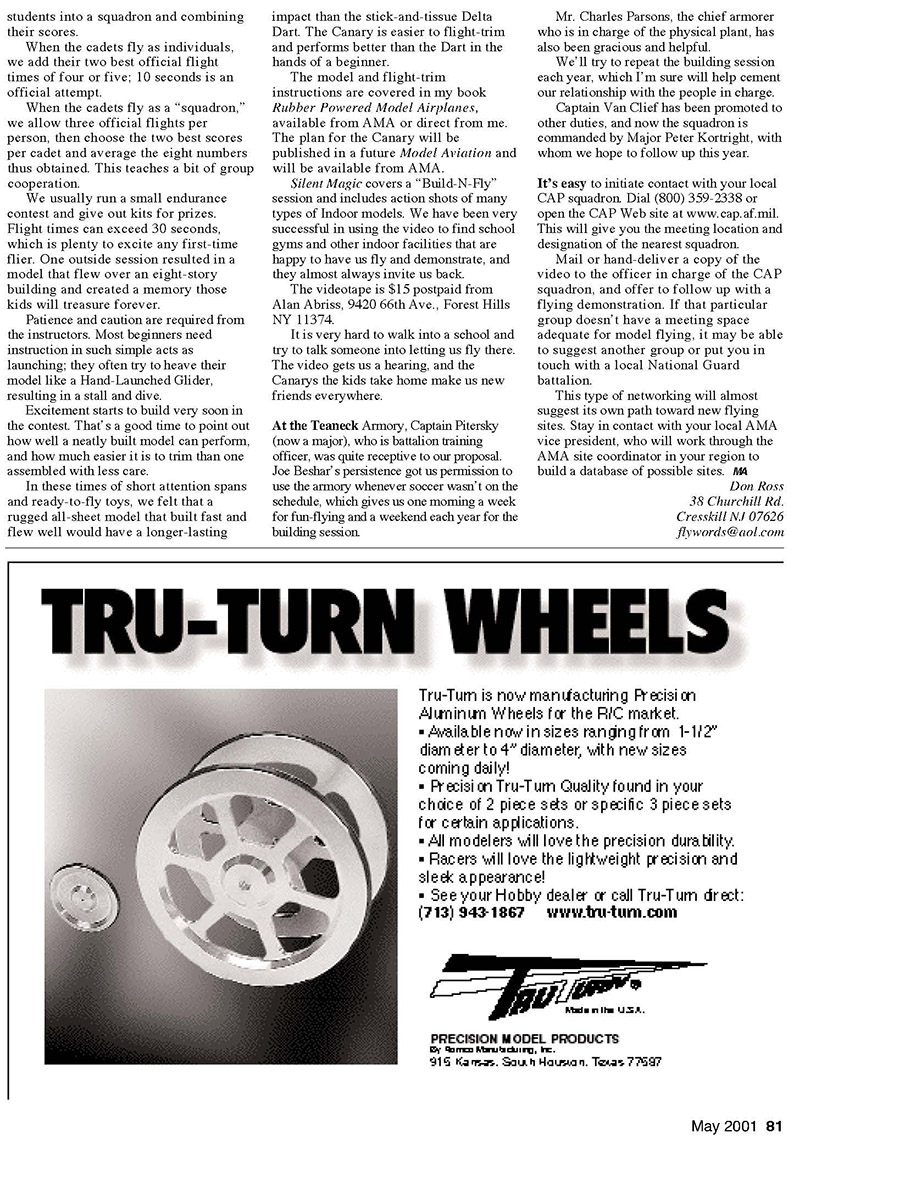
- A model called the Canarsie Canary, developed for ease of building, rugged strength, and simple flight trimming.
The Canary, designed by Marty Taft and modified for youngsters, is made from sheet balsa (foam can also be used), spans 12 inches, and has only eight glue joints. We usually prebuild the model’s simple pylon, sand a short taper into the rear of the fuselage stick, and crack the dihedral joints before the flying session. Simple car file tabs on the rudder and left wing help absorb the initial torque and establish a left turn.
Silent Magic covers a “Build‑N‑Fly” session and includes action shots of many types of indoor models. We have used the video successfully to find school gyms and other indoor facilities that are happy to have us fly and demonstrate—they almost always invite us back. The videotape is $15 postpaid from Alan Abriss, 9420 66th Ave., Forest Hills, NY 11374.
Running a Build-and-Fly session
We start the session by flying our own models for half an hour to build interest. The CAP cadets are then taken through a brief demonstration of the model and how to answer students’ questions; a few cadets are allowed to launch and fly simple models.
Then students (with supervision) build their models in roughly half an hour. We usually have them build in groups of two or three so they can reinforce each other’s learning, since the average 12-year-old has often never built anything requiring glue, care, and patience. This is a surprising lesson for old-time modelers to learn—most of today’s youngsters need careful teaching, demonstration, and supervision to complete the simplest models. The parents the kids bring along usually have even less skill, so the building part takes careful planning.
Tips for instructors:
- Provide at least one instructor for every two students.
- Demonstrate even the simplest glue joints.
- Prepare the Canary model so no cutting is required; these kids aren’t used to waiting for glue to dry or pinning something down while it dries.
- The CAP groups are usually well disciplined and easy to lead in modeling activities.
After building, our group helps students flight-trim and wind their models. We try to provide a mentor for every two students. If the group is large enough, we run a “squadron competition.”
Contest scoring and mentoring
We use simple scoring to teach both flying and cooperation.
When cadets fly as individuals:
- Each cadet gets four or five official attempts.
- We add their two best official flight times.
- Ten seconds is an official attempt.
When cadets fly as a squadron:
- Four students are made into a squadron.
- Each cadet is allowed three official flights.
- We choose the two best scores per cadet and average the eight numbers obtained.
- This format teaches group cooperation.
We usually run a small endurance contest and give out kits for prizes. Flight times can exceed 30 seconds, which is plenty to excite a first-time flier—one outside session produced a model that flew over an eight-story building and created a memory those kids will treasure forever.
Patience and caution are required from instructors. Most beginners need instruction on such simple acts as launching; they often try to heave their model like a hand‑launch glider, resulting in a stall and dive. Excitement builds quickly in the contest—this is a good time to point out how well a neatly built model can perform and how much easier it is to trim than one assembled with less care.
In these times of short attention spans and ready-to-fly toys, we felt that a rugged, all-sheet model that builds fast and flies well would have a longer-lasting impact than the stick-and-tissue Delta Dart. The Canary is easier to flight-trim and performs better than the Dart in the hands of a beginner.
The model and flight-trim instructions are covered in my book Rubber Powered Model Airplanes, available from AMA or direct from me. The plan for the Canary will be published in a future Model Aviation and will be available from AMA.
Finding and working with CAP squadrons
It’s easy to initiate contact with your local CAP squadron:
- Dial (800) 359-2338, or
- Visit the CAP website at www.cap.af.mil.
This will give you the meeting location and designation of the nearest squadron. Mail or hand-deliver a copy of the video to the officer in charge of the CAP squadron, and offer to follow up with a flying demonstration. If that group doesn’t have adequate meeting space for model flying, it may suggest another group or put you in touch with a local National Guard battalion.
This type of networking will almost suggest its own path toward new flying sites. Stay in contact with your local AMA vice president, who will work through the AMA site coordinator in your region to build a database of possible sites.
We’ll try to repeat the building session each year to help cement our relationship with the people in charge. Captain Van Cleef has since been promoted to other duties; the squadron is now commanded by Major Peter Kortright, with whom we hope to follow up this year.
Don Ross 38 Churchill Rd. Cresskill, NJ 07626 flywords@aol.com
Transcribed from original scans by AI. Minor OCR errors may remain.

