
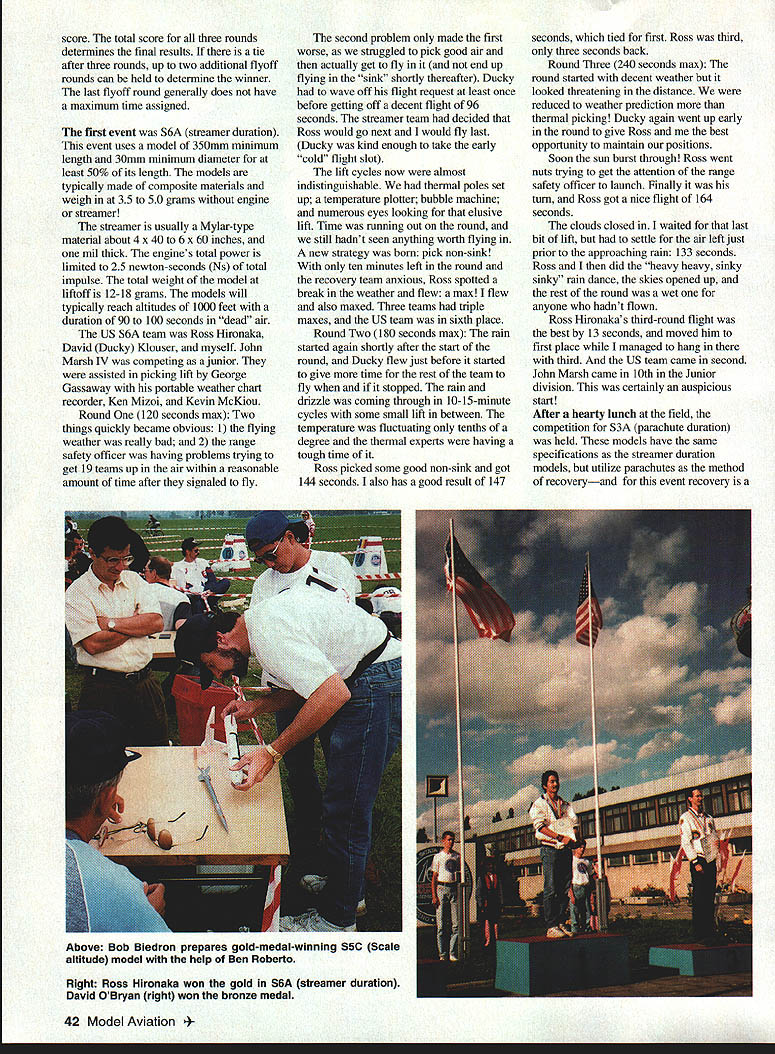
Tenth Spacemodeling World Champs
David O'Bryan
Overview
Contestants from 19 countries participated in the Tenth World Spacemodeling Championships in Leszno, Poland, September 3–10, 1994. The U.S. team of 12 seniors and 1 junior was chosen at a team selection competition held in fall 1993 at AMA's National Flying Site.
The team met in Frankfurt, flew to Prague, and took a chartered bus to Leszno. What looked like a three-hour ride on the map became a nine-hour trip over small roads in bad weather with an unplanned tour of Wroclaw—twice. We finally arrived at our lodging, a 19th-century castle, late Friday night and prepared for the contest.
Saturday was practice day, and most team members checked out the field and practiced under local conditions. The field is an active aerodrome for sport aviation, with a grass surface and long visibility (the helicopter world championships were scheduled there three weeks later). The opening ceremonies on Sunday drew an estimated 6,000 townspeople.
Scoring and general rules
- Score for each model is the sum of three flights; the highest total after three rounds determines final results.
- If tied after three rounds, up to two additional flyoff rounds may be held to determine the winner. The last flyoff round generally does not have a maximum time assigned.
- Weather was a major factor all week: rain squalls, drizzle cycles, shifting winds, and low ceilings affected many events.
S6A (streamer duration)
Specifications
- Minimum length: 350 mm.
- Minimum diameter: 30 mm for at least 50% of length.
- Typical model materials: composites.
- Model weight (without engine/streamer): typically 35–50 g total; liftoff weight usually 12–18 g.
- Streamer: Mylar-type, about 4 x 40 to 6 x 60 inches, ~0.5 mil thick.
- Engine impulse limit: 2.5 N·s (newton-seconds).
- Typical altitude: ~1,000 ft; duration in dead air: 90–100 s.
U.S. S6A team
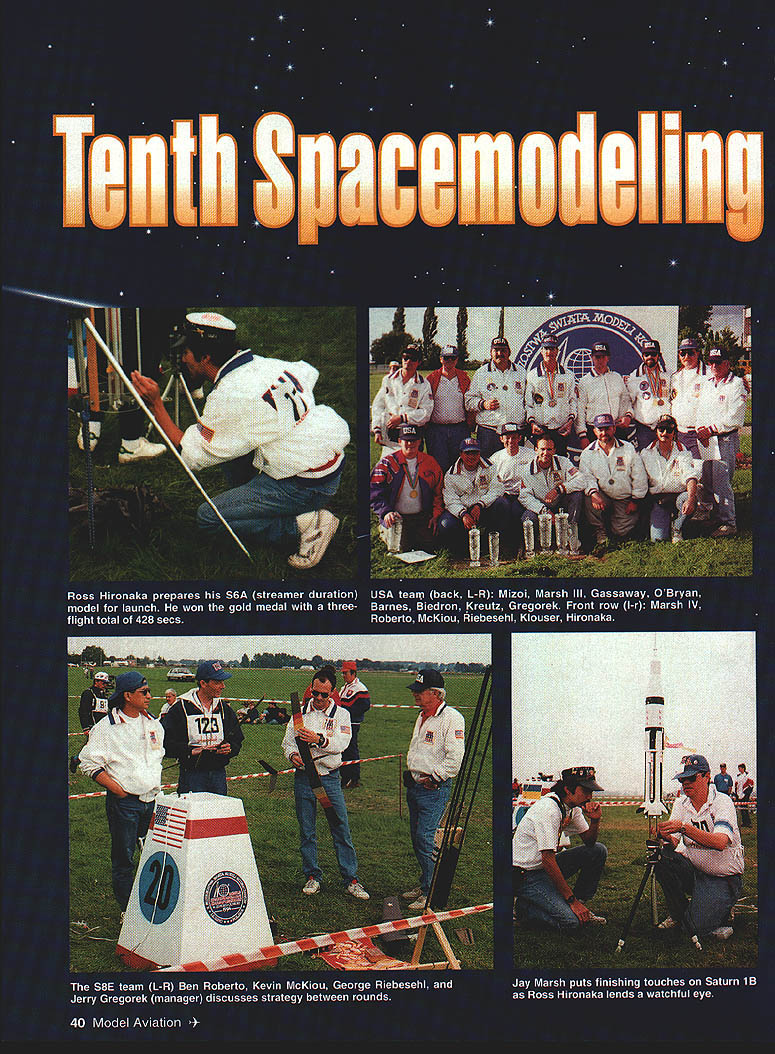
- Ross Hironaka
- David “Ducky” Klouser
- David O’Bryan
- John Marsh IV (junior)
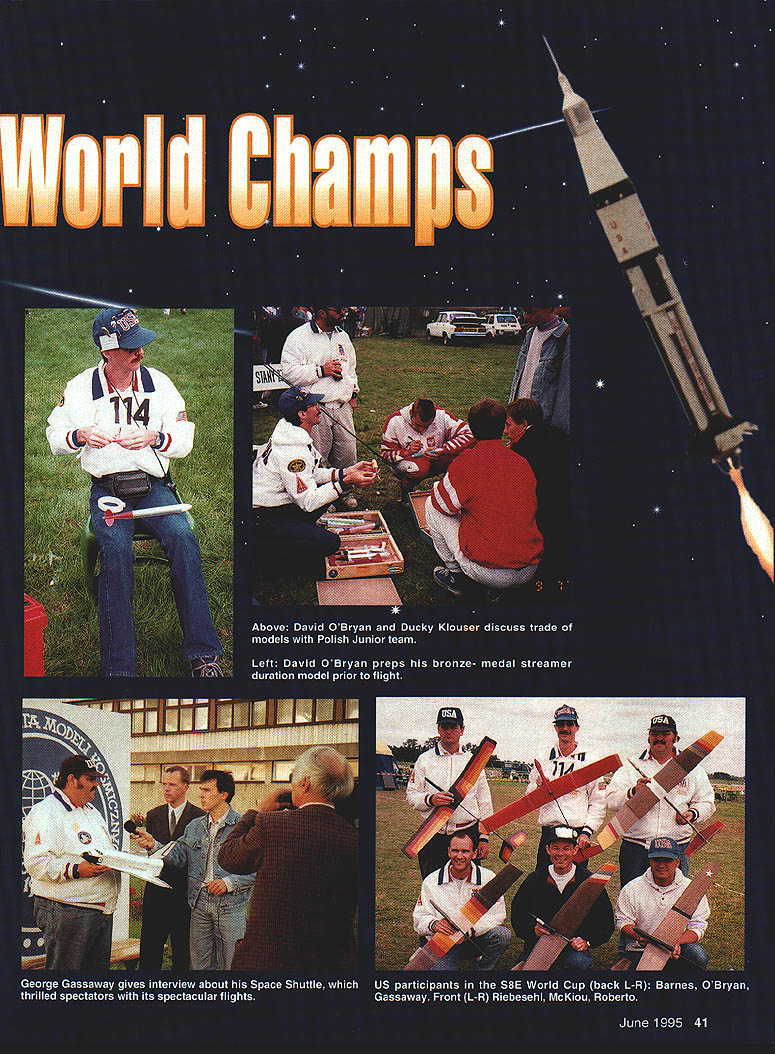
- Assistants: George Gassaway (lift picking), Ken Mizoi (portable weather-chart recorder), Kevin McKiou
Round One — 120 seconds max
- Weather and organization problems were evident: poor flying conditions and delays getting 19 teams airborne.
- Lift cycles were indistinguishable; team used temperature plotters, thermal poles, and visual spotting.
- Strategy changed to “pick non-sink.” With about ten minutes left, Ross spotted a break, flew a max, and the team also maxed. Three teams triple-maxed; U.S. finished sixth in the event after Round One.
Round Two — 180 seconds max
- Rain returned shortly after the round started. Ducky flew early to give the team time.
- Drizzle and short lift cycles made picking thermals difficult.
- Ross found good non-sink air for 144 s; Ducky recorded a 147 s flight; overall positions tightened (Ross moved into contention).
Round Three — 240 seconds max
- The round began in decent weather but looked threatening. Ducky again flew early to help teammates.
- The sun burst through; Ross got 164 s on one launch and later a 133 s flight just before rain.
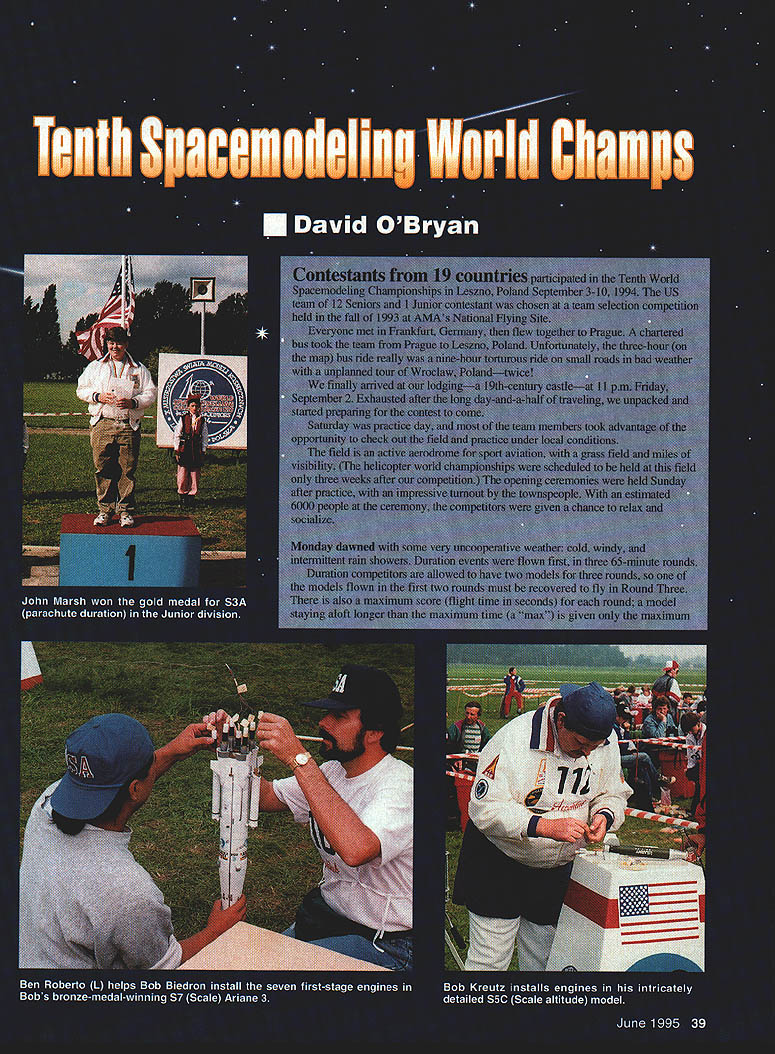
- Ross Hironaka’s third-round performance moved him into first place individually. The U.S. team finished second overall. John Marsh placed 10th in the junior division.
(End of S6A coverage)
S3A (parachute duration)
Specifications
- Same basic model dimensions as streamer-duration events.
- Recovery: parachute (36–42-inch diameter often used); recovery method and parachute sizing are critical.
- A model weighing ~15 g under a 36–42 in parachute can disappear into the sky at slight lift, making recovery challenging.
U.S. S3A team
- Phil Barnes
- George Gassaway
- David O’Bryan
- John Marsh (junior)
Notes on equipment
- Phil and the author worked on Silly Putty dethermalizers; they proved too stiff and inconsistent in ~60°F conditions.
Round One — 240 seconds max
- Difficult weather with intermittent lift and heavy rain squalls. Team members were able to get maxes.
Round Two — 300 seconds max
- Lift elusive; rain more frequent.
- George missed a max by two seconds after waving off a flight due to slow range retrieval, then scored 261 s just before a squall.
- Phil had a deployment problem and took a zero for the round.
- John Marsh (junior) maxed and remained in strong contention.
Round Three — 360 seconds max
- Seniors ensured John had clear shots to fly when ready. The recovery crew did an excellent job locating his earlier flight despite rain.
- John picked his air and maxed. Several juniors had similar scores, so results waited on other competitors.
- Final results: John Marsh won the junior event outright. A senior flyoff gave gold to Petre Nicolae of Romania. The author finished eighth; George Gassaway 28th; Phil Barnes 35th. Special thanks to the recovery crew for their efforts on an unpleasant day.
S4B (boost-glider duration)
Specifications
- Rigid-wing gliders.
- Minimum liftoff weight: 27 g.
- Engine impulse limit: 5.0 N·s total.
- Typical flying glider (after boost/case ejection) weighed around 7–10 g, wing area ~25–40 in².
- Gliders are boost-launched; spent engine casings and any ballast may be carried away at ejection.
U.S. S4B team
- Phil Barnes
- David “Ducky” Klouser
- Ken Mizoi
- Support: George Gassaway (weather chart), Ben Roberto (upwind thermal poles)
Round One — 180 seconds max
- Weather improved (no rain) but high winds made launch and long-range recovery difficult.
- Phil had a perfect flight and maxed; Ducky’s pod stripped off due to a strong ejection charge and his model could not be recovered (DQ/zero despite max flight); Ken had boost problems and scored zero.
Round Two — 240 seconds max
- Wind reduced visibility; Phil drifted out of sight 22 s short of a max.
- Ducky and Ken again had zeros. Phil remained in contention (third place overall after two rounds).
Round Three — 300 seconds max
- Phil saw good air and his model was last seen high over Leszno; timers could not hold it for a max with mandatory binoculars, so he scored 247 s—good enough for second place. The winner was timed for a full 300 s max and moved ahead.
- Final: Phil Barnes 2nd, Ducky Klouser 36th, Ken Mizoi 48th. John Marsh 20th in junior division.
S8E (radio-controlled rocket-glider duration)
Specifications
- Rigid-wing rocket-gliders.
- Maximum liftoff weight: 300 g.
- Engine impulse limit: 40 N·s.
- Typical wing area: 175–225 in²; glide weight 175–225 g.
- Models are launched vertically, reach >1,000 ft in ~9 s.
U.S. S8E team
- Kevin McKiou
- George Riebeisel
- Ben Roberto
- Sponsor support: Futaba Corporation of America (Steve Helms provided micro FM gear help)
Round One — 300 seconds max
- Weather improved; wind died down. George, Ben, and Kevin maxed; 21 of 23 competitors maxed.
Round Two — 360 seconds max
- Thicker clouds and elusive lift. Kevin continued to max; only 15 of 23 had maxes by end of round.
- One competitor’s lower stage failed to ignite upper stage properly and came up short by ~30 s.
Round Three — 420 seconds max
- Sky cleared some; U.S. team members maxed. Tie for first among 11 competitors led to flyoffs.
Flyoff Round One — 480 seconds max
- Very light winds and partly cloudy sky; minimal lift. Early rounds produced maxes for most. Ten of 11 fliers maxed.
Flyoff Round Two — 1,500 seconds max
- Max moved to 25 minutes; several groups launched. A mid-round pack found light lift at low altitude and managed surprisingly long times.
- Winning time was 826 seconds (from an early group). Franz Weissgerber of Germany took second in the flyoff; George placed sixth and Kevin eighth overall.
Notes
- The U.S. team benefited from local practice together in the Chicago area.
S1B (altitude)
Specifications and format
- Models use similar size restrictions as streamer/parachute events.
- Engines up to 5.0 N·s total impulse allowed; models are often two-stage (lower stage ~30 mm diameter, upper stage smaller).
- Models can reach up to ~900 m. Tracking aids (ejected powder, visible recovery device) help locate float.
- Each contestant has up to three tracked flights in three two-hour rounds.
U.S. S1B team
- Phil Barnes
- Bob Kreutz
- David O’Bryan
Results and notes
- Low ceiling delayed starts. Many competitors entered single-stage models to secure tracked flights.
- Phil and the author got one single-stage tracked flight each in Round One but needed higher altitude to place well.
- Attempts at two-stage flights were mixed; Phil obtained a tracked two-stage flight using reduced engines to stay under the ceiling. Many who punched full power were lost to tracking.
- Final placings: Phil Barnes 14th (467 m), David O’Bryan 34th, Bob Kreutz 44th.
S5C (Scale altitude)
Specifications and format
- Minimum diameter: 40 mm for at least 20% of length.
- Engine impulse limit: 10 N·s total.
- Prototype choice: two-stage sounding rockets (Nike-Apache, Nike-Cajun, Taurus-Tomahawk, Sergeant-Hyde, etc.).
- Models are statically judged (scale points) then flown and tracked for altitude; combined static score plus altitude determine final ranking.
U.S. S5C team
- Bob Biedron (reigning Scale world champion)
- Bob Kreutz
Static judging
- Kreutz led after static judging with 710 points for his Sergeant-Hyde.
- Biedron had 696 for his Nike-Apache.
- Tibor Gira (Slovakia) had 683 with an Ariane but used a one-stage model (ineligible to compete for the same altitude advantages).
Flight results
- Kreutz flew first; his first stage worked but second stage did not ignite as intended (fuse lit but engine failed), and the model fell with minimal damage.
- Biedron’s model used hot-gas ignition of upper stage; he was in weak lift and came up ~30 s short.
- Competition included Yuri Gapon (Ukraine) and others; static and flight performance combined to determine final standings.
Other notes, awards, and closing
- The Polish hosts treated competitors to an evening picnic with bonfires, sausages, beer, dancers, and singers.
- Award ceremonies were held under clear skies; winners received cut-glass vases and medals. Gold-medal winners attended a press conference; a traditional banquet at Rydzyna castle followed.
- This was an outstanding U.S. team in cohesion and results. I am proud to have been part of it and look forward to the 1996 World Spacemodeling Championships in Slovenia.
Interested in spacemodeling competition? Contact: 1312 Gresham Road, Silver Spring, MD 20904.
Transcribed from original scans by AI. Minor OCR errors may remain.

