
TERCEL
Keith Trostle
THE POPULARITY of 1/2A power for various types of models is growing. Perhaps one of the reasons for this trend is the increasing price of materials used in our hobby, particularly balsa, engines and fuel. Initial investment to build and keep a 1/2A model flying is considerably less than their larger counterparts. The Cox T.D. lists for less than $20.00 and with proper care, will give many hours of trouble-free operation. Those hours of flying time will use considerably less fuel too. Those that have ventured into using 1/2A power for models other than the speed and free flight events have received a bonus and a surprise from the performance that these models demonstrate. Reference is made to the several glowing articles published in the last two years on 1/2A RC pattern ships and the fast growing 1/2A RC pylon events.
Interest in 1/2A Precision Aerobatics (stunt) is similarly growing across the country. This interest has been further kindled by the unofficial 1/2A stunt events sponsored by Cox at the last three Nationals. The Precision Aerobatic Model Pilots Association (PAMPA) assisted Cox in running these unofficial events. Each year, more people have participated with even larger numbers saying they will compete next year.
To standardize the event for the recent '76 Nats, a special PAMPA committee was formed to draw up a set of rules that are meant to be easily understood and relatively non-restrictive to keep the event one that could compete and enjoy it. Arlie Preszler was the chairman of this committee and has had considerable experience flying 1/2A stunt contests in Northern California. Arlie also volunteered his capable services as the '76 Nats 1/2A stunt Event Director. His contributions are to be appreciated by all those who participate in this event. The rules used for the '76 Nats are endorsed by PAMPA to be used as guidelines for local level competition. Refinements to the following guidelines will be made as necessary and published in the monthly PAMPA publication, Stunt News, as more experience is gained.
1/2A PRECISION AEROBATICS
- Engine displacement: .051 cu. in. maximum
- Builder-of-the-model: No requirement
- Entries: One entry per pilot, one pilot per airplane (Back-up model per AMA rules is allowed)
- Appearance points: None
- Lines and pull test: .008 in. diameter and 5 lbs.
- Pattern: Per AMA rule book for CL Precision Aerobatics
- Attempts: Per AMA rule book for CL Precision Aerobatics
- Identification: Per AMA rule book for CL Precision Aerobatics (1/2-in.-high numbers permissible)
Competition results so far have indicated that 1/2A stunt is a pleasant diversion from the Precision Aerobatics event. The pressure of competition is present in 1/2A stunt, but when compared to Precision Aerobatics, it is certainly low key. The 1/2A event can be used as an introduction to Precision Aerobatics with a minimum investment and time, while still gaining the beneficial experience and discipline necessary to be competitive in Precision Aerobatics. Not only that, these models are just plain fun to build and fly.
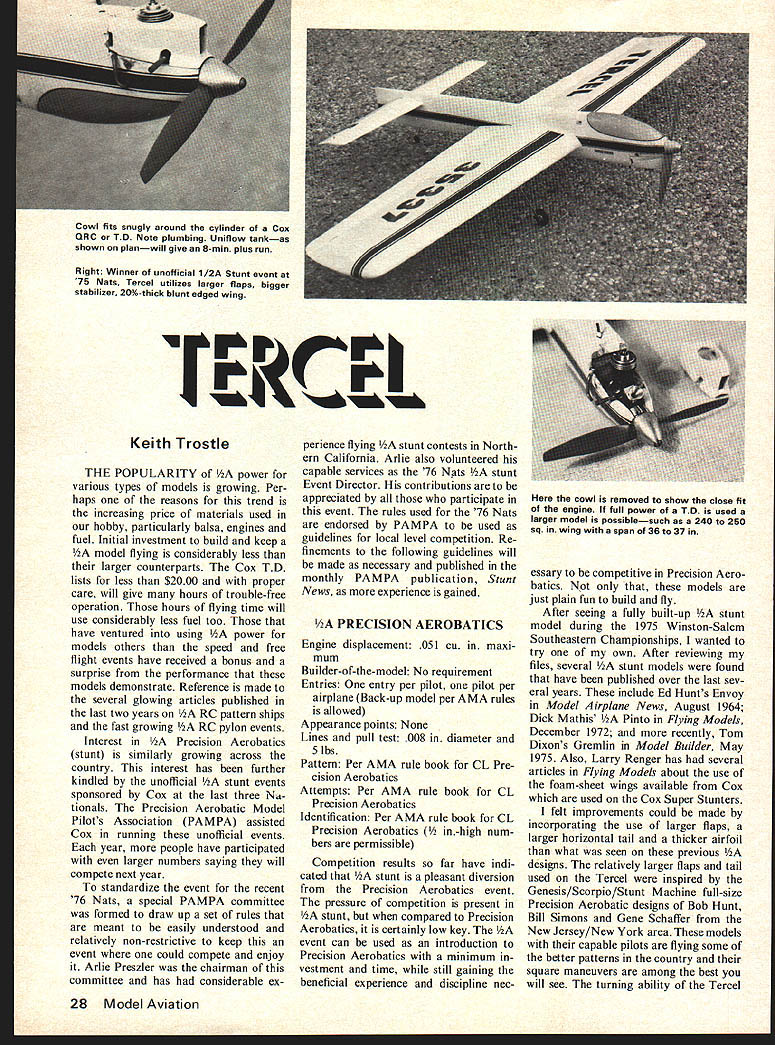
After seeing a fully built-up 1/2A stunt model during the 1975 Winston-Salem Southeastern Championships, I wanted to try my own. After reviewing my files, several 1/2A stunt models were found that have been published over the last several years. These include Ed Hunt's Envoy in Model Airplane News, August 1964; Dick Mathis' Pinto in Flying Models, December 1972; and more recently Tom Dixon's Gremlin in Model Builder, May 1975. Also, Larry Renger has had several articles in Flying Models about the use of foam-sheet wings available from Cox which are used on the Cox Super Stunters. I felt improvements could be made incorporating the use of larger flaps, a larger horizontal tail and a thicker airfoil than what was seen on these previous 1/2A designs. The relatively larger flaps and tail used on the Tercel were inspired by the Genesis/Scorpio/Stunt Machine full-size Precision Aerobatic designs of Bob Hunt, Bill Simons and Gene Schaffer from the New Jersey/New York area. These models, with their capable pilots, are flying some of the better patterns in the country and their square maneuvers are among the best you will see. The turning ability of the Tercel has certainly confirmed this approach. I strongly believe in thick, blunt airfoils for Precision Aerobatics. The airfoil shown for this design is 20% thick (including flaps) and is similar to Bart Klapinski's 1967 Nats winning Tempest which is quite popular on the West Coast. The size of the wing was determined as an approximate average of the existing 1/2A stunt designs.
The lack of a vertical tail may appeal to some. This concept was taken from the trend seen for a while from the East Coast as an attempt to improve the impression of turning sharper corners by keeping a straight fuselage with a low profile. The use of a vertical tail on your Tercel may improve the handling characteristics in the vertical maneuvers and is recommended if you feel the appearance of the model would be enhanced.
The model shown on the plans is easily adaptable to a profile type fuselage. A piece of carefully selected 3/32" sheet balsa with 1/32" plywood doublers is recommended. The aft fuselage width should be tapered from just forward of the flap hinge line to be no more than 3/16" at the stabilizer hinge line to reduce weight as much as possible.
No claim is made that this is the ultimate in 1/2A stunt design. We will probably never see such a model. I do feel that the design presented here offers some advancement over previous 1/2A models. Its performance can be termed as satisfactory as demonstrated by its win at the '75 Nats unofficial event. But the performance of these 1/2A stunt models, particularly in the wind, cannot yet compare to the current .35-.46-powered Precision Aerobatics designs. In time, improvements may be made where we will see 1/2A Precision Aerobatic models competitive with the larger models. We may not be too far away from that now under certain conditions.
There is much to be learned yet as to the optimum size for 1/2A stunt. The Tercel can be flown with the Cox QRC .049. Using the full power available from the Cox T.D., a larger model could be considered. How much larger or if performance would be enhanced, is not known. A 240 to 250 sq. in. wing with a 36 or 37 in. span is feasible, but weight must be kept to an absolute minimum. Probably some improvement could be realized after some experimentation with airfoil sections. A 22% thick section could be considered. A section similar to those Al Rabe uses on his Mustang (American Modeler, February 1973) and his successful super semi-scale stunter should be explored. Your own design philosophies can be experimented with and proven (or disproven) considerably easier, cheaper and quicker on these 1/2A models than with the larger models.
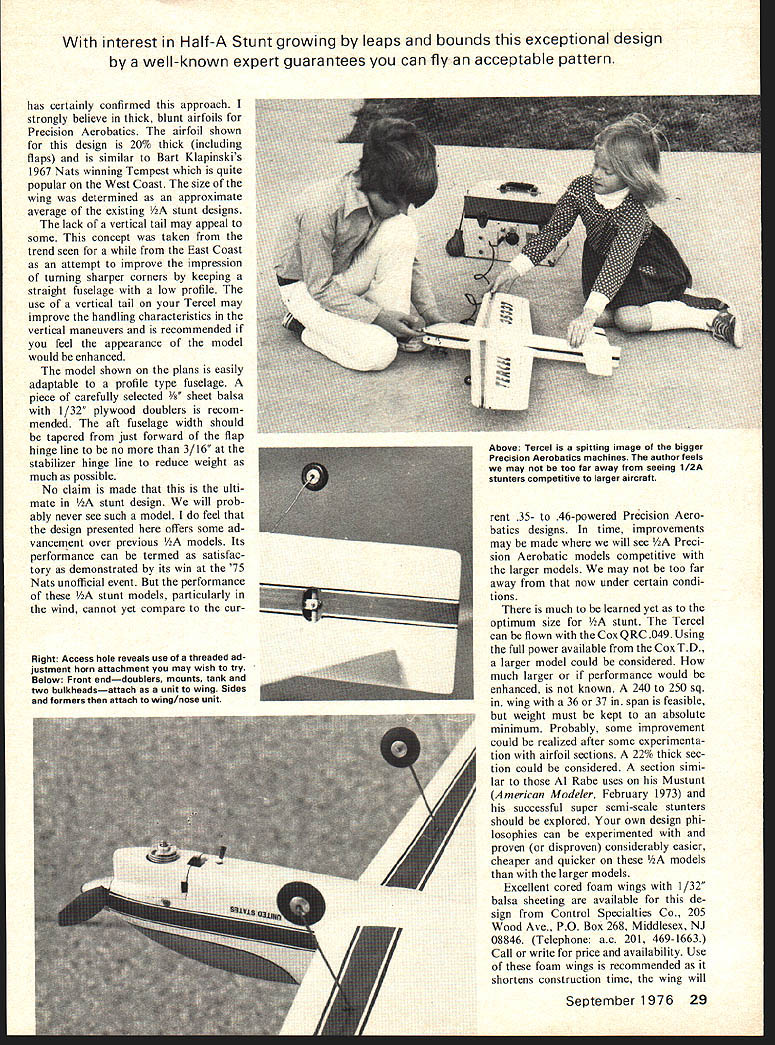
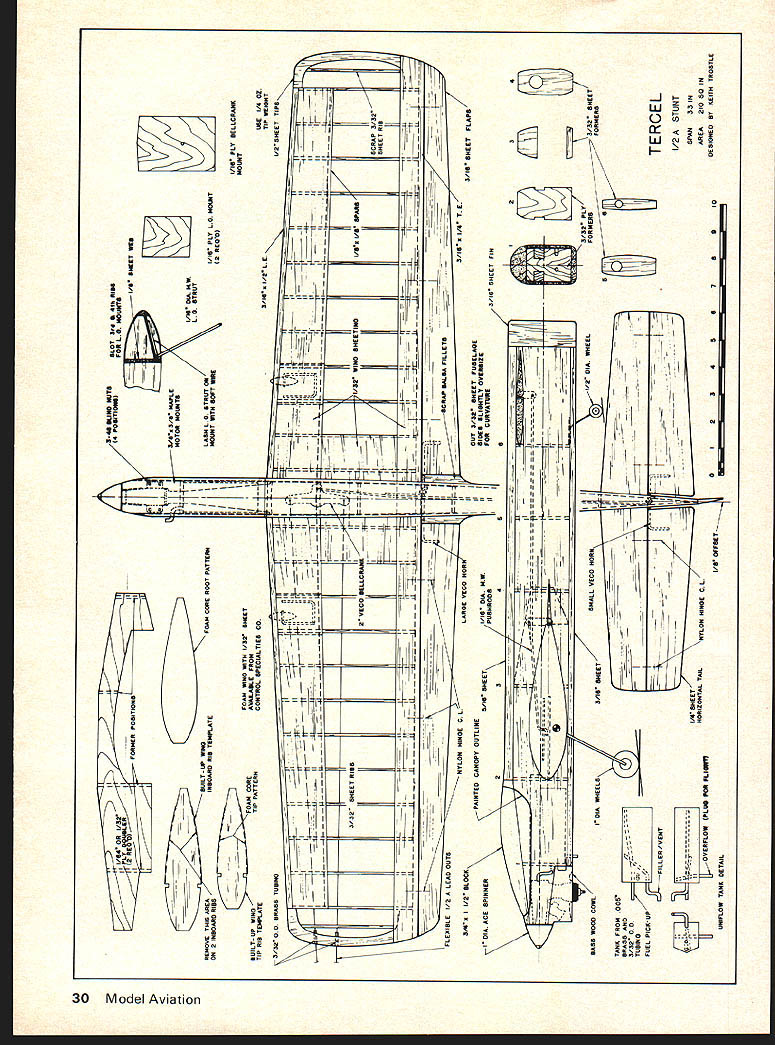
Excellent cored foam wings with 1/32" balsa sheeting are available for this design from Control Specialties Co., 205 Wood Ave., P.O. Box 268, Middlesex, N.J. 08846. (Telephone: ac. 201, 469-1663.) Call or write for price and availability. Use of these foam wings is recommended as it shortens construction time, the wing will become rigid and provide a perfect airfoil section. As built, the version shown weighed 12.5 oz. ready to fly with tank, muffler, prop, etc., and flew very well. The heavier the model gets, the worse it will be in wind. No primary article text found on this page — it contains only the Tercel plan/diagram and component labels. Minimum weight is important for a model of this size. The power available for the wing area is considerably less than the full-size competition stunt model. This must be offset by a much lighter wing loading and a more favorable power-to-weight ratio. The original Tercel weighs 10-1/2 ounces. Twelve ounces should be the maximum weight to allow when constructing and finishing your model.
If you obtain the foam wings, follow the instructions provided for bellcrank installation and wing assembly. If you construct the built-up wing, sandwich 10 pieces of 3/32" sheet balsa between the root and tip rib patterns and shape the ribs. Do this for the left and right wing panels. Assemble the ribs, spars, and leading and trailing edges over the plans, ensuring that no warps are built into the wing. Shape the trailing edge and add the 1/32" trailing edge sheets. Install the bellcrank, bellcrank mount, pushrod, leadouts and add the flaps. Lash the landing gear struts on the landing gear mounts with soft wire and install the assembly on the third and fourth ribs. A 1/8" balsa web from the landing gear mount to the top spar is recommended. Sheet the leading edge and center section. Add the tips and shape the leading edge and tips.
Cut and shape the horizontal tail parts. Add the horn and assemble the elevators to the stabilizer.
Assemble the nose unit consisting of doublers, motor mounts, tank and the first two formers as one unit with epoxy. Epoxy this unit to the wing, making sure that proper alignment of the thrust line is maintained. Assemble the fuselage sides and formers to the nose/wing assembly, making sure that the fuselage is straight. Add the horizontal tail assembly, checking that zero incidence to the wing is maintained. Add the tail wheel strut, top and bottom fuselage blocks, fillets and the fin. Shape and sand the fuselage to the desired cross section. The cowl is carved from a piece of basswood or hard balsa.
Finish on the original was kept to a minimum to reduce weight. Two coats of Sig Clear Lite Coat were brushed on the entire structure and sanded. The wings (not the flaps) were covered with Japanese tissue and given 4 coats of thinned clear dope. Several coats of sanding sealer were brushed on the fuselage, flaps, and tail; sanding between each coat until the grain began to disappear. Two coats of color were then sprayed and trim added.
Tercel
little more work and only a small penalty in weight, one of these models can be made to look as good as the full-scale stunters.
The tank shown is large enough to give an engine run of well over 8 min. You may desire to make the tank 1/4 to 3/8" shorter to keep the engine run within the 8-min. limit so you do not have to measure fuel when flying in competition. The uniflow tank shown on the plan has given very satisfactory performance.
The flap/elevator movement on the original model was first set up with a one-to-one ratio. During flight testing, the large flaps appeared to create excessive drag during the maneuvers. The flap/elevator movement was changed to the two-to-three ratio shown on the plans. This works better as these flaps with smaller deflections appear to increase lift sufficiently for square corners while not building up excessive drag. The original Tercel was constructed with an adjustable elevator horn using the Du-Bro "Swiv-Link" and has worked satisfactorily after many flights. I have found that an adjustable flap/elevator ratio and an elevator trim capability allows adjustments for fine tuning can improve the flying characteristics of any stunt model.
The balance point should not be further aft than the position shown on the plans. The model is very sensitive at this balance point. If you are wanting to use your model as a trainer to learn stunt pattern fundamentals, a more forward CG location is recommended. The leadout positions shown on the plans are satisfactory in most wind conditions that you would want to fly, though you may want to use some method to adjust leadout positions.
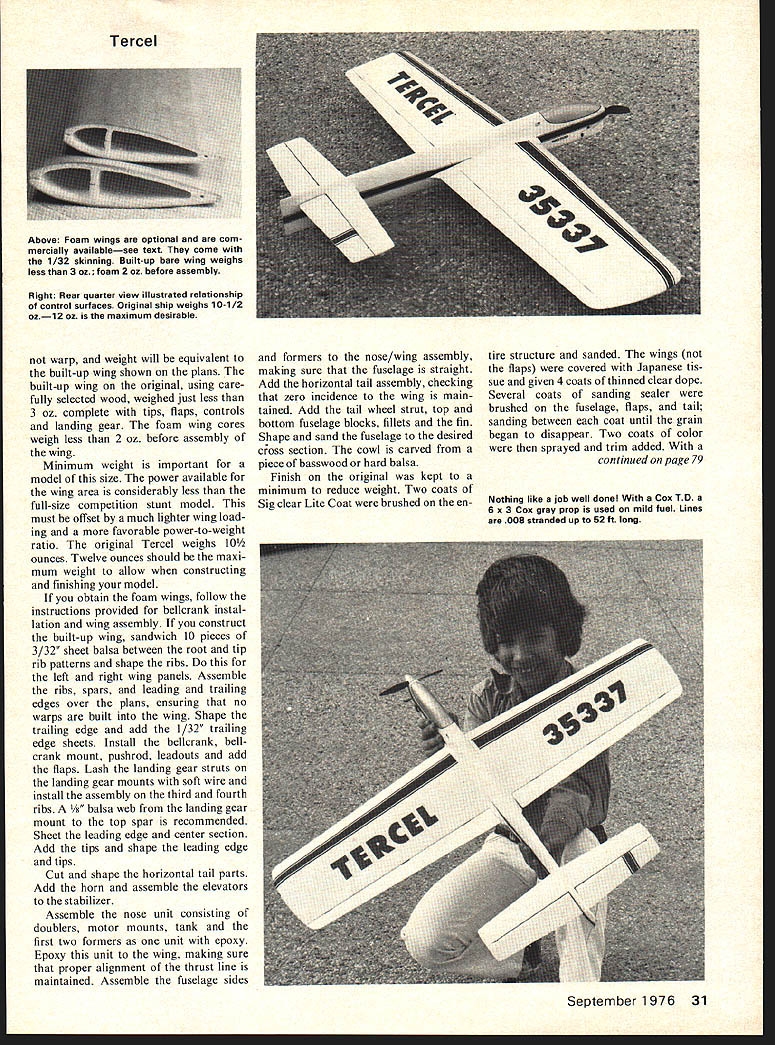
I have used the Cox handle and recommend that the line spacing at the handle not be more than 1 3/8 in. For less experienced fliers, a line spacing of 1 1/4 to 1 1/2 in. is recommended. With mild fuel (10% nitro or less), 0.008" diameter stranded lines of up to 52 ft. can be used. These cables are available from Sig and Pylon. If you cannot obtain lines from your dealer, X-Cell Models Inc., 347 Eastland Shopping Center, Lexington, KY 40505, can be contacted for prices and availability.
Flying these models is a new experience. They do not have the booming horsepower of the larger competition models and line tension is considerably less. However, rotational speed on 45- to 50-ft. lines is about the same as for the larger models. Your Tercel can be a useful tool to sharpen reflexes as its response is very quick.
If you have not yet looked it up, a Tercel is a male hawk, in particular a peregrine falcon.
If you are interested in Control Line Precision Aerobatics and want to keep informed of the latest happenings on the competition scene, you should consider joining the Precision Aerobatics Model Pilot's Association which is dedicated to the promotion of CL Precision Aerobatics. Annual dues for membership, which includes the monthly newsletter, are $6.00, in care of Wynn Paul, 1630 Maywick Dr., Lexington, KY 40504.
My address is: Keith Trostle, 10900 Phillips Dr., Upper Marlboro, MD 20770.
Transcribed from original scans by AI. Minor OCR errors may remain.

