
Richard Weber
test your muffler pressure
How do you know your muffler pressure is working properly? Check it with this makeshift manometer.
MANY PEOPLE are using muffler pressure with their fuel tanks. This provides a simple way to assist carburetor fuel draw. It reduces the percentage variation in fuel pressure at the carburetor which arises from climbing and diving, thereby maintaining a more constant fuel-air mixture. For muffler pressure to work properly it must be higher than atmospheric pressure.
This may not be the case for mufflers at all rpm. I have seen several instances of mufflers which produce suction at the pressure tap for certain rpm. Their owners were quite perplexed about why the engines would die lean after one or two minutes in the air. One flier had set the mixture rich enough to keep running, but got very short runs; evidently part of the fuel was being sucked directly from the fuel tank to the muffler, perhaps by temporarily collapsing the fuel tank.
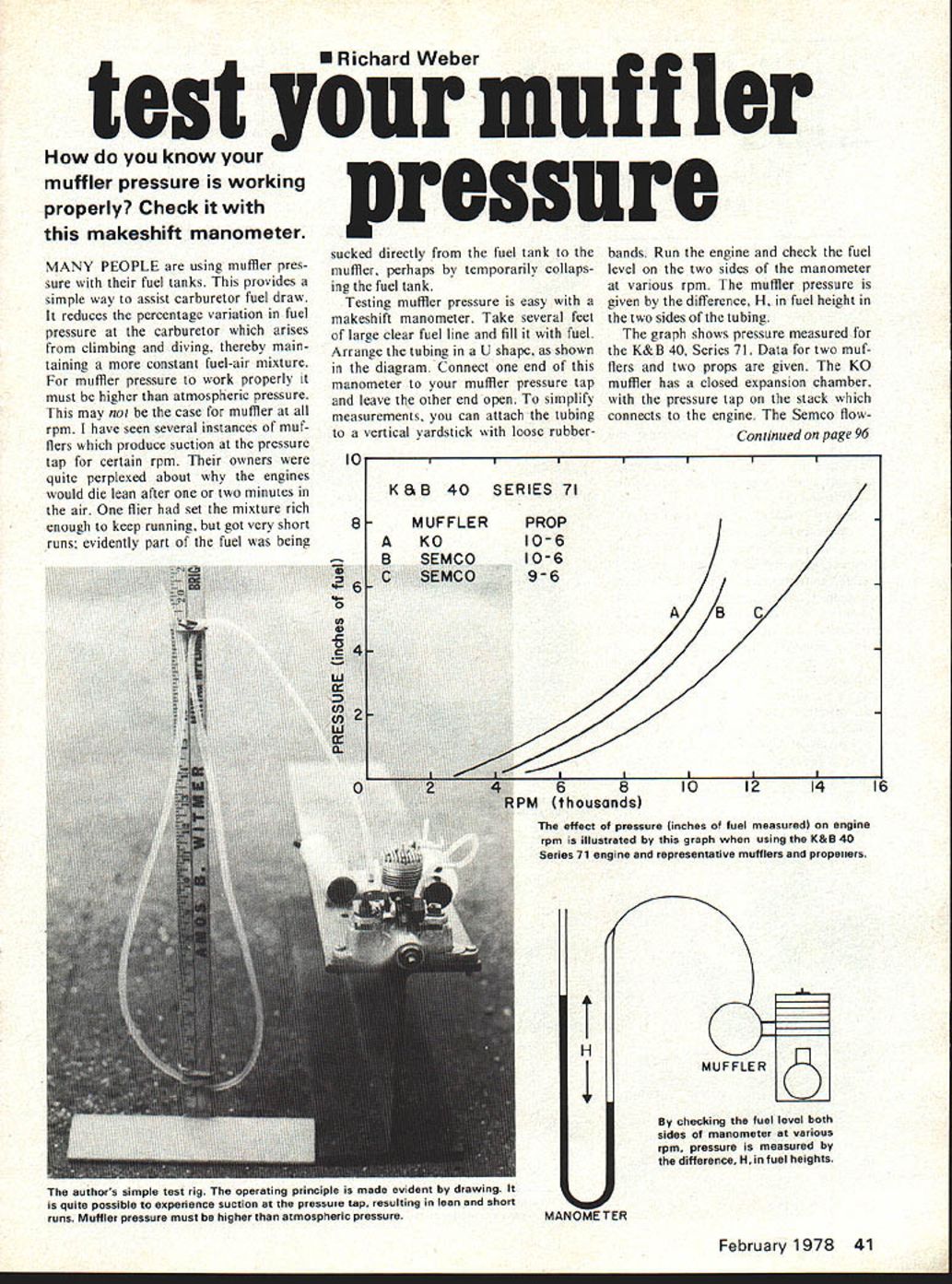
Testing muffler pressure is easy with a makeshift manometer. Take several feet of large clear fuel line and fill it with fuel. Arrange the tubing in a U shape, as shown in the diagram. Connect one end of the manometer to your muffler pressure tap and leave the other end open. To simplify measurements, you can attach the tubing to a vertical yardstick with loose rubber bands. Run the engine and check the fuel level on the two sides of the manometer at various rpm. The muffler pressure is given by the difference, H, in fuel height in the two sides of the tubing.
The graph shows pressure measured for the K & B 40, Series 71. Data for two mufflers and two props are given. The KO muffler has a closed expansion chamber, with the pressure tap on the stack which connects to the engine. The Semco flow through the muffler has the pressure tap on the main body. From the graph it can be seen that the expansion chamber supplies more pressure than the flow-through. The other comparison, between a 10-6 and a 9-6 on the Semco, shows more pressure at a given rpm for the 10-6, but at full throttle the pressure is slightly higher with the 9-6.
When testing muffler pressure with the manometer, the fuel level should be higher on the open side of the U, which indicates muffler pressure exceeding atmospheric pressure. If the fuel level is higher on the muffler side of the U, the muffler has suction instead of positive pressure. To solve this problem, try a different location for your pressure tap, get a different muffler, or just forget about using muffler pressure. A muffler which behaves well will show positive pressure at all rpm, increasing at higher rpm, as found for the examples in the graph.
This same simple manometer setup can also be used to check other pressures, such as crankcase pressure or fuel pump pressure.
Transcribed from original scans by AI. Minor OCR errors may remain.

