
Testing your engine’s performance
What really goes on with engines when they are tearing around the skies? I have always wondered. Have you?
For more years than I want to reveal, I have read the various “engine columns” of my heroes, many of whom I consider to be legends in their own time. When I was asked to do “The Engine Shop,” I was uncertain whether I could meet their levels of excellence and technical knowledge about things such as metallurgy. I was sure I couldn’t replicate their efforts.
I started thinking about what the new generation of RC pilots wants or needs to know and maybe things they might not yet know. When it comes to engines, there is much misunderstanding about propellers, airspeed, climb rates, etc. I see it regularly. I visit a large number of flying sites in my travels and see engine/fuel/propeller “folklore” in action.
This gave me the idea of testing engines in a slightly different manner than the customary bench-running method. There is no doubt that running engines on test stands with different propellers satisfies a certain appetite for information, but does it really tell you what will happen in the air?
Testing
Airborne performance has been difficult to measure and the data equally hard to collect. There are some good systems available, but none are as easy to use as the Spektrum telemetry system. This new technology became a game changer when it came with the DX8.
Spektrum and its telemetry have now made it easy to set up and capture data while you fly. Throw in an iPhone with a plug-in Spektrum receiver module, and the Spektrum STi app, and it becomes cool indeed. Not only cool, but you can use any JR or Spektrum transmitter and receiver with a data-port socket.
Some of you may have read about the engine test that I did on the O.S. FS-95V. It was cold at that time of the year, so I rigged the engine test stand with a DX8, a throttle servo, a receiver, and a telemetry module. This allowed me to monitor all of the necessary bench-run data from the warmth of my van!
The free Spektrum STi iPhone app is easy to read and records data that you can review later. For what I had in mind, I snagged a volunteer to write down all of the data as it happened on the ground, and as I flew certain speed and climb tests.
The basic plan was to read engine-performance data on the ground and in the air. This was later expanded to include flight performance such as airspeed and altitude change.
The main idea was to see the difference in engine behavior between running on the ground and running in the air.
I am inviting RC pilots to try this at home by explaining how easy it is! The equipment is readily available and easy to set up.
The First Try
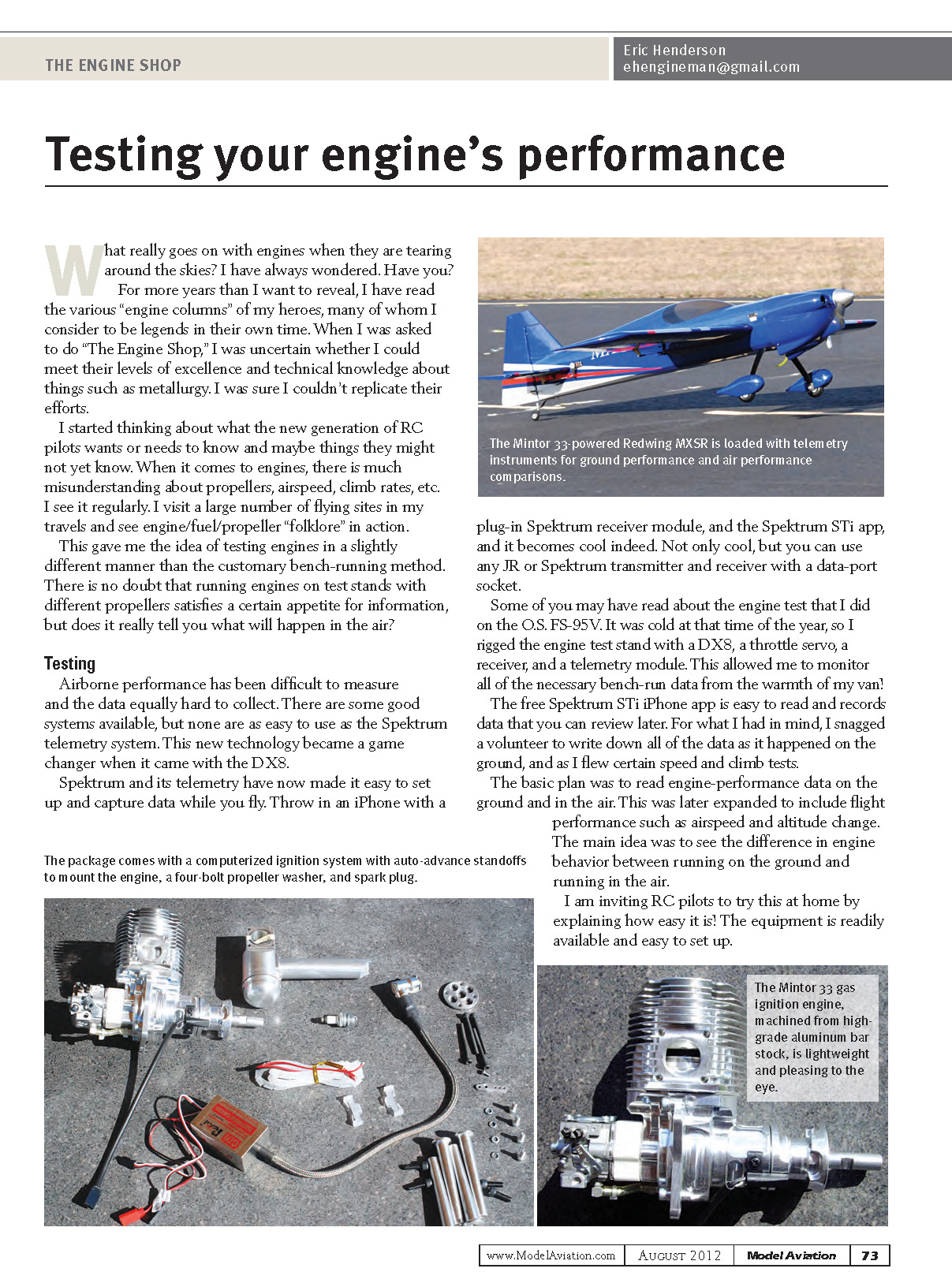
For my first foray into flight comparison data collection, I chose the Redwing RC MXSR aerobatic airplane that I had recently reviewed, using the Mintor 33cc gas ignition engine imported by Top Dawg Aviation. (Different airplanes will give different results; a scale biplane will have more aerodynamic drag, but could be lighter.)
I measured the receiver and ignition pack voltages and looked for radio communication losses that could have been caused by things such as the ignition systems. However, the main impetus of these tests was to measure head temperature, rpm on the ground, and rpm changes in the air.
The goal was to obtain meaningful comparative data. As with all testing, the methodology will have some flaws. There is some inherent delay in the telemetry readings on the iPhone. Whenever possible, I allowed sufficient time for the readings to stabilize before they were recorded.
Airspeed was measured with the aircraft flying straight and level with a non-diving entry, in both wind directions. Level flight was maintained for more than 200 yards. The head temperatures and rpm had similar durations and were recorded when steady.
Recording consisted of a volunteer, a ballpoint pen, and my printed data sheet. This is not true empirical data, but it was done the same way for each propeller and is reasonably accurate as comparison data.
I should apologize to Top Dawg Aviation for abusing the company's lovely little engine, and to RedwingRC for being mean to its excellent 3-D airplane, but I found out what I always wanted to know!
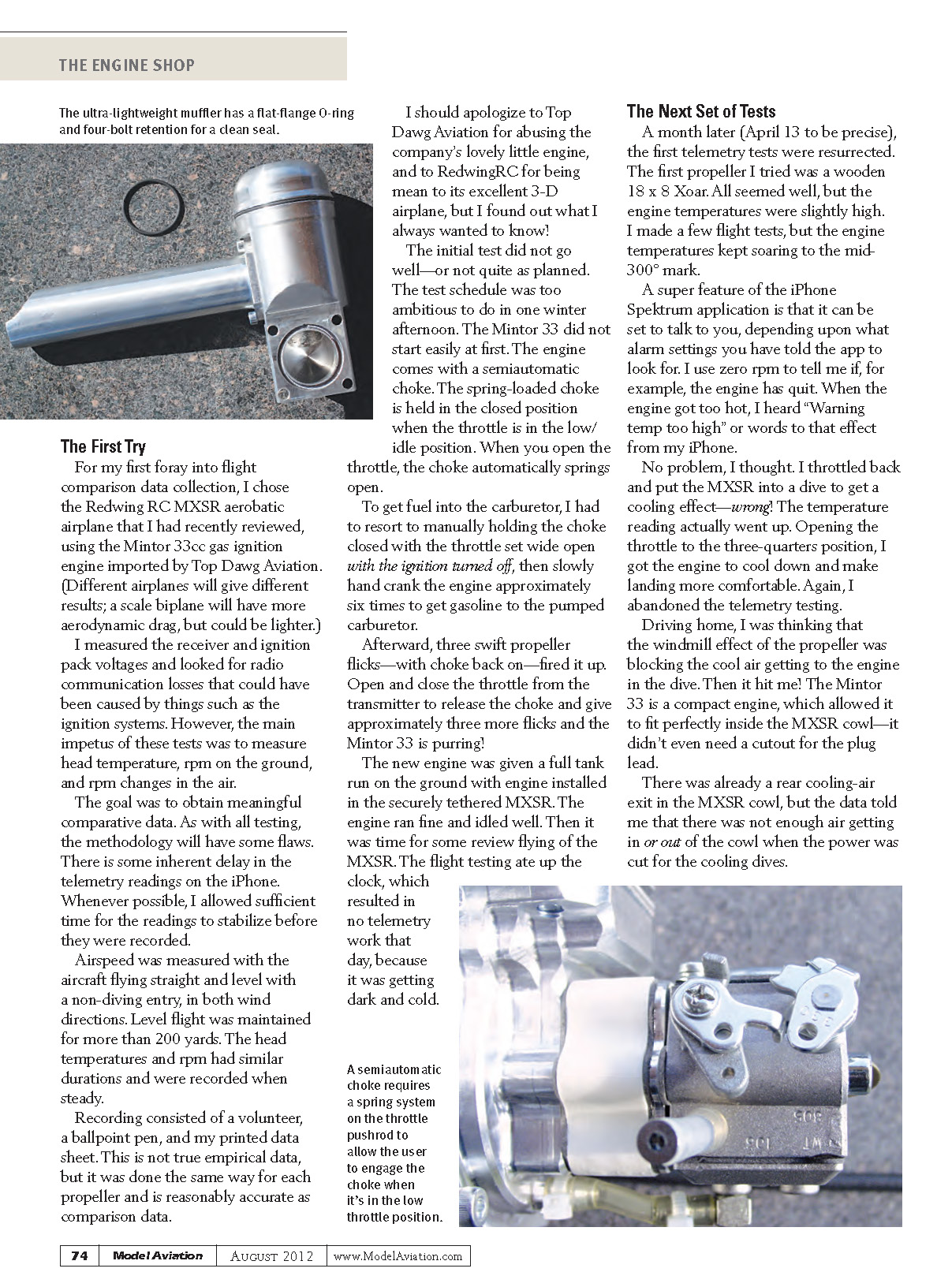
The initial test did not go well—or not quite as planned. The test schedule was too ambitious to do in one winter afternoon. The Mintor 33 did not start easily at first. The engine comes with a semiautomatic choke. The spring-loaded choke is held in the closed position when the throttle is in the low/idle position. When you open the throttle, the choke automatically springs open.
To get fuel into the carburetor, I had to resort to manually holding the choke closed with the throttle set wide open with the ignition turned off, then slowly hand-crank the engine approximately six times to get gasoline to the pumped carburetor.
Afterward, three swift propeller flicks—with choke back on—fired it up. Open and close the throttle from the transmitter to release the choke and give approximately three more flicks and the Mintor 33 is purring!
The new engine was given a full-tank run on the ground with the engine installed in the securely tethered MXSR. The engine ran fine and idled well. Then it was time for some review flying of the MXSR. The flight testing ate up the clock, which resulted in no telemetry work that day, because it was getting dark and cold.
The Next Set of Tests
A month later (April 13, to be precise), the first telemetry tests were resurrected. The first propeller I tried was a wooden 18 x 8 Xoar. All seemed well, but the engine temperatures were slightly high. I made a few flight tests, but the engine temperatures kept soaring to the mid-300° mark.
A super feature of the iPhone Spektrum application is that it can be set to talk to you, depending upon what alarm settings you have told the app to look for. I use zero rpm to tell me if, for example, the engine has quit. When the engine got too hot, I heard "Warning temp too high" or words to that effect from my iPhone.
No problem, I thought. I throttled back and put the MXSR into a dive to get a cooling effect—wrong! The temperature reading actually went up. Opening the throttle to the three-quarters position, I got the engine to cool down and make landing more comfortable. Again, I abandoned the telemetry testing.
Driving home, I was thinking that the windmill effect of the propeller was blocking the cool air getting to the engine in the dive. Then it hit me! The Mintor 33 is a compact engine, which allowed it to fit perfectly inside the MXSR cowl—it didn't even need a cutout for the plug lead.
There was already a rear cooling-air exit in the MXSR cowl, but the data told me that there was not enough air getting in or out of the cowl when the power was cut for the cooling dives. An appointment was made with "Captain Dremel," and soon a cutout in the cowl gave three times more air-exit area than air-entry openings.
I think that I hurt the Mintor 33 during the early flight tests, but then I remembered how cold it had been. The engine handled my abuse without any problems.
A New Dawn and a New Day
The next test session was satisfactory. This time the Mintor 33 did not need the carburetor to be primed and I started the engine with three flips and opened the throttle, but the engine stopped because of the choke's auto release when I applied some throttle.
Engine temperature readings stayed at or below the 200° mark and started to make sense. The increased cooling air—inflight versus on the ground—was effective. I was still using break-in fuel and because the Mintor 33 was now cooler and happier, I elected to proceed with some more serious test work.
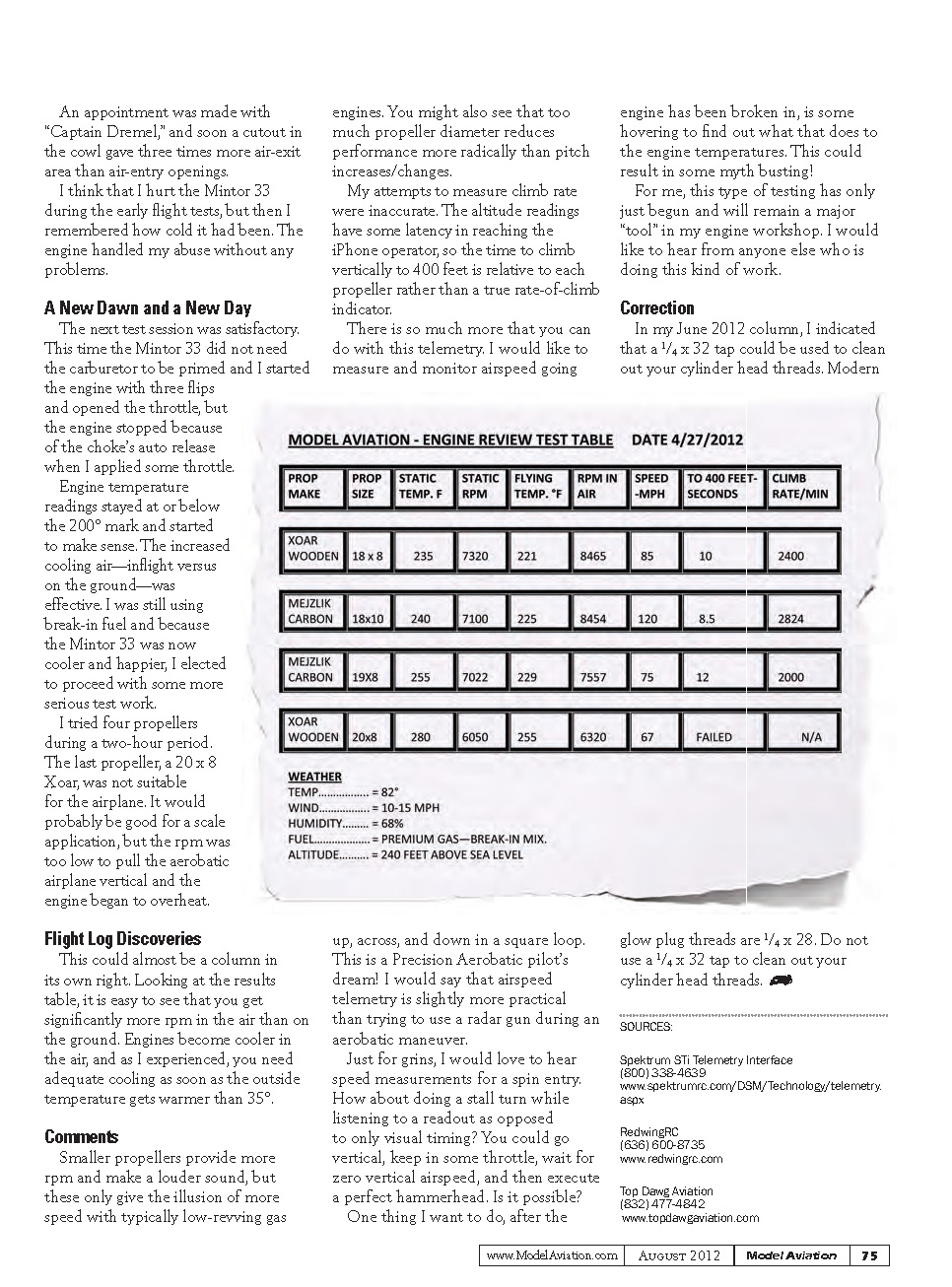
I tried four propellers during a two-hour period. The last propeller, a 20 x 8 Xoar, was not suitable for the airplane. It would probably be good for a scale application, but the rpm was too low to pull the aerobatic airplane vertical and the engine began to overheat.
Flight Log Discoveries
This could almost be a column in its own right. Looking at the results table, it is easy to see that you get significantly more rpm in the air than on the ground. Engines become cooler in the air, and as I experienced, you need adequate cooling as soon as the outside temperature gets warmer than 35°.
Comments
Smaller propellers provide more rpm and make a louder sound, but these only give the illusion of more speed with typically low-revving gas engines. You might also see that too much propeller diameter reduces performance more radically than pitch increases/changes.
My attempts to measure climb rate were inaccurate. The altitude readings have some latency in reaching the iPhone operator, so the time to climb vertically to 400 feet is relative to each propeller rather than a true rate-of-climb indicator.
There is so much more that you can do with this telemetry. I would like to measure and monitor airspeed going up, across, and down in a square loop. This is a Precision Aerobatic pilot's dream! I would say that airspeed telemetry is slightly more practical than trying to use a radar gun during an aerobatic maneuver.
Just for grins, I would love to hear speed measurements for a spin entry. How about doing a stall turn while listening to a readout as opposed to only visual timing? You could go vertical, keep in some throttle, wait for zero vertical airspeed, and then execute a perfect hammerhead. Is it possible?
One thing I want to do, after the engine has been broken in, is some hovering to find out what that does to the engine temperatures. This could result in some myth busting!
For me, this type of testing has only just begun and will remain a major "tool" in my engine workshop. I would like to hear from anyone else who is doing this kind of work.
Correction
In my June 2012 column, I indicated that a 1/4 x 32 tap could be used to clean out your cylinder head threads. Modern glow plug threads are 1/4 x 28. Do not use a 1/4 x 32 tap to clean out your cylinder head threads.
Sources
- Spektrum STi Telemetry Interface
(800) 338-4639 www.spektrumrc.com/DSM/Technology/telemetry.aspx
- RedwingRC
(636) 600-8735 www.redwingrc.com
- Top Dawg Aviation
(832) 477-4842 www.topdawgaviation.com
Transcribed from original scans by AI. Minor OCR errors may remain.

