
Texas Quickie Rat
It doesn't take super-quick speeds to make racing fun. What it does take is close competition and good flier turnout. This new experimental category—already being flown in various forms around the country—and to be unofficially flown at this year's Nats for the first time, may be the vehicle to put the fun and numbers back into Control Line racing. — Frank Williams
Background
Three-up racing with Control Line models is without a doubt one of the most exciting forms of model aircraft competition. Twenty-five years ago, when Control Line flying was flourishing, Rat Racing attracted competitors from all areas of modeling. Even though there was only one form of racing, it often took all day to run the event because of the many entries. The planes could be built and flown by the average modeler, and he didn't need an engineering degree to design the workings or muscles like Charles Atlas to fly them. Things were just simpler.
Unfortunately, we outdid ourselves striving for more horsepower, cleaner, faster airplanes. Never daring to take a step backward, we went faster and faster, finally arriving at "two-up speed." It's interesting that RC has become so popular in recent years and has drawn away many of our competitors. That shift has affected CL racing participation.
What we need is to get back to basics—to racing that emphasizes the sport of racing. We need races like we had 25 years ago: races that could be flown three- and four-up, and planes that didn't necessarily take a special pilot to handle. Races flown three-up will be physically within the reach of most people, and with thoughtful attention to the rules we can legislate a simple airframe and build around inexpensive, available engines. This kind of racing promotes success and broad participation.
Every area of the country has attempted to do this in one form or another, developing local "sport race" events to provide not only an entry-level racing event but also a format for up-and-coming racers and all skill levels to enjoy. Northwest Sport Race, Florida Slow Rat, ACLA Slow Rat, Fox Goldberg, Midwest Sport Race, Big Goodyear, Formula Unlimited, and Texas Quickie Rat evolved to fill this need. All have proven successful for the most part.
The Texas Quickie Rat
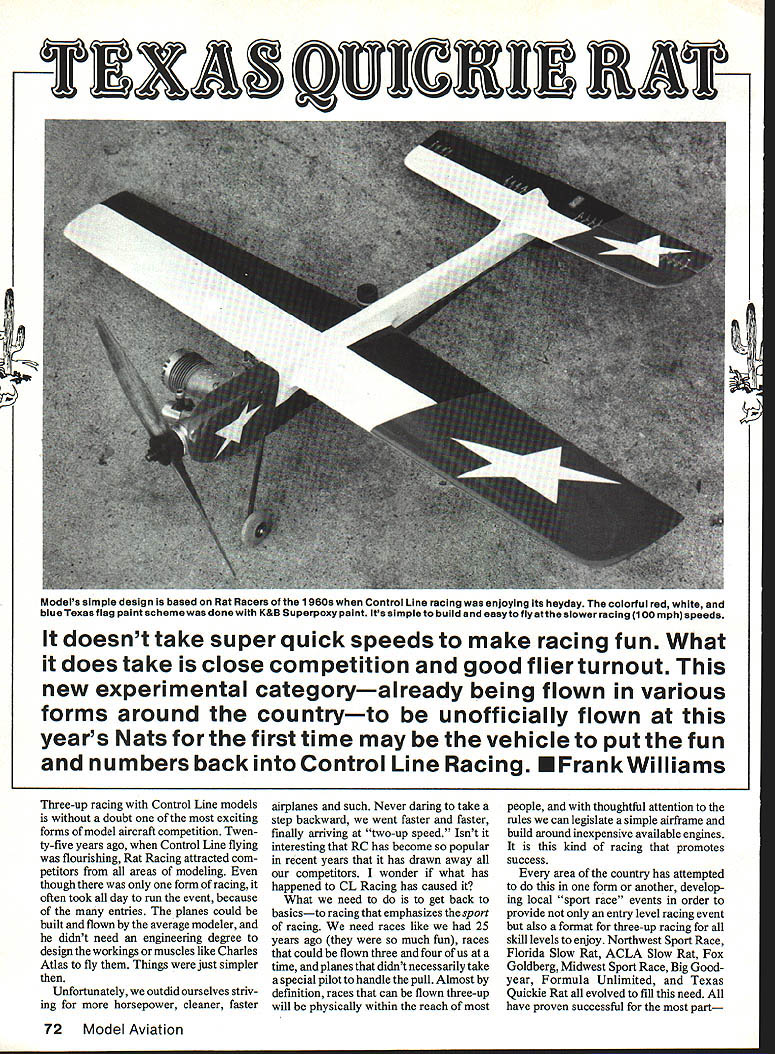
The Texas Quickie Rat evolved to fill the need and has proven successful as part of the sport-racing movement. The model's simple design is based on Rat Racers of the 1960s when Control Line racing enjoyed its heyday. The colorful red, white, and blue Texas-flag paint scheme was done with K&B Superpoxy paint. It's simple to build and easy to fly at the slower racing speeds (about 100 mph).
Quickie Rat is the most popular form of Control Line racing in the Texas/Louisiana area, and contest participation has grown every season. Many "crossovers" from Stunt and Combat enjoy racing and call Quickie their second event. At the same time we have several national-level racing competitors who spend more of their time practicing and working with Quickie than with their Fast Rats and Goodyears. The appeal of the event spans from beginner to expert.
One thing that makes local events work is that changing the rules is simpler. When a "trick" emerges that pushes up airspeed or technology, local elders can get together on the field and say, "Don't do that—from now on that's not legal."
We have also benefited from looking at AMA Slow Rat, Goodyear, and Fast Rat, and have a fairly good idea what caused those events to escalate in speed and technology. So far we have been able to write the proper limitations into our rules to keep the events at the level we desire.
There are several things about Quickie Rat that make it a perfect event to promote success. First, the airplane itself is an attempt to legislate a 1960s Rat racer—simple to build, functional, and durable. The engine specification is based on a pool of inexpensive engines that are equal in power and ringed for easy starting. Finally, we recognized that simply saying "draw only" for the fuel system wasn't enough; something more was needed to keep things in the proper perspective.
Engine and Carburetor Specification
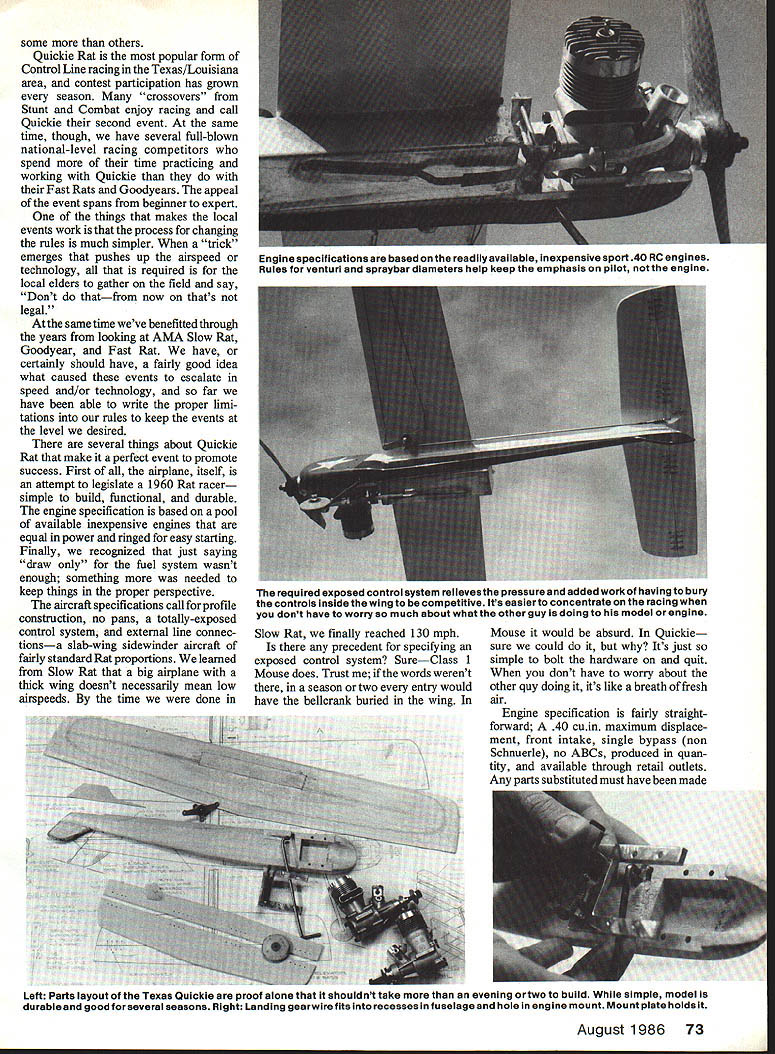
What we're taking advantage of is the wealth of inexpensive sport .40 RC engines. Examples include:
- K&B
- O.S.
- Enya
- Webra
- ST
Key engine requirements:
- Maximum displacement: .40 cu. in.
- Front intake.
- Single bypass (non-Schnuerle).
- No ABC (aluminum piston/cylinder) construction.
- Produced in quantity and available through retail outlets.
- Any substituted parts must have been made by the original engine manufacturer.
For sport-racing events, choosing an engine that is easy to start and maintain is important. Ringed engines generally start better in hot-pit situations than over-polished or tightly lapped engines. This class of ringed .40s has proven to be an excellent source of Control Line racing power: inexpensive (about $45–$65), easily available new and used, and reliable starters.
The problem with "draw only" racing is that competitors will keep drilling out the venturi to get more air until performance escalates beyond what is desired. That forces awkward pitting tactics and unreliable needle settings. To avoid this and to keep speeds in the 95–100 mph range, Quickie Rat specifies a maximum venturi bore and a minimum spraybar size. This limits power output while making the carburetor easy to needle on the ground.
For Quickie Rat the specification is:
- Venturi bore: .315 in. (about a 5/16 in. drill plus a little slop).
- Minimum spraybar diameter: .155 in., with the spraybar going through the center of the venturi.
- The rules prohibit introducing air into the engine by any passage other than the venturi and designate a minimum length above and below the spraybar that the specified bore must be maintained.
- Fuel: 10% nitro recommended for the event.
These requirements allow comfortable racing in the 100-mph range and provide a simple, reliable system that promotes success for competitors of all levels. Venturi regulation is common in many forms of internal combustion racing (e.g., carburetor plates in auto racing). Similar restrictions could allow three-up racing even for Fast Rats if desired—simply reduce the venturi bore a few thousandths if speeds climb too high.
Construction
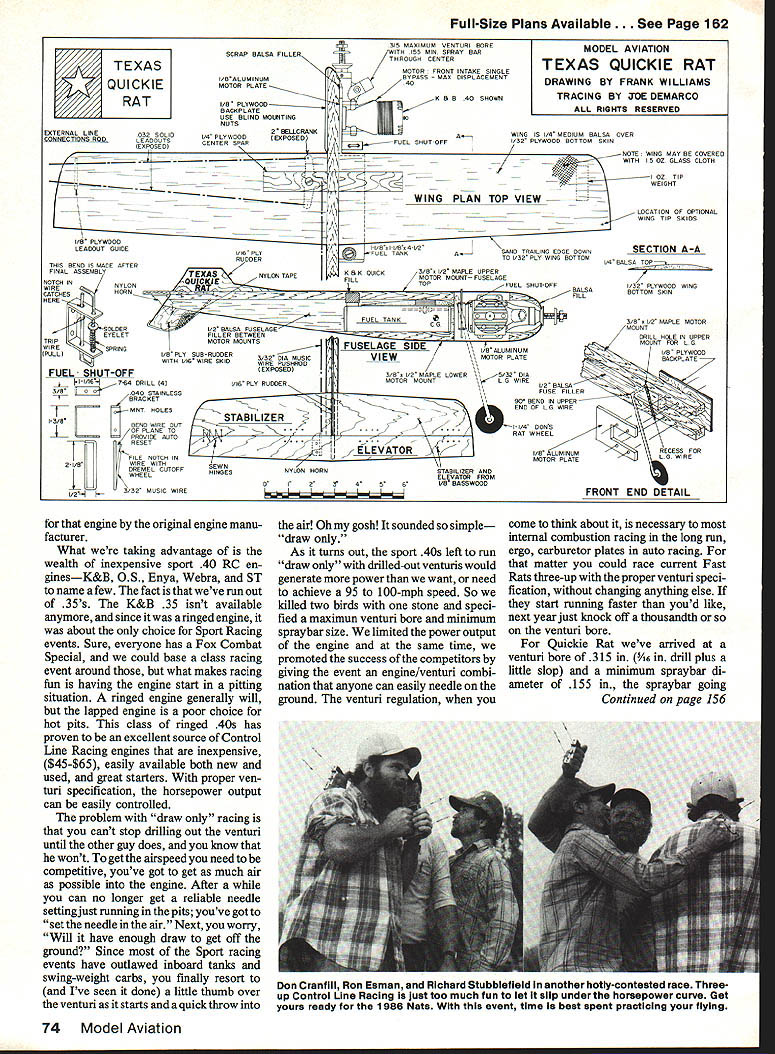
Construction of the airplane is straightforward and shouldn't take more than a couple of days for the basic airframe.
Wing:
- Epoxy (or Tite-Bond) a piece of 1/4-in. medium-to-firm balsa onto a continuous 1/32-in. plywood wing bottom. Do not butt two 12-in. pieces together at the center.
- Rout out the center of the balsa down to—but not through—the plywood, and insert a 1/4-in. plywood belly skin to mount the main spar with epoxy.
- After curing, sand the wing to shape, bringing the trailing edge down to the plywood skin. This yields a light, rigid wing with a trailing edge firm enough to grasp during pitting without damage.
- Rout a recess in the outboard tip and bury about 1 oz. of lead in the wing tip.
- Optional: cover the wing with 1.5-oz. glass cloth adhered with K&B Clear Superpoxy.
Notes: You can substitute 1/16-in. plywood for the wing bottom if you like, but 1/32-in. saves weight and works well.
Fuselage and engine mounts:
- The fuselage is a short evening's work. Engine mounts are built into the fuselage.
- Use a piece of 3/8 x 2 x 18-in. maple for the upper engine mount and a shorter piece for the lower mount.
- Fill between mounts with 1/2-in. balsa. Add a 1/8-in. plywood sub-rudder/tail skid and a piece of 1/8-in. plywood on the inboard side of the engine mount; finish with a power sander for fit.
- Rout a recess into the fuselage/engine mounts for the landing gear wire to lay into, and cut an engine plate from 3/8-in. aluminum to fit your engine.
- Bend the landing gear wire at the upper end so it fits into the upper engine mount; the bend will keep it from rotating and the aluminum plate holds it in place. 3/8-in. wire is used here, but 1/8-in. also works fine.
Tail surfaces and assembly:
- Stab and elevator: cut from 1/8-in. basswood. Sewn hinges are shown, but other hinge methods will work.
- Add a 1/8-in. plywood rudder if desired.
- Mount the wing and stab to the fuselage with liberal amounts of epoxy and nylon tape; check carefully for alignment. I prefer the wing to go through the fuselage rather than be mounted on top of the upper engine mount for greater strength and safety.
- Add a 1/8-in. plywood lead-out guide.
Finish:
- Give the whole airplane a couple of coats of K&B Superpoxy clear and set it aside to cure.
- Build a tank and a shutoff of your favorite type. I like using silicone sealer to attach the tank to the fuselage.
- Add tip skids if you prefer.
- Bolt on the bellcrank once the airframe is ready.
- Use hooks and rubber bands to hold the hatch for easy access; since we are not running pressure tanks, nylon tape is critical to secure components.
Durability: The planes are quite durable—one example has been used as a loaner for eight years.
Engine rework: With the intake restrictions, a new engine runs as well as anything else. You'd be better off spending time practicing racing and pitting than trying to polish, re-time, or heavily modify engines.
Racing, Rules, and Growth
Quickie Rat captures the excitement and fun of Control Line racing in an atmosphere that promotes success and appeals to all levels of competitors. Local rule changes can be made quickly when necessary to curb trick developments that push speeds or technology beyond the intended level.
The Clear Lake Line Winders plan to sponsor Quickie Rat as an unofficial event at the Lake Charles Nats this summer. If you're going to the Nats, come and race with us.
Conclusion
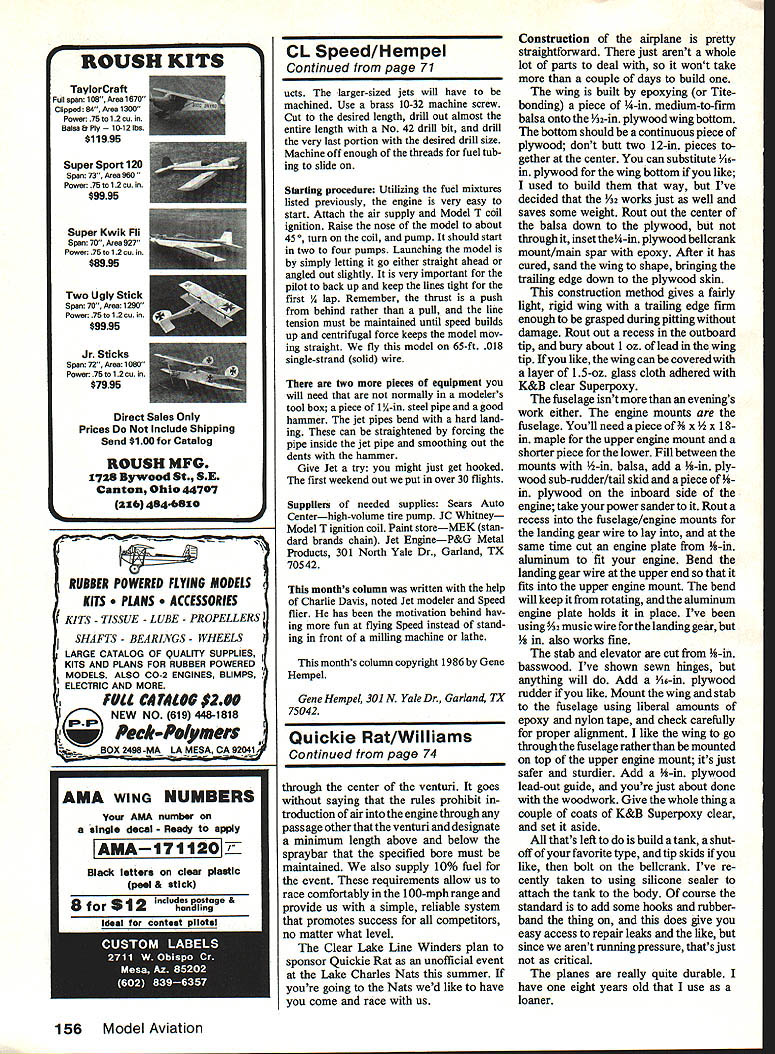
Three-up Control Line racing is too much fun to let slip away under the horsepower curve. Quickie Rat emphasizes simple, durable airframes, accessible engines, and sensible carburetor restrictions to keep speeds reasonable and competition close. The result is an event that is enjoyable, affordable, and welcoming to beginners and experts alike.
Contact
Frank Williams 710 Silverpines Houston, TX 77062 Phone: 713-488-1371
Transcribed from original scans by AI. Minor OCR errors may remain.

