
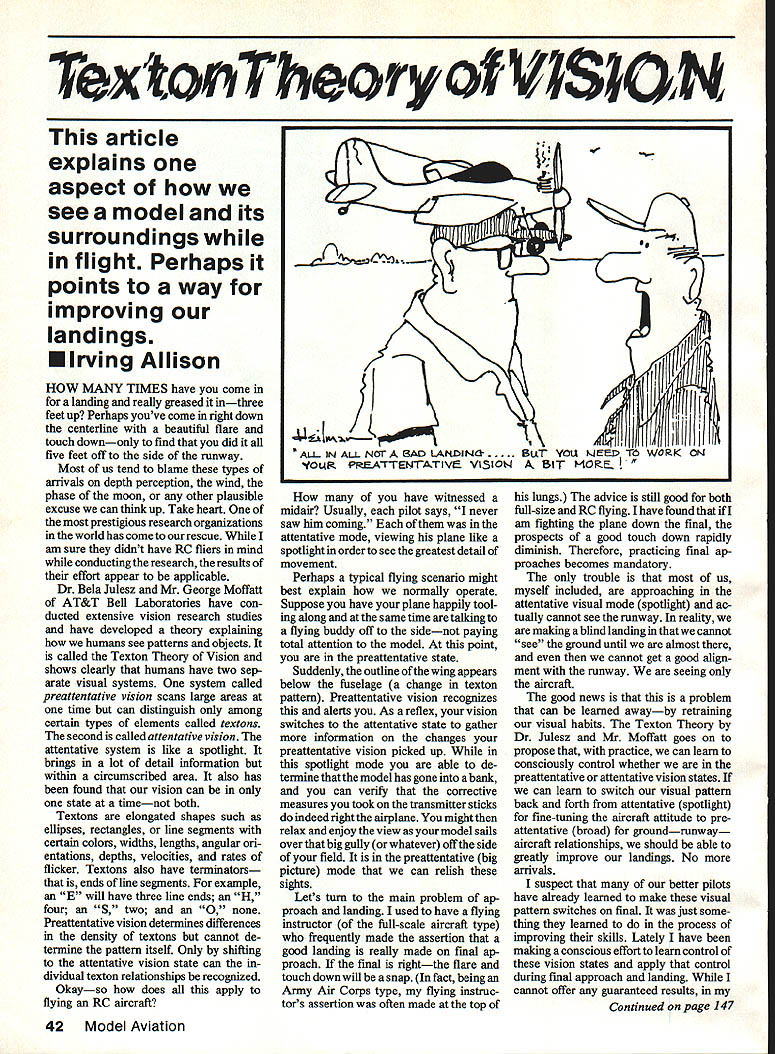
Texton Theory of VISION
By Irving Allison
This article explains one aspect of how we see a model and its surroundings while in flight. Perhaps it points to a way for improving our landings.
How many times have you come in for a landing and really greased it — three feet up? Perhaps you've come in right down the centerline with a beautiful flare and touchdown — only to find that you did it all five feet off to the side of the runway.
Most of us tend to blame these types of arrivals on depth perception, the wind, the phase of the moon, or any other plausible excuse we can think up. Take heart. One of the most prestigious research organizations in the world has come to our rescue. While I am sure they didn't have RC fliers in mind while conducting the research, the results of their effort appear to be applicable.
Dr. Bela Julesz and Mr. George Moffatt of AT&T Bell Laboratories have conducted extensive vision research studies and have developed a theory explaining how we humans see patterns and objects. It is called the Texton Theory of Vision and shows clearly that humans have two separate visual systems. One system, called preattentive vision, scans large areas at one time but can distinguish only among certain types of elements called textons. The second is called attentive vision. The attentive system is like a spotlight. It brings in a lot of detail information but within a circumscribed area. It also has been found that our vision can be in only one state at a time — not both.
Textons are elongated shapes such as ellipses, rectangles, or line segments with certain colors, widths, lengths, angular orientations, depths, velocities, and rates of flicker. Textons also have terminators — the ends of line segments. For example, an "E" will have three line ends; an "H", four; an "S", two; and an "O", none. Preattentive vision determines differences in the density of textons but cannot determine the pattern itself. Only by shifting to the attentive vision state can the individual texton relationships be recognized.
Application to RC Flying
How does all this apply to flying an RC aircraft?
How many of you have witnessed a midair? Usually, each pilot says, "I never saw him coming." Each of them was in the attentive mode, viewing his plane like a spotlight in order to see the greatest detail of movement.
A typical flying scenario might best explain how we normally operate. Suppose you have your plane happily tooling along and at the same time are talking to a flying buddy off to the side — not paying total attention to the model. At this point, you are in the preattentive state.
Suddenly, the outline of the wing appears below the fuselage (a change in texton pattern). Preattentive vision recognizes this and alerts you. As a reflex, your vision switches to the attentive state to gather more information on the change your preattentive vision picked up. While in this spotlight mode you are able to determine that the model has gone into a bank, and you can verify that the corrective measures you took on the transmitter sticks indeed righted the airplane. You might then relax and enjoy the view as your model sails over the big gully (or whatever) off the side of your field. It is in the preattentive (broad) mode that we can relish these sights.
Approach and Landing
Let's turn to the main problem of approach and landing. I used to have a flying instructor (of the full-scale aircraft type) who frequently made the assertion that a good landing is really made on final approach. If the final is right — the flare and touchdown will be a snap. (In fact, being an Army Air Corps type, my flying instructor's assertion was often made at the top of his lungs.) The advice is still good for both full-size and RC flying. I have found that if I am fighting the plane down the final, the prospects of a good touchdown rapidly diminish. Therefore, practicing final approaches becomes mandatory.
The only trouble is that most of us, myself included, are approaching in the attentive visual mode (spotlight) and actually cannot see the runway. In reality, we are making a blind landing in that we cannot "see" the ground until we are almost there, and even then we cannot get a good alignment with the runway. We are seeing only the aircraft.
Training Your Vision
The good news is that this is a problem that can be learned away — by retraining our visual habits. The Texton Theory by Dr. Julesz and Mr. Moffatt goes on to propose that, with practice, we can learn to consciously control whether we are in the preattentive or attentive vision states. If we can learn to switch our visual pattern back and forth from attentive (spotlight) for fine-tuning the aircraft attitude to preattentive (broad) for ground–runway–aircraft relationships, we should be able to greatly improve our landings. No more arrivals.
I suspect that many of our better pilots have already learned to make these visual pattern switches on final. It was just something they learned to do in the process of improving their skills. Lately I have been making a conscious effort to learn control of these vision states and apply that control during final approach and landing. While I cannot offer any guaranteed results, in my case the landings do seem to be more consistent and substantially improved.
For the purposes of this article I have left out large portions of this extraordinarily complex pattern-recognition study. I have used only those segments I feel to be directly applicable to the control of RC aircraft. For further information on the Texton Theory of Vision, please refer to the following publications.
References
- AT&T Bell Laboratories Record, May 1984, pp. 4–7.
- Bell System Technical Journal, July/August 1983, pp. 1619–1645.
- George M. Myers, 70 Froehlich Farm Rd., Hicksville, NY 11801.
Transcribed from original scans by AI. Minor OCR errors may remain.

