
Then and Now: RC Special
If there were a DC-3 of model aviation, one of the very top contenders for that title would be Bill Winter's classic design, the RC Special. Designed by Winter in the late 1940s, the Special has been resurrected over the years with minor modifications, size changes and updates by a number of modelers — including Winter himself. Its latest version is a fun-fly design that will be detailed in Part Two. The model could very easily reach the same 50-year service-life plateau as the venerable Douglas.
Bill Winter's models have always crystallized the essence of classic design. The Special isn't a Rearwin Speedster, a Piper J‑3, or a Gullwing Stinson; like all of Winter's designs it has proportions and lines that complement the Golden Age aviation classics. Beyond outstanding looks, Winter's designs are distinguished by realistic, honest flight characteristics — Bill was concerned that true performance come through. The Special's reputation is evidenced by countless testimonials from those who have built and flown versions. In fact, probably the single biggest factor responsible for the design's longevity has been its solid, realistic flight performance.
Mervyn Buckmaster, editor of Airborne (an Australian model magazine), summarized the point: "[There is] no other RC design almost 40 years old still continuously flown; [one is] a converted old‑time Free‑Flight model — none today still has the future original."
The original RC Special was designed in 1947. The prototype was built by modeling great Walt Schroder, who did the initial testing; it was also flown by the late Cal Smith. The model had a 6‑ft span and, after four decades of development by pioneer designers, it evolved into a state‑of‑the‑art sport machine that combined realism and good looks with smooth‑flying, ultrastable performance — yet with the unexpected ability to do rolling 360s when pushed.
Part One — John Hunton (March 1990)
The original RC Special (1947) flew well from the beginning. Bill recalls that on early flights Walt Schroder insisted Bill “never had control,” while Bill insisted he controlled it all the way — an argument unsettled to this day. On the first flight the huge stabilizer (later greatly reduced in area) struck a head upon launch, but the model flew on. There was evidence of control; it landed on the small airport. On the short second flight it landed on the runway close by and under obvious control. “No control” flights wandered but always ended up in the general vicinity of the launch point. Because Bill never gave up positioning the escapement as the model free‑flighted, there were months of “I had it” / “No you didn't” arguments.
In 1948 the RC Special design was published in Mechanix Illustrated (readership over 500,000) and later in the M1 Modelers Annual (1950). The MI article gives interesting background on the basic design concepts and the early radio/control systems:
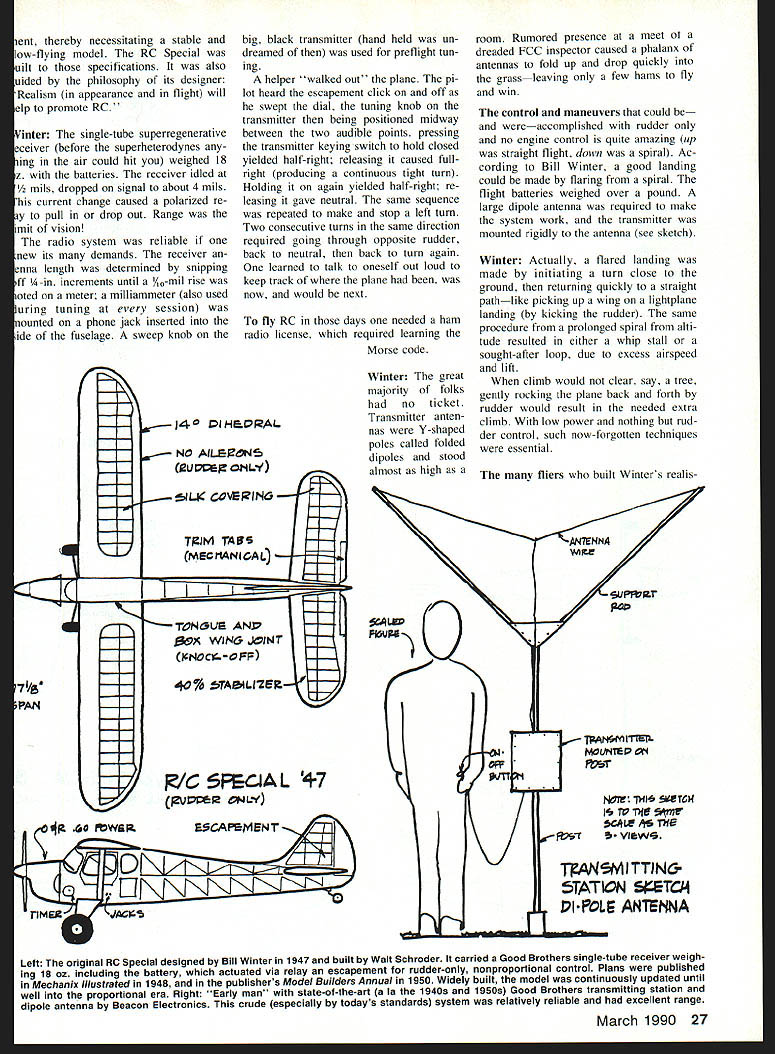
- The receiver was a single‑tube superregenerative type (before superheterodynes). The receiver idled at 15 V, dropping on signal to about 4 mA. This current change actuated a polarized reed relay to pull in or drop out. Range was basically line‑of‑sight.
- The radio system was reliable if one understood its many demands. Receiver antenna length was set by snipping off 1/4‑in. increments until a rise was noted on a meter; a milliammeter was mounted on a phone jack inserted into the side of the fuselage for tuning checks.
- A sweep knob on the large black transmitter was used for preflight tuning; a helper “walked out” the plane while the pilot swept the dial and listened for the escapement clicks to set midpoints and detents.
- To fly RC then required a ham radio license, which involved learning Morse code. Transmitter antennas were Y‑shaped folded dipoles, often as tall as a room. Rumored visits by FCC inspectors would cause a phalanx of antennas to fold up and drop into the grass.
Rudder‑only control techniques were sophisticated: up was straight flight, down was a spiral. A good landing could be made by flaring from a spiral. Light batteries weighed over a pound, a large dipole antenna was necessary, and the transmitter was mounted rigidly to the antenna. When climb wouldn't clear an obstacle, gently rocking the plane back and forth with the rudder could gain extra climb. These now‑forgotten techniques were essential in low‑power, rudder‑only days.
The prototype used an Ohlsson & Rice .60 and featured a Wakefield‑type knock‑off wing with a tongue‑and‑box attachment. Over the years the stabilizer area was reduced and refinements were made, but the core design remained true.
Scaled‑down RC Special — For Three‑channel Control
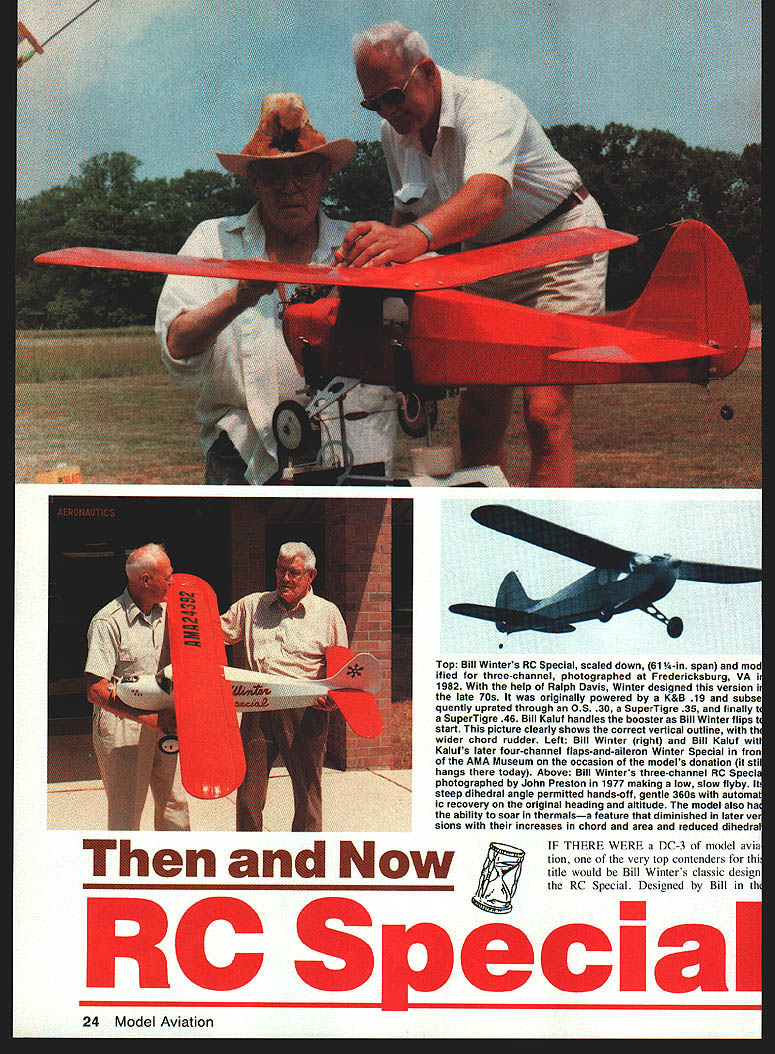
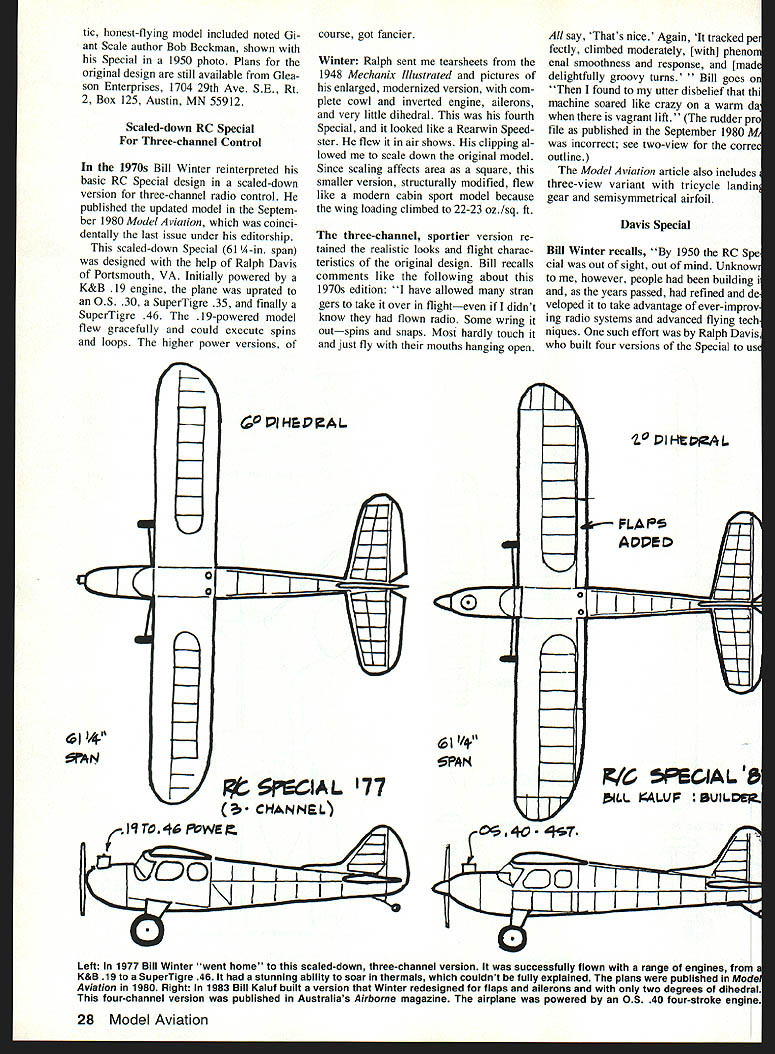
In the 1970s Bill Winter reinterpreted his basic RC Special in a scaled‑down version for three‑channel radio control. He published the updated model in the September 1980 Model Aviation (coincidentally his last issue as editor). This scaled‑down Special had a 61‑1/4‑in. span and was designed with the help of Ralph Davis of Portsmouth, VA.
Initial and later powerplants used on the scaled version:
- K&B .19 (initial)
- O.S. .30
- SuperTigre .35
- SuperTigre .46
The .19‑powered model flew gracefully and could execute spins and loops; higher‑powered versions of course allowed fancier maneuvers. Winter noted that scaling affected area as a square, so the smaller version, structurally modified, flew like a modern cabin‑sport model because the wing loading climbed to about 22–23 oz./sq. ft.
The three‑channel sportier version retained the realistic looks and flight characteristics of the original. Pilots often allowed strangers to take it over in flight; most “hardly touched it and just flew with their mouths hanging open.” It tracked perfectly, climbed moderately, and had phenomenal smoothness and response. Winter also observed that the machine could soar exceptionally well on a warm day when there was vagrant lift. The Model Aviation article included a three‑view variant with tricycle landing gear and a semisymmetrical airfoil. (Note: the rudder profile as published in Sept. 1980 was incorrect; see the two‑view for the correct outline.)
Davis Special
By 1950 the RC Special had spread beyond Winter's immediate circle. Ralph Davis built four versions of the Special, refining and modernizing it to take advantage of improving radio systems and flying techniques. Davis' first model (circa 1950) weighed 12 lb and was the first RC in his area to have takeoff ability — powered by a Fox .35. His large show model (the fourth version) featured a curved outer wing planform achieved by adding an open structure to parallel‑edged inner‑wing foam cores, plus ailerons and very little dihedral.
Bill Kaluf's Special
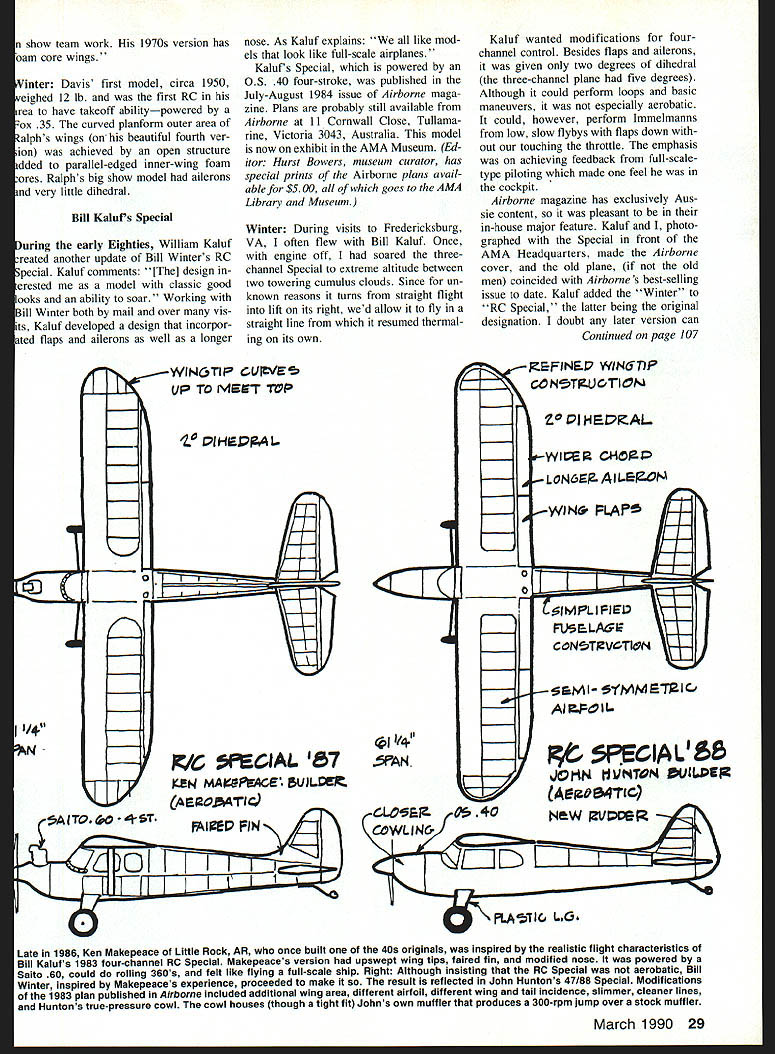
In the early 1980s William Kaluf created another update of Winter's RC Special. Kaluf worked with Winter by mail and many visits to develop a version that incorporated flaps, ailerons and a longer nose. Kaluf’s Special was powered by an O.S. .40 four‑stroke and was published in the July–August 1984 issue of Airborne magazine. Plans may still be available from Airborne (11 Cornwall Close, Tullamarine, Victoria 3043, Australia). This model is now on exhibit in the AMA Museum (the museum curator has special prints of the Airborne plans available for a small fee to support the AMA Library and Museum).
Kaluf sought four‑channel control. Modifications included:
- Flaps and ailerons
- Only two degrees of dihedral (the three‑channel plane had five degrees)
- A longer nose and styling to resemble full‑scale airplanes
Although not a highly aerobatic model, Kaluf's Special could perform Immelmanns from low, slow flybys with flaps down, without touching the throttle. The emphasis was on producing feedback akin to a full‑scale cockpit. Kaluf also added the "Winter" to "RC Special" in naming. Bill and Kaluf photographed the Special in front of AMA Headquarters for the Airborne cover.
Winter recalls soaring Kaluf's three‑channel Special to extreme altitude between towering cumulus clouds; for unexplained reasons the model tended to turn into lift on its right, and they would allow it to fly straight until it resumed thermalling on its own.
Makepeace Special
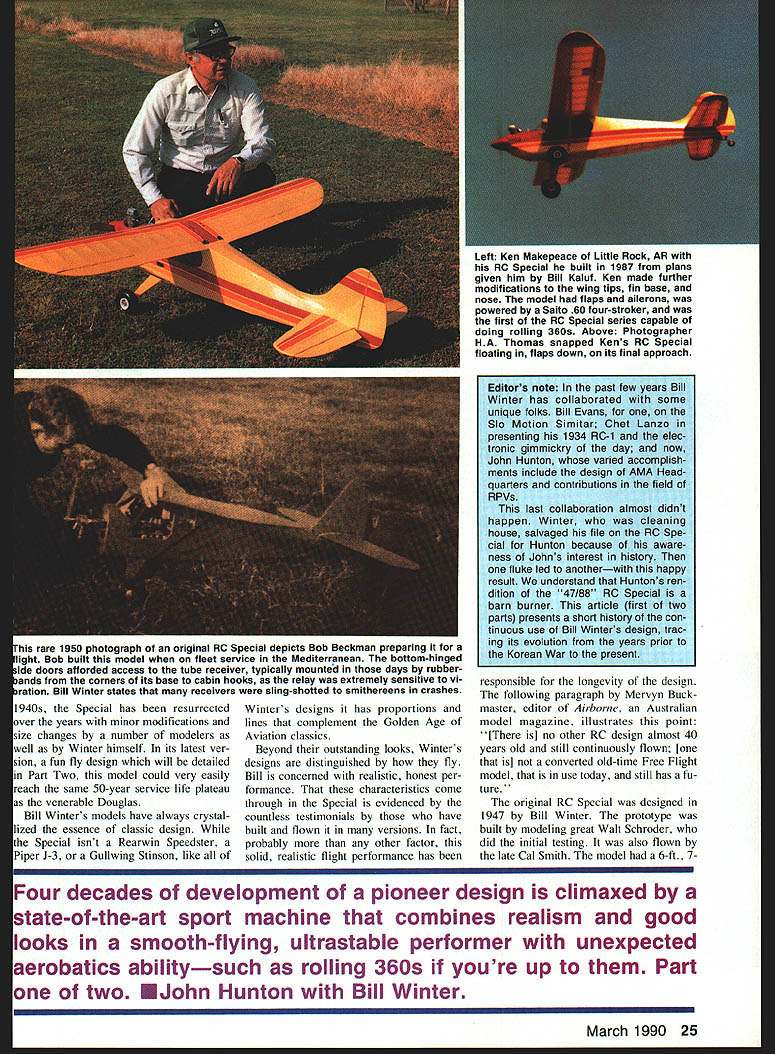
On a visit to Little Rock, AR with his flapped Special, Bill Kaluf met full‑scale pilot Ken Makepeace. Ken had built and flown an original large‑size Special many years earlier and in 1987 built another Special from Airborne plans (given him by Kaluf), adding modifications to bring it even closer to full‑scale practice.
Makepeace's changes and features:
- Saito .60 four‑stroke powerplant (made the version fully aerobatic)
- First in the series to perform rolling 360s, despite a flat‑bottomed airfoil
- Nose contour changed to accommodate a sheet‑metal coaming
- Wing tips modified to terminate flush with the top wing surface
- Fabric fin‑attachment fairing similar to Cubs
Ken described the first flight: “It was obvious that this was a top‑notch model and a superb flyer. It isn't the goer that the RC Special was (in the original version) with an Atwood Champion engine and a McNabb 465 radio, but it will slow down with flaps and glide like it's sliding down a wire.”
Winter recalls the early radio era with a mix of nostalgia and amazement. His “Scrapbox” column in Model Airplane News in the Forties led to Vernon McNabb allowing him to fly experimental 465 systems before FCC approval. These systems were line‑of‑sight and subject to multipath and reflections from scoreboards, tanks and buildings, which could make them glitchy. Spark ignition engines exacerbated interference and suppression of high‑tension spark was not yet common practice.
Early equipment facts and anecdotes:
- Transmitters and antennas were large; receiver boxes could be as big as a modern 10‑oz fuel tank.
- Batteries were heavy (a six‑volt “A” battery; B batteries were enormous).
- The Sigma 4F relay adapted to low escapement voltage required very close seating; even minor vibration could induce catastrophic failures leading to out‑of‑sight flights and crashes.
- Kits such as the Live Wire trainer and Trixter Beam were early popular systems.
How pilots managed with those radios and roaring engines is remarkable. In the Forties there were no instructors and many modelers learned by trial and error; success rates were low, but pioneers showed the way.
Fun‑fly and the “47/88” Special
As fun‑fly events have evolved, designers have emphasized characteristics such as vertical performance, rapid roll rate and tight‑turn capability — traits that often lead to stylized, unrealistic models. Perhaps there is more to fun‑fly participation than simply winning; perhaps there is such a thing as competing with class. If so, why not use a classic design such as the Winter Special?
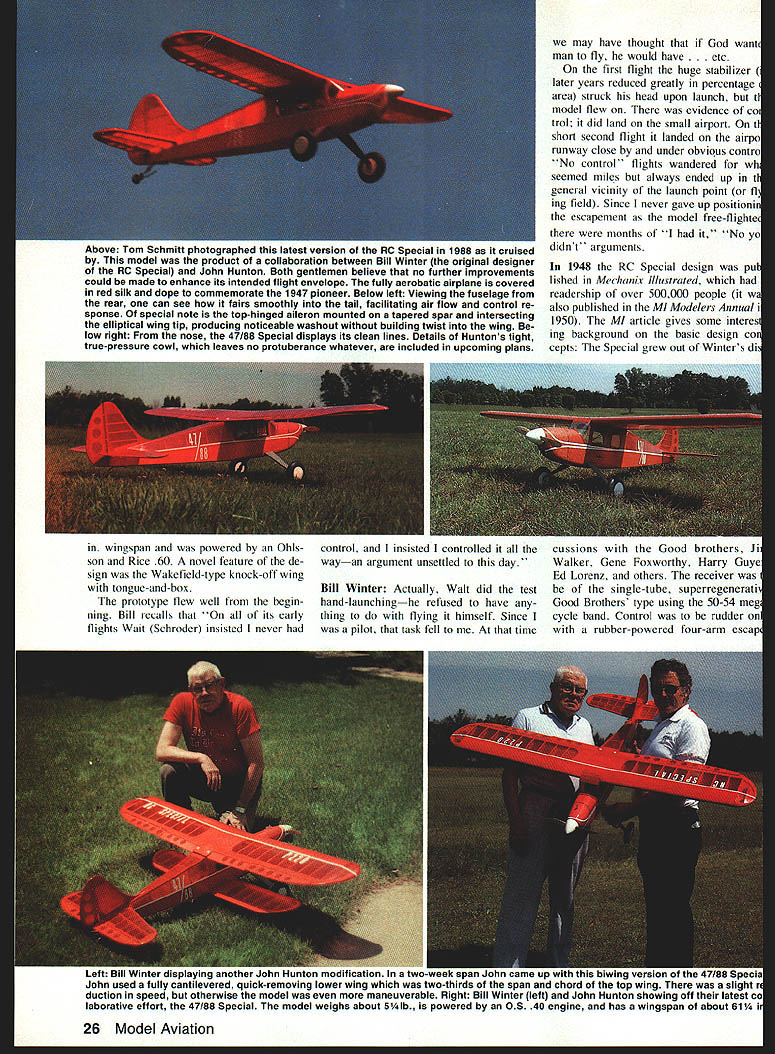
Updated by Bill Winter, the 1988 Special retains classic proportions and solid flight characteristics while becoming a very flexible and capable fun‑fly contender. One notable variant is the “47/88” Special, which features a quick‑attach/detach lower wing with two‑thirds of the span and chord of the top wing. The “47/88” has outstanding performance as a biplane and has done well as a fun‑fly biplane.
Bill Winter summed up his design philosophy: “It always was just a very stable, pleasant‑looking and‑flying ‘anybody's’ airplane. My design approach always favored controllability and realistic response that makes one sense that he is actually in the airplane. That is life when I fly it, it talks to me.” He added, “If you fly it, you will find yourself thinking in full‑scale terms — it's that kind of machine.”
This article will continue next month with detailed plans of the ultimate “47/88” aircraft.
Transcribed from original scans by AI. Minor OCR errors may remain.

