

There She Goes
"I've behaved well enough to join you in the great Valhalla." "Well, if she's gonna blow, now's the time because Ol' Muddy down there is sure big enough to quench it. And forget the Val stuff—I'm with you."
It was a trip intended as pure fun and it sure turned out to be that. The closest thing to work was that I had built a 32-in. span Delta speed model and put an electrostatic wing leveler on it. During the past five years, we've used electrostatic autopilots on about 50 different models and RPVs that flew at speeds of 100 miles an hour or less. I was really curious to see if we could make it work at 200—maybe even at 250.
One of the many fun parts was that the Houston Club is made up of some of the finest people I've ever met. Hard work on the flying field doesn't bother them. They had 16 timers and at least ten other officials on duty, all sitting in the boonies, pushing buttons, writing numbers, shouting encouragement for hours on end with no complaints, even though they were in territory occupied by native troops of rattlesnakes.
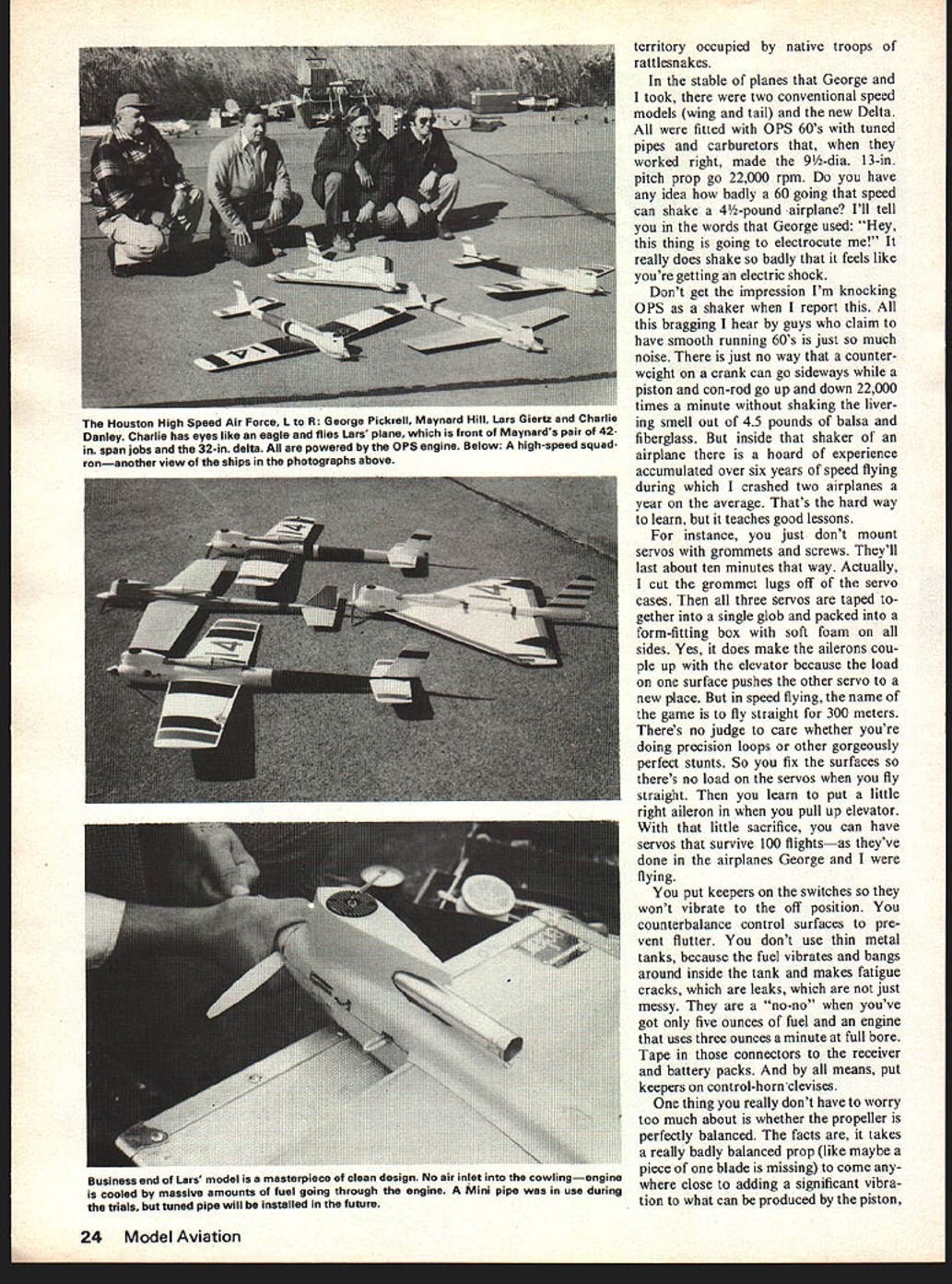
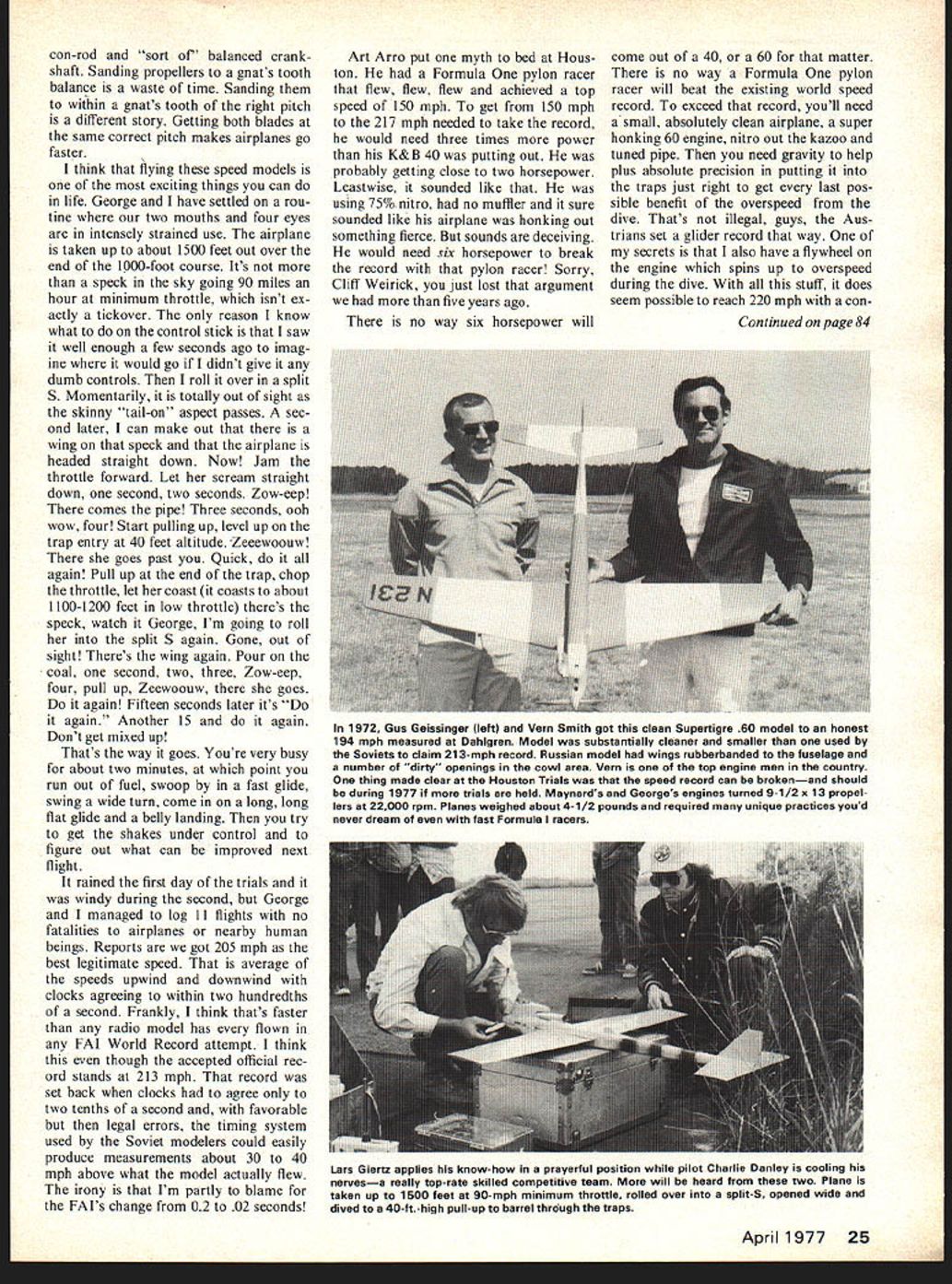
In the stable of planes that George and I took, there were two conventional speed models (wing and tail) and the new Delta. All were fitted with OPS 60's with tuned pipes and carburetors that, when they worked right, made the 9½‑dia., 13‑in. pitch prop go 22,000 rpm. Do you have any idea how badly a 60 going that speed can shake a 4½‑pound airplane? I'll tell you in the words that George used: "Hey, this thing is going to electrocute me!" It really does shake so badly that it feels like you're getting an electric shock.
Don't get the impression I'm knocking OPS as a shaker when I report this. All this bragging I hear by guys who claim to have smooth running 60's is just so much noise. There is just no way that a counterweight on a crank can go sideways while a piston and con-rod go up and down 22,000 times a minute without shaking the livering smell out of 4.5 pounds of balsa and fiberglass. But inside that shaker of an airplane there is a hoard of experience accumulated over six years of speed flying during which I crashed two airplanes a year on the average. That's the hard way to learn, but it teaches good lessons.
For instance, you just don't mount servos with grommets and screws. They'll last about ten minutes that way. Actually, I cut the grommet lugs off the servo cases. Then all three servos are taped together into a single glob and packed into a form‑fitting box with soft foam on all sides. Yes, it does make the ailerons couple up with the elevator because the load on one surface pushes the other servo to a new place. But in speed flying, the name of the game is to fly straight for 300 meters. There's no judge to care whether you're doing precision loops or other gorgeously perfect stunts. So you fix the surfaces so there's no load on the servos when you fly straight. Then you learn to put a little right aileron in when you pull up elevator. With that little sacrifice, you can have servos that survive 100 flights—as they've done in the airplanes George and I were flying.
You put keepers on the switches so they won't vibrate to the off position. You counterbalance control surfaces to prevent flutter. You don't use thin metal tanks, because the fuel vibrates and bangs around inside the tank and makes fatigue cracks, which are leaks, which are not just messy. They are a "no‑no" when you've got only five ounces of fuel and an engine that uses three ounces a minute at full bore. Tape in those connectors to the receiver and battery packs. And by all means, put keepers on control‑horn devices.
One thing you really don't have to worry too much about is whether the propeller is perfectly balanced. The facts are, it takes a really badly balanced prop (like maybe a piece of one blade is missing) to come anywhere close to adding a significant vibration to what can be produced by the piston, con-rod and "sort of" balanced crankshaft. Sanding propellers to a gnat's tooth balance is a waste of time. Sanding them to within a gnat's tooth of the right pitch is a different story. Getting both blades at the same correct pitch makes airplanes go faster.
I think that flying these speed models is one of the most exciting things you can do in life. George and I have settled on a routine where our two mouths and four eyes are in intensely strained use. The airplane is taken up to about 1500 feet out over the end of the 1000-foot course. It's not more than a speck in the sky going 90 miles an hour at minimum throttle, which isn't exactly a tickover. The only reason I know what to do on the control stick is that I saw it well enough a few seconds ago to imagine where it would go if I didn't give it any dumb controls. Then I roll it over in a split S. Momentarily, it is totally out of sight as the skinny "tail-on" aspect passes. A second later, I can make out that there is a wing on that speck and that the airplane is headed straight down. Now! Jam the throttle forward. Let her scream straight down, one second, two seconds. Zow-eep! There comes the pipe! Three seconds, ooh wow, four! Start pulling up, level up on the trap entry at 40 feet altitude. Zeeewoouw! There she goes past you. Quick, do it all again! Pull up at the end of the trap, chop the throttle, let her coast (it coasts to about 1100-1200 feet in low throttle) there's the speck, watch it George, I'm going to roll her into the split S again. Gone, out of sight! There's the wing again. Pour on the coal, one second, two, three. Zow-eep, four, pull up, Zeeewoow, there she goes. Do it again! Fifteen seconds later it's "Do it again." Another 15 and do it again. Don't get mixed up!
That's the way it goes. You're very busy for about two minutes, at which point you run out of fuel, swoop by in a fast glide, swing a wide turn, come in on a long, long flat glide and a belly landing. Then you try to get the shakes under control and to figure out what can be improved on the flight.
It rained the first day of the trials and it was windy during the second, but George and I managed to log 11 flights with no fatalities to airplanes or nearby human beings. Reports are we got 205 mph as the best legitimate speed. That is average of the speeds upwind and downwind with clocks agreeing to within two hundredths of a second. Frankly, I think that's faster than any radio model has ever flown in any FAI World Record attempt. I think this even though the accepted official record stands at 213 mph. That record was set back when clocks had to agree only to two tenths of a second and, with favorable but then legal errors, the timing system used by the Soviet modelers could easily produce measurements about 30 to 40 mph above what the model actually flew. The irony is that I'm partly to blame for the FAI's change from .2 to .02 seconds! conventional airplane. We had passes downwind and upwind at 228 and 210 — which would have been a record if they had happened in the same flight. So it can be done.
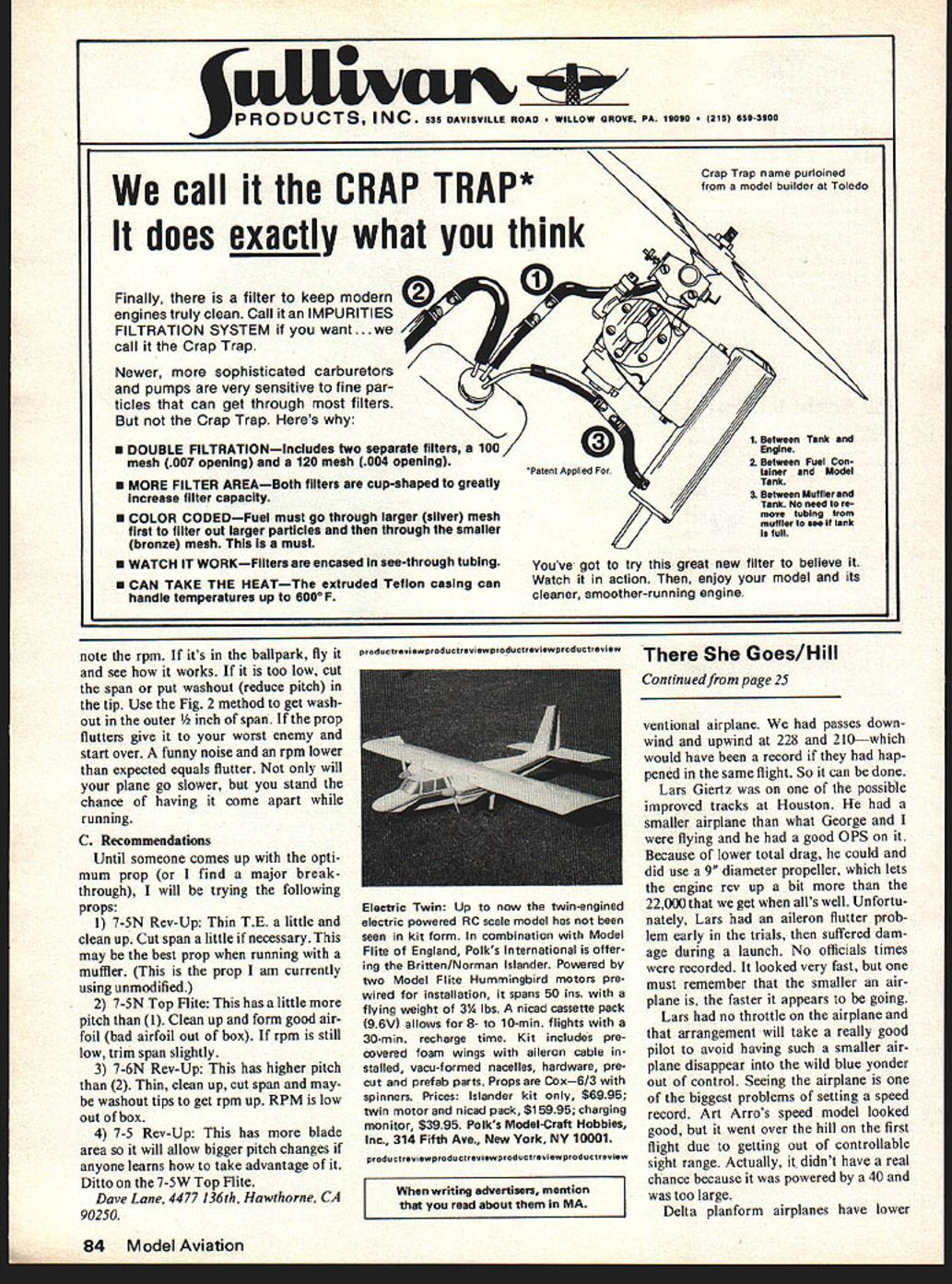
Lars Giertz was on one of the possible improved tracks at Houston. He had a smaller airplane than what George and I were flying and he had a good OPS on it. Because of lower total drag, he could and did use a 9" diameter propeller, which lets the engine rev up a bit more than the 22,000 that we get when all's well. Unfortunately, Lars had an aileron flutter problem early in the trials, then suffered damage during a launch. No official times were recorded. It looked very fast, but one must remember that the smaller an airplane is, the faster it appears to be going.
Lars had no throttle on the airplane and that arrangement will take a really good pilot to avoid having such a smaller airplane disappear into the wild blue yonder out of control. Seeing the airplane is one of the biggest problems of setting a speed record. Art Arro's speed model looked good, but it went over the hill on the first flight due to getting out of controllable sight range. Actually, it didn't have a real chance because it was powered by a .40 and was too large.
Delta-platform airplanes have lower drag but are a real handful to fly if they get out of sight. George took two conventional speed models, a wing-tail and a new delta fitted with OPS 60s. Tuned pipes and carburetors worked right and made a 9"-dia., 13"-pitch prop turn at 22,000 rpm. Have any idea how badly 60s going at speed can shake a 4-pound airplane? I'll tell you the words George used: "Hey — this thing's going to electrocute!" It really does shake badly; it feels like you're getting an electric shock.
Don't get the impression I'm knocking OPS shakers — I'm not. I'm just reporting. I've heard guys claim they have smooth-running 60s; there's just much noise. There's no way the counterweight crank can go sideways — the piston and conrod go up and down 22,000 times a minute, producing severe vibration. Forty-five pounds of balsa and fiberglass inside a shaking airplane is an experience that accumulates over time. In six years of speed flying I've averaged crashing about two airplanes a year. That's a hard way to learn, but it teaches good lessons. For instance, just don't mount servos with grommets and screws — they'll last about ten minutes that way. Actually, cut the grommet lugs off the servo cases; three servos taped together and packed in a single, form-fitting glob of soft foam will last. Yes, that does make the ailerons couple up with the elevator because the load surface pushes the other servo to a new place.
Speed flying is a game of flying straight for 300 meters. There's no judge who cares whether you're doing precision loops or other gorgeously perfect stunts. So fix the surfaces, since there's no load on the servos when you fly straight. Learn to put a little right aileron and a little up elevator; a little sacrifice there can have the servos survive 100 flights, as they've done on airplanes George has been flying. Put keepers on switches so they won't vibrate off position. Counterbalance control surfaces to prevent flutter. Don't use thin metal fuel tanks because the fuel vibrates and bangs around inside, making fatigue cracks and leaks — just messy, a no-no. You've got five ounces of fuel and the engine uses three ounces a minute at full bore.
Tape the connectors on receiver battery packs and put keepers on control-horn devices; these are things you really don't need to worry about later. You don't have to worry too much about whether a propeller is perfectly balanced — it takes a really badly balanced prop, like a piece of a blade missing, to add significant vibration to that produced by the piston. Getting both blades to the same correct pitch makes airplanes go faster. I think flying speed models is one of the most exciting things in life. drag for a given wing area, so they have better potential for setting the speed record. With deltas, though, seeing them is still a bigger problem. The electrostatic wing leveler was put on the new bird mostly to help with this problem. With it, the airplane will stay upright when the pilot takes his hands off the controls. The device saved the Delta several times during these trials. One time it went through the sun and George and I were shouting, "Where is it? Where is it?" for about five seconds before we found it. It would have been into the ground in that time without an autopilot. As it was, it just kinda got far away — going like a Concorde with Wrong Way Corrigan at the controls. We abandoned the Delta after three flights at this trial because it had some control surface problems that looked too big to fix in the time available. Maybe next time?
In a follow-on article, some of the technical stuff about drag, horsepower, gravity, propellers, flywheels of speed flying will be discussed. For now, the remaining available space must absolutely be devoted to saying thanks to the Johnson Space Center Club for providing one of the funnest times of hobbying that I've ever had in my life. George Pickrell feels the same. This was a superbly organized affair. Plenty of good workers stuck to the job, lots of friendly help was always available and, by golly, there are some marvelous senses of humor down in that corner of Texas. To Owen Morris and Bert Streigler who served as Contest Directors, to John Kiker who hosted us on a super tour of the impressive facilities at J.S.C., to all the J.S.C. Club members who pitched in, George Pickrell and I say thank you for a truly wonderful experience, full of fun. We are glad that all your hard work made it possible for Howard Bittner to set that helicopter speed record. But we also wish we could have erased that Soviet speed number for you. Please do it again sometime. We'll pitch in, that's for sure.
Transcribed from original scans by AI. Minor OCR errors may remain.

