
They Call
Old friends revisited! Twinboom pushers leaping from anxious hands. Ten-cent kits bought from the neighborhood variety store. Majestic Wakefields purring overhead, striving for new endurance records. Shavings of balsa and pine on the kitchen floor from a miniature solid airliner, taking shape from nothing more than primitive carving tools and sandpaper.
The search for nostalgia has taken over nowhere more than the model airplane hobby.
And it shows no signs of subsiding. Even those who never had a chance to live in the so-called embryonic or Golden Days of model aviation are anxious to learn about those times. The quest for nostalgia has brought forth the old-timer movement, model historical clubs, and collecting model airplane magazines and books.
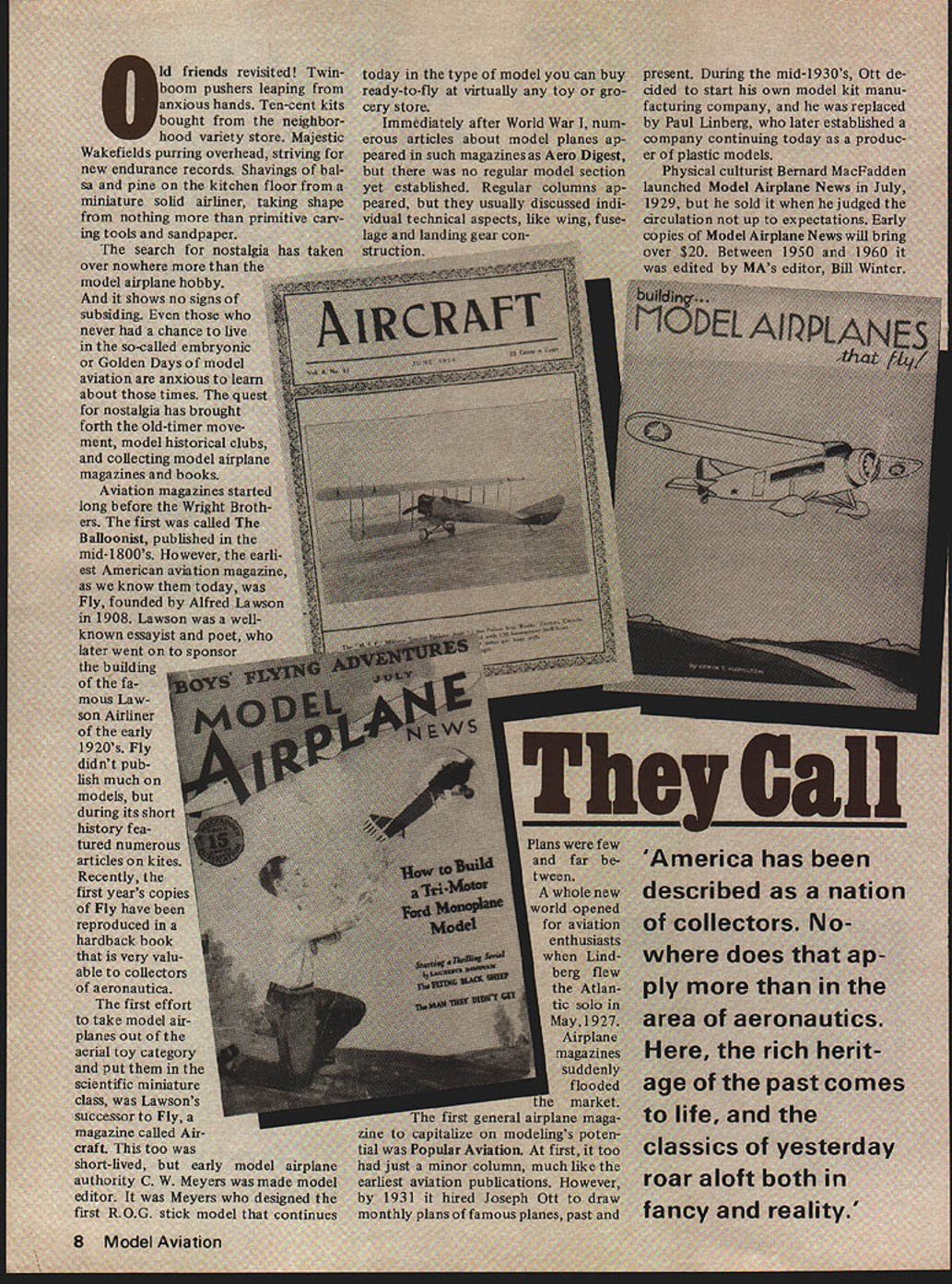
Aviation magazines started long before the Wright Brothers. The first was called The Balloonist, published in the mid-1800's. However, the earliest American aviation magazine, as we know them today, was Fly, founded by Alfred Lawson in 1908. Lawson was a well-known essayist and poet, who later went on to sponsor the building of the famous Lawson Airliner of the early 1920's. Fly didn't publish much on models, but during its short history featured numerous articles on kites. Recently, the first year's copies of Fly have been reproduced in a hardback book that is very valuable to collectors of aeronautica.
The first effort to take model airplanes out of the aerial toy category and put them in the scientific miniature class was Lawson's successor to Fly, a magazine called Aircraft. This too was short-lived, but early model airplane authority C. W. Meyers was made model editor. It was Meyers who designed the first R.O.G. stick model that continues today in the type of model you can buy ready-to-fly at virtually any toy or grocery store.
Immediately after World War I, numerous articles about model planes appeared in such magazines as Aero Digest, but there was no regular model section yet established. Regular columns appeared, but they usually discussed individual technical aspects, like wing, fuselage and landing gear construction.
Plans were few and far between.
A whole new world opened for aviation enthusiasts when Lindbergh flew the Atlantic solo in May, 1927.
Airplane magazines suddenly flooded the market.
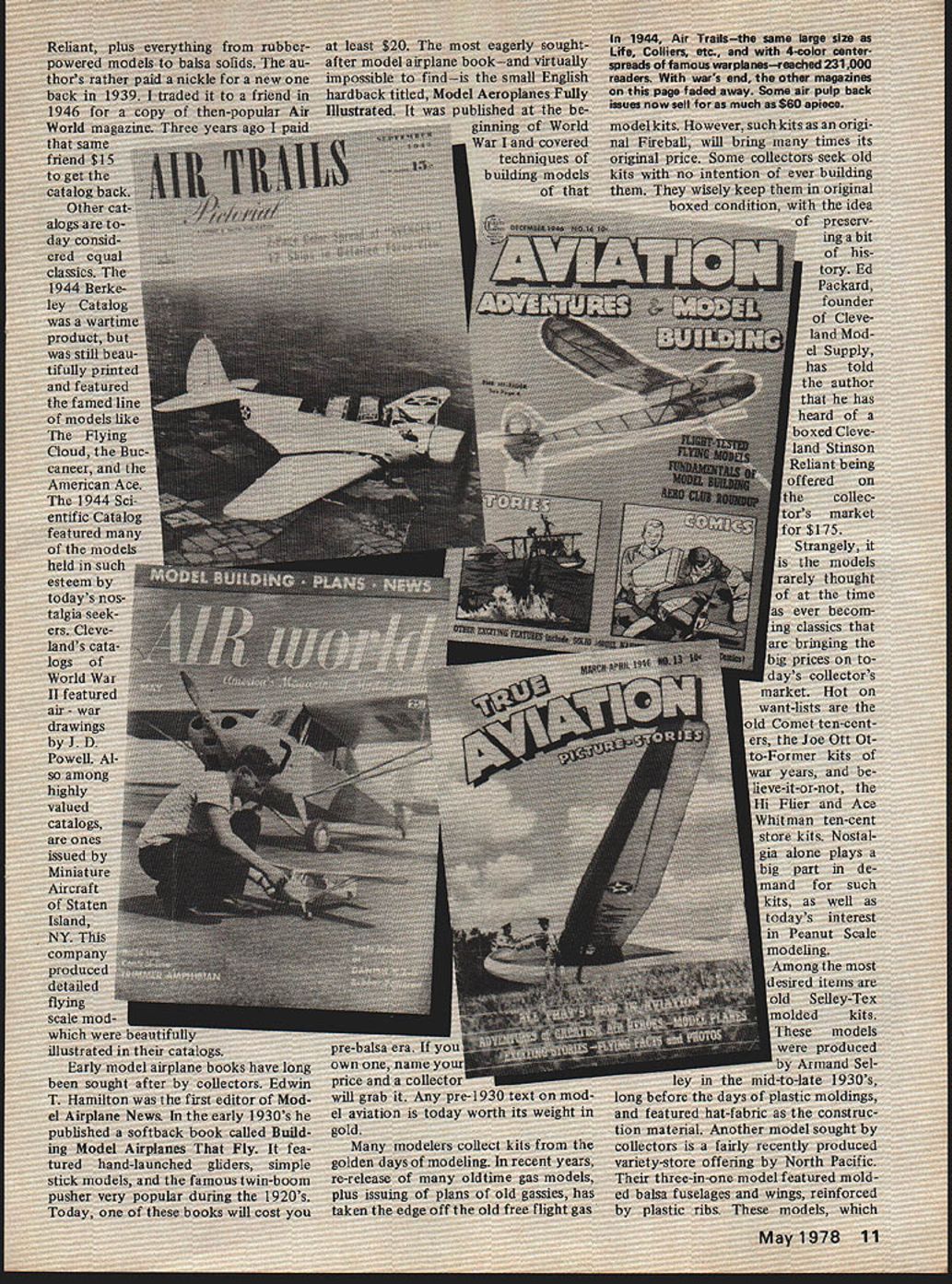
The first general airplane magazine to capitalize on modeling's potential was Popular Aviation. At first, it too had just a minor column, much like the earliest aviation publications. However, by 1931 it hired Joseph Ott to draw monthly plans of famous planes, past and present. During the mid-1930's, Ott decided to start his own model kit manufacturing company, and he was replaced by Paul Lindberg, who later established a company continuing today as a producer of plastic models.
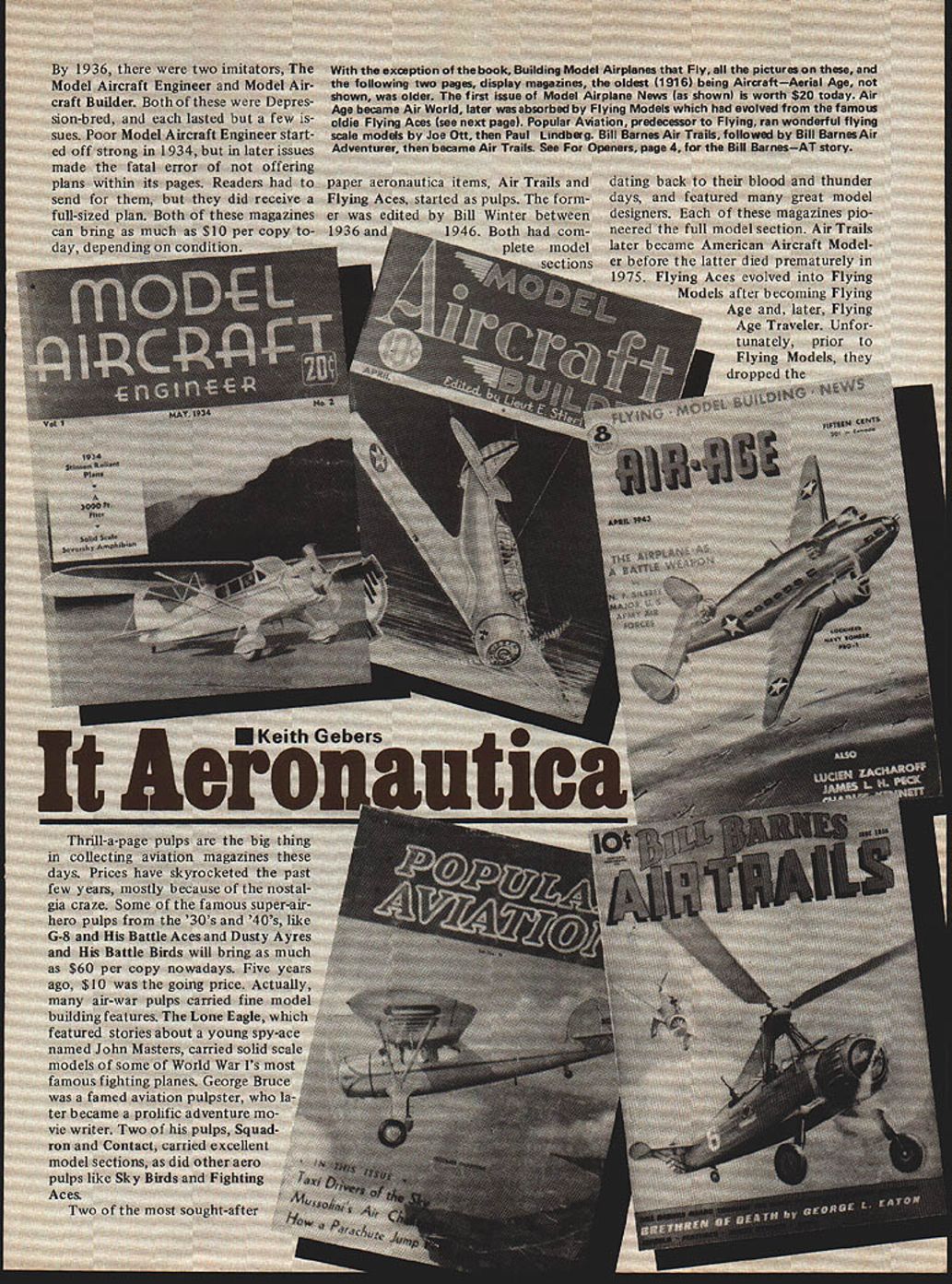
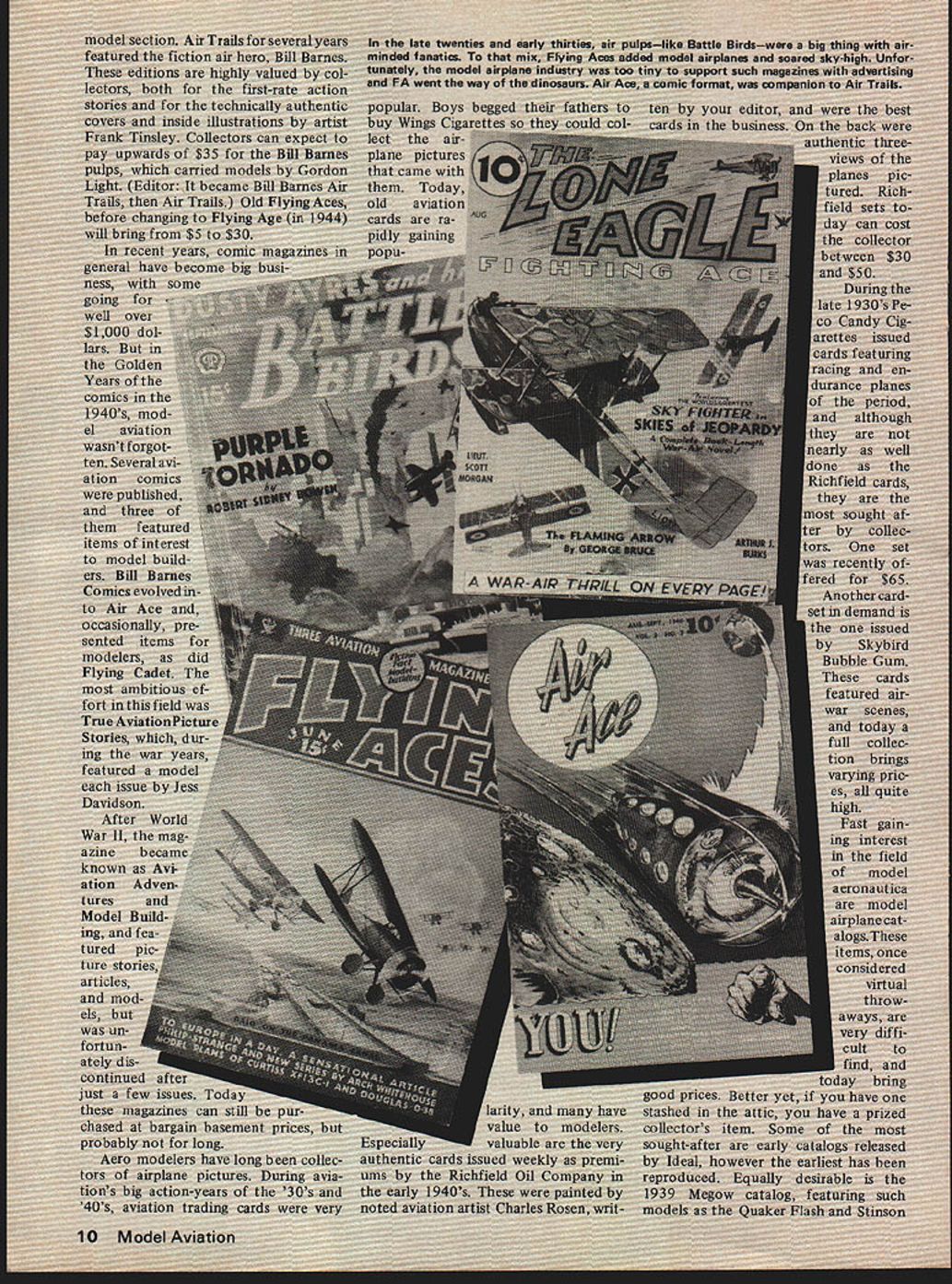
Physical culturist Bernard MacFadden launched Model Airplane News in July, 1929, but he sold it when he judged the circulation not up to expectations. Early copies of Model Airplane News will bring over $20. Between 1950 and 1960 it was edited by MA's editor, Bill Winter.
'America has been described as a nation of collectors. Nowhere does that apply more than in the area of aeronautics. Here, the rich heritage of the past comes to life, and the classics of yesterday roar aloft both in fancy and reality.'
They Call It Aeronautica
Keith Gebers
Thrill-a-page pulps are the big thing in collecting aviation magazines these days. Prices have skyrocketed the past few years, mostly because of the nostalgia craze. Some of the famous super-air-hero pulps from the '30's and '40's, like G-8 and His Battle Aces and Dusty Ayres and His Battle Birds will bring as much as $60 per copy nowadays. Five years ago, $10 was the going price. Actually, many air-war pulps carried fine model building features. The Lone Eagle, which featured stories about a young spy-ace named John Masters, carried solid scale models of some of World War I's most famous fighting planes. George Bruce was a famed aviation pulpster, who later became a prolific adventure movie writer. Two of his pulps, Squadron and Contact, carried excellent model sections, as did other aero pulps like Sky Birds and Fighting Aces.
Two of the most sought-after paper aeronautica items, Air Trails and Flying Aces, started as pulps. The former was edited by Bill Winter between 1936 and 1946. Both had complete model sections dating back to their blood and thunder days, and featured many great model designers. Each of these magazines pioneered the full model section. Air Trails later became American Aircraft Modeler before the latter died prematurely in 1975. Flying Aces evolved into Flying Models after becoming Flying Age and, later, Flying Age Traveler. Unfortunately, prior to Flying Models, they dropped the model building sections.
By 1936, there were two imitators, The Model Aircraft Engineer and Model Aircraft Builder. Both of these were Depression-bred, and each lasted but a few issues. Poor Model Aircraft Engineer started off strong in 1934, but in later issues made the fatal error of not offering plans within its pages. Readers had to send for them, but they did receive a full-sized plan. Both of these magazines can bring as much as $10 per copy today, depending on condition. In recent years, comic magazines in general have become big business, with some going for well over $1,000. But in the Golden Years of the comics in the 1940's, model aviation wasn't forgotten. Several aviation comics were published, and three of them featured items of interest to model builders. Bill Barnes Comics evolved into Air Ace and, occasionally, presented items for modelers, as did Flying Cadet. The most ambitious effort in this field was True Aviation Picture Stories, which, during the war years, featured a model each issue by Jess Davidson.
After World War II, the magazine became known as Aviation Adventures and Model Building, and featured picture stories, articles, and models, but was unfortunately discontinued after just a few issues. Today these magazines can still be purchased at bargain basement prices, but probably not for long.
Aero modelers have long been collectors of airplane pictures. During aviation's big-action years of the '30s and '40s, aviation trading cards were very popular. Boys begged their fathers to buy Wings Cigarettes so they could collect the airplane pictures that came with them. Today, old aviation cards are rapidly gaining popularity. To that extent, air pulps—like Battle Birds—were a big thing with air-minded fanatics. To that mix, Flying Aces added model airplanes and scored sky-high. Unfortunately, the model airplane industry was too tiny to support such magazines with advertising and FA went the way of the dinosaurs. Air Ace, a comic format, was companion to Air Trails.
Especially popular were the cigarette cards issued with various brands. On the back were authentic three-views of the planes pictured. Richfield sets today can cost the collector between $30 and $50.
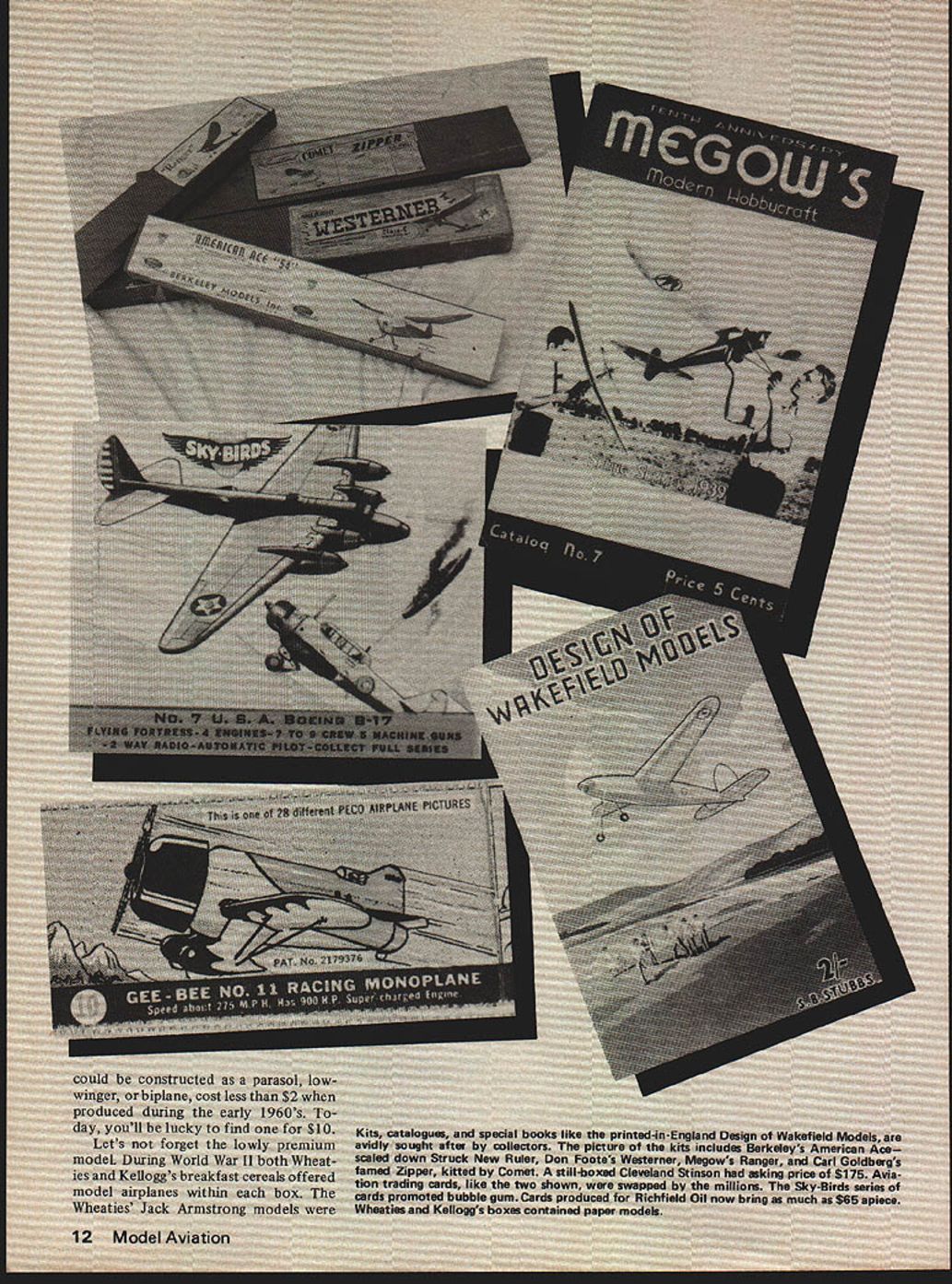
During the late 1930's Pecco Candy Cigarettes issued cards featuring racing and endurance planes of the period, and although they are not nearly as well known as Richfield cards, they are the most sought after by collectors. One set was recently offered for $65.
Another card set in demand is the one issued by Skybird Bubble Gum. These cards featured air-war scenes, and today a full collection brings varying prices, all quite high.
Fast gaining interest in the field of model aeronautica are model airplane catalogs. These items, once considered virtual throwaways, are very difficult to find, and today bring good prices. Better yet, if you have one stashed in the attic, you have a prized collector's item. Some of the most sought-after are early catalogs released by Ideal; however the earliest has been reproduced. Equally desirable is the 1939 Megow catalog, featuring such models as the Quaker Flash and Stinson. Reliant, plus everything from rubber-powered models to balsa solids. The author's father paid a nickel for a new one back in 1939. I traded it to a friend in 1946 for a copy of the then-popular Air World magazine. Three years ago I paid that same friend $15 to get the catalog back.
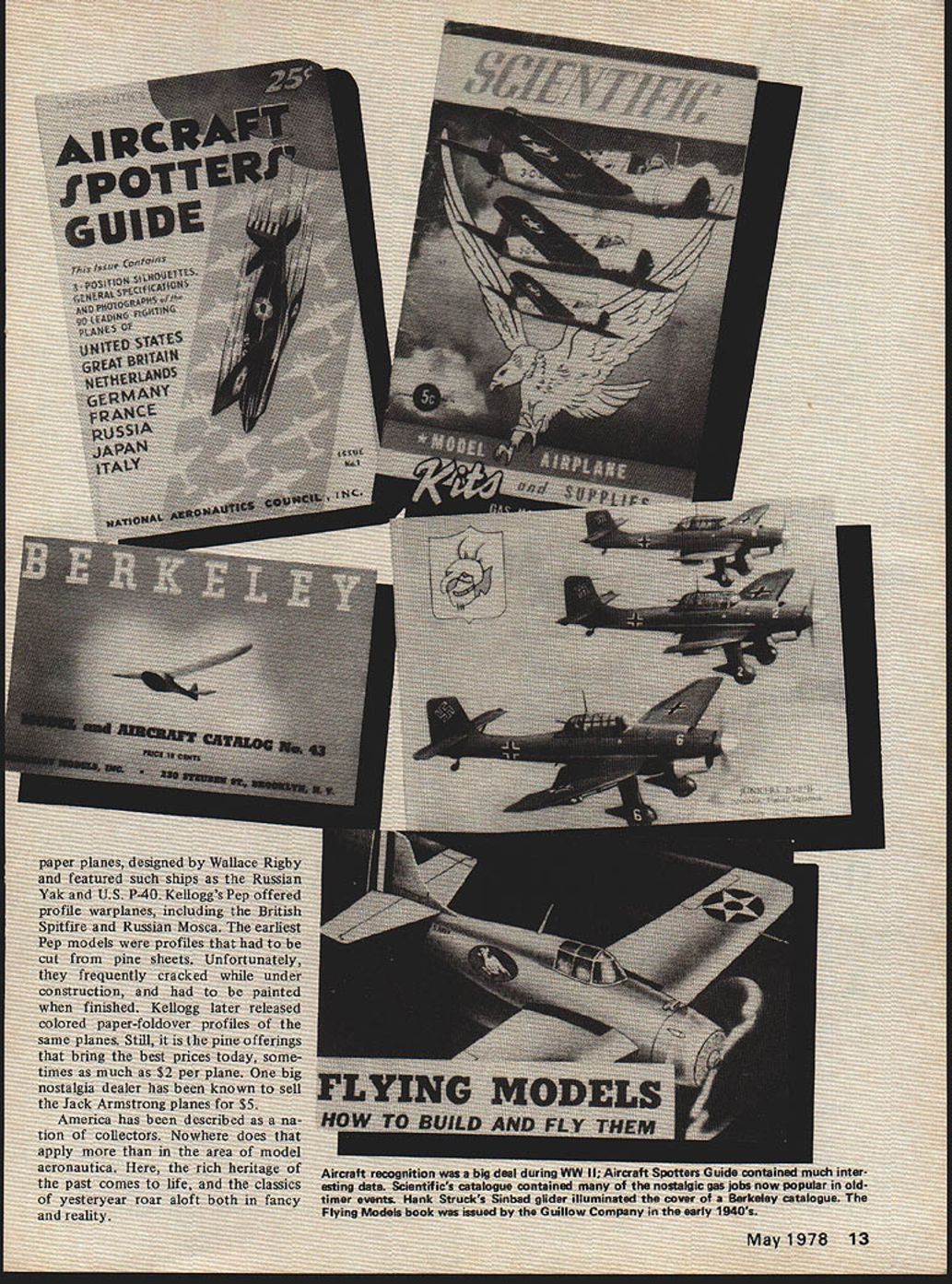
Other catalogs are today considered equal classics. The 1944 Berkeley Catalog was a wartime product, but was still beautifully printed and featured the famed line of models like The Flying Cloud, the Buccaneer, and the American Ace. The 1944 Scientific Catalog featured many of the models held in such esteem by today's nostalgia seekers. Cleveland's catalogs of World War II featured air-war drawings by J. D. Powell. Also among highly valued catalogs are ones issued by Miniature Aircraft of Staten Island, N.Y. This company produced detailed flying scale models which were beautifully illustrated in their catalogs.
Early model airplane books have long been sought after by collectors. Edwin T. Hamilton was the first editor of Model Airplane News. In the early 1930's he published a softback book called Building Model Airplanes That Fly. It featured hand-launched gliders, simple stick models, and the famous twin-boom pusher very popular during the 1920's. Today, one of these books will cost you at least $20. The most eagerly sought-after model airplane book—and virtually impossible to find—is the small English hardback titled Model Aeroplane Fully Illustrated. It was published at the beginning of World War I and covered techniques of building models of that pre-balsa era. If you own one, name your price and a collector will grab it. Any pre-1930 text on model aviation is today worth its weight in gold.
Many modelers collect kits from the golden days of modeling. In recent years, re-release of many old-time gas models, plus issuing of plans of old gassies, has taken the edge off the old free-flight gas model kits. However, such kits as an original Fireball will bring many times its original price. Some collectors seek old kits with no intention of ever building them. They wisely keep them in original boxed condition, with the idea of preserving a bit of history. Ed Packard, founder of Cleveland Model Supply, has told the author that he has heard of a boxed Cleveland Stinson Reliant being offered on the collector's market for $175.
Strangely, it is the models rarely thought of at the time as ever becoming classics that are bringing the big prices on today's collector's market. Hot on want-lists are the old Comet ten-centers, the Joe Ott O.T.O.-former kits of war years, and—believe-it-or-not—the Hi Flier and Ace Whitman ten-cent store kits. Nostalgia alone plays a big part in demand for these kits, as well as today's interest in Peanut Scale modeling.
Among the most desired items are old Selley-Tex molded kits. These models were produced by Armand Selley in the mid-to-late 1930's, long before the days of plastic moldings, and featured fabric as the construction material. Another model sought by collectors is a fairly recently produced variety-store offering by North Pacific. Their three-in-one model featured molded balsa fuselages and wings, reinforced by plastic ribs. These models, which were produced in limited numbers, have attracted collectors interested in the development of kit construction. They could be constructed as a parasol, low-winger, or biplane, and cost less than $2 when produced during the early 1930's. Today, you'll be lucky to find one for $10.
Let's not forget the lowly premium model. During World War II both Wheaties and Kellogg's breakfast cereals often offered model airplanes within each box. The Wheaties' Jack Armstrong models were popular.
Kits, catalogues, and special books like the printed-in-England Design of Wakefield Models, are avidly sought after by collectors. The picture of the kits includes Berkeley's American Ace, scaled down Struck New Ruler, Don Foote's Westerner, Megow's Ranger, and Carl Goldberg's famed Zipper, kitted by Comet. A still-boxed Cleveland Stinson had asking price of $175. Aviation trading cards, like the two shown, were swapped by the millions. The Sky-Birds series of cards promoted bubble gum. Cards produced for Richfield Oil now bring as much as $65 apiece. Wheaties and Kellogg's boxes contained paper models. paper planes, designed by Wallace Rigby and featured such ships as the Russian Yak and U.S. P-40. Kellogg's Pep offered profile warplanes, including the British Spitfire and Russian Mosca. The earliest Pep models were profiles that had to be cut from pine sheets. Unfortunately, they frequently cracked while under construction, and had to be painted when finished. Kellogg later released colored paper-foldover profiles of the same planes. Still, it is the pine offerings that bring the best prices today, sometimes as much as $2 per plane. One big nostalgia dealer has been known to sell the Jack Armstrong planes for $5.
America has been described as a nation of collectors. Nowhere does that apply more than in the area of model aeronautica. Here, the rich heritage of the past comes to life, and the classics of yesteryear roar aloft both in fancy and reality.
Transcribed from original scans by AI. Minor OCR errors may remain.

