
THING III
Barnaby Wainfan
The Thing takes the process of reducing an airplane to absurdity one step beyond good judgment and eliminates the wings. The lift-to-drag ratio was virtually eliminated along with the wings, but in the immortal last words of Otto Lilienthal, "sacrifices must be made."
The Thing is not efficient, but it is incredibly quick and simple to build and a lot of fun to fly. (Unfortunately, the vertical tail has reappeared — I tried to make it go away, but I needed someplace to hang a rudder.)
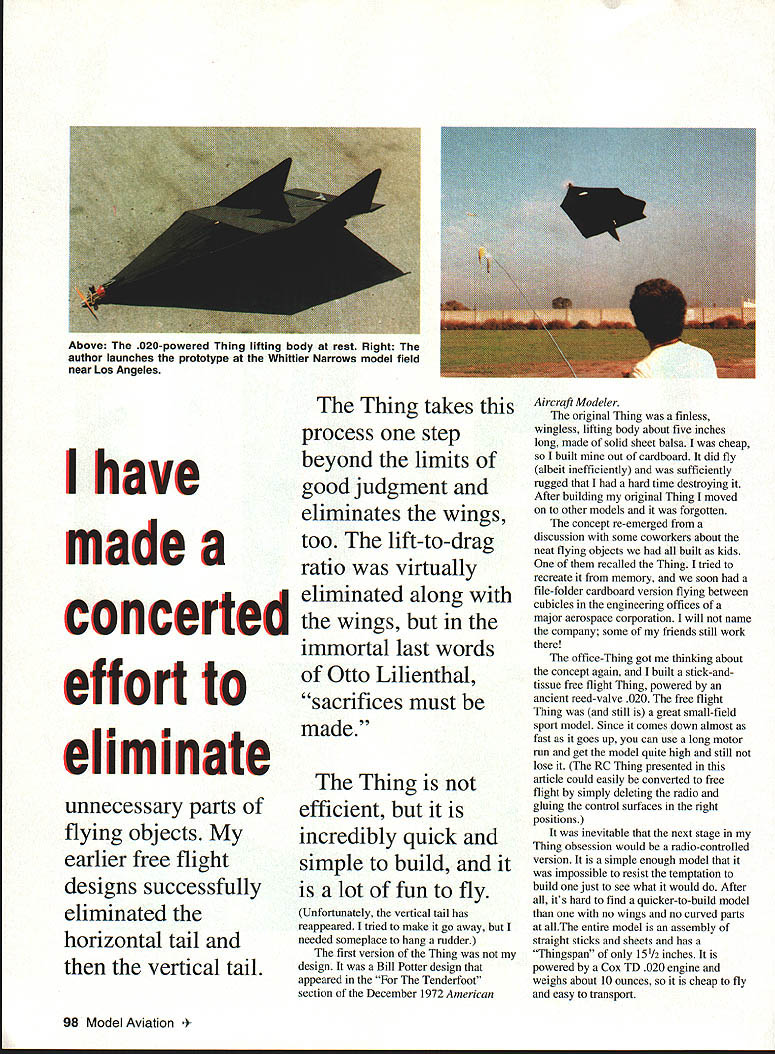
The first Thing I built was not my design. It was a Bill Potter concept that appeared in the "For The Tenderfoot" section of the December 1972 American Aircraft Modeler. The original was a finless, wingless lifting body about five inches long, made of solid sheet balsa. I was cheap, so I built mine out of cardboard; it flew inefficiently and was very rugged. After that first model it was forgotten for years.
The concept re-emerged after a discussion with coworkers about neat flying objects from our youth. I recreated the Thing from memory and we soon had a file-folder cardboard version flying between cubicles in the engineering offices of a major aerospace company. That office-Thing inspired me to build a stick-and-tissue free-flight Thing powered by an ancient reed-valve .020. The free-flight Thing is a great small-field sport model — because it comes down almost as fast as it goes up you can use a long motor run and still recover it.
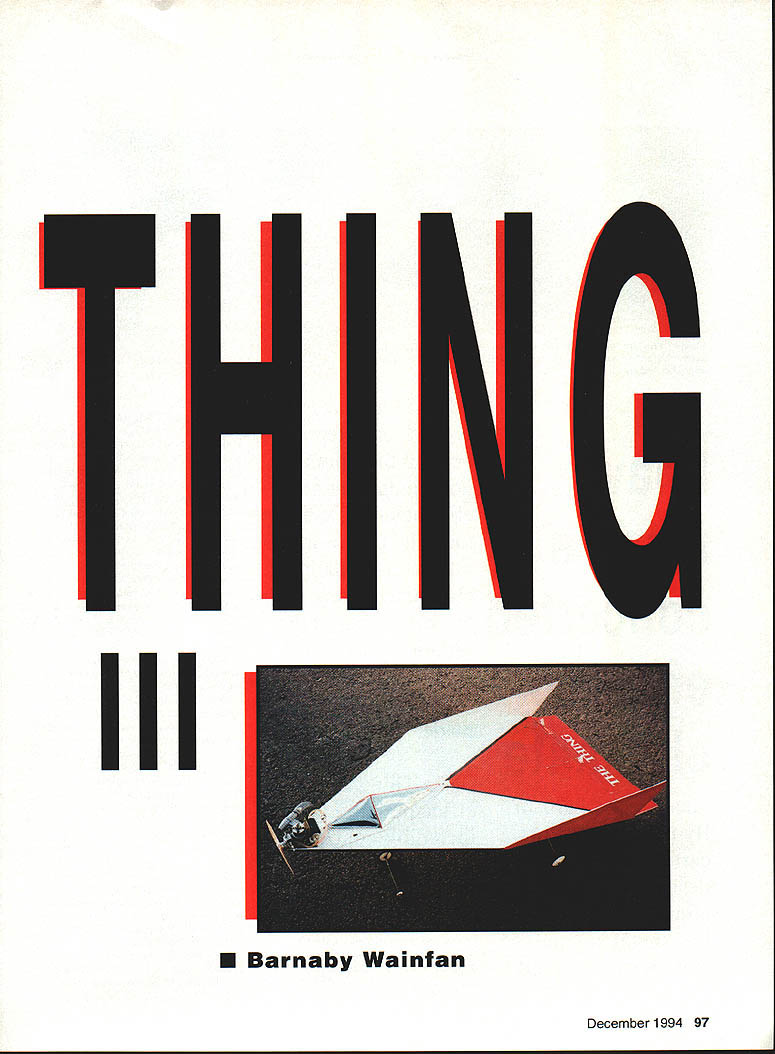
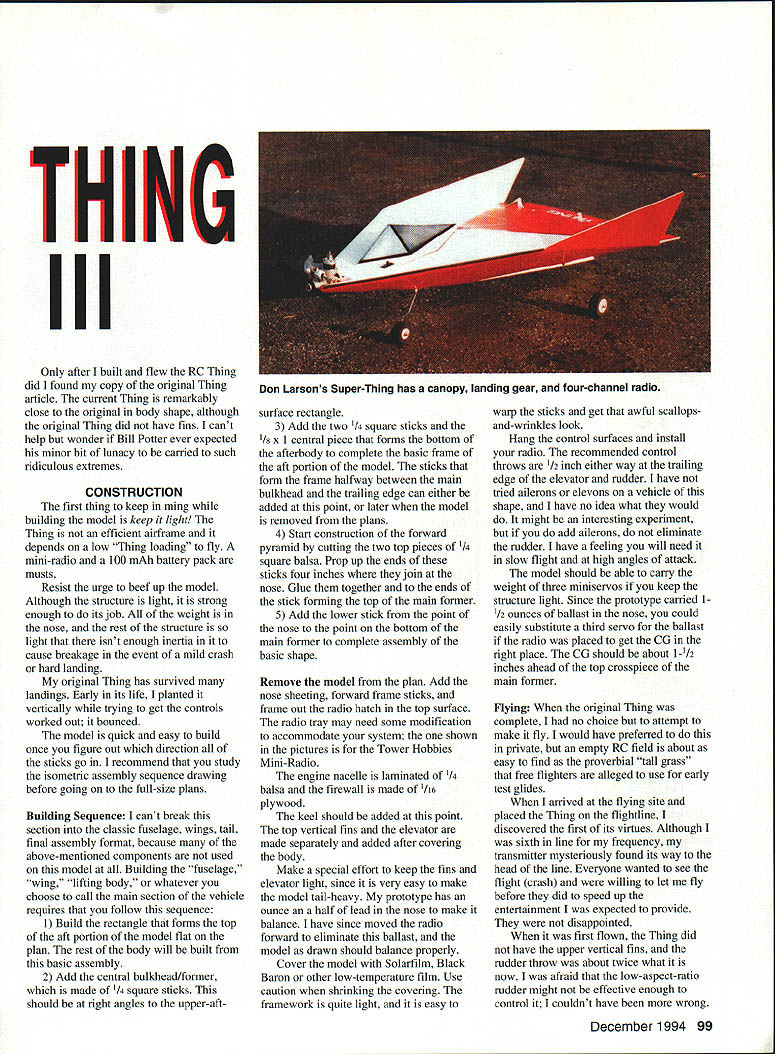
It was inevitable that I would build a radio-controlled version. With no wings and no curved parts, the RC Thing is very quick to build: an assembly of straight sticks and sheets with a Thingspan of only 15-1/2 inches. The prototype is powered by a Cox TD .020, weighs about 10 ounces, and is cheap to fly and easy to transport. Only after I built and flew the RC Thing did I find a copy of the original article — the current Thing is remarkably close to Bill Potter’s body shape, though he did include fins.
CONSTRUCTION
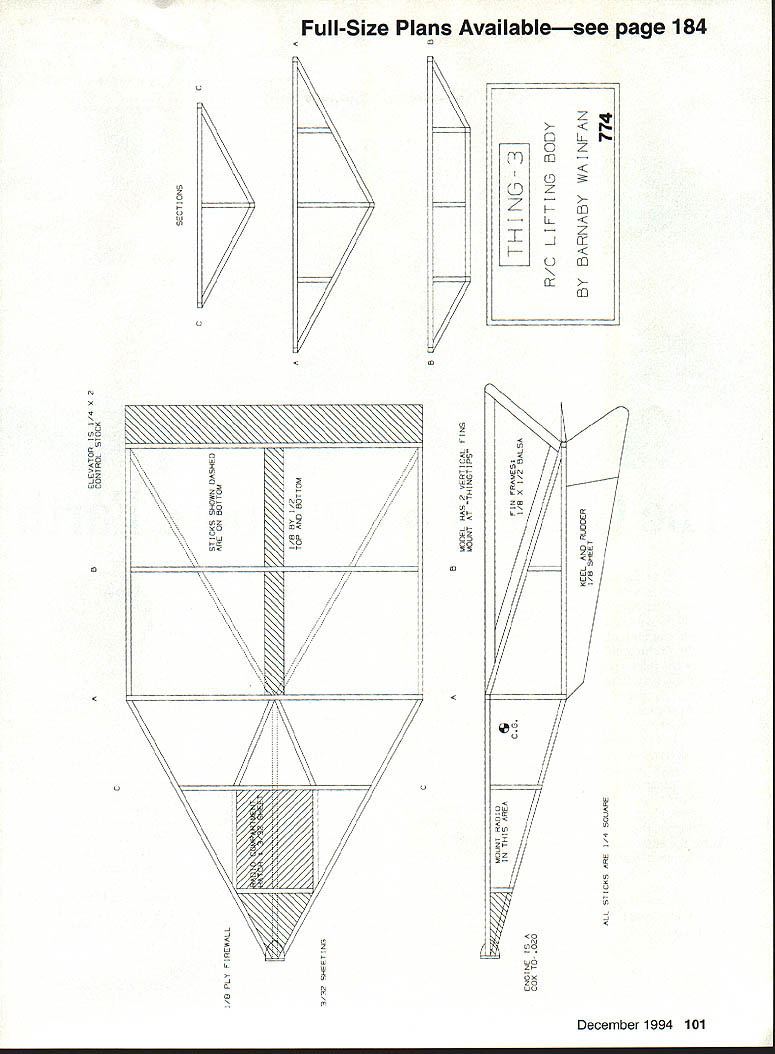
The first thing to keep in mind when building the model is to keep it light. The Thing's efficiency depends on low wing loading. A mini radio and a 100 mAh battery pack will suffice; resist the urge to beef up the structure. The framework should be light yet strong enough for its job. Too little nose inertia can increase the chance of damage in a hard landing, but excessive nose ballast degrades performance. My prototype carried about 1-1/2 ounces of lead in the nose originally; I later moved the battery forward to eliminate that ballast. The model as drawn should balance properly if built light.
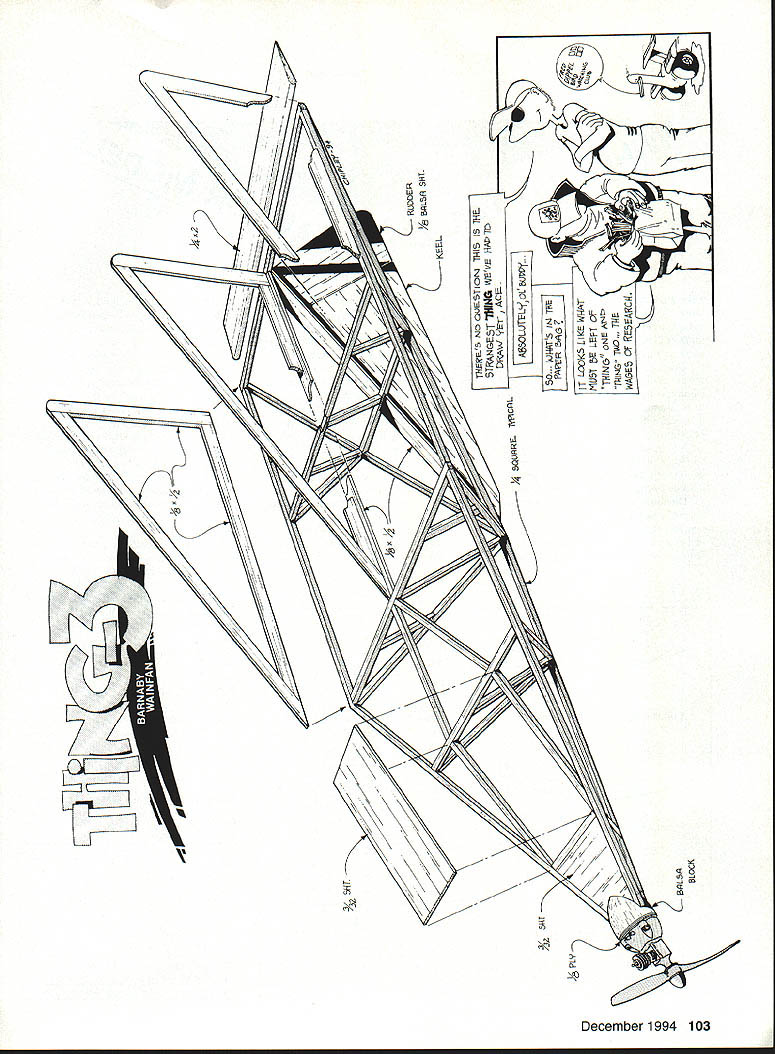
I recommend studying the isometric assembly sequence drawing before cutting full-size plans. Once you understand which direction the sticks go, the build is quick and straightforward.
Building sequence
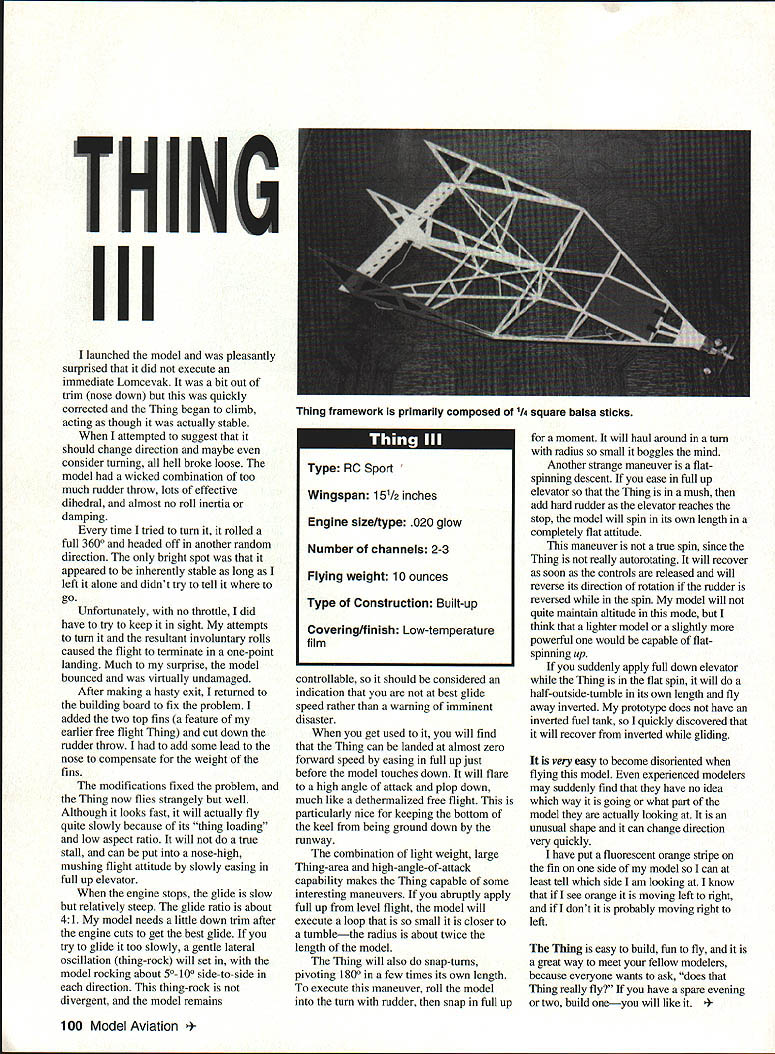
- Build the rectangular former that forms the top aft portion of the model on the flat plan. The rest of the body will be built on this basic assembly.
- Add the central bulkhead/former made from 1/4" square sticks; it should form a right angle with the upper-aft surface of the rectangle.
- Add two 1/4" square sticks and a 1/8" central piece to form the bottom afterbody. These sticks form a frame halfway between the main bulkhead and the trailing edge. This frame can be added now or later after removing the model from the plan.
- Start the forward pyramid by cutting the two top pieces from 1/4" square balsa. Prop up the ends of the sticks about four inches and join at the nose. Glue the ends together to form the top main former.
- Add the lower stick to form the nose point and the bottom main former to complete the basic shape. Remove the assembly from the plan, add nose sheeting and forward frame sticks, and frame out the radio hatch on the top surface. The radio tray may need modification to accommodate the chosen system.
Add the keel at this point. The top vertical fins and the elevator are built separately and added after covering the body. Make a special effort to keep fins and elevator very light — it is easy to make the model tail-heavy.
The engine nacelle is laminated 1/4" sheet balsa; the firewall is 1/16" plywood. The prototype used a Tower Hobbies mini-radio system; adapt the radio tray as needed.
Cover the model with Solarfilm, Black Baron, or other low-temperature film. Use caution when shrinking the covering: the framework is light and can warp easily, producing scallops and wrinkles if overheated.
Hang the control surfaces and install your radio. Recommended control throws are 1/2" each way at the trailing edge of the elevator and rudder. I have not tried ailerons or elevons on this shape and have no firm idea what they would do; if you add ailerons, do not eliminate the rudder — you will likely need it for slow flight and high angles of attack.
The model should carry the weight of three mini servos if you keep the structure light. Since the prototype used 1-1/2 ounces of nose ballast, you could substitute a third servo in the nose to achieve the correct balance. The CG should be about 1-1/2 inches ahead of the top crosspiece of the main former.
FLYING
When first flown, the Thing demonstrated one of its virtues: people want to see it fly. The prototype initially flew without the upper vertical fins and with very large rudder throws, and it was surprisingly controllable off the ground. At about three-quarters throttle and a couple degrees of up trim, it will accelerate and climb gently under wheeled power. It is quite maneuverable and recoverable from near-stall conditions, and it lands predictably — cutting the throttle produces a nice flat glide and it can be landed on a very small patch of grass.
However, with too much rudder throw, lots of effective dihedral, and almost no roll inertia or damping, attempts to initiate turns produced full 360° rolls and random headings. Adding the small upper fins and cutting down the rudder throw fixed this problem and greatly improved directional stability. The weight of the fins required a bit of nose ballast (or moving the battery forward) to restore proper balance.
Flight characteristics and maneuvers:
- The Thing will not do a true stall and can be mushed into a nose-high attitude with full up elevator.
- Glide ratio is about 4:1. After the engine cuts, a small amount of down trim helps get the best glide.
- At very slow speeds a gentle lateral oscillation ("thing-rock") of about 5°–10° can appear; it is not divergent and indicates you are below best glide speed rather than imminent instability.
- Landings can be made at almost zero forward speed by easing in full up just before touchdown; the model will flare to a high angle of attack and plop down, protecting the keel.
- Abrupt full up from level flight produces a very small loop/tumble with a radius about twice the length of the model.
- Snap-turns: roll with rudder, then snap in full up briefly — the Thing pivots in a very small radius.
- Flat-spinning descent: ease in full up into a mush and then apply hard rudder as elevator reaches the stop; the model will flat-spin in its own length. This is not a true autorotative spin and it recovers when controls are released; reversing the rudder reverses the spin direction.
- From a flat spin, full down elevator produces a half outside-tumble and the model will fly away inverted. The prototype lacks an inverted tank, so inverted engine runs were not maintained.
Orientation can be difficult because of the unusual shape and rapid direction changes. I put a fluorescent orange stripe on one fin to help identify roll direction: if you see orange, the model is moving left to right.
The Thing is easy to build, fun to fly, and a good conversation piece at the flying field. If you have a spare evening or two, build one — you will like it.
SPECIFICATIONS
- Type: RC Sport
- Wingspan (Thingspan): 15-1/2 inches
- Engine size/type: .020 glow (Cox TD .020 used in prototype)
- Number of channels: 2–3
- Flying weight: ~10 ounces
- Type of construction: Built-up stick-and-sheet
- Covering/finish: Low-temperature film (Solarfilm, Black Baron, etc.)
Transcribed from original scans by AI. Minor OCR errors may remain.

