

Things You Should Know About Noise
"SOUND," according to Webster, is "... the sensation produced in the ears when certain vibrations are caused in the surrounding air." "Noise," on the other hand, is called "sound, of a loud, harsh, or confused kind." Human perception of sound varies with the individual; what may be noise to one person may not be experienced negatively by another.
Prolonged exposure to high-decibel sound levels is well documented as potentially leading to permanent hearing damage. The sound produced by model aircraft engines can be damaging to the modeler's hearing and to that of others who may be closely involved in operating the engines. It can also be annoying to people a considerable distance away.
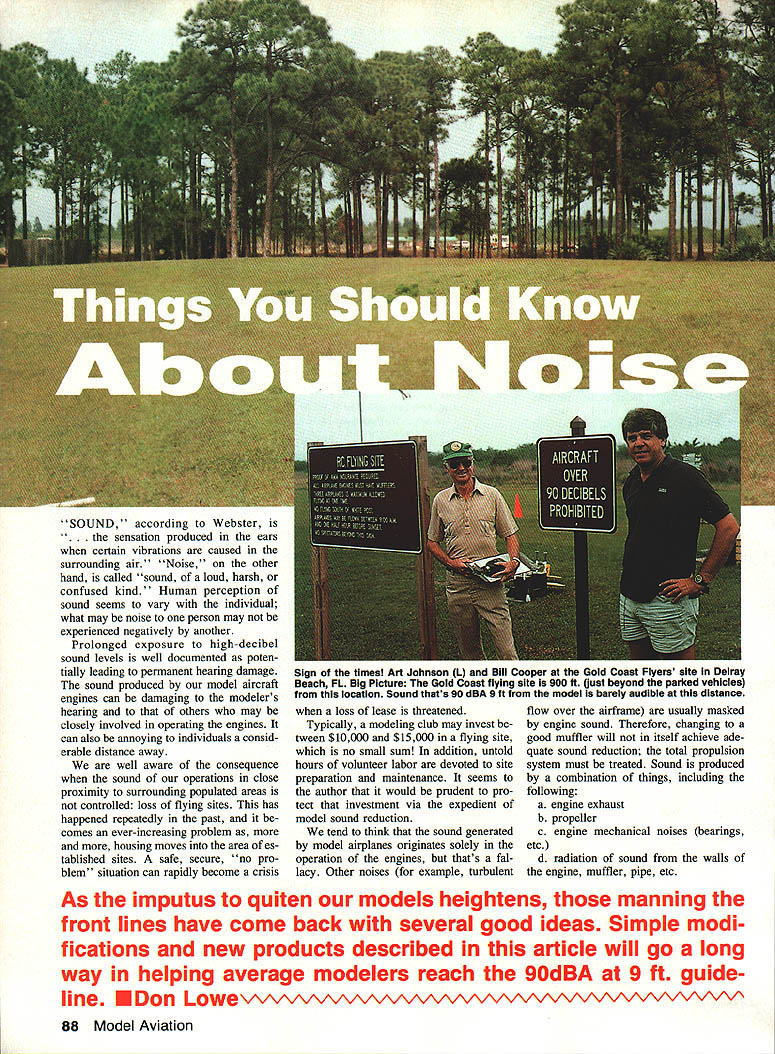
When the sound of our operations is not controlled near populated areas, the consequence is often loss of flying sites. This has happened repeatedly, and becomes an increasing problem as housing expands into areas near established sites. A club may invest $10,000–$15,000 (or more) in a flying site, plus many hours of volunteer labor. It is prudent to protect that investment by reducing model sound.
Many assume model sound comes solely from the engine, but that is a fallacy. Other noises (for example, turbulent flow over the airframe) are usually masked by engine sound. Therefore, changing to a good muffler alone will not achieve adequate reduction; the total propulsion system and airframe must be treated.
Sound is produced by a combination of sources, including:
- a. engine exhaust
- b. propeller
- c. engine mechanical noises (bearings, etc.)
- d. radiation from engine/muffler/pipe surfaces
- e. intake
- f. airframe
The total sound your model produces is a nonlinear summation of all these factors. Each condition, however small, contributes to the aggregate sound footprint of the model.
Exhaust
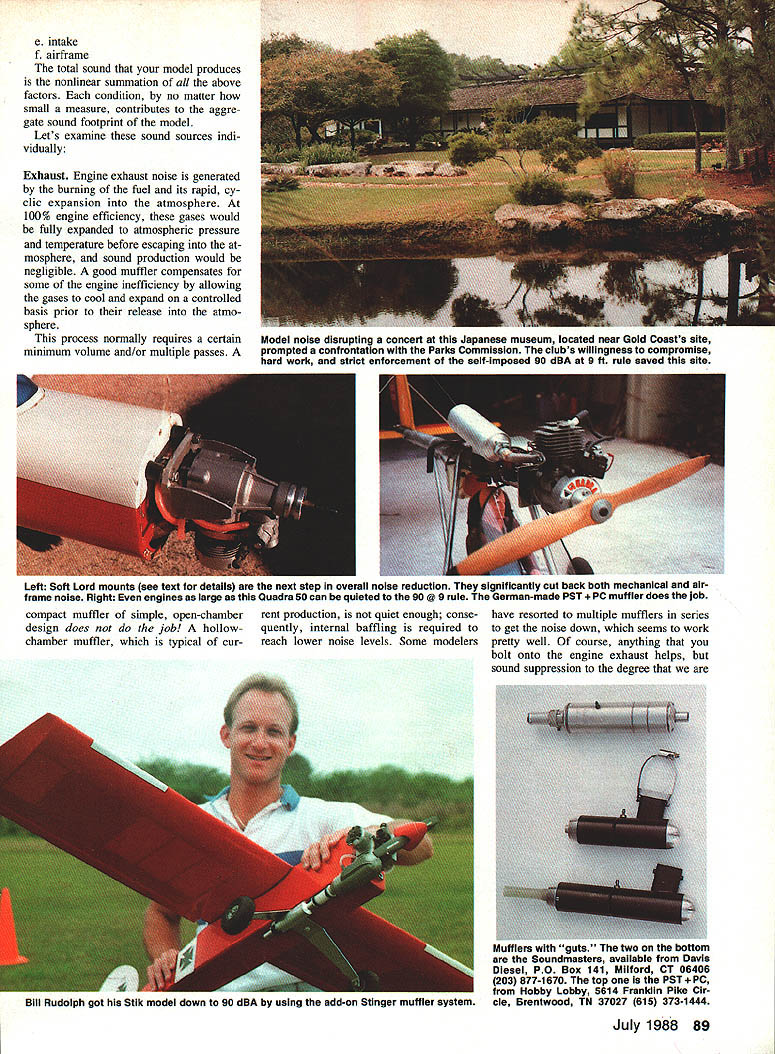
Engine exhaust noise is generated by burning fuel and its rapid, cyclic expansion into the atmosphere. If an engine were 100% efficient the gases would be fully expanded to atmospheric pressure and temperature before escaping and sound production would be negligible. A good muffler compensates for some engine inefficiency by allowing gases to cool and expand in a controlled way prior to release.
Key points:
- Effective muffling normally requires a certain minimum volume and/or multiple passes through internal baffling. Simple open-chamber or hollow-chamber mufflers are often not quiet enough.
- Internal baffling or multiple mufflers in series can substantially reduce noise.
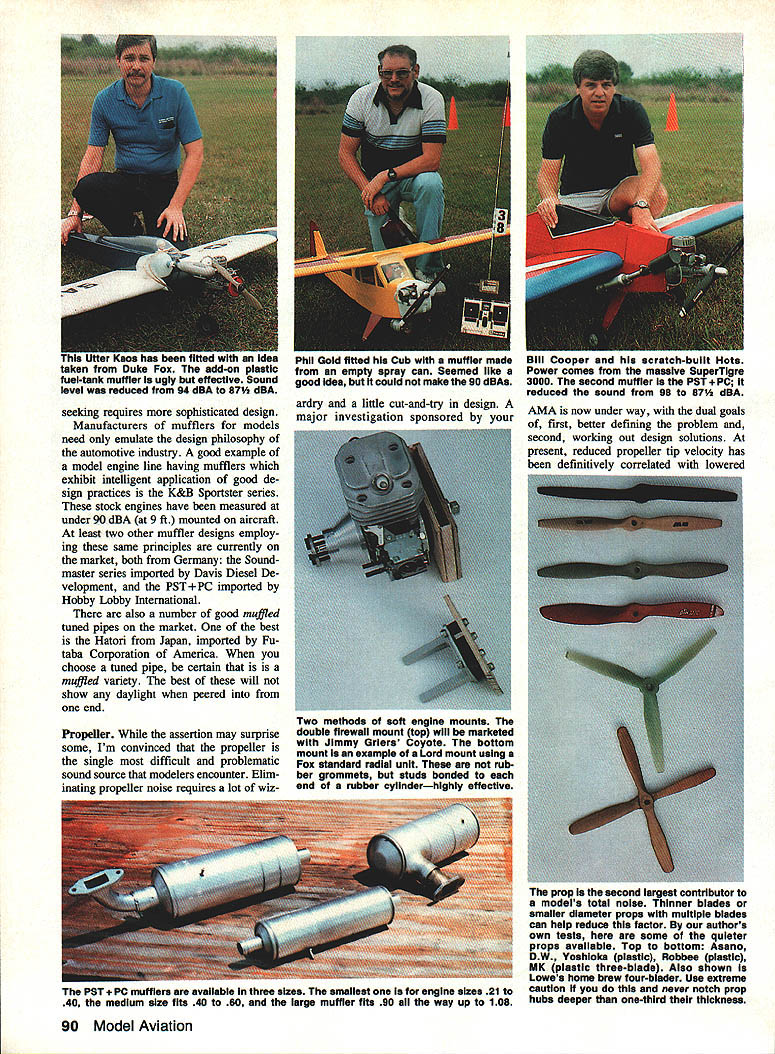
- There are commercial mufflers and muffled tuned pipes that apply sound-engineering principles (examples: K&B Sportster series; Soundmaster series; PST+PC; Hatori muffled tuned pipe). When choosing a tuned pipe, be certain it is a muffled variety (the best will not show daylight when peered into from one end).
Propeller
The propeller is often the single most problematic noise source. Eliminating propeller noise requires design work and testing. Reduced propeller tip velocity is strongly correlated with lowered noise.
Key points:
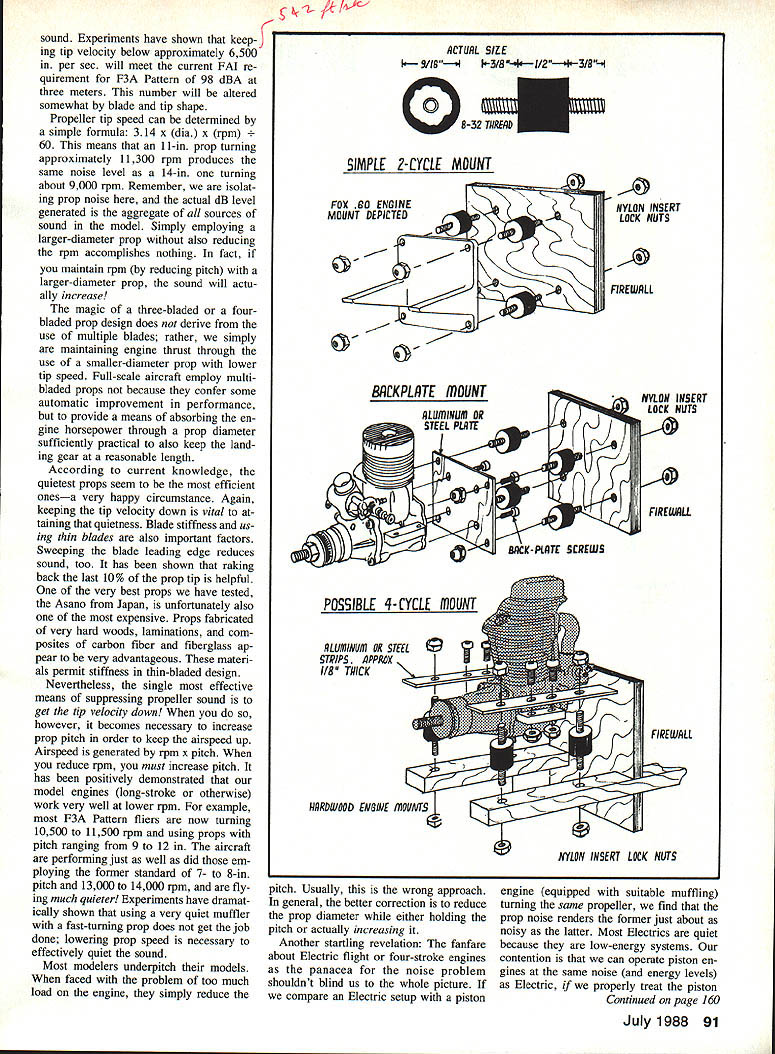
- Tip speed formula: 3.14 x (diameter in inches) x (rpm) ÷ 60.
Example: an 11-in prop at ~11,300 rpm produces approximately the same tip speed as a 14-in prop at ~9,000 rpm.
- Experiments have shown keeping tip velocity below roughly 6,500 in/sec helps meet the FAI F3A Pattern guideline of 98 dBA at 3 m (results vary with blade and tip shape).
- Lowering tip speed usually means reducing rpm and increasing pitch to retain airspeed (airspeed ≈ rpm x pitch). Many F3A Pattern fliers now run 10,500–11,500 rpm with 9–12 in pitch and achieve quieter flight with similar performance to earlier high-rpm setups.
- Simply using a larger-diameter prop without reducing rpm can increase noise. The effectiveness of multi-blade props often comes from allowing a smaller diameter at the same absorbed power.
- The quietest props tend to be the most efficient ones. Important design factors include blade stiffness, thin blades, swept leading edge, and raked-back tip (~last 10%).
- Materials that help: very hard woods, laminations, and composites (carbon fiber, fiberglass). Some high-quality props (e.g., Asano from Japan) are effective but expensive.
- Electric setups can be as noisy as piston engines if turning the same prop at similar rpm—prop noise dominates if tip speeds are the same.
- Four-stroke engines are not automatically quieter in dB terms than two-strokes. The primary frequency differs (four-strokes lower), which may sound more pleasant, but measured dB levels can be comparable. The A-weighted dB meter compensates for perceived loudness at different frequencies.
Most modelers underpitch their models. When faced with excessive engine load they often reduce pitch, which is usually the wrong approach. Better corrections are to reduce prop diameter while holding or increasing pitch.
Mechanical, Radiated, and Intake Noise
Mechanical noise includes bearings, gear mesh, and other moving parts; radiated noise includes sound from engine, muffler, and pipe surfaces; intake noise arises from direct radiation and interactions with internal gas dynamics.
Examples of measurable improvements:
- Replacing noisy bearings with new ones: ~2 dB reduction.
- Using a rubber sleeve on a tuned pipe: ~1–2 dB reduction.
- Using an intake filter or foam silencer: ~1 dB reduction (design must avoid restricting the engine).
These measures are secondary to having a quality muffler and lowering prop tip speed, but they are worthwhile.
Airframe and Vibration Isolation
Airframe noise can be significant, particularly as engine noise is reduced. It is generated by turbulent flow over surfaces and by engine-induced vibration transmitted into the airframe. Single-cylinder model engines cannot be perfectly balanced due to piston acceleration nonlinearities and connecting-rod offset; they also create torsional vibration from the impulsive firing.
Solutions and considerations:
- Enclosing the engine and exhaust inside the airframe helps some, but does not eliminate torsional vibration.
- Multiple cylinders reduce certain vibrations but are impractical for most models.
- Electric motors are smoother in some respects but still exhibit impulsive/torsional vibrations related to motor pole count.
- The most satisfactory solution is to isolate the engine from the airframe using rubber or metal isolators. Benefits include reduced airborne noise, fewer radio failures, less fuel foaming, and reduced likelihood of loosening/breakage of fittings.
- Proper isolation design is empirical: the mount system's natural frequency should be outside the engine's operating frequency range (usually lower), and isolators must withstand peak loads without bond failure. A typical .60 engine installation might use three or four Lord-type mounts about 1/2 to 3/16 in diameter in a radial pattern; the exhaust pipe should also be rubber isolated.
- Ground testing may understate airborne noise because the airframe is constrained on the ground. Airborne testing at a distance is most representative. A better ground test can be done by suspending the airframe on rubber to allow natural vibration during measurement.
Open-framework, film-covered airframes and fiberglass fuselages can be noisy; foam/plastic ready-to-fly airframes often absorb vibration well. Solid balsa airframes can perform best. Watch for vibrating pushrods and other loose rattling parts.
Intake
The intake contributes by direct radiation and by affecting internal gas dynamics. Simple measures such as a foam filter or intake silencer can give small improvements (~1 dB) if they do not restrict airflow.
A Case Study: Gold Coast Fliers (Delray Beach, FL)
The Gold Coast Fliers faced a "get quiet or get out" situation with a county park site located near picnic facilities and a Japanese museum. During a special event held about 900 ft from the flying site, model noise drowned out music and prompted the Parks Commission to threaten expulsion.
The club and county agreed to adopt the AMA suggested standard of 90 dBA at 9 ft. The club strictly enforced this rule and pursued many practical changes:
- Modified mufflers and added mufflers in series
- Baffle-style exhausts and rubber hose additions to muffler intake
- Use of larger and/or higher-pitch props to lower rpm
- Operating at reduced horsepower where feasible
The club's willingness to compromise, hard work, and rule enforcement saved the site. Members found many solutions that reduced sound without significant loss of power when properly designed. The sound from compliant two- and four-stroke engines can still be heard at long distances but is not disagreeable; neighbors stopped complaining and became interested spectators.
The case shows that prevention and proactive sound control are far better than facing irate neighbors and possible loss of a flying site.
Summary and Recommendations
- Noise reduction requires treating the total package: exhaust, propeller, mechanical components, intake, and airframe.
- The most important items are a quality muffler and reduced propeller tip speed (lower rpm and appropriate increase in pitch).
- Use rubber isolation to decouple engine vibration from the airframe.
- Make incremental improvements: replace noisy bearings, use rubber sleeves on pipes, add intake filters, and correct prop diameter/pitch combinations.
- Measure and monitor: buy a sound meter and test changes. Ground tests are useful guides but airborne measurements at operational distances are the most representative.
- Encourage industry to offer optional quiet mufflers and more high-pitch prop options in common plastic prop lines.
Don't be afraid to experiment. Properly applied sound-reduction measures can protect your flying site and your hearing.
— Ed Lowe
Transcribed from original scans by AI. Minor OCR errors may remain.

