
Third NIMAS International Record Trials
By John Martin
Meet and Venue
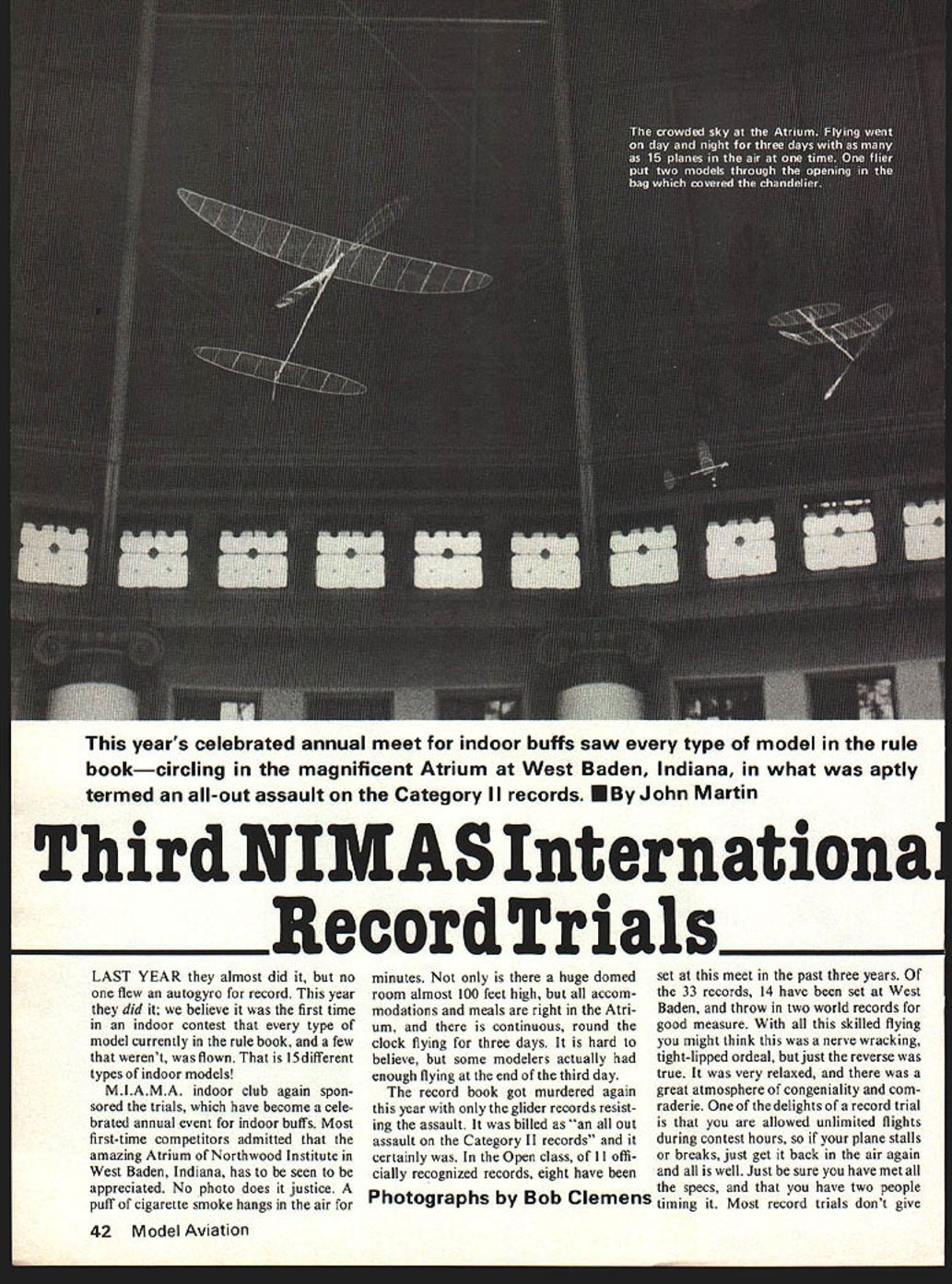
This year's celebrated annual meet for indoor buffs saw every type of model in the rule book—circling in the magnificent Atrium at Northwood Institute in West Baden, Indiana—in what was aptly termed an all-out assault on the Category II records.
Last year they almost did it, but no one flew an autogyro for record. This year they did it; we believe it was the first time in an indoor contest that every type of model currently in the rule book, and a few that weren't, was flown. That is 15 different types of indoor models!
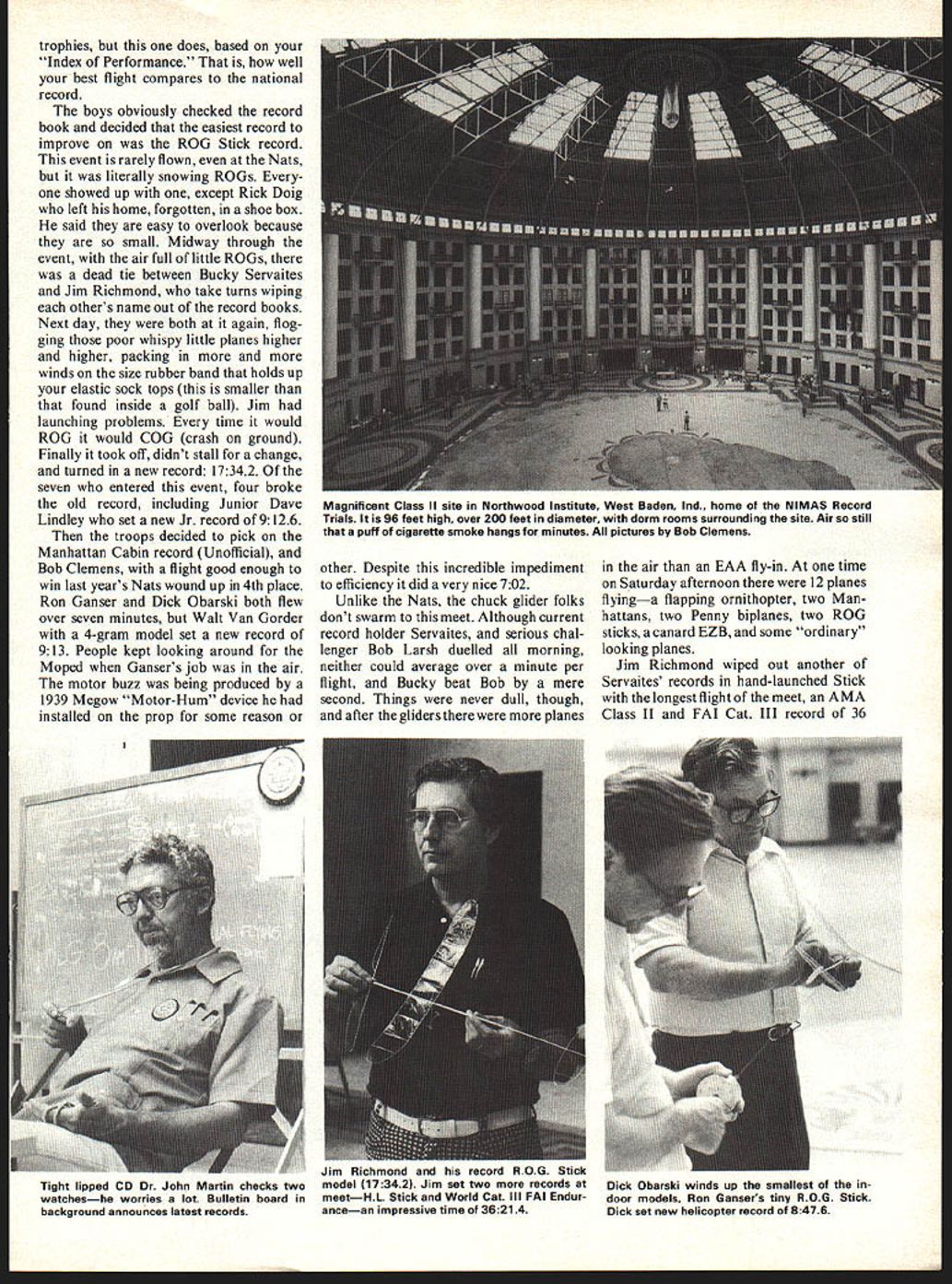
The Miami Indoor Aircraft Model Assoc. (M.I.A.M.A.) indoor club again sponsored the trials, which have become a celebrated annual event for indoor buffs. Most first-time competitors admitted that the amazing Atrium has to be seen to be appreciated. No photo does it justice. A puff of cigarette smoke hangs in the air for minutes.
Not only is there a huge domed room almost 100 feet high, but all accommodations and meals are right in the Atrium, and there is continuous, round-the-clock flying for three days. It is hard to believe, but some modelers actually had enough flying at the end of the third day.
Records and Competition
The record book got murdered again this year with only the glider records resisting the assault. It was billed as "an all-out assault on the Category II records" and it certainly was. In the Open class, of 11 officially recognized records, eight have been set at this meet in the past three years. Of the 33 records, 14 have been set at West Baden, and throw in two world records for good measure. With all this skilled flying you might think this was a nerve-wracking, tight-lipped ordeal, but just the reverse was true. It was very relaxed, and there was a great atmosphere of congeniality and comradery.
One of the delights of a record trial is that you are allowed unlimited flights during contest hours, so if your plane stalls or breaks, just get it back in the air again and all is well. Just be sure you have met all the specs, and that you have two people timing it. Most record trials don't give trophies, but this one does, based on your "Index of Performance" — that is, how well your best flight compares to the national record.
The boys obviously checked the record book and decided that the easiest record to improve on was the ROG Stick record. This event is rarely flown, even at the Nats, but it was literally snowing ROGs. Everyone showed up with one, except Rick Doig who left his at home, forgotten, in a shoe box. He said they are easy to overlook because they are so small. Midway through the event, with the air full of little ROGs, there was a dead tie between Bucky Servaites and Jim Richmond, who take turns wiping each other's name out of the record books.
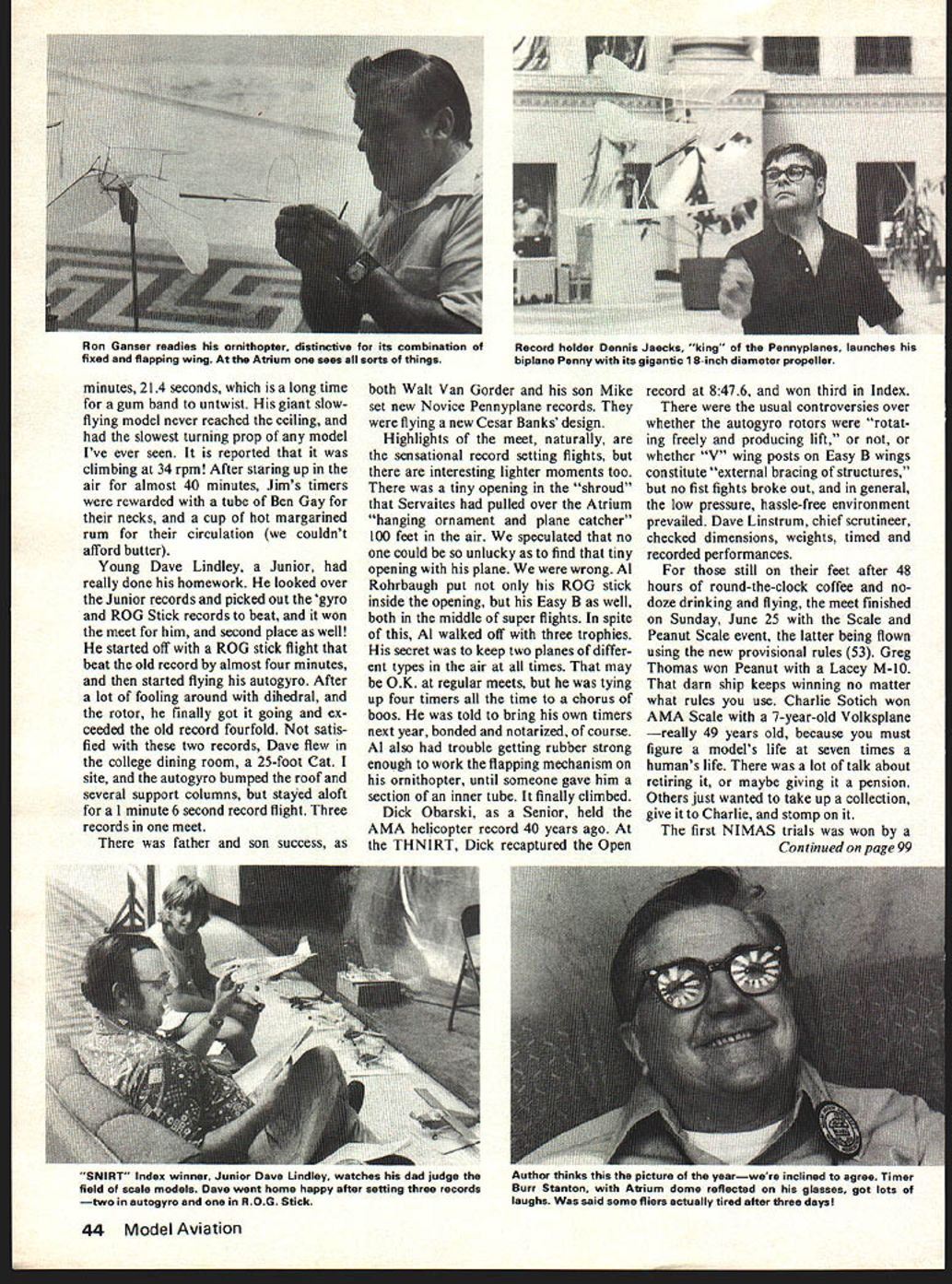
Next day, they were both at it again, flogging those poor wispy little planes higher and higher, winding more and more turns on the tiny rubber band that holds up elastic sock tops (smaller than the band found inside a golf ball). Jim had launching problems. Every time it would ROG it would COG (crash on ground). Finally it took off, didn't stall for a change, and turned in a new record: 17:34.2. Of the seven who entered this event, four broke the old record, including Junior Dave Lindley who set a new Jr. record of 9:12.6.
Then the troops decided to pick on the Manhattan Cabin record (unofficial), and Bob Clemens, with a flight good enough to win last year's Nats, wound up in fourth place. Ron Ganser and Dick Obarski both flew over seven minutes, but Walt Van Gorder, with a 4-gram model, set a new record of 9:13. People kept looking around for the moped when Ganser's model was in the air. The motor buzz was being produced by a 1939 Megow "Motor-Hum" device he had installed on the prop for some reason or other. Despite this incredible impediment to efficiency it did a very nice 7:02.
Unlike the Nats, the chuck glider folks don't swarm to this meet. Although current record holder Servaites and serious challenger Bob Larsh dueled all morning, neither could average over a minute per flight, and Bucky beat Bob by a mere second. Things were never dull, though, and after the gliders there were more planes in the air than an EAA fly-in. At one time on Saturday afternoon there were 12 planes flying—a flapping ornithopter, two Manhattans, two Penny biplanes, two ROG sticks, a canard EZB, and some "ordinary" looking planes.
Jim Richmond wiped out another of Servaites' records in hand-launched Stick with the longest flight of the meet, an AMA Class II and FAI Cat. III record of 36:21.4 (36 minutes, 21.4 seconds), which is a long time for a gum band to untwist. His giant slow-flying model never reached the ceiling and had the slowest turning prop of any model I've ever seen. It is reported that it was climbing at 34 rpm! After staring up in the air for almost 40 minutes, Jim's timers were rewarded with a tube of Ben Gay for their necks and a cup of hot margarine rum for their circulation (we couldn't afford butter).
Young Dave Lindley, a Junior, had really done his homework. He looked over the Junior records and picked out the gyro and ROG Stick records to beat, and it won the meet for him, and second place as well! He started off with a ROG stick flight that beat the old record by almost four minutes, and then started flying his autogyro. After a lot of fooling around with dihedral and the rotor, he finally got it going and exceeded the old record fourfold. Not satisfied with these two records, Dave flew in the college dining room, a 25-foot Cat. I site, and the autogyro bumped the roof and several support columns but stayed aloft for a 1 minute 6 second record flight. Three records in one meet.
There was father-and-son success, as both Walt Van Gorder and his son Mike set new Novice Pennyplane records. They were flying a new Cesar Banks design.
Notable Moments
Highlights of the meet, naturally, are the sensational record-setting flights, but there are interesting lighter moments too. There was a tiny opening in the "shroud" that Servaites had pulled over the Atrium "hanging ornament and plane catcher" 100 feet in the air. We speculated that no one could be so unlucky as to find that tiny opening with his plane. We were wrong. Al Rohrbaugh put not only his ROG stick inside the opening, but his Easy B as well, both in the middle of super flights. In spite of this, Al walked off with three trophies. His secret was to keep two planes of different types in the air at all times. That may be O.K. at regular meets, but he was tying up four timers all the time to a chorus of boos. He was told to bring his own timers next year, bonded and notarized, of course. Al also had trouble getting rubber strong enough to work the flapping mechanism on his ornithopter until someone gave him a section of an inner tube. It finally climbed.
Dick Obarski, as a Senior, had held the AMA helicopter record 40 years ago. At the meet, Dick recaptured the Open record at 8:47.6, and won third in Index.
There were the usual controversies over whether the autogyro rotors were "rotating freely and producing lift" or not, or whether "V" wing posts on Easy B wings constitute "external bracing of structures," but no fist fights broke out, and in general the low-pressure, hassle-free environment prevailed. Dave Linstrum, chief scrutineer, checked dimensions, weights, timed and recorded performances.
For those still on their feet after 48 hours of round-the-clock coffee, no-doze drinking, and flying, the meet finished on Sunday, June 25 with the Scale and Peanut Scale event, the latter being flown under the new provisional rules (53). Greg Thomas won Peanut with a Lacey M-10. That darn ship keeps winning no matter what rules you use. Charlie Sotich won AMA Scale with a 7-year-old Volksplane—really 49 years old, because you must figure a model's life at seven times a human's life. There was a lot of talk about retiring it, or maybe giving it a pension. Others just wanted to take up a collection, give it to Charlie, and stomp on it.
Conclusion
The first NIMAS trials was won by a Senior, Richard Whitten; the second by a Junior, Mike Van Gorder; and the third by a Junior, Dave Lindley. It doesn't take Sherlock Holmes to deduce that the Junior and Senior indoor records are easier to exceed for the serious younger modeler than are the Open records. The nice part about all this is that these records are being upgraded for these younger people, and they have great incentive.
In my youth, a few summers ago, the Open class times were usually much worse than the Junior and Senior times. In those days, when the vigorous competition was about 17 years old, the Open class modeler was patronized as some kind of doddering grandpa and contest results bore out this concept. The Open modeler was tolerated as a hanger-on, a well-meaning but non-serious competitor who was way off current standards. Unfortunately, that is the concept the Open class modeler now has for the Junior and Senior, and contest results prove this to be true. Except for glider, where the youthful arm can peg a plane into the rafters, the indoor records are all dominated by the Open class (over 19) modeler.
The NIMAS and the earlier record trials have done much to bring the younger state of the art up to realistic standards. Let's keep it up. Of course there are always those who feel that "old age and treachery will beat youth and skill" any time, but they are all in SAM.
The Miami Indoor Aircraft Model Assoc. plans to continue this annual unique meet, and we've already booked Northwood for the FNART (Fourth NIMAS Annual Record Trials). This will be the third weekend next June, so plan ahead. This is more than a model meet; it's a happening. If any of this type of flying sounds interesting to you, and you might like to try it yourself, see elsewhere in this issue for information on how to join the National Indoor Model Airplane Society. When the summer is over and the winter winds blow we're the only game in town. Snug and warm in the local high school gym, or such, we'll keep 'em flying. See 'ya at the FNART.
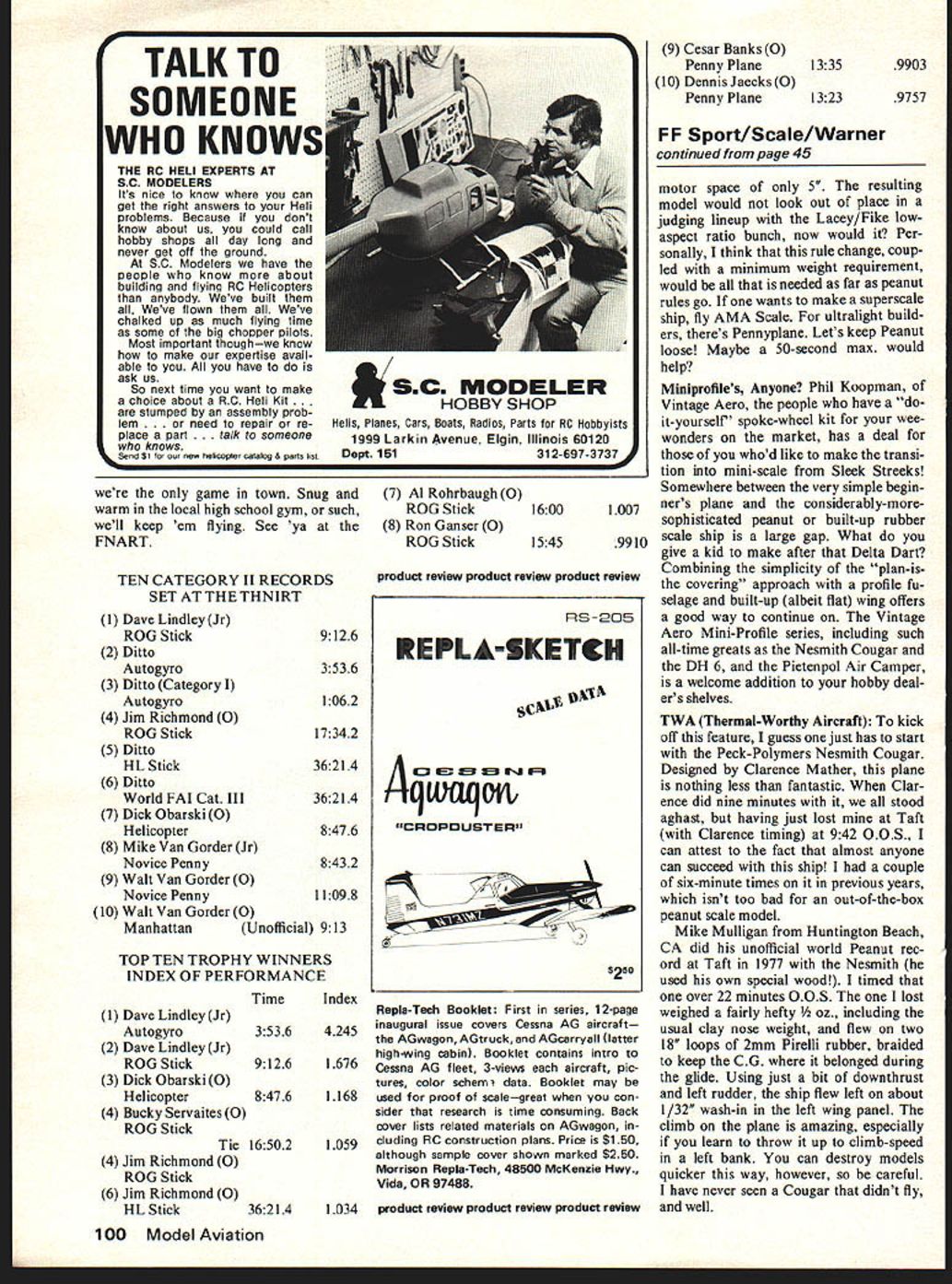
TEN CATEGORY II RECORDS SET AT THE THIRD
- Dave Lindley (Jr) — ROG Stick — 9:12.6
- Dave Lindley (Jr) — Autogyro — 3:53.6
- Dave Lindley (Jr) — Autogyro (Category I) — 1:06.2
- Jim Richmond (O) — ROG Stick — 17:34.2
- Jim Richmond (O) — Hand-Launched (HL) Stick — 36:21.4
- Jim Richmond (O) — World FAI Cat. III — 36:21.4
- Dick Obarski (O) — Helicopter — 8:47.6
- Mike Van Gorder (Jr) — Novice Pennyplane — 8:43.2
- Walt Van Gorder (O) — Novice Pennyplane — 11:09.8
- Walt Van Gorder (O) — Manhattan (Unofficial) — 9:13
TOP TEN TROPHY WINNERS
Index of Performance
- Dave Lindley (Jr) — Autogyro — 3:53.6 — Index: 4.245
- Dave Lindley (Jr) — ROG Stick — 9:12.6 — Index: 1.676
- Dick Obarski (O) — Helicopter — 8:47.6 — Index: 1.168
- Bucky Servaites (O) — ROG Stick — Tie 16:50.2 — Index: 1.059
- Jim Richmond (O) — ROG Stick — 36:21.4 — Index: 1.034
- Jim Richmond (O) — HL Stick — 36:21.4 — Index: 1.034
Transcribed from original scans by AI. Minor OCR errors may remain.

