
Thirty Years of RC Model Aviation
Peter Waters
A milestone
In 1992 the St. Paul Model RC Club (SPMRC) marked 30 years of continuous club activity. In doing so, SPMRC became the second-oldest club in Minnesota and the oldest continuously operating club in the state. With a membership of 150–200, it ranks among the largest clubs in Minnesota and likely in the top 10% in the country. Many area modeling clubs have benefited from SPMRC members.
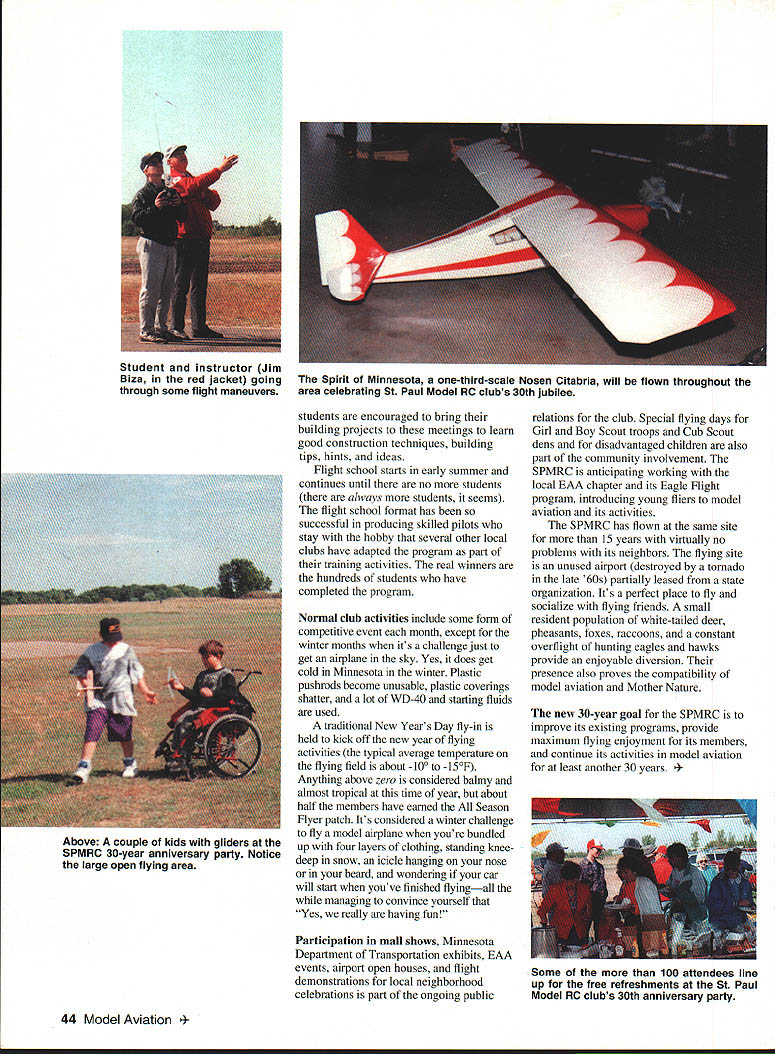
To celebrate the anniversary, the club hosted a 30-year party and family picnic in mid-September. More than 100 people attended and enjoyed abundant food and conversation. Several founding members shared colorful stories of early RC flying: large battery packs for transmitters, vacuum-tube receivers, control escapements powered by rubber bands, and ignition engines with gas-and-oil fuel mixed at the local filling station for only cents a gallon—an entertaining contrast with today’s high-tech equipment.
History and achievements
Originally organized by a group of radio amateurs as a recreational RC flying club, SPMRC quickly evolved into a competitive club focused on pattern and racing events. As the club grew, it gradually reverted to a sport-flying organization while retaining a core of skilled racers and pattern fliers. Over the years the club has developed many local and national champions.
Flight training
For many years SPMRC has been a leader in flight training. The current program includes:
- Instructor tests
- Printed checklists
- Flight-time log sheets
- Evaluation sheets for consistent instructor feedback
Students may begin in midwinter with a series of ground-school meetings covering basic aerodynamics, engines, radios, flight-safety rules, and field courtesy. Flight school starts in early summer and continues until there are no students—though there always seem to be more. Students are encouraged to bring building projects to meetings to learn construction techniques, tips, and ideas. The flight-school format has been so successful that several other local clubs have adopted it; the real winners are the hundreds of students who have completed the program and remained in the hobby.
Activities and events
Normal club activities include some form of competitive event each month except during winter when it’s often a challenge just to get an airplane into the sky. Cold Minnesota winters can wreak havoc on equipment—plastic pushrods become unusable, plastic coverings shatter, and members rely on WD-40 and starting fluids.
Highlights:
- Traditional New Year’s Day fly-in to kick off the flying year (typical field temperatures about -10° to -15°F)
- Monthly competitive events (seasonal)
- Special flying days for Girl and Boy Scout troops, Cub Scout dens, and disadvantaged children
- Participation in mall shows, Minnesota Department of Transportation exhibits, EAA events, airport open houses, flight demonstrations, and local neighborhood celebrations
Many members have earned the All-Season Flyer patch. Flying in winter—bundled in multiple layers, standing knee-deep in snow with icicles on your beard—remains a badge of honor for the hardy few.
Public relations and community involvement
SPMRC maintains active public-relations efforts, including:
- Mall shows
- State DOT exhibits
- EAA events and airport open houses
- Local flight demonstrations and neighborhood celebrations
- Special outreach days for scouts and disadvantaged children
The club anticipates collaborating with the local EAA chapter’s Eagle Flight program to introduce young fliers to model aviation.
Flying site and environment
SPMRC has flown at the same site for more than 15 years with virtually no problems with neighbors. The flying site is an unused airport destroyed by a tornado in the late ’60s and is partially leased from a state organization. It’s an ideal place to fly and socialize with flying friends.
The site supports local wildlife—white-tailed deer, pheasants, foxes, raccoons—and frequent overflights by hunting eagles and hawks. Their presence provides enjoyable diversion and demonstrates the compatibility of model aviation with the local environment.
Goals for the next 30 years
The club’s goal for the next 30 years is to improve existing programs, maximize flying enjoyment for members, and continue active participation in model aviation for at least another three decades.
Transcribed from original scans by AI. Minor OCR errors may remain.

