
Those Days of Wonder and Change
Fred Lehmberg
Introduction
Man's fascination with flight is age-old. Daedalus and his son Icarus were the first to try it in myth, and Leonardo da Vinci—one of the earliest self-taught aerodynamicists—drew flapped-wing ornithopters around 1500 that show astonishing understanding of flight dynamics. Centuries later, small models played a key role in modern aviation development: Samuel Pierpont Langley built some 40 rubber-powered aerodromes between 1887 and 1895, and Wilbur and Orville Wright used models to discover experimental truths about flight. Like these originators, many early modelers worked alone.
The Golden Age: Late 1920s–1930s
Model aviation began to change in the late 1920s and early 1930s. Stirred by the glamour of World War I aviators, movies such as Wings and Hell's Angels, and daily newspaper excitement about aviation, the American public was ready for model flying. Entrepreneurs formed small companies offering building materials and crude kits. Carl Goldberg and his boys in Chicago produced gossamer-winged models with outstanding flights. Newspapers and department stores organized modeler groups such as the Jordan Marsh Junior Aviator League. Pulp magazines, though printed on cheap paper and carrying mostly fiction, sometimes included three-view plans and solid-model articles—both contemporaneous and futuristic designs. Incidentally, many aerodynamicists of the period discounted space flight and doubted aircraft would exceed the speed of sound.
Founded by William Randolph Hearst, the Junior Birdmen of America became the largest youth organization promoting model aviation. Hearst newspapers sponsored regular indoor and outdoor contests with national championships for winners.
Early Gas-Model Controversy and the NAA
Gas model flying began to come into its own in 1932 when a young man in Philadelphia set a gasoline-powered model world record of two minutes 35 seconds. The National Aeronautic Association (NAA) sponsored a meet in 1933 where that same modeler won the Texaco Trophy for longest-flying gas model—and, because of ambiguous rules, claimed two rubber-event trophies (the Moffett and Mulvihill). Rules were quickly revised.
The 1933 misunderstanding polarized model aviation into pro-Gas and anti-Gas factions. Some state legislatures considered making gas-model flying illegal. Sensational press stories—about fire-breathing engines, tanks of explosive gasoline, and rogue models crashing through windows—fueled public alarm. The NAA intervened by organizing a Gas Model Division with regional Gas Model Chapters to educate the public and promote safe contests, shows, and demonstrations. The NAA’s lobbying and regulatory work later helped make Radio Control models legal.
San Antonio and the Rise of SAGMAA
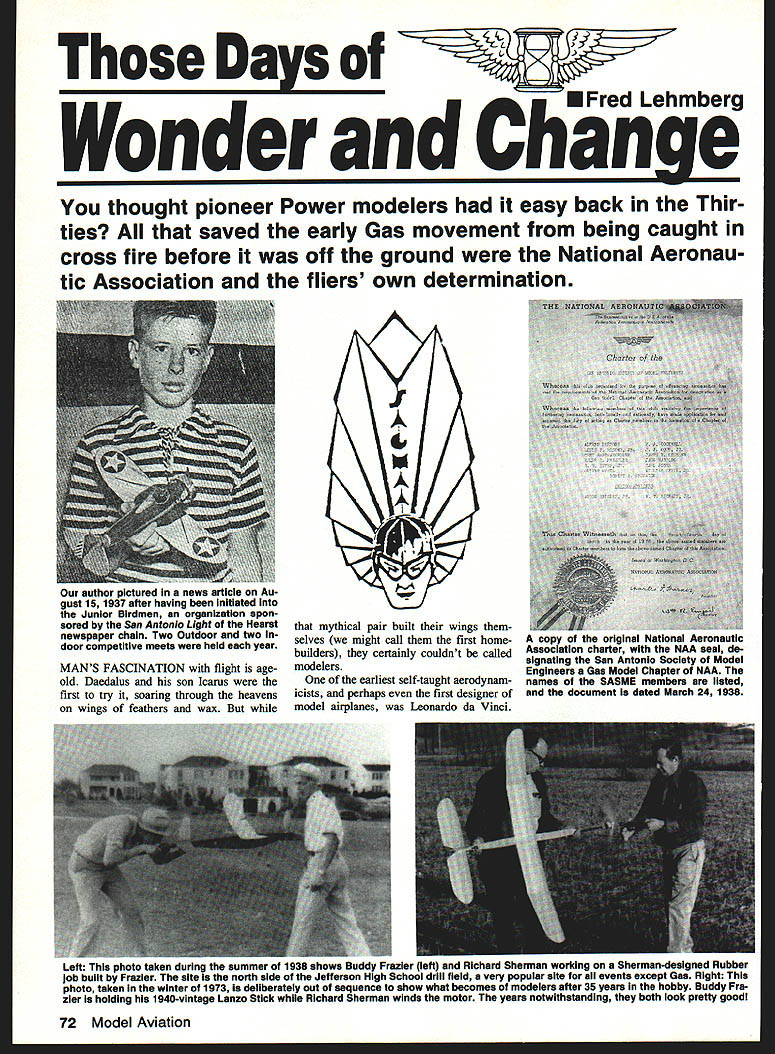
San Antonio's link in the Hearst chain was the San Antonio Light. Local Junior Birdmen included Charlie Adams, Fred Cordova, and Richard (Dick) Sherman—competent fliers who helped novices despite teen brusqueness. The Birdmen were divided into Junior (under 16) and Senior (under 21) classes, and competition was fierce.
A small-house trailer on San Antonio's south side hid a future aerospace leader: Roy Marquardt, who later founded Marquardt Aviation. This exemplifies what promoting model aviation could accomplish.
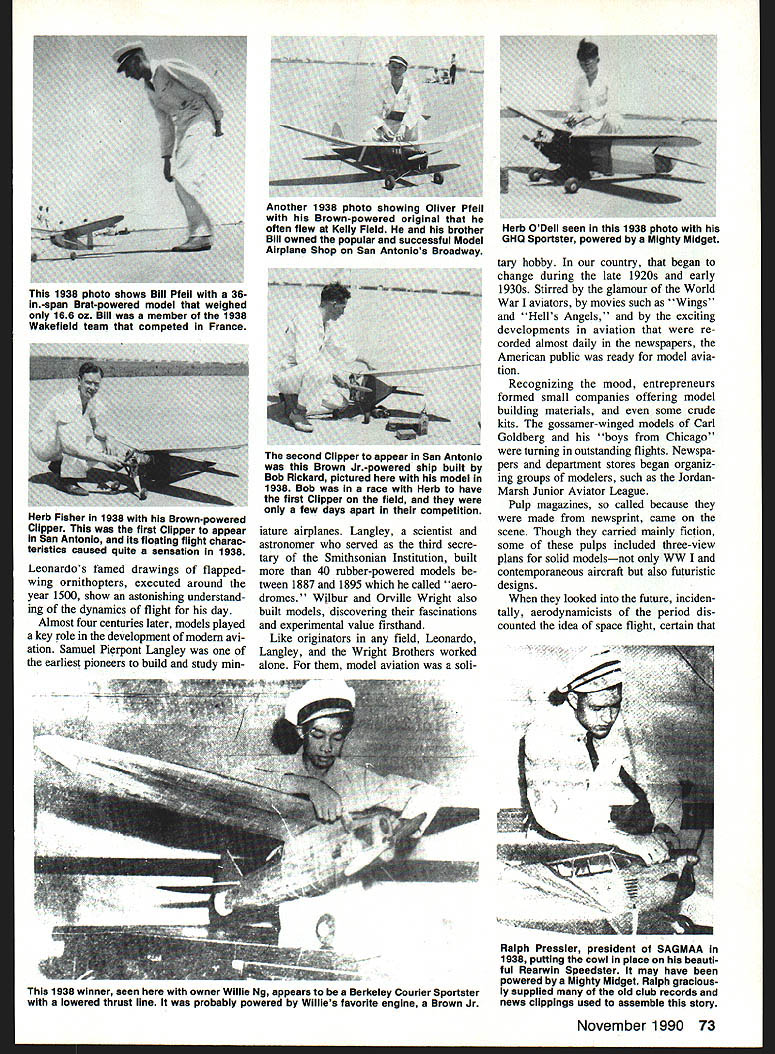
In San Antonio, the International Gas Model Airplane Association members joined an NAA Gas Model Division movement in early 1938. Ralph R. Pressler, president of the local chapter, represented San Antonio at NAA meetings. With permission of the Army Air Corps, the chapter flew at Kelly Field on Sunday mornings, attracting attention.
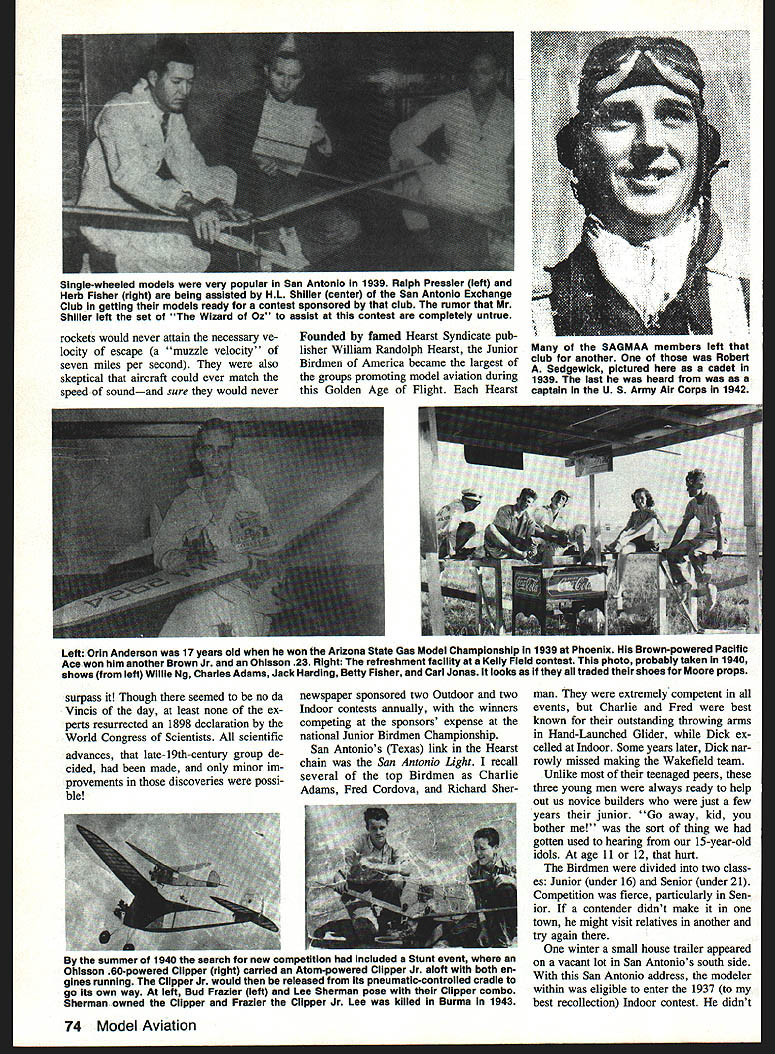
On March 24, 1938, the San Antonio Society of Model Engineers became an NAA Gas Model Chapter. Charter members included:
- Alfred Person
- Louis F. Ridder Jr.
- Gene Hartmangruber
- Ralph R. Pressler
- R. H. Estes Jr.
- Oliver Pfeil
- William Pfeil Jr.
- P. J. Cockrell
- J. J. Cody Jr.
- James E. Kessler
- Jack Harding
- Carl Jonas
- Robert A. Sedgewick
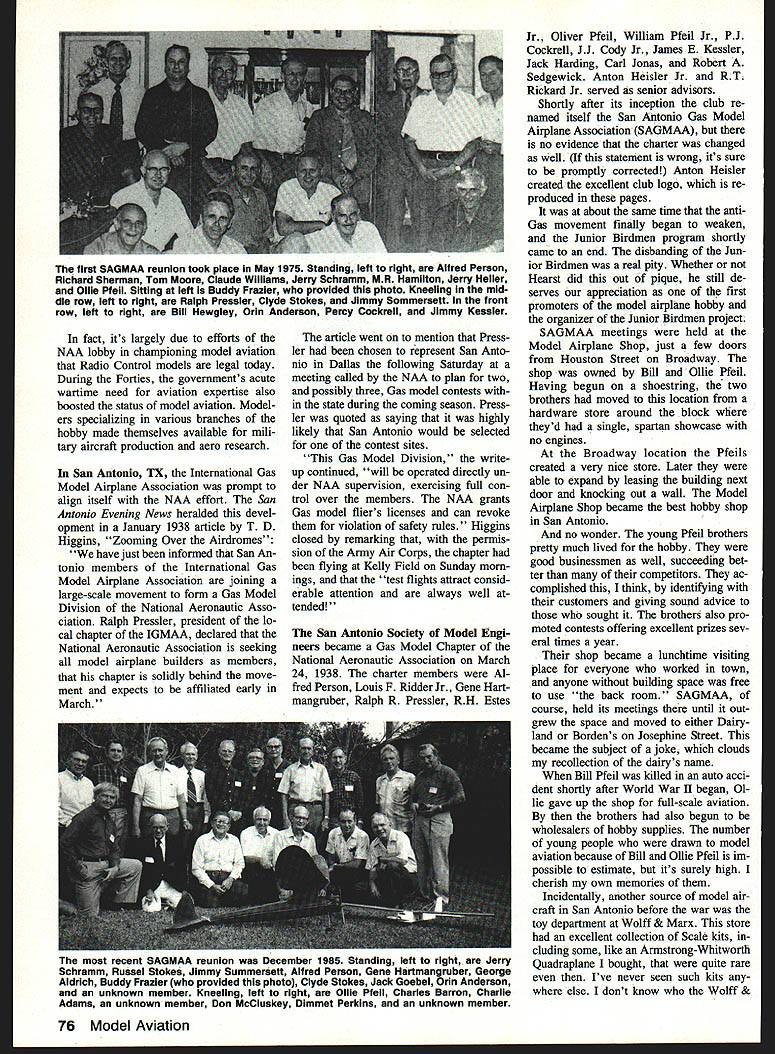
Anton Heisler Jr. and R. T. Rickard Jr. served as senior advisors. Shortly after, the club renamed itself the San Antonio Gas Model Airplane Association (SAGMAA). Anton Heisler created the club logo.
SAGMAA meetings were held at the Model Airplane Shop on Broadway, owned by Bill and Ollie Pfeil. Starting modestly, the Pfeil brothers expanded the shop and became successful hobby wholesalers and community promoters. The shop offered a gathering place, a “back room” for builders, and hosted contests with attractive prizes. After Bill Pfeil was killed in an auto accident shortly after World War II began, Ollie moved into full-scale aviation.
Another San Antonio source for model kits was Wolff & Marx’s toy department, notable for a rare selection of scale kits.
Youth, Membership, and Costs
NAA recommended leaving minimum age for membership to chapters; SAGMAA set 12 years as the minimum, with a young member accompanied by an adult. New young members quickly learned the hobby's cost realities: a scratch-built rubber model with a 3–4 ft wingspan cost about $1.50 (including rubber); a seven-foot-span gas model about $10 (excluding the engine). Engines ranged from roughly $11 to over $21. Many builders earned their living as draftsmen, earning less than $30 a week, so the hobby required significant commitment.
Contests and Texas Successes (1938–1939)
With Ralph Pressler as president, SAGMAA leveraged its IGMAA background to become a strong NAA chapter. Pressler's leadership helped organize an ambitious 1938 contest season across Texas—Corpus Christi, San Antonio, Dallas, Houston, and Fort Worth—exceeding initial expectations.
At Corpus Christi, 10 San Antonio entrants (one woman, Betty Fisher) took eight places out of 20. Notable winners from San Antonio:
- Anton Heisler — Flying Scale (1st, one group)
- Bob Rickard — Gas Model Duration (1st)
- Gene Hartmangruber — Open (2nd), Open Gas Model Duration (1st, Senior)
- Ed Martinez — Open (3rd, Senior)
- Charlie Adams — Class C Rubber (1st, Senior)
- Willie Ng — Class D Rubber (1st, Junior)
Fort Worth featured a limited-engine run event judged by engine-run durations. Out of 52 entrants, the top finishers included Bob Rutledge (Houston, 3:50.5) and Ed Martin (San Antonio, 3:26.5). A local press anecdote: Martin's plane landed on a grazing horse, which kicked the model to pieces, but his record stood.
The San Antonio meet at Kelly Field drew an estimated 7,000–10,000 spectators for 70 contestants. Herb Fisher won first place in the limited-engine run; Orin Anderson and Bob Rickard placed sixth and seventh. Betty Fisher won the Women's Event. Pressler used showmanship—awarding a prize for the loudest audience applause and staging the “Wrong Way Corrigan” Le Mans-style start—to entertain crowds. Bob Rickard won the Wrong Way Corrigan event.
Dallas saw Willie Ng win; Bill Pfeil earned a place on the U.S. Lord Wakefield team at the 1938 NAA Nationals and went to France to compete for the British trophy.
The 1939 season was even larger. The Southwest Gas Model Association (SWGMA) scheduled contests across Texas from May through September (Abilene, San Antonio, Houston, Fort Worth, Mineral Wells, Dallas, Corpus Christi, Waco, Wichita Falls), with most contests spaced about two weeks apart to allow repairs. Local merchants and clubs contributed generous prizes; by 1941 prize pools reached about $1,000.
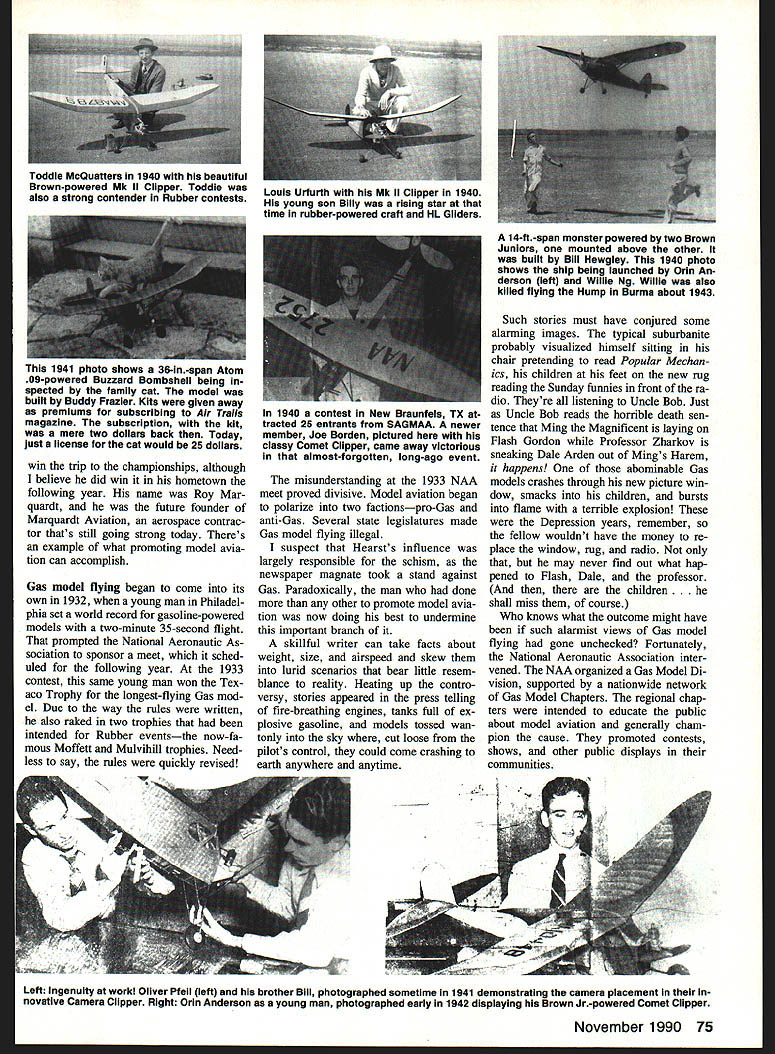
San Antonio’s strong roster in 1939 included Herb Fisher, Bob Rickard, Orin Anderson, Willie Ng, Anton Heisler, Percy Cockrell, Alfred Person, Carl Jonas, Jack Harding, Bob Sedgewick, Joe Bordon, J. A. Carney and son Jimmy, Bill Hensley, and Clyde Stokes. Younger SAGMAA Rubber fliers included Jack Gobel, W. L. Vavricks, Buddy Frazier, Toddy McQuatters, Hilton Mollenhauer, Hilton Mollenhauer, Charles Barron, and Alfred Lehmberg. Many contests were held at the Thomas Jefferson High School drill field—a large, mowed area ideal for Rubber Free Flight.
A few contest anecdotes:
- At a 1939 San Antonio meet (won by Sid Smart of Dallas), J. A. Carney’s model was sliced in half by another plane’s propeller; he repaired it and returned to finish.
- Jerry Heller, a novice who had been building for less than a year, caught a thermal at Corpus Christi and flew a Comet Zipper for 1:10:55.2. Because he hand-launched (not rise-off-ground), the record could not be officially recognized.
- Gene Hartmangruber won a small-bore engine event at Corpus Christi.
The Zipper and Rule Changes
In 1939 Carl Goldberg’s Comet Zipper design came to dominate contests. So many wins prompted calls for rule changes. In 1941 new rules were adopted:
- 8 oz per sq ft wing loading retained
- Engine run reduced to 20 seconds (from longer runs)
- 80 oz per cu in engine displacement power-loading rule imposed to limit maximum height
These rules dampened the Zipper blitz by controlling climb and altitude, analogous to later debates about Radio Control assistance.
Publicity, Records, and Public Demonstrations
SAGMAA members staged publicity feats: club members based at Kelly Field built a 13-ft model powered by two Brown Jr. engines, flown by Willie Ng and Orin Anderson for promotional photos. Bill and Ollie Pfeil installed a camera in a Clipper model and captured aerial photos with a timer. Walter Lehmann built a successful replica of a Good Brothers RC model. The author set a Class D Indoor Stick record.
The War Years and Aftermath
December 7, 1941 (the day after the author's Class D record), USA entry into World War II halted many hobby activities. Kelly Field was closed to civilian flying. By the end of 1941, SAGMAA had grown to about 70 members, but many enlisted or joined war work; by early 1942 the roster dropped to about 15 active members.
Several SAGMAA members supported the national war effort and aviation research. At least three—Gene Hartmangruber, Orin Anderson, and the author—accepted invitations from the National Advisory Committee for Aeronautics (NACA) to build models for wind-tunnel testing at Langley Field, Virginia. Tragically, at least two members, Willie Ng and Lee Sherman, were killed flying “the Hump” in India.
Organization and 1939–1940 Programs
The NAA–SAGMAA alliance proved strong. At an organizational meeting at the end of 1938, officers were elected and a 12-point program adopted for 1939. Pressler served as president for both SAGMAA and the SWGMA region. The 12-point program included:
- scheduling model development and experimentation
- staging open-house meetings to educate the public
- improving management of flying activities at various locations
In 1940 the rapid growth in the NAA Gas Model Division encouraged formation of a separate national body—the Academy of Model Aeronautics—affiliated with the NAA and the Fédération Aéronautique Internationale. Model airplanes had come of age.
A static show in May 1940 displayed nearly 1,000 models at the Express Publishing Company auditorium, followed by a public flying demonstration at Kelly Field. The 1940 State Meet at Kelly Field, sponsored by the San Antonio Exchange Club, drew 1,000 spectators and concluded ahead of schedule despite 137 entrants. Contest procedures were strict: models were weighed before flight, and competitors had limited time windows to start engines and launch; attempts and penalties were carefully recorded to discourage delays and sandbagging.
At the 1940 meet, eight Zippers were lost; one belonging to Hilton Mollenhauer was recovered five miles away at Alamo Downs racetrack. Rule changes and new designs continued to evolve through 1941.
Club Life, Publicity, and Goodwill
Publicity and community goodwill often helped the club. For example, high school caretaker “Cannonball” Smith assisted model retrievals from roofs after reading about SAGMAA’s activities in local papers. The local press eagerly covered colorful meet incidents that drew crowds into the hobby.
Acknowledgments and Closing
For assistance in preparing this article, the author thanks Ralph Pressler, who preserved many club records and clippings, Buddy Frazier and Jim Summersett for photographs, and the San Antonio Light and the publishers of the Express and Evening News for their support.
Revisiting those days of wonder and change has been a happy experience. Many memories—and perhaps dreams—have lit the author's way.
Transcribed from original scans by AI. Minor OCR errors may remain.

