
Thoughts About Lowering Engine Noise
OBJECTIVE
The purpose of this article is to present three simple, practical, and effective steps that the average RC sport flier can take to reduce the noise level of his or her model aircraft. These steps are:
- Buy or make an effective muffler.
- Reprop your engine.
- Readjust some of your flying methods.
By following these procedures you will, in effect, "sound process" your models. The rewards are considerable and will justify your efforts:
- You will find flying more pleasurable at lower sound levels.
- You will be surprised at the minimal effects on actual flying with a quieter aircraft.
- You will gain the satisfaction of taking positive, constructive action to help assure the future of our hobby/sport.
The ideas offered here result from experimenting and working with readily available products and materials, using construction techniques feasible in most modelers' workshops. Since I do not believe in reinventing the wheel, I reviewed the wealth of noise articles and ideas appearing over the past several years in model aircraft publications, including Model Aviation, Radio Control Modeler, and RC Report. I am basing these efforts on research, experiments, and products offered by a number of individuals and companies, including Gordon Banks (RC Report), Bob Davis (Davis Diesel Development), Duke Fox (Fox Engines), John Hunton (K&B Manufacturing), Don Lowe (AMA President), United Model Products, Jim VanSant (Bucks County RC Club), and others who have contributed to sound-reduction efforts.
While research continues to find better ways to lessen the sound our models make, the following practical information and simple solutions can be put into practice now. — Gil Weiss
What You Need to Do
Step No. 1 — Use an effective muffler
The single-chamber expansion mufflers that come with many current-production engines do not do the job required. We must better cool and control the expanding exhaust gases by using technology from both automotive mufflers and gun silencers. Effective mufflers need multiple expansion chambers or pipes with small holes surrounded by sound-absorbing material to cut down high-frequency noise, which is the greater annoyance. Experimentation with different silencer configurations for each model's specific design will help determine which arrangement achieves optimal sound reduction while least hindering performance.
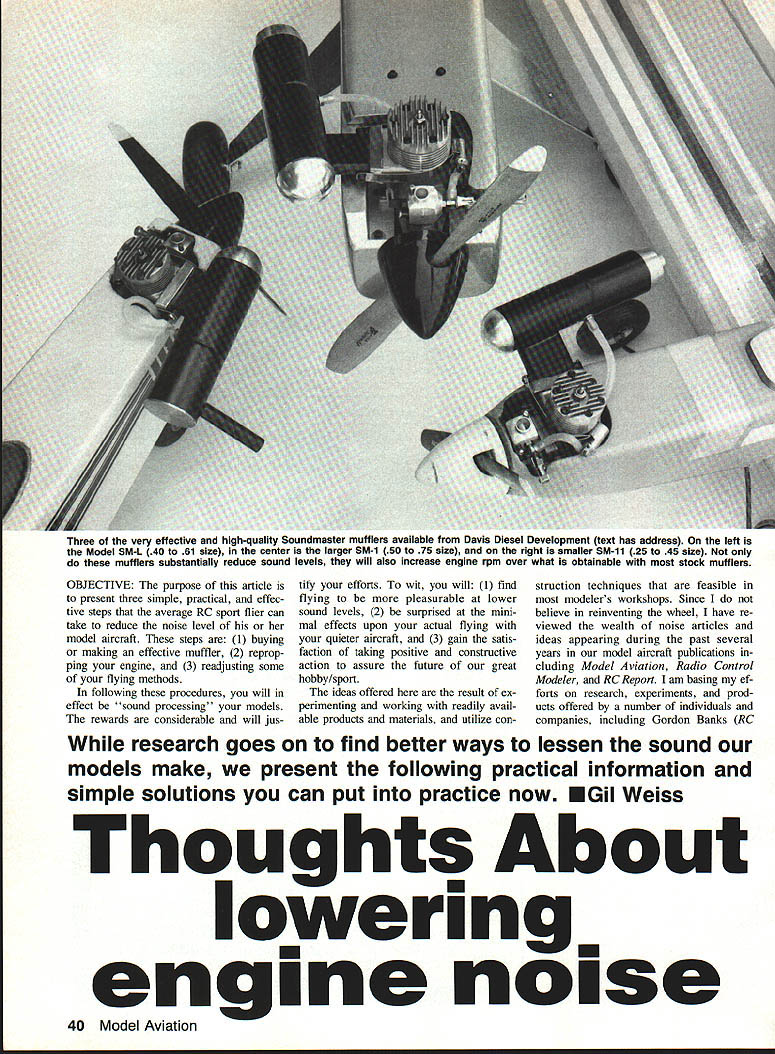
One final but very important point: bigger is better where mufflers are concerned. At this point you must make personal decisions relative to time, money, and effort. A highly effective commercial muffler I recommend is the Soundmaster, available from Davis Diesel Development Co., Milford, CT (203-877-1670). I didn't say "the least expensive," but considering their quality and ease of installation, these imported mufflers are good value. Several sizes and configurations are offered, including silenced tuned pipes and four-stroke models. The type of flying you do and the aircraft used determines the size you'll need. Simple adapters configure each muffler for different engines.
Using such mufflers can actually increase engine performance by a few hundred RPM. The Soundmaster utilizes several internal baffles in conjunction with an exhaust pipe filled with tiny holes; gases enter off-center and set up a swirling effect which seems to "tune" the muffler for increased performance. Tubing may also be attached to the end of these mufflers to further reduce sound and redirect exhaust residue.
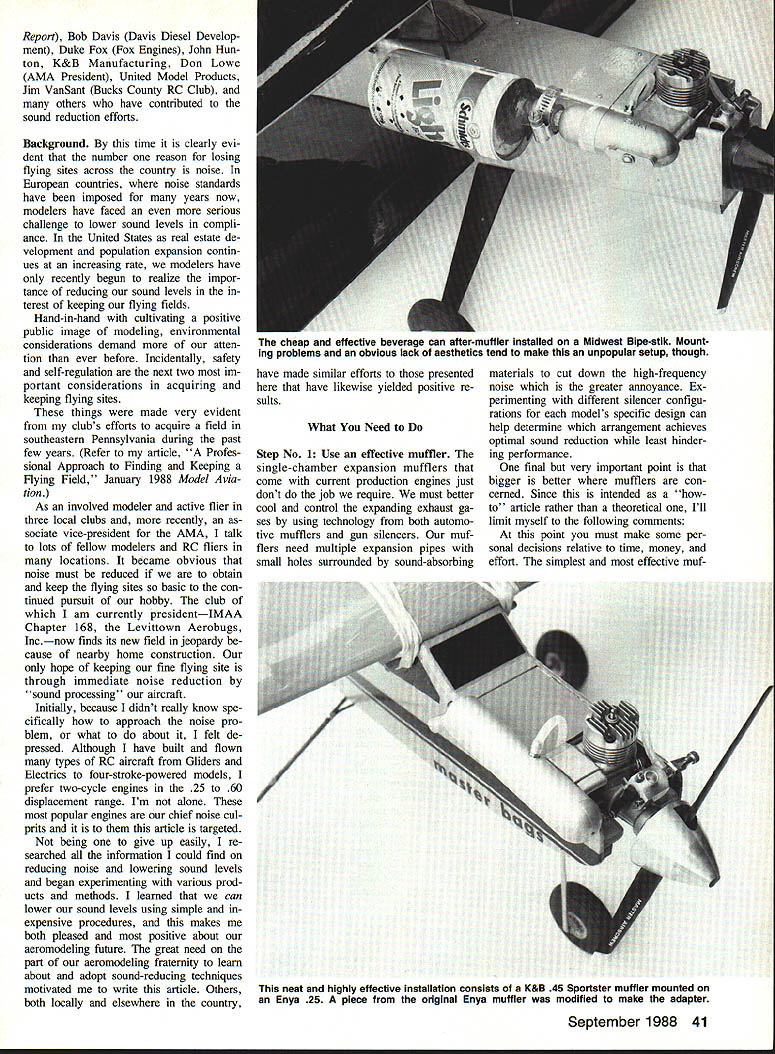
A low-cost, do-it-yourself approach is to add an aftermarket expansion chamber that provides additional exhaust gas cooling. You can use a polyethylene 8- to 10-oz. fuel tank or an empty beverage can. I opted for the can, which seems to cool things better. Enlarge the pop-top opening and install a 3-in. piece of silicone tubing as a pipe connector, but using high-temperature RTV silicone sealer (the red automotive type). Make eight 1/64-in. holes in the rear of the can or fuel tank, then clamp it onto the end of your engine's regular muffler. It is somewhat large and unsightly and poses mounting challenges, but it does work. A simple aluminum clamp screwed to a plywood plate on the fuselage helps keep the aftermarket chamber in place.
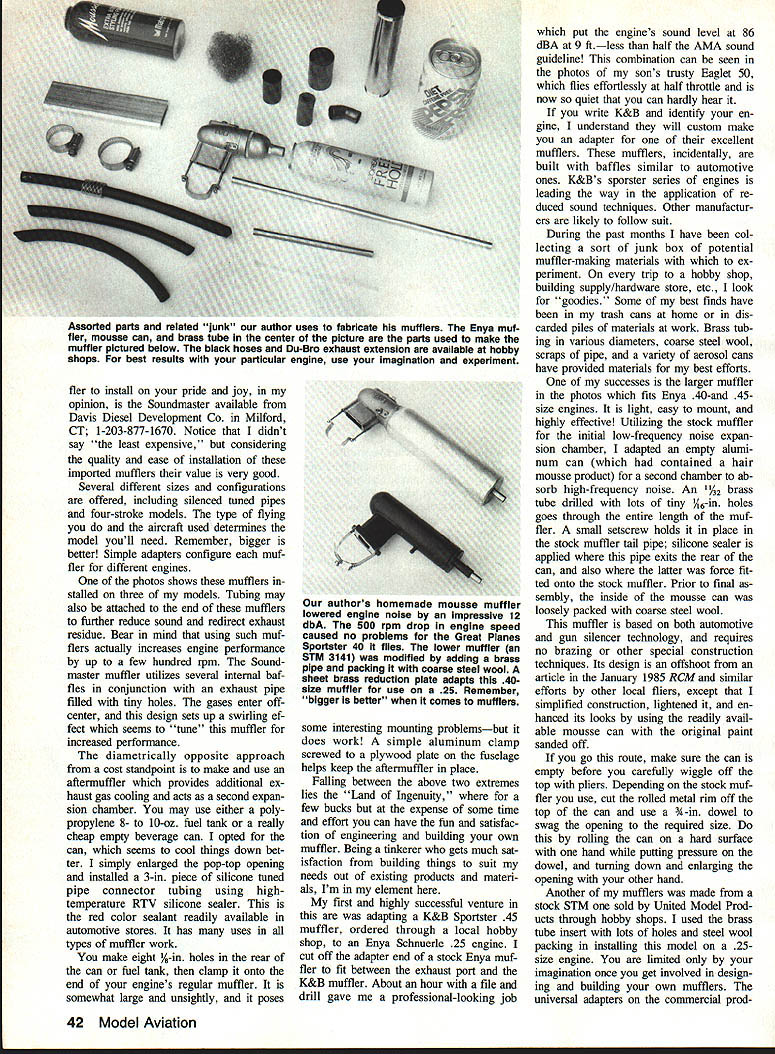
Between commercial and do-it-yourself extremes lies the "Land of Ingenuity," where, for modest cost and some effort, you can design and build your own muffler. I adapted a K&B Sportster .45 muffler to an Enya .35 by cutting off the adapter end of a stock Enya muffler to fit between the exhaust port and the K&B muffler, finishing the adapter with a file and drill. The result reduced my engine's sound level to 86 dBA at 9 ft.—less than half the AMA sound guideline—and the engine now flies effortlessly at half throttle. If you write K&B and identify your engine, they will custom make an adapter for one of their mufflers. K&B mufflers use baffles similar to automotive ones; their Sportster series is leading the way in reduced-sound applications.
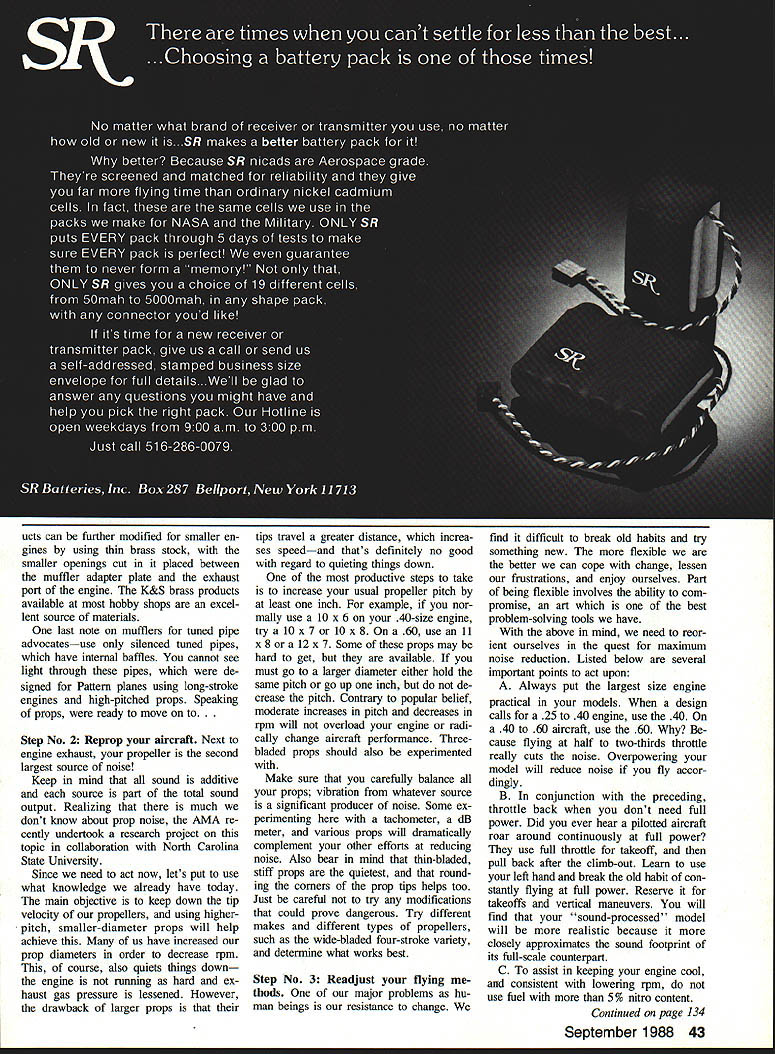
Collecting a "junk box" of potential muffler materials is useful: brass tubing in various diameters, coarse steel wool, scraps of pipe, and empty aerosol cans are good sources. One successful design I built for Enya .40–.45 engines used the stock muffler as an initial low-frequency expansion chamber and an empty aluminum can as a second chamber to absorb high-frequency noise. A 1/2-in. brass tube drilled with many 1/64-in. holes runs the length of the muffler; a small setscrew holds it in the stock muffler tail pipe, and silicone sealer is applied where this pipe exits the rear of the can and where the can was forced fit onto the stock muffler. Prior to final assembly, the inside of the can was loosely packed with coarse steel wool.
Products can be modified for smaller engines by using thin brass stock, placing the smaller openings between the muffler adapter plate and the engine exhaust port. K&S brass stock available at many hobby shops is an excellent source of material.
One last note for tuned-pipe advocates: only use silenced tuned pipes that have internal baffles. You cannot see light through these pipes; they were designed for pattern planes using long-stroke engines and high-pitched props.
Step No. 2 — Reprop your aircraft
Next to engine exhaust, the propeller is the second-largest source of noise. All sound is additive, so each source contributes to the total sound output. To reduce prop noise, the main objective is to keep down tip velocity. Using higher-pitch, smaller-diameter props will help achieve this.
Many modelers have increased prop diameter to decrease RPM, which quiets the engine because it is not running as hard and exhaust gas pressure is reduced. However, larger prop tips travel a greater distance and may increase tip speed, which is counterproductive for quieting. One productive step is to increase your usual propeller pitch by at least one inch. For example:
- If you normally use a 10 x 6 on a .40-size engine, try a 10 x 7 or 10 x 8.
- On a .60, try an 11 x 8 or a 12 x 7.
Some of these props may be harder to find, but they are available. If you must go to a larger diameter, either hold the same pitch or go up one inch in pitch, but do not decrease the pitch. Contrary to popular belief, moderate increases in pitch and decreases in RPM will not overload your engine or radically change aircraft performance. Experiment with three-bladed props as well.
Carefully balance all props; vibration from any source is a significant producer of noise. Use a tachometer, a dB meter, and various props to determine what works best with your setup. Thin-bladed, stiff props are generally the quietest, and rounding the tips helps too. Be careful not to attempt any modifications that could be dangerous. Try different brands and types of propellers, such as wide-bladed four-stroke props, to determine the quietest and best-performing option.
Step No. 3 — Readjust your flying methods
One major human problem is resistance to change. Flexibility and willingness to compromise are valuable problem-solving tools. To achieve maximum noise reduction, we need to reorient some flying habits. Important points to act upon:
- A. Always install the largest practical engine for your model. When a design calls for a .25 to .40, use the .40. On a .40 to .60 aircraft, use the .60. Why? Flying at half to two-thirds throttle significantly cuts noise. Overpowering the model will reduce noise if you fly accordingly.
- B. Throttle back when you don't need full power. Use full throttle for takeoff and climb-out, then reduce power. Break the habit of constantly flying at full throttle—reserve it for takeoffs and vertical maneuvers. A "sound-processed" model will often sound more realistic, closer to its full-scale counterpart.
- C. To assist in keeping your engine cool (consistent with lower RPM), do not use fuel with more than 5% nitro content.
Background
For a number of reasons we are losing flying sites across the country. Noise standards have been imposed in European countries for years; now modelers face similar challenges in the United States as real estate development and population expansion continue. Modelers have begun to realize the importance of reducing sound levels to help keep flying fields. Cultivating a positive public image and attending to environmental considerations are essential now more than ever. Safety and self-regulation are also important factors in acquiring and retaining flying sites. These lessons were evident to clubs working to acquire fields in southeastern Pennsylvania (see "Professional Approach: Finding and Keeping a Flying Field," January 1988 Model Aviation).
As an involved modeler and active flier in three local clubs, a former AMA associate vice-president, and current president of AMA Chapter 168, Levittown Aerobugs, Inc., I have seen how nearby home construction can jeopardize a field. Immediate noise reduction and sound-processing of aircraft can help preserve flying sites.
Initially I felt depressed because I didn't know how to approach the noise problem. Although I have built and flown many types of RC aircraft, I prefer two-cycle engines in the .25 to .60 displacement range—popular engines that are often chief noise culprits. I researched available information, experimented with products and methods, and learned that simple, inexpensive procedures can yield practical and positive improvements. I am optimistic about the future of aeromodeling if more of our fraternity adopts sound-reducing techniques.
Others, both locally and elsewhere, have made similar efforts and achieved positive results.
What is needed
- Use an effective muffler (commercial or well-designed homemade).
- Reprop to reduce prop tip velocity and vibration.
- Adjust flying methods: use appropriately larger engines, throttle back when possible, and limit fuel nitro to 5% or less.
Adopting these steps will significantly reduce model noise and help preserve flying sites for the future.
Transcribed from original scans by AI. Minor OCR errors may remain.

