
Three Generations of Scale Modelers
Pa Pa Ramon A. Torres (first generation)
Pa Pa Ramon A. Torres, as most of us came to know him, started modeling airplanes in 1933 at the age of ten. He made nonflying models from cigar boxes. Young Ramon grew up with several kids who became modelers and later selected careers in full-scale aviation in their native Cuba. Ramon had wanted to join his friends in this field, but parental pressure and other influences prompted him to enter the field of electronics.
By the mid-1950s, Ramon worked for AT&T in Havana, Cuba, and opened one of only two hobby shops in the country. His wife, Victoria, worked in the shop during the day, and he worked there in the evenings. Victoria became proficient with Control Line (CL) models during this time.
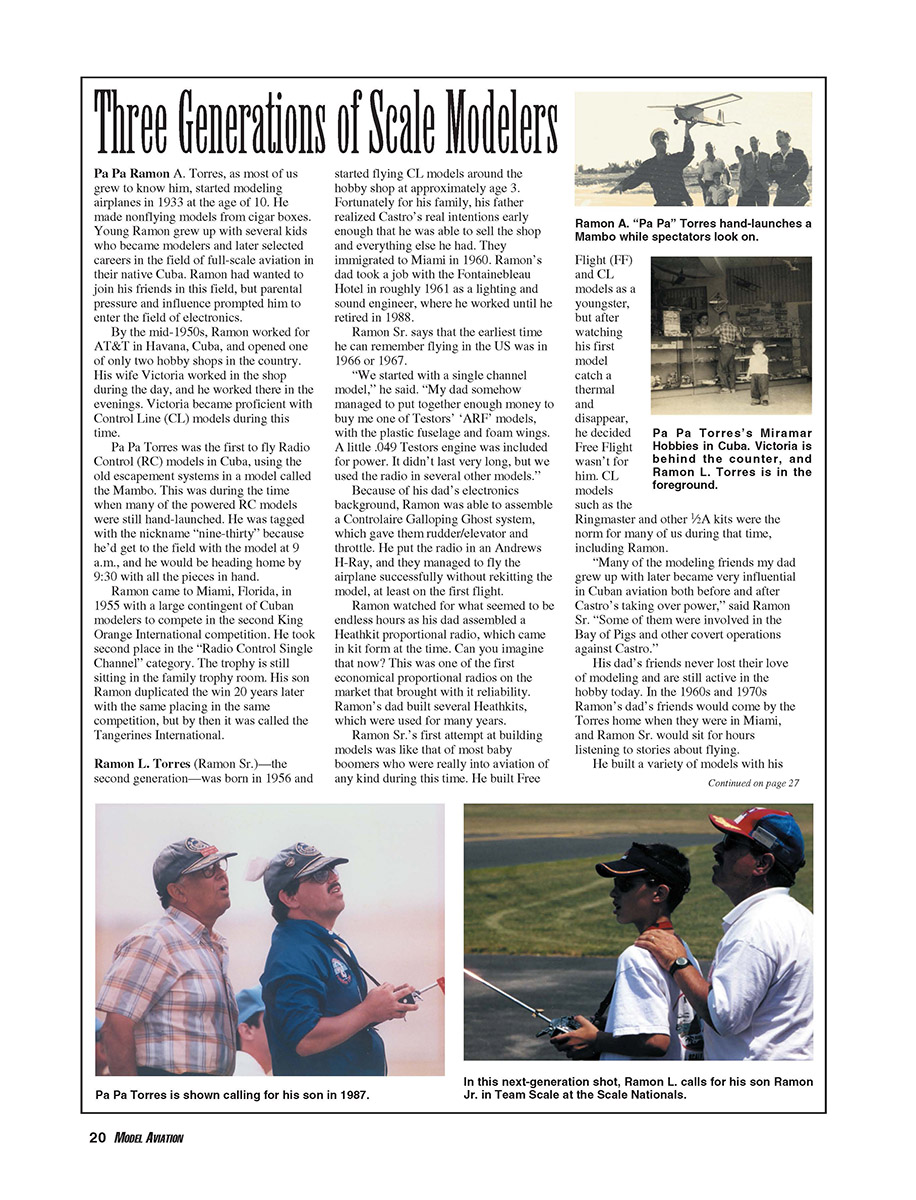
Pa Pa Torres was the first to fly Radio Control (RC) models in Cuba, using old escapement systems in a model called the Mambo. This was during the era when many powered RC models were still hand-launched. He earned the nickname "nine-thirty" because he would get to the field with a model at 9:00 a.m. and often be heading home by 9:30 with all the pieces in hand.
Ramon came to Miami, Florida, in 1955 with a large contingent of Cuban modelers to compete in the second King Orange International competition. He took second place in the Radio Control Single Channel category. The trophy still sits in the family trophy room. His son would duplicate the same placing 20 years later in the same competition (then called the Tangerines International).
Ramon L. Torres (Ramon Sr.) — second generation
Ramon L. Torres (Ramon Sr.) was born in 1956 and started flying CL models around the hobby shop at approximately age three. In 1960, after his father recognized Castro’s intentions, the family sold the shop and everything else they had and immigrated to Miami. Ramon Sr.’s father later took a job with the Fontainebleau Hotel around 1961 as a lighting and sound engineer, a position he held until his retirement in 1988.
Ramon Sr. says the earliest time he remembers flying in the U.S. was in 1966 or 1967.
"We started with a single-channel model," he said. "My dad somehow managed to put together enough money to buy me one of Testors' ARF models, with a plastic fuselage and foam wings. A little .049 Testors engine was included for power. It didn't last very long, but we used the radio in several other models."
Because of his father's electronics background, Ramon was able to assemble a Controlaire Galloping Ghost system, which provided rudder, elevator, and throttle control. He installed the radio in an Andrews H-Ray and they managed a successful first flight without major rework.
Ramon watched for endless hours as his dad assembled a Heathkit proportional radio kit — one of the first economical proportional radios on the market that brought much more reliable control. Ramon’s father built several Heathkits that were used for many years.
Ramon Sr.'s early building was typical of baby boomers passionate about aviation: Free Flight (FF) and CL models. After his first model caught a thermal and disappeared, he decided Free Flight wasn't for him. CL models such as the Ringmaster and other 1/2A kits were his early staples.
"Many of the modeling friends my dad grew up with later became very influential in Cuban aviation both before and after Castro took power," said Ramon Sr. "Some were involved in the Bay of Pigs and other covert operations against Castro."
Those friends never lost their love of modeling and remained active in the hobby. In the 1960s and 1970s they would visit the Torres home when in Miami, and Ramon Sr. would sit for hours listening to flying stories.
He built a variety of models with his dad, including:
- Royal Cessna 310
- P-51 Mustang
- Sig Clipped Wing Cub
- Numerous Ugly Stiks
In the early 1970s, Quarter Midget, Ugly Stik, and Quickie 500 racing were popular in South Florida; most weekends were spent racing or preparing for races.
In 1972 Ramon Sr. bought a Sig Chipmunk, an aircraft that resembled the later crop of purpose-built fun-fly planes with a profile fuselage and plastic shells. He and his father worked with fiberglass and vacuum-forming to improve the model, producing a new canopy and cowling. The modified Sig Chipmunk flew successfully in competition for several years.
Ramon started college in Gainesville, Florida, in 1974. He continued racing for about a year, but changing rules and limited time and money while in college led him to focus more on building Scale models, an interest he still pursues.
His modeling background led to a degree in aerospace engineering and an MBA. He won an AMA scholarship for $500 in 1974. Modeling can be a strong influence on young people in many ways.
Around 1975, a friend of Ramon Sr.'s father from Cuba, Fred Campos — a master scale builder who was working for Beech Aircraft Corporation in Wichita, Kansas — visited Miami. Fred noticed an unfinished Sig T-34A kit hanging on the wall and said Beechcraft was about to deliver the new turbine-powered T-34C to the U.S. Navy. He sent photos and scale information before the Navy's first delivery.
Using Fred's photos and three-views, Ramon and his father quickly modified the Sig kit to the T-34C and competed with it at the 1976 National Championships. Ramon Sr. placed fifth in Sport Scale that year. He says he was edged out of fourth place by a "big, old guy" named George Burns, who flew a Piper Navajo. (George later became team manager of the 1990 and 2000 FAI Scale teams, teams on which Ramon Sr. later served.)
Ramon Sr. made 1/5-scale three-view drawings from Fred's material while in his college dorm. He commuted home on weekends with drawings and a fuselage plug; he and his father made the molds at home. The new T-34C flew in 1978, and Ramon Sr. graduated in 1979.
Other models followed the T-34, including:
- Beechcraft King Air
- Beechcraft Baron
- Beechcraft Bonanza
- Cessna O-2A Skymaster
Marriage and children, plus new business opportunities in full-scale aviation and model-kit manufacturing, followed. Ramon Sr. completed engineering work on everything from Cessna 150s to Boeing 747s and flew many types of civil aircraft. He enjoys full-scale flying and work, but says he still receives more satisfaction from building and flying Scale models.
Ramon Sr.'s competitive achievements through the 1980s and 1990s include:
- Two Scale Masters Championships
- Several National wins
- A Top Gun Designer Scale win
- Membership on six FAI Scale RC (FAC) teams
However, the father-son team of Torres and Torres ended abruptly with the passing of Pa Pa Torres in April 2000. Ramon Sr. competed in the 2000 World Championships in Switzerland; instead of having his father at his side, his caller was his 11-year-old son, Ramon Jr.
Ramon Torres Jr. — third generation
In a sea of gray hair at the US Scale Masters Championships, there was one Junior AMA competitor: Ramon Torres Jr., representing the third generation of Torres family scale competitors.
In July of that season, Ramon Jr. flew his dad's T-34C to a second-place finish at the RC Scale National Championships. That was only his second Scale competition. He also flew Ramon Sr.'s A-36 Bonanza to a first-place finish in Fun Scale Novice. His first contest win had come earlier that year in Sarasota, Florida.
Ramon Jr.'s mother allowed the family to take a week off from school and work to attend the Scale Masters. The 13-year-old eighth-grade student attends Renaissance Middle School in Miramar, Florida. That October week, he flew his dad's design to a win in Team Scale, continuing a family tradition of aeromodeling competition that goes back to the 1930s. Their success even surprised his mother.
Look for Ramon Jr. in Sportsman or Fun Scale Expert next year at a contest near you. His success is an encouraging example that may inspire other young modelers to enter competition. Ramon Sr. says it is very satisfying to see Ramon Jr.'s successes, and his only regret is that the "old man" isn't around to see his grandson win.
Inspire, mentor, and teach young people about model aviation!
My thanks to Ramon Torres Sr. for his help and cooperation in writing this piece.
— Stan Alexander
Transcribed from original scans by AI. Minor OCR errors may remain.

