
Three Goodyears: Rivets, Misty I, La Jollita
John Penhallow
Here are three designs for control-line 1/2A scale racing, each with its own distinct personality. They fit the rules for Goodyear handily. Hold down the prop and the nitro, and they're great sport fliers as well.
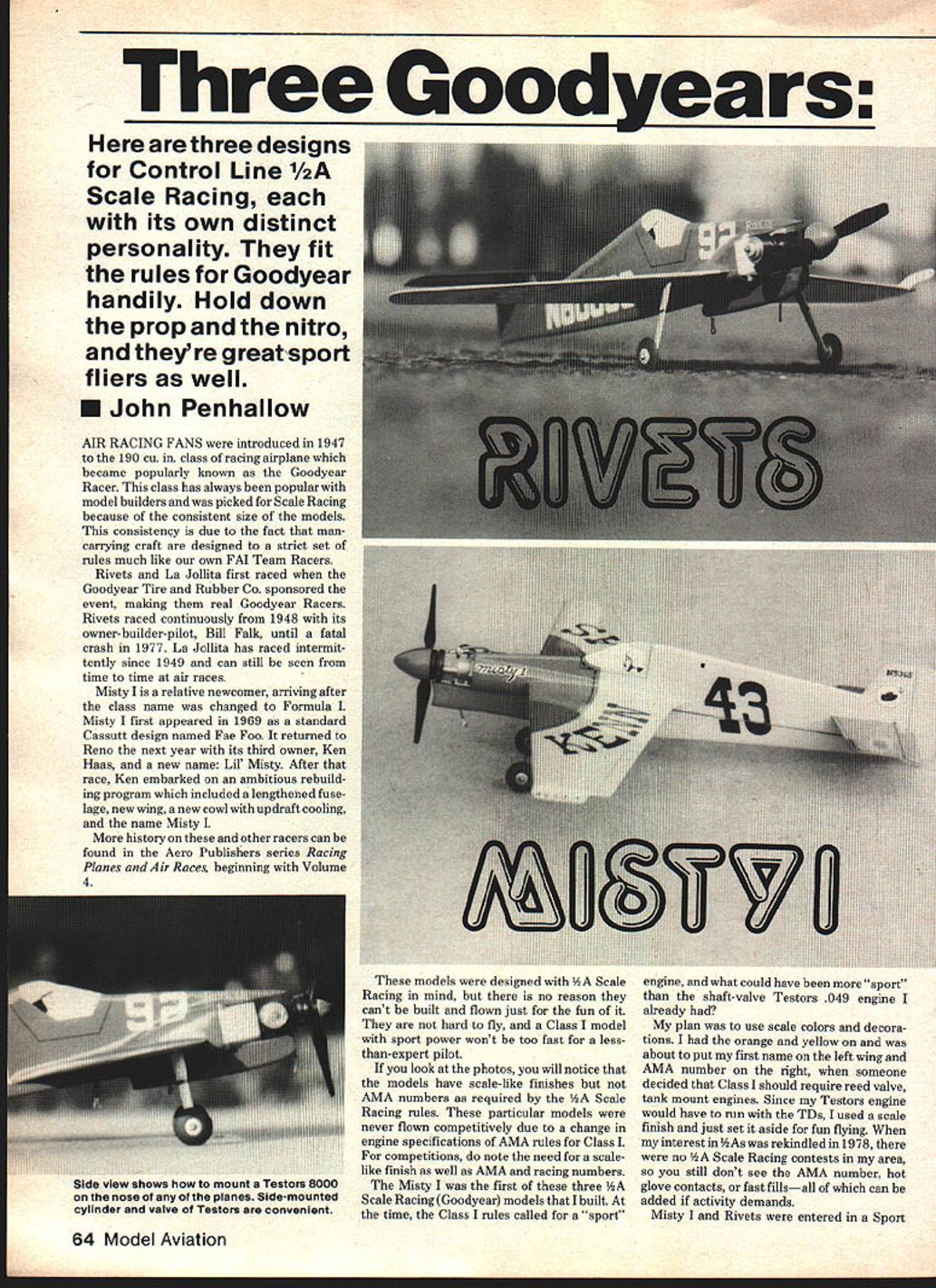
Air racing fans were introduced in 1947 to the 190 cu. in. class of racing airplane which became popularly known as the Goodyear Racer. This class has always been popular with model builders and was picked for scale racing because of the consistent size of the models. This consistency is due to the fact that man-carrying craft are designed to a strict set of rules much like our own FAI team racers.
Rivets and La Jollita first raced when the Goodyear Tire and Rubber Co. sponsored the event, making them real Goodyear Racers. Rivets raced continuously from 1948 with its owner-builder-pilot, Bill Falk, until a fatal crash in 1977. La Jollita has raced intermittently since 1949 and can still be seen from time to time at air races.
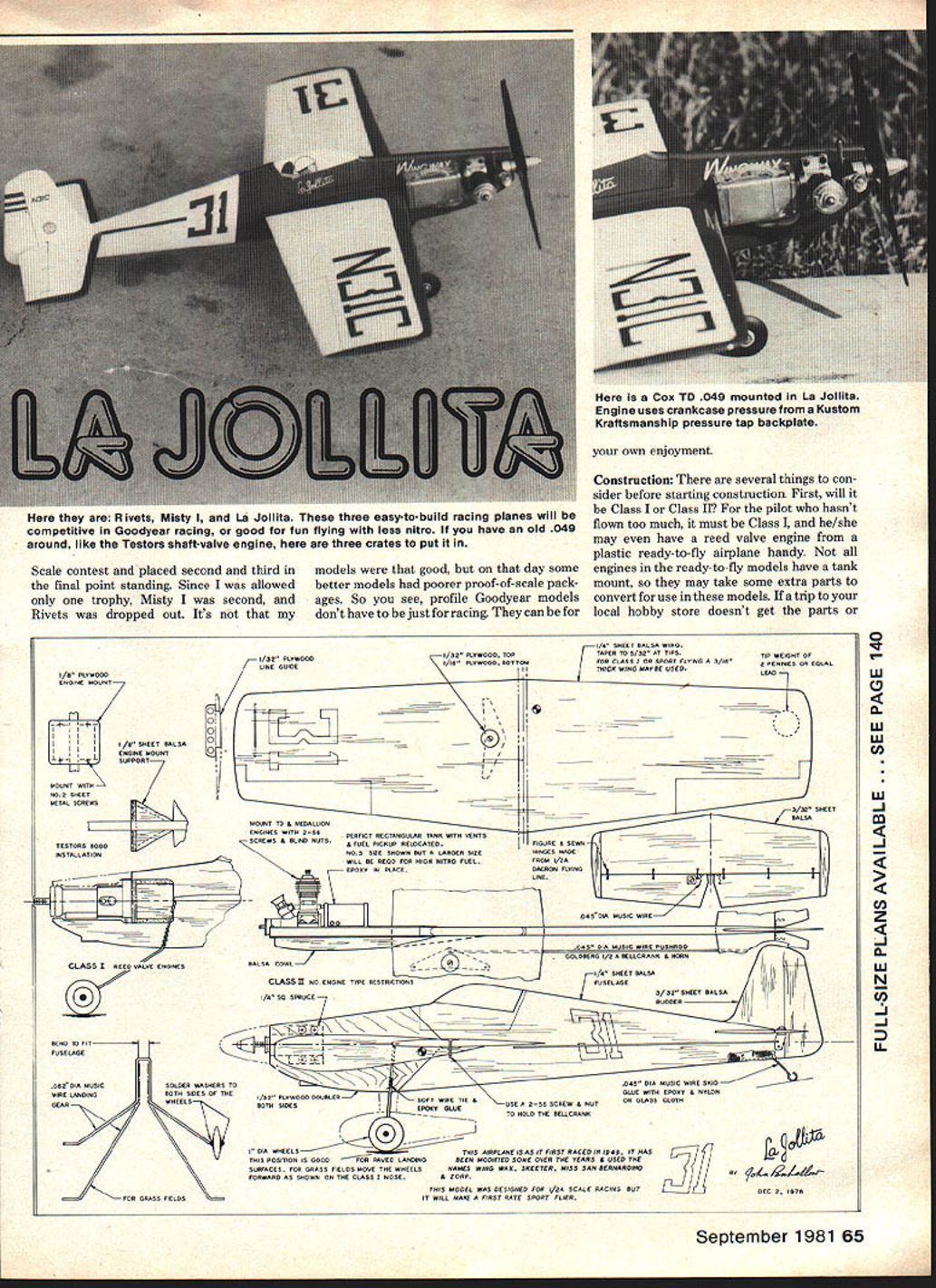
Misty I is a relative newcomer, arriving after the class name was changed to Formula I. Misty I first appeared in 1969 as a standard Cassutt design named Fae Foo. It returned to Reno the next year with its third owner, Ken Haas, and a new name: Lil' Misty. After that race, Ken embarked on an ambitious rebuilding program which included a lengthened fuselage, new wing, a new cowl with updraft cooling, and the name Misty I.
More history on these and other racers can be found in the Aero Publishers series Racing Planes and Air Races, beginning with Volume 4.
These models were designed with 1/2A scale racing in mind, but there is no reason they can't be built and flown just for the fun of it. They are not hard to fly, and a Class I model with sport power won't be too fast for a less-than-expert pilot.
If you look at the photos, you will notice that the models have scale-like finishes but not AMA numbers as required by the 1/2A scale racing rules. These particular models were never flown competitively due to a change in engine specifications of AMA rules for Class I. For competitions, do note the need for a scale-like finish as well as AMA and racing numbers.
The Misty I was the first of these three 1/2A scale racing (Goodyear) models that I built. At the time, the Class I rules called for a "sport" engine, and what could have been more "sport" than the shaft-valve Testors .049 engine I already had?
My plan was to use scale colors and decorations. I had the orange and yellow on and was about to put my first name on the left wing and AMA number on the right, when someone decided that Class I should require reed-valve, tank-mount engines. Since my Testors engine would have to run with the TDs, I used a scale finish and just set it aside for fun flying. When my interest in 1/2A was rekindled in 1978, there were no 1/2A scale racing contests in my area, so you still don't see the AMA number, hot glove contacts, or fast fills — all of which can be added if activity demands.
Misty I and Rivets were entered in a Sport Scale contest and placed second and third in the final point standing. Since I was allowed only one trophy, Misty I was second, and Rivets was dropped. It's not that my models were that good, but on that day some better models had poorer proof-of-scale packages. So you see, profile Goodyear models don't have to be just for racing. They can be for your own enjoyment.
Construction
There are several things to consider before starting construction.
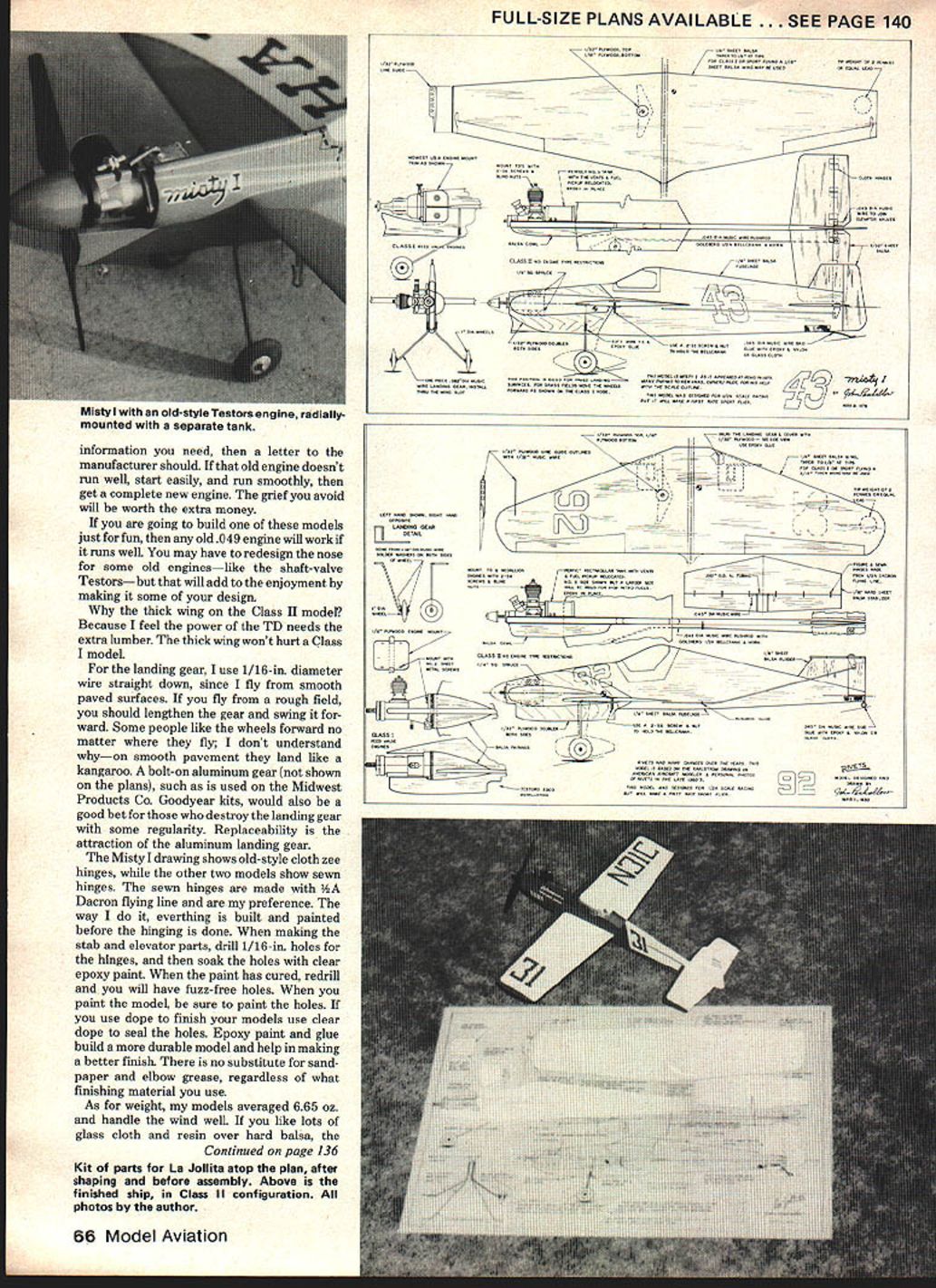
- First, will it be Class I or Class II? For the pilot who hasn't flown much, it must be Class I, and he or she may even have a reed-valve engine from a plastic ready-to-fly airplane handy. Not all engines in the ready-to-fly models have a tank mount, so they may take some extra parts to convert for use in these models. If a trip to your local hobby store doesn't get the parts or information needed, a letter to the manufacturer should help.
- If that old engine doesn't run well, start easily, and run smoothly, then get a complete new engine. The grief you avoid will be worth the extra money.
- If you are going to build one of these models just for fun, then any old .049 engine will work if it runs well. You may have to redesign the nose for some old engines—like the shaft-valve Testors—but that will add to the enjoyment by making it some of your own design.
Why the thick wing on the Class II model? Because I feel the power of the TD needs the extra lumber. The thick wing won't hurt a Class I model.
For the landing gear, I use 1/16-in. diameter wire straight down, since I fly from smooth paved surfaces. If you fly from a rough field, you should lengthen the gear and swing it forward. Some people like the wheels forward no matter where they fly; I don't understand why—on smooth pavement they land like a kangaroo. A bolt-on aluminum gear (not shown on the plans), such as is used on the Midwest Products Co. Goodyear kits, would also be a good bet for those who destroy the landing gear with some regularity. Replaceability is the attraction of the aluminum landing gear.
The Misty I drawing shows old-style cloth-zee hinges, while the other two models show sewn hinges. The sewn hinges are made with 3/4A Dacron flying line and are my preference. The way I do it, everything is built and painted before the hinging is done. When making the stab and elevator parts, drill 1/16-in. holes for the hinges, and then soak the holes with clear epoxy paint. When the paint has cured, redrill and you will have fuzz-free holes. When you paint the model, be sure to paint the holes. If you use dope to finish your models use clear dope to seal the holes. Epoxy paint and glue build a more durable model and help in making a better finish. There is no substitute for sandpaper and elbow grease, regardless of what finishing material you use.
As for weight, my models averaged 6.65 oz. and handle the wind well.
Transcribed from original scans by AI. Minor OCR errors may remain.

