
Thunderbird 60
A modern-day adaptation of one of Control Line Stunt flying's earlier designs. Pleasing elliptical wings produce a good-looking model with winning potential that honors its heritage.
Tom Dixon
Introduction
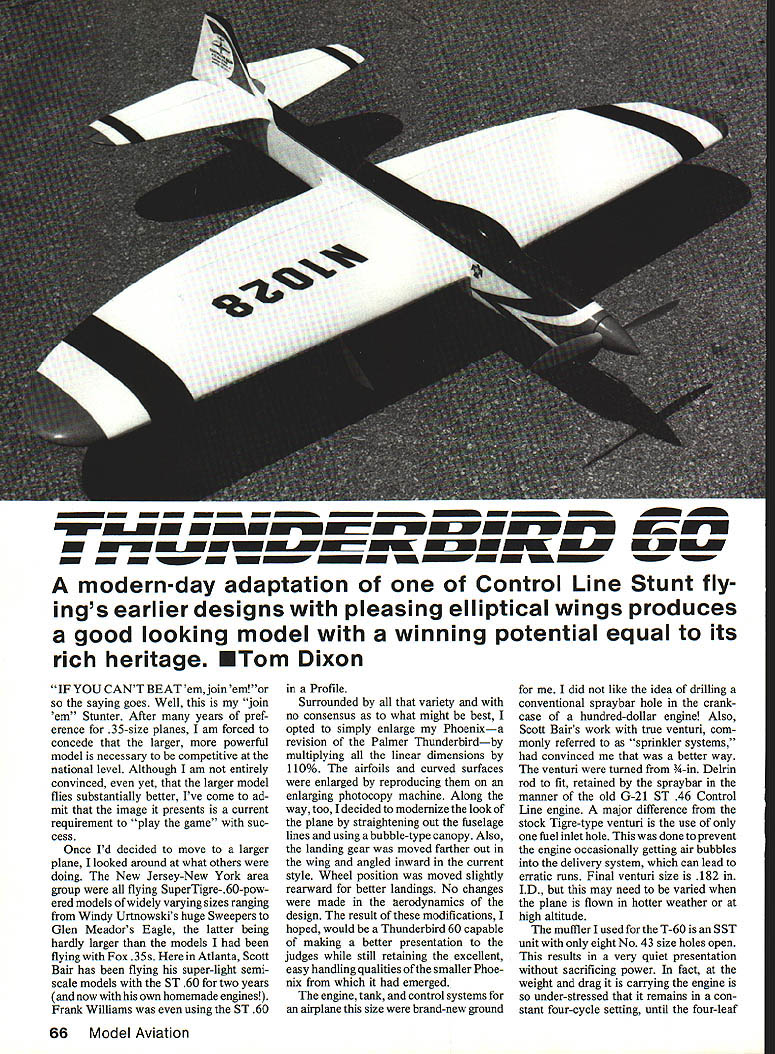
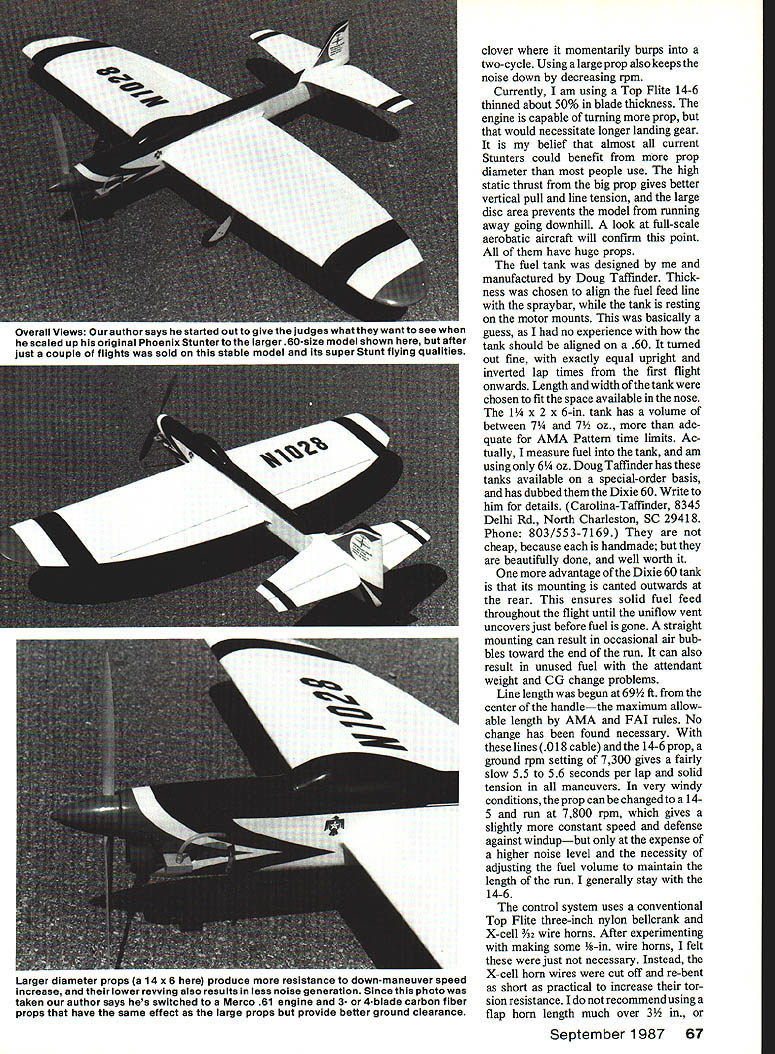
" If you can't beat 'em, join 'em." After many years preferring .35-size planes, I moved to a larger, more powerful model to be competitive at the national level. I enlarged my Phoenix (a revision of the Palmer Thunderbird) by scaling all linear dimensions by 110%, reproducing airfoils and curved surfaces on an enlarging photocopy machine. I also straightened the fuselage lines, fitted a bubble canopy, moved the landing gear outward and slightly rearward, and modernized the wheel angle. No aerodynamic changes were made; the aim was a Thunderbird 60 that presents better to judges while retaining the Phoenix's easy handling.
Design development
- Scaled Phoenix by 110% (airfoils and curves enlarged from photocopies).
- Fuselage lines straightened; bubble canopy used.
- Landing gear moved outboard and angled inward; wheels positioned slightly rearward for better landings.
- Aerodynamics left unchanged to preserve handling qualities.
Engine, induction and muffler
- I avoided drilling a conventional spraybar hole in the crankcase and adopted a "true venturi" (sprinkler) system inspired by Scott Bair.
- Venturi: turned from 3/4-in Delrin rod to retain the spraybar like G-21 / ST .46 engines. Only the fuel-inlet hole is used to reduce air-bubble problems.
- Final venturi I.D.: 0.182 in (may need adjustment for hot weather or high altitude).
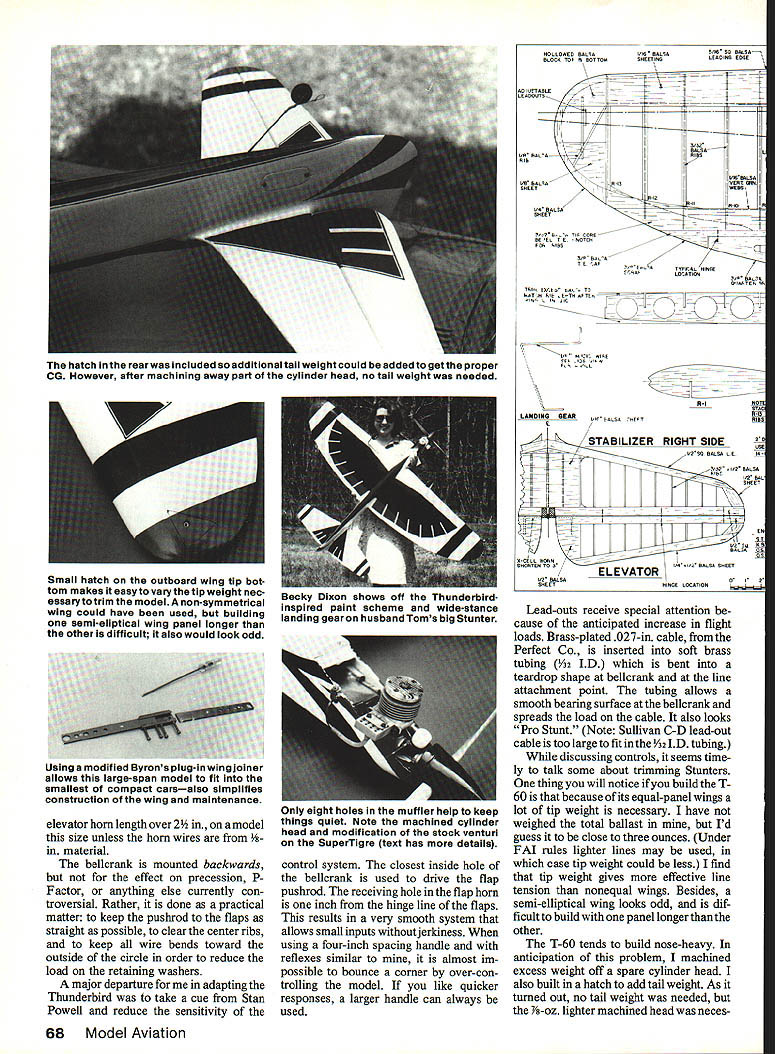
- Muffler: SST unit with No. 43-size holes opened for a quiet installation without significant power loss. At the T-60's weight and drag the engine tends to run under-stressed and stays in a steady four-cycle setting, occasionally burping into two-cycle.
Propeller and performance
- Typical prop: Top Flite 14x6, thinned about 50% in blade thickness.
- Using a larger-diameter prop reduces noise (lower RPM), increases static thrust, improves vertical pull and line tension, and helps prevent the model from running downhill.
- An engine able to turn a larger prop may require longer landing gear.
- Typical tuning: ground RPM ≈ 7,300, giving about 55–56 seconds per lap with solid tension for maneuvers. In very windy conditions a 14x5 at ≈7,800 RPM can be used for a steadier speed but with higher noise and possibly shorter run length.
Fuel tank
- Tank design / maker: Doug Taffinder (the "Dixie 60"). Tanks are special-order, handmade, and well finished. Contact: Doug Taffinder, 8345 Delhi Rd., North Charleston, SC 29418. Phone: 803/553-7169.
- Typical dimensions referenced: roughly 1–1.25 x 2 x 6 in, giving about 7–7.5 oz capacity; the tank I used measured and was filled to about 6–6.25 oz for flights (adequate for AMA Pattern time limits).
- Tank mounts on the motor mounts and is canted outward toward the rear to ensure solid fuel feed until the uniflow vent uncovers. A straight mounting can allow air bubbles near the end of the run and leave unused fuel, causing CG/weight shift.
Lines and handling
- Line length: started at 69 ft to the center handle (maximum under AMA/FAI rules); no change found necessary.
- Line cable: .018 in cable.
- Handling: with the 14x6 prop and lines above, the T-60 achieves solid tension and good maneuver control at the recommended rpm.
Control system
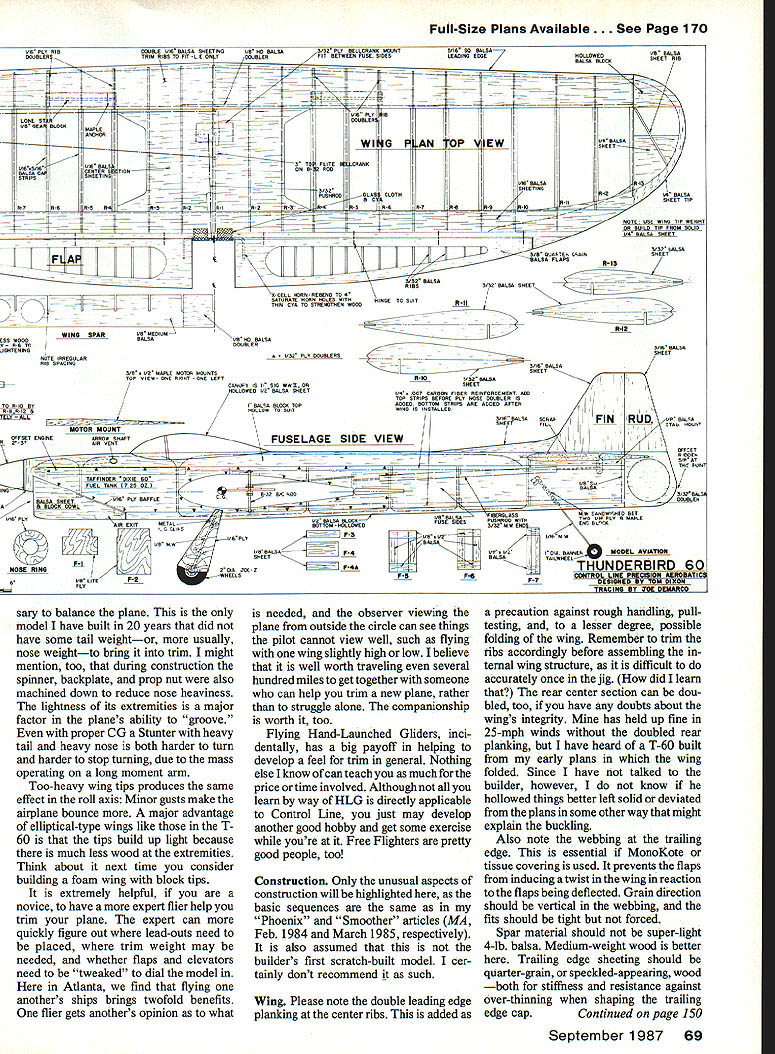
- Bellcrank: conventional Top Flite 3-inch nylon bellcrank mounted "backwards" (practical placement) to keep the flap pushrod straight, clear center ribs, and keep bends to the outside of the circle to reduce load on retaining washers.
- Horns: X-cell 3½-in wire horns used. I experimented with 5/16-in wire horns and found them unnecessary; instead cut and re-bent the X-cell wires short to increase torsional resistance.
- Recommended horn lengths: flap horn ≤ 3½ in; elevator horn ≤ 2½ in on a model this size unless using thicker (3/32-in) horn wire.
- Reduced sensitivity: use the closest inside hole on the bellcrank to drive the flap pushrod and use a receiving hole in the flap horn about 1 in from the hinge line. This smoothing makes small inputs less jerky and helps prevent overcontrol with a standard 4-in spacing handle. Use a larger handle for quicker response if desired.
- Lead-outs: brass-plated .027-in cable (Perfect Co.) inserted into soft brass tubing (3/32 in I.D.) bent into teardrop shapes at the bellcrank and line attachment. Tubing provides a smooth bearing surface, spreads load on the cable, and gives a professional appearance. (Note: Sullivan C-D lead-out cable is too large to fit in 3/32 in tubing.)
Trimming and weight
- Tip weight: because of equal-panel elliptical wings, a fair amount of tip ballast is required—my T-60 has roughly 3 oz of tip weight (FAI rules permitting lighter lines could reduce this). Tip weight improves effective line tension and avoids the odd look or construction difficulty of unequal panels.
- Nose/tail balance: the T-60 tends to be nose-heavy. I machined weight off a spare cylinder head (7/8 oz lighter) and built a hatch for adding tail weight if needed. Ultimately the lighter machined head was necessary; no tail weight was added. Spinner, backplate, and prop nut were also lightened to reduce nose heaviness.
- Moment of inertia: light extremities help the plane "groove"—heavy nose or tail makes turning and stopping turns harder due to long moment arms.
Construction notes
- This overview highlights only unusual aspects; basic sequences follow my earlier "Phoenix" and "Smoother" articles (MA, Feb. 1984 and March 1985). Not recommended as a first scratch-built model.
- Wing construction:
- Double leading-edge planking at the center ribs is recommended as a precaution against rough handling, pull-testing, or possible wing folding. Trim ribs before assembling the internal wing structure.
- Rear center section can also be doubled if in doubt. The prototype has held up in 25-mph winds without doubled rear planking.
- Webbing at the trailing edge is essential when using MonoKote or tissue covering to prevent flap deflection from inducing wing twist; grain direction should be vertical and stringers tight but not forced.
- Spars: use medium-weight balsa rather than ultra-light 4-lb. balsa.
- Trailing-edge sheeting: quarter-grain or similar for stiffness and to resist over-thinning when shaping the trailing-edge cap.
Final thoughts
- Trimming help: it is extremely helpful—especially for novices—to have an experienced flier assist in trimming. They can quickly locate lead-out placement, trim weight needs, and subtle flap/elevator tweaks. Flying and observing one another's ships is mutually beneficial and worth travel.
- Cross-training: flying hand-launched gliders (HLG) is excellent for developing a feel for trim and control. Much of the trim sense transfers to Control Line and it's inexpensive exercise and enjoyment.
- Aerobatic insight: full-scale aerobatic aircraft typically use large props—high static thrust and large disk area give better vertical performance and line tension, a principle that applies in Stunt models.
Specifications (typical setup)
- Engine: Super Tigre .60 (ST .60) or similar
- Venturi: turned Delrin; final I.D. ≈ 0.182 in
- Muffler: SST with No. 43-size holes opened
- Prop: Top Flite 14x6 (thinned ≈ 50% in blade thickness)
- Lines: 69 ft; .018-in cable
- Ground RPM: ≈ 7,300 (14x6); ≈ 7,800 (14x5 in windy conditions)
Transcribed from original scans by AI. Minor OCR errors may remain.

