
Tiger Moth
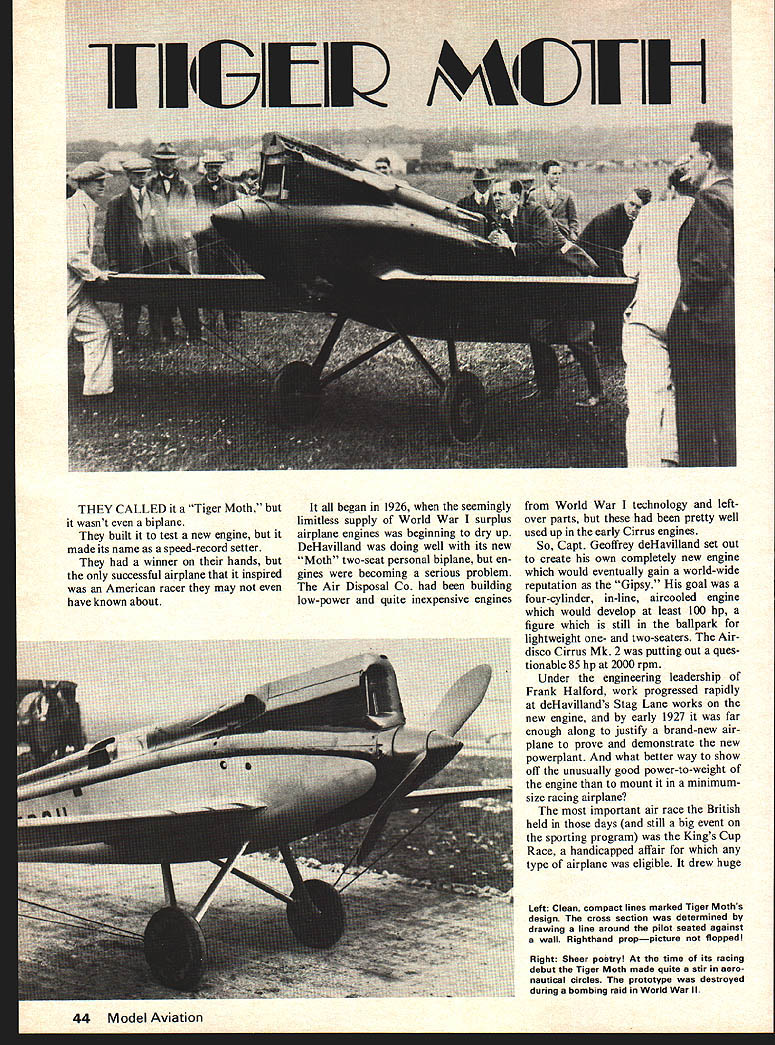
THEY CALLED it a "Tiger Moth," but it wasn't even a biplane.
They built it to test a new engine, but it made its name as a speed-record setter. They had a winner on their hands, but the only successful airplane that it inspired was an American racer they may not even have known about.
It all began in 1926, when the seemingly limitless supply of World War I surplus airplane engines was beginning to dry up. DeHavilland was doing well with its new "Moth" two-seat personal biplane, but engines were becoming a serious problem. The Air Disposal Co. had been building low-power, quite inexpensive engines from World War I technology and leftover parts, but these had been pretty well used up in the early Cirrus engines.
So, Capt. Geoffrey deHavilland set out to create his own completely new engine which would eventually gain a world-wide reputation as the "Gipsy." His goal was a four-cylinder, in-line, air-cooled engine which would develop at least 100 hp, a figure which is still in the ballpark for lightweight one- and two-seaters. The Cirrus Mk.2 was putting out a questionable 85 hp at 2000 rpm.
Under the engineering leadership of Frank Halford, work progressed rapidly at deHavilland's Stag Lane works on the new engine, and by early 1927 it was far enough along to justify a brand-new airplane to prove and demonstrate the new powerplant. And what better way to show off the unusually good power-to-weight of the engine than to mount it in a minimum-size racing airplane?
The most important air race the British held in those days (and still a big event on the sporting program) was the King's Cup Race, a handicapped affair for which any type of airplane was eligible. It drew huge crowds and heavy press attention, and so was the ideal stage on which to introduce both the engine and the airplane.
The design of the DH.71 had begun early in 1927 in darkest secrecy. It was to be the smallest possible airframe that could still be used for serious test work. To keep the fuselage at a bare minimum, the company test pilot, Capt. Hubert Broad, was used as a template for the cockpit. They sat him against a wall and drew a chalk line around him! Apparently there was no thought of any larger pilots being involved in the test program, and certainly none of producing such a special machine for sale to the public.
On June 24, 1927, the first of the DH.71's was ready to fly. It was G-EBQU, powered for the first tests by an older 85-hp Cirrus. Three quick flights by Hubert Broad demonstrated that it was a basically sound machine, though the controls were at first very sensitive. The second airplane was completed and flown just a few days later, also with a Cirrus engine.
As the time for the King's Cup Race neared, both airplanes received their Certificates of Airworthiness, but the new Gipsy engine had not gotten its all-important approval from the Air Ministry. Since the first airplane had already received its new engine, it had to be withdrawn from the race, leaving the newer G-EBRV to be flown by Capt. Broad. Introduction of the Gipsy was put off 'till later, and all the attention was focused on the DH.71, by now named the "Tiger Moth," and sometimes referred to as the "Tiger Moth Racer."
On the day of the great race, visibility around the course was poor and the air was very rough over most of the course which rambled for more than 500 miles around England. Broad took off across the bumpy field and sped away into the gloom on his way to victory, fame and engine sales. Twenty-six miles later he landed, for the air was so rough he could barely keep his hands on the controls of the little craft. It was a pretty sad public debut for the DH.71, but it did demonstrate what might be expected in the future, for Hubert Broad averaged better than 160 mph, despite the weather. And at that time, hardly any airplanes had ever gone that fast with so little power.
A few weeks later, the more powerful Gipsy-engined Tiger Moth was at last ready to show its stuff. On August 24, 1927, just two months after its first flight, the DH.71 was flown over a 100-km (62 mi.) closed course by Hubert Broad to set a World Speed Record for Class II airplanes. He averaged an official 186.47 mph. Today, almost a half century later, the 100-km speed record for airplanes of that weight is barely 20 mph higher!
Fifty years ago, deHavilland's "Tiger Moth" had a top speed within 20 mph of today's racers in its weight class.
Don Berliner
Five days after the speed record, Capt. Broad went aloft in an effort to set a world-class altitude mark. He climbed smoothly to more than 19,000 ft., but had to stop well short of the 22,250-ft. record, even though he was still climbing at a solid 1,000 ft. per minute because of problems with his oxygen system. Still, he set a British record which was less than two miles short of the modern record for very light airplanes. This appears to have been about the end of the public flying for the two Tiger Moth Racers. The Cirrus-powered machine was used by deHavilland for another year of airframe testing and research, while the Gipsy-engined airplane was used for its originally-intended purpose—the flight and development testing of the more powerful engine. It was also seen on static display at air shows during 1928 and 1929.
What was of greatest importance was that the first production Gipsy engines started coming off the assembly lines in June of 1928, beginning a major new phase of lightplane history. Tens of thousands were produced in the succeeding years, for the still-popular Tiger Moth training and touring biplanes and decades of other British light aircraft and the Canadian-built Chipmunk trainers. The original four-cylinder Gipsy was expanded into the Gipsy Six for the Comet racers and deHavilland Dove light transport. And they were built in the U.S. under license for U.S.-built DH.60 Gipsy Moths, several of which can still be seen flying in good weather.
The original G-EBRV, with its 85-hp Cirrus engine, was retired in 1928 and hung, engineless, from the rafters of its birthplace. It was taken down briefly in 1933 to be used as an advertisement for the coming King's Cup Race, and then once again tucked away in deHavilland's Hatfield shops, where the Comet Racers were built. In the fall of 1940, not long after the end of the Battle of Britain, a lone German Ju-88 slipped through the British defenses and plastered the factory in the only successful raid on it during the war. Several workmen were killed and the prototype DH.71 destroyed.
The record-setting G-EBQU had a shorter life. In 1930 it was sold to a party in Australia. In September of that year, a pilot took off to practice for a forthcoming air race; the engine quit at about 150 ft. altitude and the Moth Racer crashed, killing its pilot.
While neither of the original Tiger Moths remained in front of the public for very long, they contributed a great deal to both engine and airframe design progress in Great Britain and, partly without plan, elsewhere. The only deHavilland design which can be traced back to the '71 was the DH.77, an unsuccessful all-metal, low-wing interceptor which was similar looking, but much larger and had a 330-hp engine, giving it a top speed of about 180 mph. As that was still very much the era of the biplane in all combat roles, the Royal Air Force turned up its nose at such a radical idea.
Yet there was at least one man who seemed to like the idea very much: American racing plane designer Benny Howard, who turned out a very successful lightweight, low-powered racer which bore a strong resemblance to the DH.71. His DGA-3 "Pete", which first competed on even terms with much more powerful racers in 1930, had a wire-braced low wing, an upright American-built 319 cu. in. Cirrus engine, and its windscreen faired smoothly into the rear of the engine cowling—much like the DH.71.
While there is no direct evidence that Pete was actually copied from the Tiger Moth Racer, not only the shape but the dimensions are close enough to suggest there was at least a strong inspiration. Pete's wing span is halfway between the long and the short wings of the DH.71, while its length is just 10% less, empty weight 50 lbs. more, and gross weight a mere 5 lbs. less. Even in performance they were close; Pete's best race-course speed was 170 mph, while that of the Cirrus-powered Tiger Moth was about 166 mph. Pete was once clocked at 195 mph on a straight run, while the DH.71 had an official 187 mph and an unofficial 204 mph with the bigger engine.
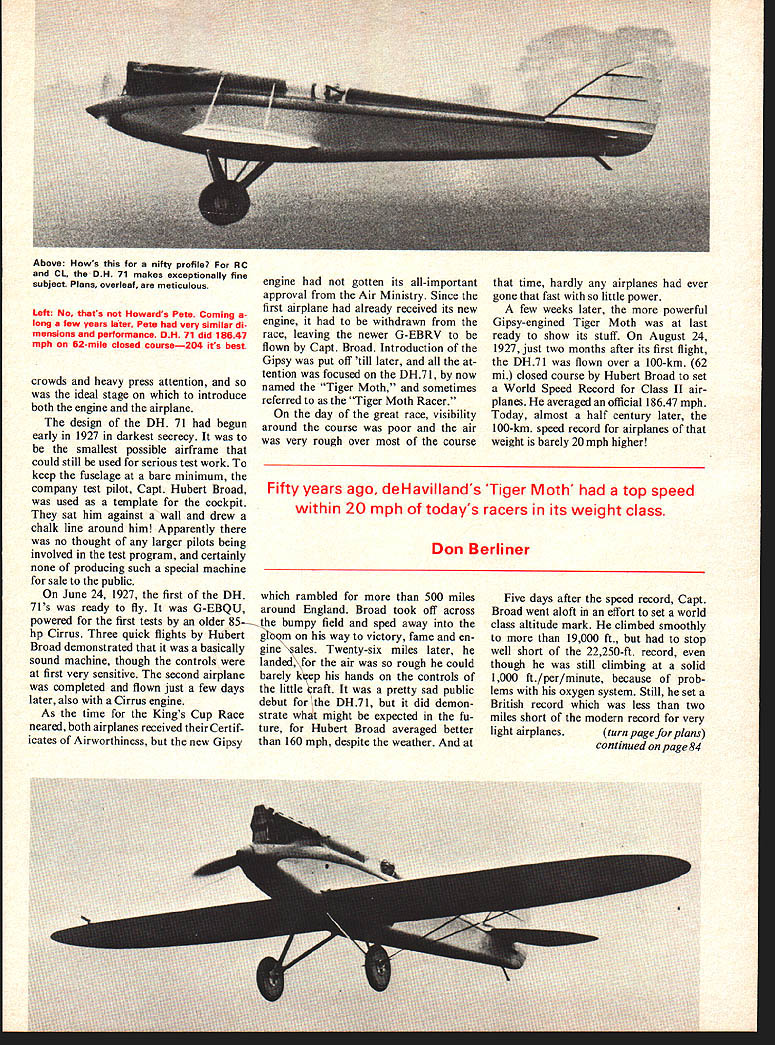
Construction of the deHavilland midget was traditional for that firm. The fuselage had a wooden main structure and plywood covering; the cockpit, of minimum width, had a partial canopy and could be entered by folding down the two sides. While pictures make it look like there was no forward visibility at all, it was not quite that bad, for the glassed side panels were slightly played outwards, so the pilot might look down either side of the very narrow cowling and around the upright cylinders. Later, a more enclosed canopy was fitted, and still the visibility was no worse than for many later high-speed airplanes.
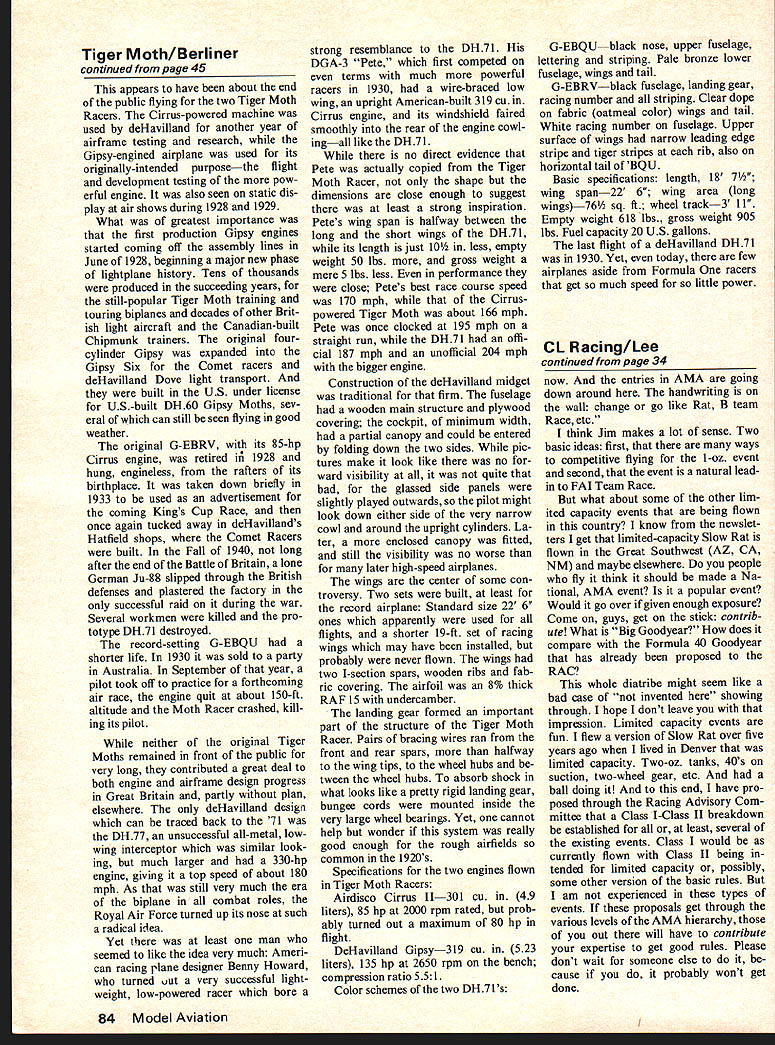
The wings are the center of some controversy. Two sets were built, at least for the record airplane. Standard size was 22 ft. 6 in.; there was also a shorter 19-ft. set of racing wings which may have been fitted, but probably were never flown. The wings had two I-section spars, wooden ribs and fabric covering. The airfoil was an 8% thick RAF 15 with undercamber.
The landing gear formed an important part of the structure of the Tiger Moth Racer. Pairs of bracing wires ran from the front and rear spars, more than halfway to the wing tips, to the wheel hubs and between the wheels. To absorb shock in what looks like a pretty rigid landing gear, huge rubber cords were mounted inside the very large wheel bearings. Yet one cannot help but wonder if this system was really good enough for the rough airfields so common in the 1920's.
Specifications for the two engines flown in Tiger Moth Racers:
- Airdisco Cirrus II — 301 cu. in. (4.9 liters); 85 hp at 2000 rpm, but probably turned out a maximum of 80 hp in flight.
- deHavilland Gipsy — 319 cu. in. (5.23 liters); 135 hp at 2650 rpm on the bench; compression ratio 5.5:1.
Color schemes of the two DH.71's:
- G-EBQU — black nose, upper fuselage, lettering and striping. Pale bronze lower fuselage, wings and tail.
- G-EBRV — black fuselage, landing gear, racing number and all striping. Clear-doped fabric (a mottled color) wings and tail. White racing number on fuselage. Upper surfaces of wings had a narrow leading-edge stripe and tiger stripes; same on horizontal tail of 'BQU'.
Basic specifications: length, 18 ft. 7-1/2 in.; wing span—22 ft. 6 in.; wing area (long wings)—76 sq. ft.; wheel track—3 ft. 11 in.; empty weight 618 lbs.; gross weight 905 lbs.; fuel capacity 20 U.S. gallons.
The last flight of a deHavilland DH.71 was in 1930. Yet, even today, there are few airplanes aside from Formula One racers that get so much speed for so little power.
Transcribed from original scans by AI. Minor OCR errors may remain.

