
TIME FLIES
The cleanest, most powerful radial-engined airplane of its day, this sleek racer seemed destined for a career of record smashing. ■ Don Berliner Drawings by Harry Robinson
IT SEEMED to have absolutely everything an airplane needs to go fast. Except, maybe, a normal supply of luck.
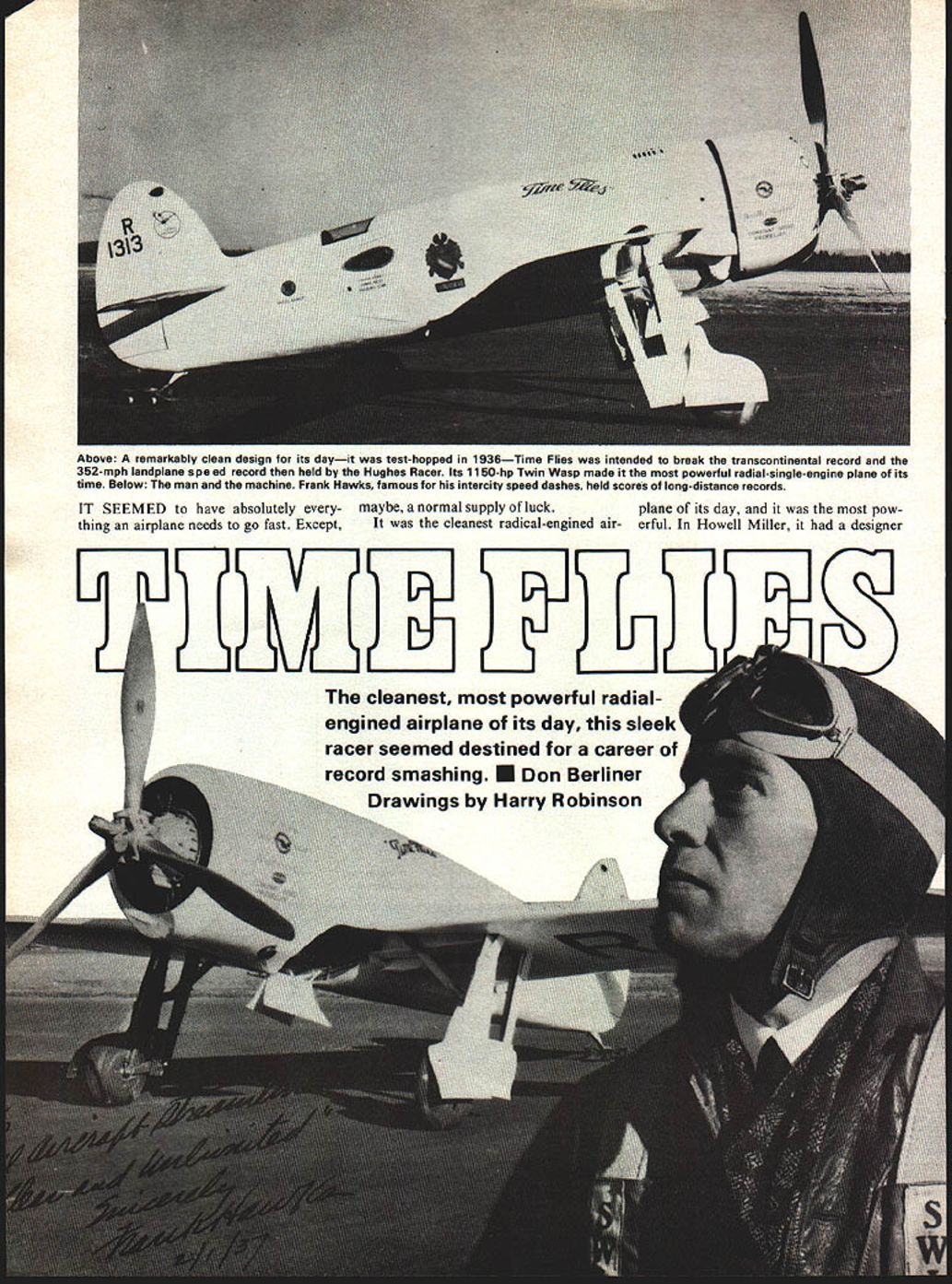
It was the cleanest radial-engined airplane of its day, and it was the most powerful. In Howell Miller, it had a designer who had learned his trade as chief engineer for the Granville Brothers when they were building GeeBees. And in Frank Hawks, it had a pilot who already had scores of long-distance records to his credit.
"Time Flies" was aimed at the transcontinental speed record, the world speed record over a short course, and just about everything in between. That it could have taken a lot of speed records seems obvious. But it was destined to have but two days of glory, one of which would come after Hawks' death when the airplane was in a form hardly dreamed of by its originators.
When the scheme was first considered by Hawks and Miller, the world speed record stood at 352 mph, achieved by little-known young Howard Hughes in a sleek all-metal machine that now hangs majestically in the National Air & Space Museum. To beat Hughes, it would be necessary to greatly reduce drag and/or greatly increase power, since the Hughes Racer was a masterpiece of contemporary design.
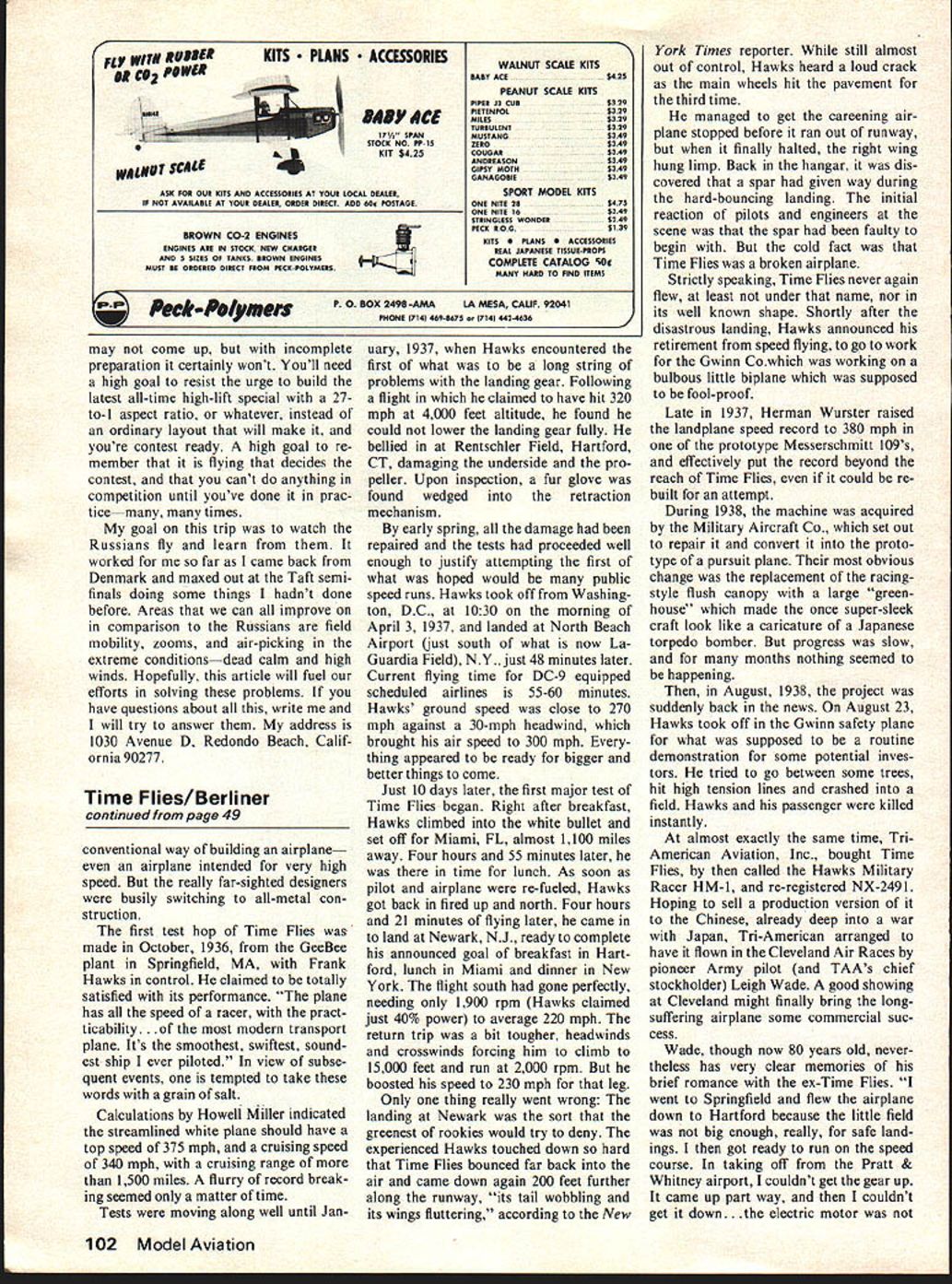
The airplane that began to take shape on Miller's drawing board in 1935 looked exceedingly clean. It also looked a bit peculiar, since it lacked that popular protrusion called a windshield! To gain speed, the most effective technique is drag reduction, and so Miller eliminated the windshield and canopy by making them mechanically retractable into the top of the fuselage, where they would lie flush except during takeoff and landing.
The engine was also a step ahead of Hughes' 1,000 hp, being a Pratt & Whitney R-1830 Twin Wasp used by special permission of the Army Air Corps; in ground tests it produced 1,150 hp. A very new 3-bladed, constant-speed Hamilton Standard propeller was fitted to the potent engine, giving as effective a power unit as the industry could provide.
Just about every piece of equipment on the Gruen Watch Co.-sponsored Time Flies was the last word. The instruments for long-distance flight included a Sperry gyroscopic autopilot, a gyro-magnetic compass, and an exhaust gas analyzer, and both LF and UHF radios, the antennas for the latter being buried within the airplane's structure. For 1936, this was pretty futuristic stuff.
Construction of the machine was not quite so modern, however, and undoubtedly played a major role in its downfall. The fuselage was welded up from chromemolybdenum steel tubing and covered with plywood. The wings had three spruce-and-plywood box spars, plywood ribs and plywood covering. For 1936, this was a fairly
Time Flies/Berliner
conventional way of building an airplane— even an airplane intended for very high speed. But the really far-sighted designers were busily switching to all-metal construction.
The first test hop of Time Flies was made in October, 1936, from the GeeBee plant in Springfield, MA, with Frank Hawks in control. He claimed to be totally satisfied with its performance. "The plane has all the speed of a racer, with the practicability... of the most modern transport plane. It's the smoothest, swiftest, soundest ship I ever piloted." In view of subsequent events, one is tempted to take these words with a grain of salt.
Calculations by Howell Miller indicated the streamlined white plane should have a top speed of 375 mph, and a cruising speed of 340 mph, with a cruising range of more than 1,500 miles. A flurry of record breaking seemed only a matter of time.
Tests were moving along well until January, 1937, when Hawks encountered the first of what was to be a long string of problems with the landing gear. Following a flight in which he claimed to have hit 320 mph at 4,000 feet altitude, he found he could not lower the landing gear fully. He belly-landed at Rentschler Field, Hartford, CT, damaging the underside and the propeller. Upon inspection, a fur glove was found wedged into the retraction mechanism.
By early spring, all the damage had been repaired and the tests had proceeded well enough to justify attempting the first of what was hoped would be many public speed runs. Hawks took off from Washington, D.C., at 10:30 on the morning of April 3, 1937, and landed at North Beach Airport (just south of what is now LaGuardia Field), N.Y., just 48 minutes later. Current flying time for DC-3 equipped scheduled airlines is 55-60 minutes. Hawks' ground speed was close to 270 mph against a 30-mph headwind, which brought his air speed to 300 mph. Everything appeared to be ready for bigger and better things to come.
Just 10 days later, the first major test of Time Flies began. Right after breakfast, Hawks climbed into the white bullet and set off for Miami, FL, almost 1,100 miles away. Four hours and 55 minutes later, he was there in time for lunch. As soon as pilot and airplane were re-fueled, Hawks got back in, fired up and north. Four hours and 21 minutes of flying later, he came in to land at Newark, N.J., ready to complete his announced goal of breakfast in Hartford, lunch in Miami and dinner in New York. The flight south had gone perfectly, needing only 1,900 rpm (Hawks claimed just 40% power) to average 220 mph. The return trip was a bit tougher, headwinds and crosswinds forcing him to climb to 15,000 feet and run at 2,000 rpm. But he boosted his speed to 230 mph for that leg.
Only one thing really went wrong: The landing at Newark was the sort that the greenest of rookies would try to deny. The experienced Hawks touched down so hard that Time Flies bounced far back into the air and came down again 200 feet further along the runway; its tail wobbling and its wings fluttering, according to the New York Times reporter. While still almost out of control, Hawks heard a loud crack as the main wheels hit the pavement a third time.
He managed to get the careening airplane stopped before it ran out of runway, but when it finally halted, the right wing hung limp. Back in the hangar, it was discovered that a spar had given way during the hard-bouncing landing. The initial reaction of pilots and engineers at the scene was that the spar had been faulty to begin with. But the cold fact was that Time Flies was a broken airplane.
Strictly speaking, Time Flies never again flew, at least not under that name, nor in its well known shape. Shortly after the disastrous landing, Hawks announced his retirement from speed flying, to go to work for the Gwinn Co. which was working on a bulbous little biplane which was supposed to be fool-proof.
Late in 1937, Herman Wurster raised the landplane speed record to 380 mph in one of the prototype Messerschmitt 109's, and effectively put the record beyond the reach of Time Flies, even if it could be rebuilt for an attempt.
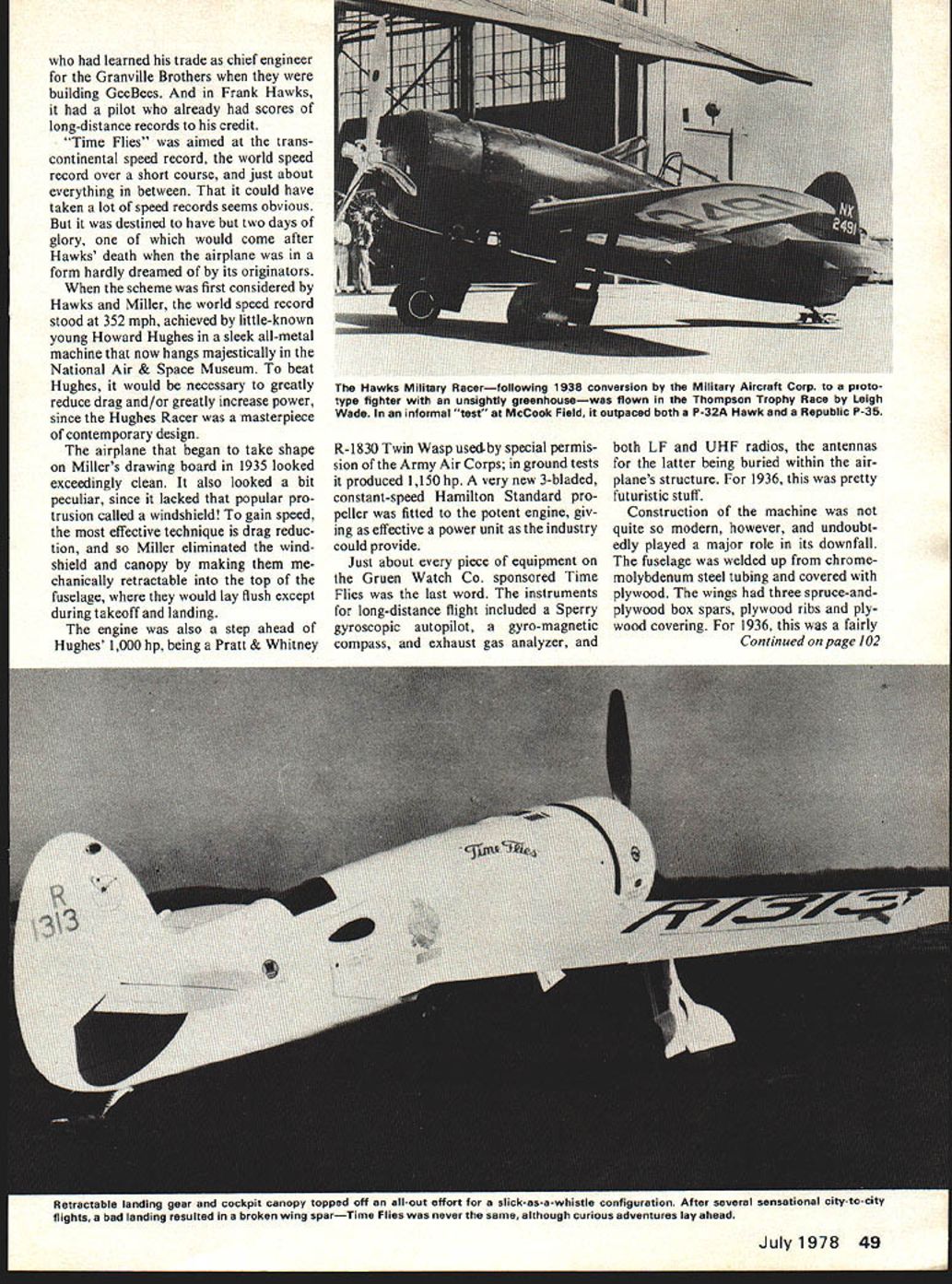
During 1938, the machine was acquired by the Military Aircraft Co., which set out to repair it and convert it into the prototype of a pursuit plane. Their most obvious change was the replacement of the racing-style flush canopy with a large "greenhouse" which made the once super-sleek craft look like a caricature of a Japanese torpedo bomber. But progress was slow, and for many months nothing seemed to be happening.
Then, in August, 1938, the project was suddenly back in the news. On August 23, Hawks took off in the Gwinn safety plane for what was supposed to be a demonstration for some potential investors. He tried to go between some trees, hit high tension lines and crashed into a field. Hawks and his passenger were killed instantly.
At almost exactly the same time, Tri-American Aviation, Inc., bought Time Flies, by then called the Hawks Military Racer HM-1, and re-registered NX-2491. Hoping to sell a production version of it to the Chinese, already deep into a war with Japan, Tri-American arranged to have it flown in the Cleveland Air Races by pioneer Army pilot (and TAA's chief stockholder) Leigh Wade. A good showing at Cleveland might finally bring the long-suffering airplane some commercial success.
Wade, though now 80 years old, nevertheless has very clear memories of his brief romance with the ex-Time Flies. "I went to Springfield and flew the airplane down to Hartford because the little field was not big enough, really, for safe landings. I then got ready to run on the speed course. In taking off from the Pratt & Whitney airport, I couldn't get the gear up. It came up part way, and then I couldn't get it down... the electric motor was not powerful enough to crank the wheels up; I had to raise them by hand."
At Cleveland, however, he managed to finish in fifth place despite the clumsy greenhouse. After the races the airplane was sent to Wright Field for tests by the Army Air Corps. There it sat for some time, and eventually was declared surplus.
The end came in 1941 when the old racer was stripped for parts and junked. sufficient.
"I was fearful that I would have to make a belly landing, and with the gear part-way down, it would have been a catastrophe. It was only by putting it up a little and down a little, until finally we got the landing gear down and came in and landed. And then we found out the reason. The firewall was made primarily of asbestos and where the controls went through the firewall they had left a little bit of this material. It would fly around and get into the gear to stick it.
"They corrected that, but then I didn't have time to run the speed run (before going) to Cleveland. So we gassed up and it meant a non-stop run, but it cruised so fast that I had no difficulty in making Cleveland. Getting there and getting the airplane ready for the one short test hop before the race didn't enable us to get a measurement of its maximum speed."
The first accurate timing of the HM-1 version of Time Flies came during qualifying trials for the Thompson Trophy Race. Leigh Wade was timed for two laps of the 10-mile course at 264 mph, which placed fourth behind Roscoe Turner (281 mph), Earl Ortman (270 mph) and Art Chester (268 mph). Considering his low time in the airplane, and a complete lack of pylon racing experience during the preceding decade, this wasn't at all bad in a prototype military pursuit plane.
"We figured with the Pratt & Whitney people, that, by cruising the first half of the race, then I could open up and fly full-out the remaining half. Many of (the other
racers) would drop out of the race, and it'd be easier to fly full speed at that time. But I ran low on fuel about six minutes earlier than calculated (for) the cruising, so then I had to quickly estimate what I could do for the rest of the race. I flew as fast as I possibly could, figuring to make it, and as I turned the last pylon and turned to come in to land... I landed, but I didn't have enough gasoline to taxi to the hangar!"
But, despite his fuel consumption problems, Leigh Wade finished a creditable fourth, at 249.8 mph. Roscoe Turner won easily, at a record 283 mph, followed by Earl Ortman at 270 mph, and Steve Wittman at 259 mph. Just 3½ seconds behind Wade after almost 1¾ hours of racing, was Joe Mackey in the Wedell-Williams Racer in which Turner had won the 1934 Thompson.
When the Hawks Military Racer was rolled into the hangar at Cleveland Airport and inspected, "we found that the bolt holes through the landing gear, attaching it to the spar, had elongated." Apparently, there was insufficient bushing material through the wooden spar, and each landing had done its dirty work. It was hastily repaired.
"With the race over, we decided to fly to Dayton," Wade recalled, "for the purpose of showing it to the Army Air Corps. Having been at the old McCook Field (as a test pilot), I knew many people there, so it wasn't too difficult to arrange a little demonstration... for them to take up their experimental fighter planes, and they would fly alongside us and see how much faster they were, or we were. But the thing was, I didn't have to open up, as they couldn't keep up." (While Gen. Wade couldn't remember which Army pursuits had been sent up against him, it would appear that they probably were the Curtiss P-36A Hawk, the Republic P-35 and either the Boeing YP-29A or the Bell XFM-1.)
"But the Army wasn't interested at that particular moment," Wade said, "(because) it was of all-wood construction. They were interested in using the same design, but in metal construction. So, therefore, it was decided to return the airplane to Springfield."
Wade flew it back to Cleveland, and Earl Ortman took it from there to the East Coast, while Wade returned to his business interests in South America. Tri-American then prepared for Ortman to fly the Hawks airplane in a speed dash from New York to San Diego on October 10, 1938.
But it was never to be. On October 3, Ortman was testing the airplane near East Hartford, CT, when a wing ripped off. He was able to jump free and parachute down safely, but the airplane crashed into a barn and burned completely.
That was the end of everything. The Chinese lost interest when the design suffered a major structural failure, and there had never been very much Army interest. Hawks was gone, and it had been his drive and ideas and flair for publicity that had gotten the machine as far as it had been. Because of all its troubles, it is far from clear how good or bad the airplane really was. Wade recalls it as a very good one. "It was very maneuverable. I was very comfortable in it, and had no trouble landing it. The visibility was fine. It was an excellent design for speed."
But the combination of hard landings and an apparent weakness in the wing spelled doom for what had been potentially the fastest airplane in the world. No American propeller-driven airplane would ever again try for the Absolute World Speed Record. The crash of Time Flies was part of the end of an era.
Transcribed from original scans by AI. Minor OCR errors may remain.

