
TIMING MODELS WITH RADAR
RC fan-jet contests need to measure actual model speed. Most meets use radar—but how accurate and how safe is it to use? The author presents a long-needed improvement.
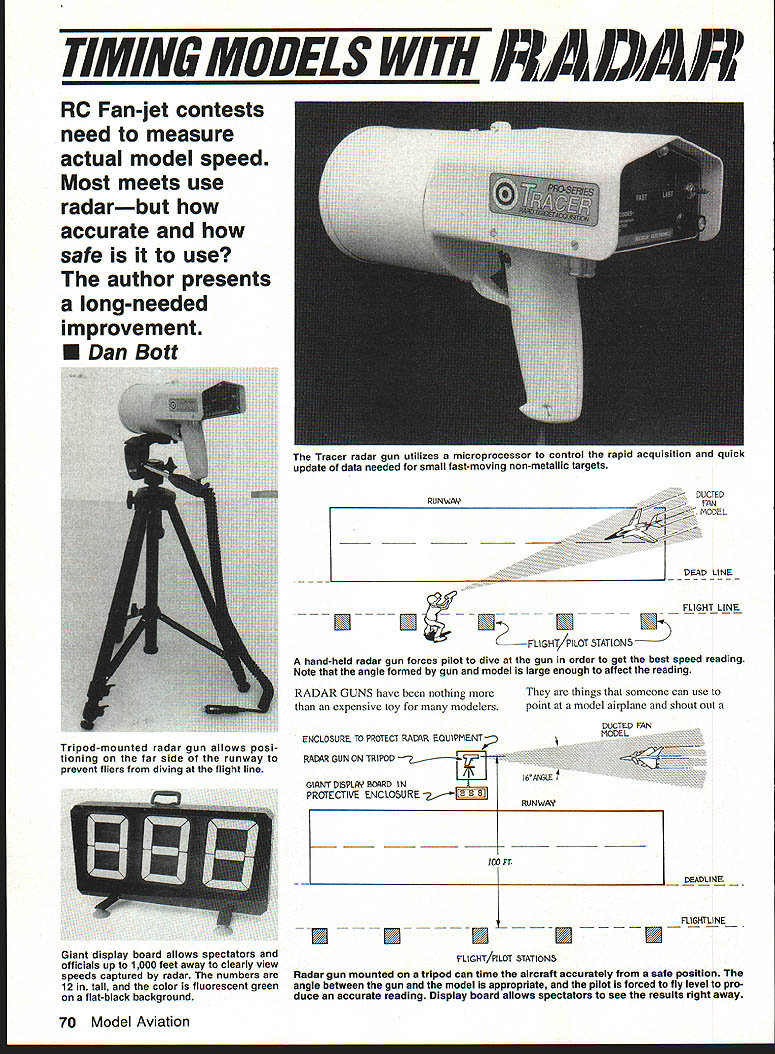
RADAR GUNS have been nothing more than an expensive toy for many modelers. They are things someone can use to point at a model airplane and call out a speed. Unfortunately, this practice sometimes causes a pilot to make unsafe dives toward the flight line in an effort to get the best angle toward the hand-held radar gun and produce the fastest possible reading.
Radar gun mounted on a tripod can time the aircraft accurately from a safe position. The angle between the gun and the model is appropriate, and the pilot is forced to fly level to produce an accurate reading. A display board allows spectators to see the results right away.
This unsafe aiming at the gun has become common at many jet rallies and fan flys around the country, and it has drawn growing criticism from those increasingly concerned about safety. Since model RC jets are noted for speed and spectator appeal, the lure of the clocking continues.
The Jet Pilots Organization (JPO) developed a system to clock the speed of jets that doesn't require diving at the flight line. Their system uses two switching positions 600 feet apart that measure the time interval it takes the plane to fly between them. The plane can fly parallel to the runway and away from the flight line.
But there is a weak link in the JPO system—the operators. The system requires two individuals, one at each end of the flight line, who follow the plane through the traps. A 200 mph jet plane travels at approximately 300 feet per second, so if one or the other switch operator is even slightly early or late—say 0.25 second—the measured speed can vary by about 12.5% (higher or lower). That's nearly 25 mph in the example.
At the Arizona Jet Rally in Mesa (November 1991), the JPO clocks were in use, and the top speed winner of the event was Steve Korney with a Hurricane Cobra. His first attempt at the JPO clocks registered 218 mph; on the second attempt he ran 165 mph.
While standing about 15 feet back from the flight line I was hand-holding a Decatur Electronics Tracer radar gun specially designed for radio-controlled models. I picked up the Cobra about 1,000 feet away at 186 mph on the first pass and 189 mph on the second. The event promoter elected to use the speeds from my radar gun rather than the JPO official clocks for the event since my speeds were more consistent. Participants and event promoters were amazed that I could pick up the plane's speeds so far away, with such accuracy and consistency.
The Tracer
The Tracer is a sports radar gun that takes computer technology a step beyond previous radar guns by using microprocessors to control a high-quality, back-lit liquid-crystal readout and signal processing. The Tracer's performance and features are unmatched.
Performance specifications of the Tracer include:
- System accuracy: ±0.1 mph
- Target acquisition time: 0.02 seconds
- Target update speed: 50 times per second
- Range: 6–199 mph
Readout specifications:
- Back-lit liquid-crystal display with six-digit capacity
- LCD readout to 199 mph; speeds over 200 mph display only the last two digits
- Full readout above 200 mph is revealed on a giant display board
Other features:
- Test sequence: internal tests for time base verification, counter verification, and segment-illumination verification
- Error indicators: radio-frequency interference indicator; low-voltage indicator when voltage falls below 10.8 VDC; reset indicator for internal test failure
- Fast and Last mode: displays highest speed (large left digits) and current or last speed (smaller right digits)
- One-tenth mph mode: uses three large digits for whole numbers and one smaller digit for tenths
Past radar technology
Many modelers have noticed a need for planes to fly close-in or aim directly at the gun to get adequate readings. Most modelers' exposure to radar guns has come from refurbished and/or modified police radar guns. Police guns are designed to clock passenger cars—large metal targets that usually don't travel very fast or accelerate very quickly—and are not well suited to high-speed, rapidly accelerating small targets.
Getting a police radar gun to clock model planes generally requires modifying the gun's target acquisition time and speed updating. Often the gun's sensitivity at higher speeds will decrease due to filtering designed to reduce erroneous readings. Some guns can be modified to maintain sensitivity to extremely high speeds, but most are not, which explains why many past applications required targets to fly much closer than would be considered safe.
Accuracy
Some guns have internal calibration. For those that don't, tuning forks are available to verify internal calibration. Each tuning fork is stamped with a specific speed (for X or K band) that a radar gun should display when the fork is placed in front of the gun and struck to vibrate. This is the same method police departments use to check their radar equipment.
I recommend getting a tuning fork for every radar gun, especially if your gun does not have an internal calibration check. The Tracer has internal calibration, and I use a tuning fork set for 93.6 mph. The Tracer should maintain accuracy to within ±0.1 mph.
I have tested the effects of picking up the plane at an angle. In the same way parallax becomes a problem with close-up photography, the angular effect of close-range radar timing creates understated speeds. When the reading is taken straight on instead of at an angle to the direction of the object, the angular effect is reduced. This happens naturally with long-range capability.
A gun of less range would understate the speed because the angular effect is greater. The long-range capability of the Tracer solves much of this problem by picking out the target from farther out, thus reducing angular error.
To demonstrate the effect, I've taken readings on a model that was actually 150 mph at approximately a 3–5 degree angle, then panned to a 45-degree angle and seen the speed drop to 120 mph. This is the problem that has caused some pilots to keep aiming at the gun, operator, or flight line until it becomes unsafe. Even though the new technology allows rapid acquisition at much longer ranges, many pilots will still feel compelled to get that little extra edge and continue to "aim for fame." In other words, the problem still exists.
The obvious remedy to assure safety and best possible accuracy is to put the radar gun directly in front of the plane's line of safe flight, on the other side of the runway away from the flight line.
Display boards and safety
Decatur Electronics, Inc., has invented the Visimax giant display board. When matched to the Tracer radar gun, it yields a Tracer Display Board System—the best available, offering the largest display board with more features than any other system on the market.
Features of the Tracer/Visimax display board system:
- Battery built into the display board for simple operation, with an AC adapter included for extended use
- Three mechanical numbers 12 inches high, day-glo green over a flat black background, visible nearly 1,000 feet away—great for spectators
- Low power requirement allows extended operation from remote power packs
With the Tracer mounted on a fixed tripod, the gun can be located on the other side of the runway, forcing speed runs to take place away from the flight line and removing the pilot's temptation to dive where it's unsafe. The radar cone is 16 degrees, and the tripod can be adjusted so the gun aims parallel to the ground; this forces the pilot to enter the cone when the plane has flattened out rather than while diving.
Before, there was no way to read the speed measured by the gun without someone standing in harm's way. That is no longer necessary with the giant display board.
Cost and availability:
- Gun price: about $1,295
- Complete system (with digital giant display board): around $2,495
- Rental: approximately $200 per week
- Available through Radar Sales in Maple Grove, Minnesota, the exclusive marketers of the Tracer system
Does everyone need the latest technology for speed tracking? It depends on the application. If you want to measure approach and landing speeds or recreate scale speeds, most standard systems will suffice. If you want to measure numerous speed runs for performance tuning or competition events with the utmost accuracy, the new technology is worthwhile.
Do we need speed?
Some ask whether we really need this technology or should measure speed at all. Over the past 10 years, jet rallies and fan flys have become very popular, allowing accomplished jet pilots to show their skills. One of the most exciting events at these flys has been the top-speed honors.
Speeds of 170–190 mph—and some almost unbelievable 220 mph runs—have received a lot of attention. This is partly because of spectator appeal and partly because manufacturers are competing to claim the best performance. Jets are fast and exciting, but not everyone has or wants a Viper, Cobra, or Starfire; many pilots are left out of the limelight or receive no recognition for having a good-performing combination.
For the past few years the AMA has looked for ways to include jets at the Nationals in a way that would bring out more than just a few for scale competition. Chip Smith, general manager of the AMA Nationals, says the public finds jets exciting and loves to watch them dive down and fly low and fast. Since the Nationals center around skill and competition, and jets are noticeably scarce at this event, an opportunity exists to create a jet competition.
As a result of this new radar technology, which provides a viable mechanism to address safety issues, an all-jet competition is under review and development as an unofficial event for the 1993 AMA Nationals with multiple classes for various types of jets (see accompanying story on jet competition).
RC jets are getting more efficient and faster each year. Speed is one of the drawing cards for jets and one of the driving forces behind the jet enthusiast. Some in the hobby think the need for speed is unhealthy and should be held in check. In the 1950s, street racing gave hot rodders a bad image; it was looked at as unsafe and a passing fancy. Today we have the National Hot Rod Association and championship drag racing—multi-million-dollar businesses and popular spectator sports.
There are many of us who have the need for speed and want recognition for our accomplishment in putting it all together. Regardless of whether you are a pattern flier, scale flier, or jet jockey, the method for measurement must center around fairness, consistency, and safety. As far as measuring speed goes, it appears we now have a new tool to satisfy a gaping need.
NEW RADAR TECHNOLOGY CREATES OPPORTUNITY FOR JET COMPETITION CLASSES SLATED
February 22–23, 1992 — Phoenix, Arizona
The Great Frontier Jet Shootout event, centered around new radar technology, will safely and accurately measure speed performance of RC jet airplanes. Aircraft will be designated into various classes based on engine sizes and aircraft styles: precision scale, standoff scale, and sport categories for speed. Fan designs include pusher, tractor, and twin-engine aircraft. Plans for a PAI class event are being formed as a potential unofficial event at the AMA Nationals.
The competition is being organized by a group of jet enthusiasts operating under the name Enthusiasts Timing Association. Rules for the event became effective January 1992 and include classes based on engine size.
The event centers on a flight-line system that involves two switching positions 600 feet apart to measure the time interval it takes a plane to fly between them. A plane can fly parallel to the runway away from the flight line. The weak link in many such systems is the operator: the JPO system requires two individuals, one at each end of the flight line, to follow the plane through the traps. A 200-mph jet travels approximately 300 feet per second; if one switch operator is even slightly early or late—say 0.25 second—the measured speed can vary about 12.5% higher or lower, which is nearly 25 mph for a 200-mph run.
Transcribed from original scans by AI. Minor OCR errors may remain.

