


The TIMPA Story
Finding & Keeping FLYING FIELDS
John Clarke
Tenacity, hard work, and donations make Modelplex Park a reality
In a moment of inspiration in early December 1990, Michael (Mike) Osier, a Tucson city policeman and avid Radio Control (RC) flier, came up with the idea for a multipurpose model park: a permanent site for future modelers and the "old guys," without fear of loss to "progress." It was to combine model aircraft, boat, and car activities.
Mike enlisted a local architect and fellow modeler, Robert (Bob) Cousins. Bob's credits include work on the world-renowned Biosphere project. With the expertise Bob had gained dealing with government agencies in prior projects, he agreed to lead a citizen group to develop this park.
On December 19, 1990 the first meeting was held with the leaders of local RC clubs—the Tucson International Modelplex Park Association (TIMPA). It was the start of a long journey with many highs and lows.
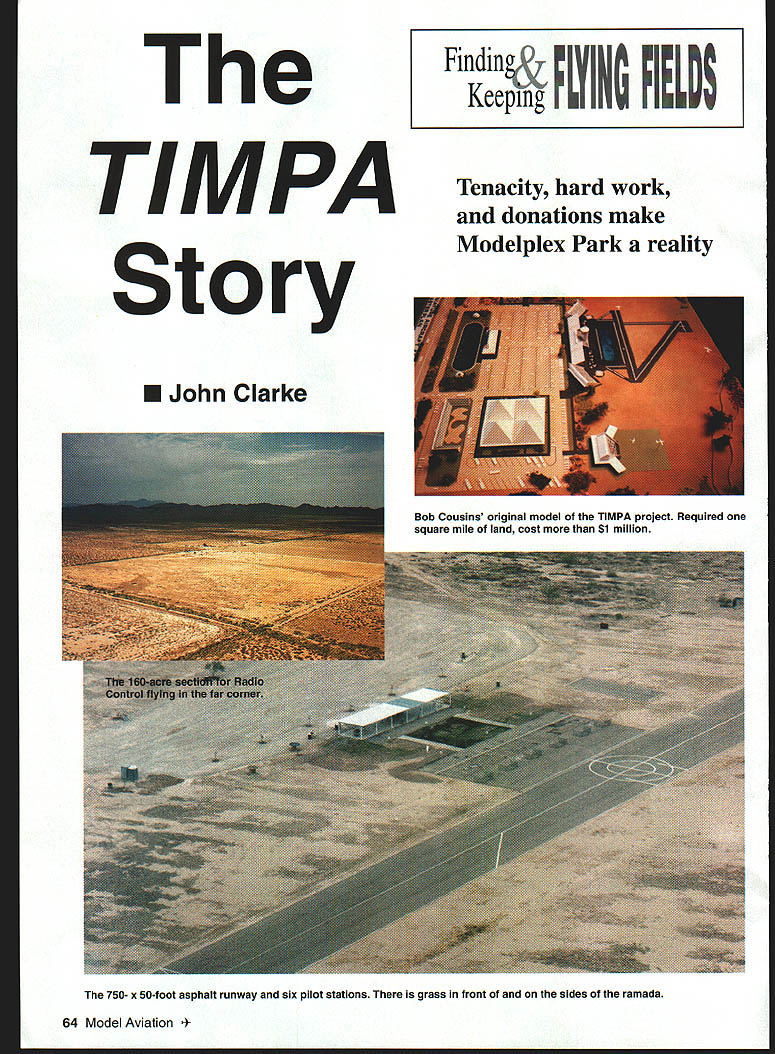
Bob drew plans and made a three-dimensional model of the facility he envisioned. As planned, the project would need a square mile of land, and the estimated cost would exceed one million dollars.
Early on, the Pima County Parks & Recreation Department offered a large site eight miles east of Tucson. With the offer came a caveat that any friction between clubs would void the offer, so each group pledged not to displace any other.
However, there was possible radio interference with a nearby club. An offer was made for that club to be the host, but it declined, and the county withdrew the offer of that location.
Two members of the Old Pueblo Flyers (OPF) and members of the TIMPA board of directors researched land held by the BLM (Bureau of Land Management), the state of Arizona, and the city of Tucson. They remembered a city-owned site eight miles from town.
I had met with the city real estate manager several times much earlier on the OPF site. Another meeting led to an offer by the city, but it fell through; an expanding full-scale airport nearby and the commercial development around it made the site unsuitable.
I found the third site. It was retired and restless, driving around and looking at every possible location that the city owned. Because Tucson is located in the Great Sonoran Desert, where water is in short supply, the city had purchased 51 square miles of farmland in the 1970s for water rights. The agreement included a provision that this land could never again be used for farming or commercial use. However, it could be used for recreation.
I had discovered a gem: a 160-acre former cotton farm, with a brick house and a 40 x 100-foot steel barn. This parcel had no urban encroachment, with power and telephone lines in place, and a small family-sized well.
I went to the city and learned that the land could be leased if TIMPA could meet the city's criteria, which included:
- State incorporation as a nonprofit organization.
- Internal Revenue Service approval as a 501(c)(3) nonprofit organization.
- A management plan for use.
- Projected income to sustain operation.
- AMA site insurance.
Another setback occurred when Bob Cousins, leader and source of inspiration, died of a heart attack.
Mike Osier called a board meeting. Every club except the OPF leaders dropped out, expecting the project to fail. The remaining board members—whom Bob affectionately called the "Dummies"—voted to carry on. My neighbor, a city councilman, concurred that the project was worthwhile and agreed to help carry it through the council.
During the following four years, it was necessary to have an architect, a CPA, and a lawyer. Jerry Beal, a CPA and modeler, did the 501(c)(3) work for nearly nothing, and he referred us to a lawyer: Bruce Dusenberry. Bruce did our incorporation for a reasonable fee.
A University of Arizona professor continued the architectural work that Bob had started, but he had to quit the project because of workload. Then we convinced retired architect and modeler A.S. (Kip) Merker to look at the project. He was opposed at first, but soon he was doing all of the necessary drawings and more, at no charge.
Funding plans included:
- Corporate grants.
- Business donations.
- Model auctions.
- Direct mail requests to Arizona AMA members.
- Mall shows and public presentations.
With the new site, our capital costs were greatly reduced. However, we had to prioritize to complete things by order of importance as funds allowed.
Large corporations with grant programs did not rate model parks highly in community interest. Tucson City Parks considered the project worthy, but not in its long-range plans. That left it up to us to reach deep into our pockets many times to keep the project afloat.
With city requirements in order, we met with the city council members for the first time. At a council meeting in June 1995, TIMPA was awarded a $1-per-year lease for the Tucson International Modelplex Park.
We were excited, but not for long; days later we were informed that the lease had been changed to require thousands of dollars per year in rent. In a panic, we made calls to councilmen, and got a 20-year lease at $20 per year.
The project was just beginning. While the city owned the land, the county controlled it. Eighteen departments had to approve everything we wanted to do on the site, and each required a complete set of blueprints. Some departments required things that other departments prohibited, but on July 1, 1995, we had the lease, the keys, and the permits.
Joy again!
The most important thing we did before starting to build was to take decibel readings at all edges of the property. Even though the nearest home was 1/2 mile away, we used the loudest un‑muffled airplane available to find worst case. We recorded readings of 50 decibels at the property's boundary for future reference.
Not long after the runway was paved, there was a noise complaint, but it was defeated because we had the data.
Clubs: do your homework, and be prepared to have complaints.
Now that the site was a reality, the first order of business was to clean the grounds, house, and hangar—they had been badly neglected. We learned that the city was close to tearing down the house and barn (renamed the hangar) and letting the property return to its natural state.
The house was restored with a new roof, a brick floor on the rear porch, tile floors inside, a new heat pump for heating and cooling, freshly patched and painted walls, broken window replacement, and rewiring with an underground 200-amp electrical service. Most of this was done with donated paint, materials, and labor—some of it professional.
Outside, we installed an above-ground water pump in the well, painted the hangar, coated the runway, and painted a one-car garage (mostly with donated materials and equipment, some from rental tool companies). We also moved a 10,000-gallon water tank from another part of the 160 acres.
A 1,600-foot runway was graded, then we decided that we had made a mistake. We moved the runway 500 feet further from the house and graded a road to it, which included a parking area.
We purchased an 84 x 16-foot ramada and erected it without professional help; then we poured the concrete floor with donated ready-mix.
With donated and purchased (at dealer cost) pipe and fittings, water was piped to the runway. An irrigation system was installed to water the grass, and landscaping was added. Telephone service was installed professionally with donated wire and labor.
All that was left was the thing our group wanted above all else: a paved runway and pit area. Sundt Corporation, a large construction company, agreed to provide free equipment and labor to construct a 750 x 50-foot runway, a 160 x 60-foot pilot station, a pit area, and a 20 x 40-foot engine test area. Calmat of Arizona donated all of the asphalt.
If TIMPA had not received these generous donations, we would have had to borrow money and divide the payments among our small membership.
Many thanks to the AMA for the $9,900 site improvement donation. The grant was spent installing safety fencing, runway barriers for pilot stations, and gravel for the driveway and the parking lot, which has made them dust free.
It is hoped that the park district will take over management of Modelplex Park. Until it does, the site is a labor of love. Significant contributions of cash, labor, and material are still donated to TIMPA.
Recent purchases include a large tractor and mower. Volunteers do the mowing and other maintenance. We are indebted to this small group, which had little or no experience in planning, building, and maintaining a community park. They have taken us from rags to riches.
The future looks good, with the remaining 480 acres available for expansion. Acquisitions include the leasing of a three-square-mile site, approximately 25 miles from the main TIMPA site, exclusively for Free Flighters. Long-range plans include a pond for RC floatplanes, rise-off-water Free Flight models, and RC boats.
Other hobby groups have shown an interest in Modelplex Park. The Southern Arizona Rocketry Association (SARA) is a new user of the original park; SARA flies high-power model rockets during club launches.
On the opposite side of the parking lot, the Tucson Amateur Astronomy Association plans to build a 20 x 30-foot observatory with a 16-inch telescope (a non-interfering activity that TIMPA encourages).
Come and enjoy Tucson’s moderate weather, clear skies, and the Modelplex Park. There are caretakers living in the house, and the site is open every day.
Recreational vehicle parking is available at many nearby parks; a list is available when you contact TIMPA:
- TIMPA, Box 22666, Tucson, AZ 85734
The cost to AMA members is a daily fee of $3 to fly, or $50 for a yearlong pass. A special winter visitor pass, good from October 1 through April 30, is available for $40. All fees go to maintaining the facility.
Hope to see you soon!
John Clarke 2833 W. Calle Carapan Tucson, AZ 85745
Transcribed from original scans by AI. Minor OCR errors may remain.

