
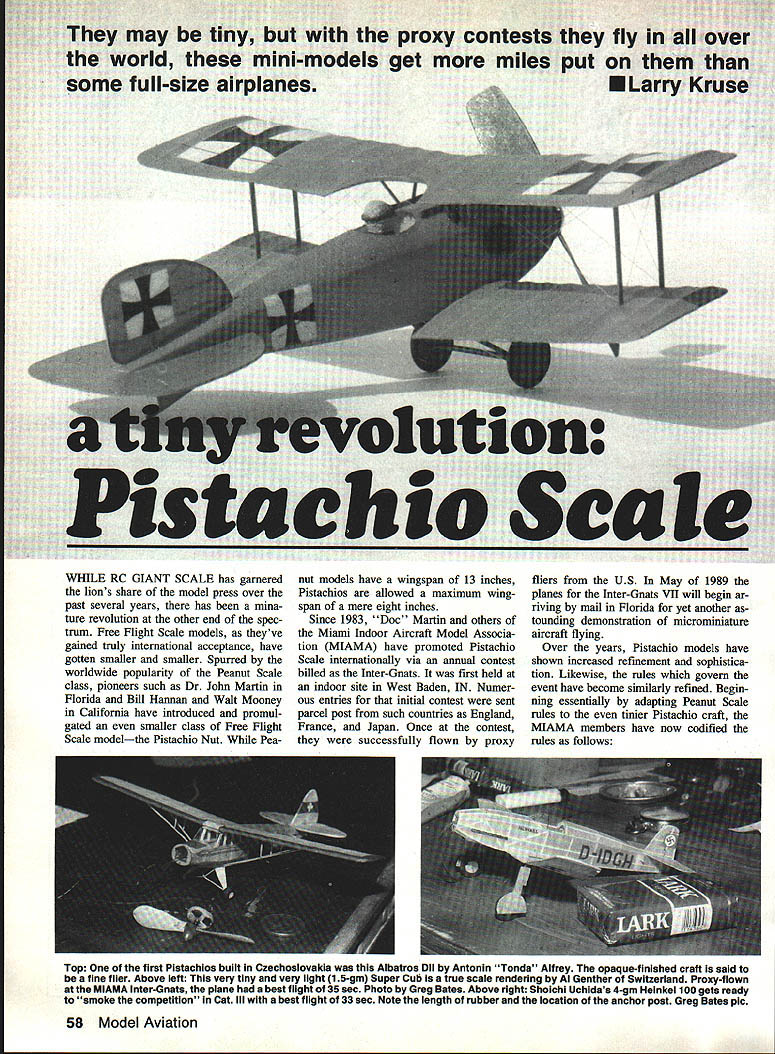
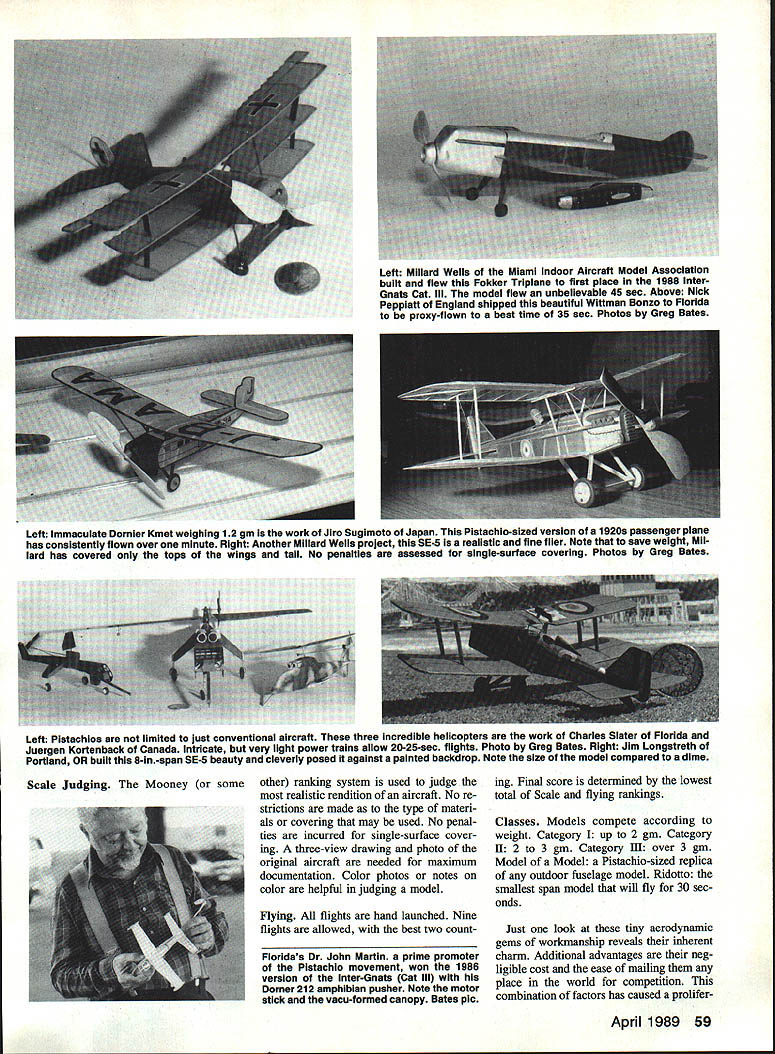
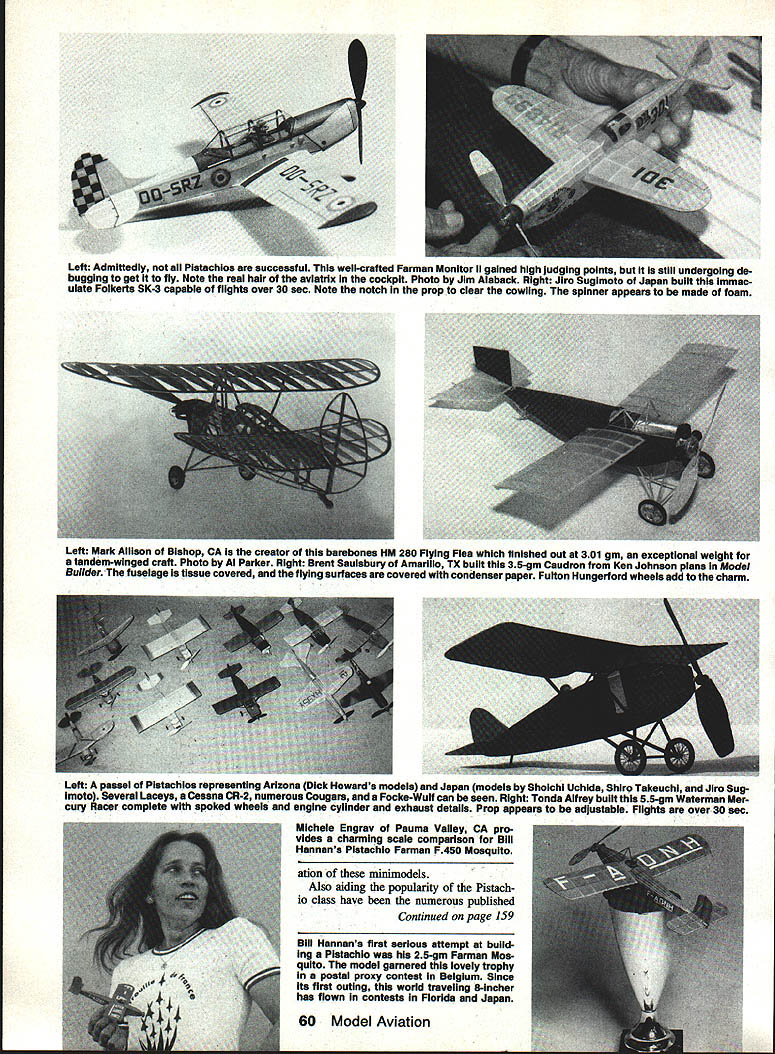
A Tiny Revolution: Pistachio Scale
While R/C giant-scale has garnered the lion's share of the model press over the past several years, there has been a miniature revolution at the other end of the spectrum. Free Flight Scale models, as they've gained truly international acceptance, have gotten smaller and smaller. Spurred by the worldwide popularity of the Peanut Scale class, pioneers such as Dr. John Martin in Florida and Bill Hannan and Walt Mooney in California have introduced and promulgated an even smaller class of Free Flight Scale model—the Pistachio.
While peanut models have a 13-inch wingspan, Pistachios are allowed a maximum wingspan of a mere 8 inches. Since 1983, "Doc" Martin and others of the Miami Indoor Aircraft Model Association (MIAMA) have promoted Pistachio Scale internationally via an annual contest billed as the Inter-Gnats. It was first held at an indoor site in West Baden, IN. Numerous entries for that initial contest were sent parcel post from such countries as England, France, and Japan. Once at the contest, they were successfully flown by proxy fliers from the U.S. In May of 1989 the planes for the Inter-Gnats VII began arriving by mail in Florida for yet another astounding demonstration of microminiature aircraft flying.
Over the years, Pistachio models have shown increased refinement and sophistication. Likewise, the rules which govern the event have become similarly refined. Beginning essentially by adapting Peanut Scale rules to the even tinier Pistachio craft, the MIAMA members have now codified the rules as follows:
Scale Judging
The Mooney (or some other) ranking system is used to judge the most realistic rendition of an aircraft. No restrictions are made as to the type of materials or covering that may be used. No penalties are incurred for single-surface covering. A three-view drawing and a photo of the original aircraft are needed for maximum documentation. Color photos or notes on color are helpful in judging a model.
Flying
All flights are hand launched. Nine flights are allowed, with the best two counting. Final score is determined by the lowest total of scale and flying rankings.
Classes
- Category I: up to 2 gm.
- Category II: 2 to 3 gm.
- Category III: over 3 gm.
- Model of a Model: a Pistachio-sized replica of any outdoor fuselage model.
- Ridotto: the smallest-span model that will fly for 30 seconds.
Just one look at these tiny aerodynamic gems of workmanship reveals their inherent charm. Additional advantages are their negligible cost and the ease of mailing them anywhere in the world for competition. This combination of factors has caused a proliferation.
Also aiding the popularity of the Pistachio class have been the numerous published plans by Don Mace of Mace Model Airplane Co., as well as three booklets by Bill Hannan. Bill's books are appropriately entitled Peanuts and Pistachios, Vols. I, II, and III. Walt Mooney has also jumped on the Pistachio wagon by shrinking some 36 of his plans, originally published as Peanuts, to the diminutive 8-inch wingspan size and offering them as an economical plan package.
In all fairness, it should also be pointed out that Pistachio models do have some drawbacks. To begin with, their small size increases the chance of damage; repairs can be tedious, since many Pistachios seem to have their own ideas about how they should be adjusted to fly. Nonetheless, as Doc Martin says, "We plan to continue to promote these neat little planes." They do possess an indefinable quality that makes trying at least one a challenge, and the fascinating exercise in miniaturizing and solving the problems associated with building and flying such miniature craft can be very rewarding. That enthusiasm can be one of the real attractions for the modeler.
More information, plans, and inspiration can be obtained from the addresses below if you feel the urge to join the Pistachio parade. As the MIAMA members say, "Pistachio isn't for everyone." But it may be for you.
Pistachio Plan and Information Sources
- Hannan's Runway, P.O. Box A, Escondido, CA 92025; publishers of Peanuts and Pistachios, Vols. I, II, and III, and purveyors of Walt Mooney's Pistachio plans.
- Mace Model Airplane Co., 359 S. 119th East Ave., Tulsa, OK 74128.
- The Hangar Pilot, 2180 Tigertail Ave., Miami, FL 33133; the newsletter of the Miami Indoor Aircraft Model Association (MIAMA).
Transcribed from original scans by AI. Minor OCR errors may remain.

