
Tipperons
By Joe Poletti
This is a new way (to us) of obtaining roll control in an RC sailplane that holds the promise of greater efficiency and greater effect at landing speeds. At the very least, it's food for thought.
We're all familiar with ailerons—their function, effects and shortcomings. Many of us have heard of entire wings rotating slightly in opposite directions to achieve the same effect without some of the shortcomings of ailerons. Either of these systems provides response improvement with a significant efficiency loss. Tipperons give further improvement in response with far less efficiency loss.
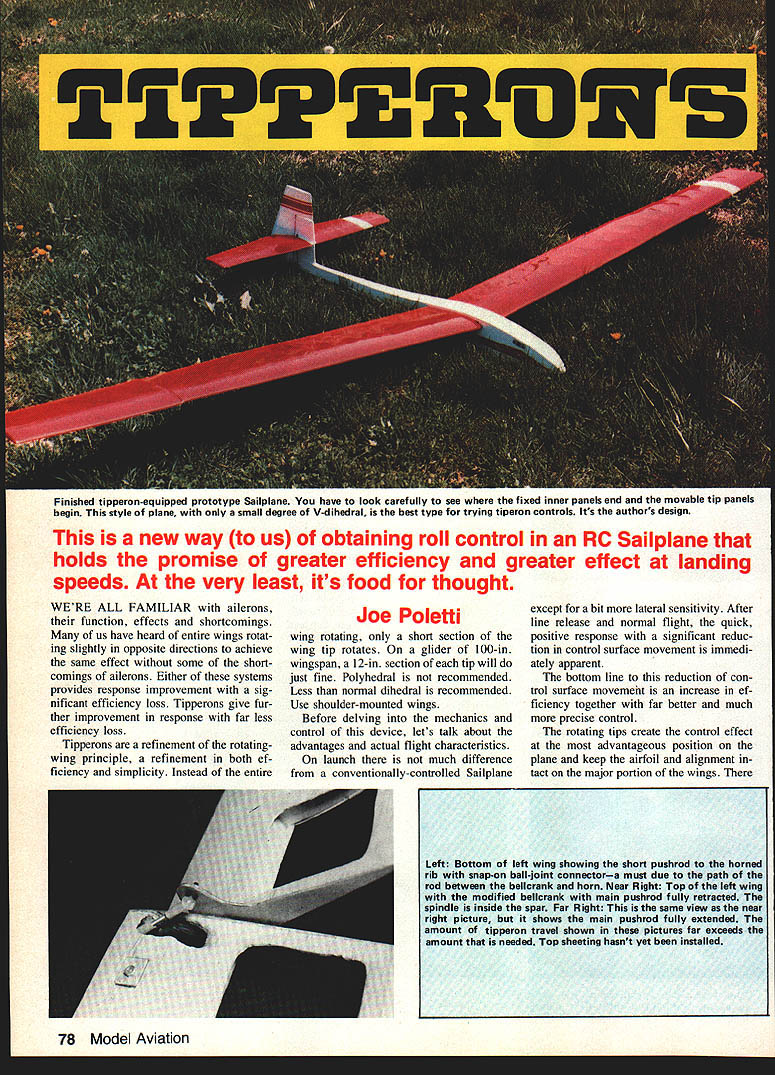
Tipperons are a refinement of the rotating-wing principle, a refinement in both efficiency and simplicity. Instead of the entire wing rotating, only a short section of the wing tip rotates. On a glider of 100 in. wingspan, a 12 in. section of each tip will do just fine.
Recommendations:
- Polyhedral is not recommended.
- Less than normal dihedral is recommended.
- Use shoulder-mounted wings.
- If in doubt about the tipperon length, allocate 20% of the wing area.
Before delving into the mechanics and control of this device, let's talk about the advantages and actual flight characteristics.
On launch there is not much difference from a conventionally controlled sailplane except for a bit more lateral sensitivity. After line release and during normal flight, the quick, positive response with a significant reduction in control surface movement is immediately apparent. The bottom line to this reduction of control surface movement is an increase in efficiency together with far better and much more precise control.
The rotating tips create the control effect at the most advantageous position on the plane and keep the airfoil and alignment intact on the major portion of the wings. There is no inefficient aileron hinge line. This method of control will not interfere with spoiler installation. In short, the tipperons are very effective and efficient in providing super-precise control even at very low speeds, such as when landing.
Control arrangement
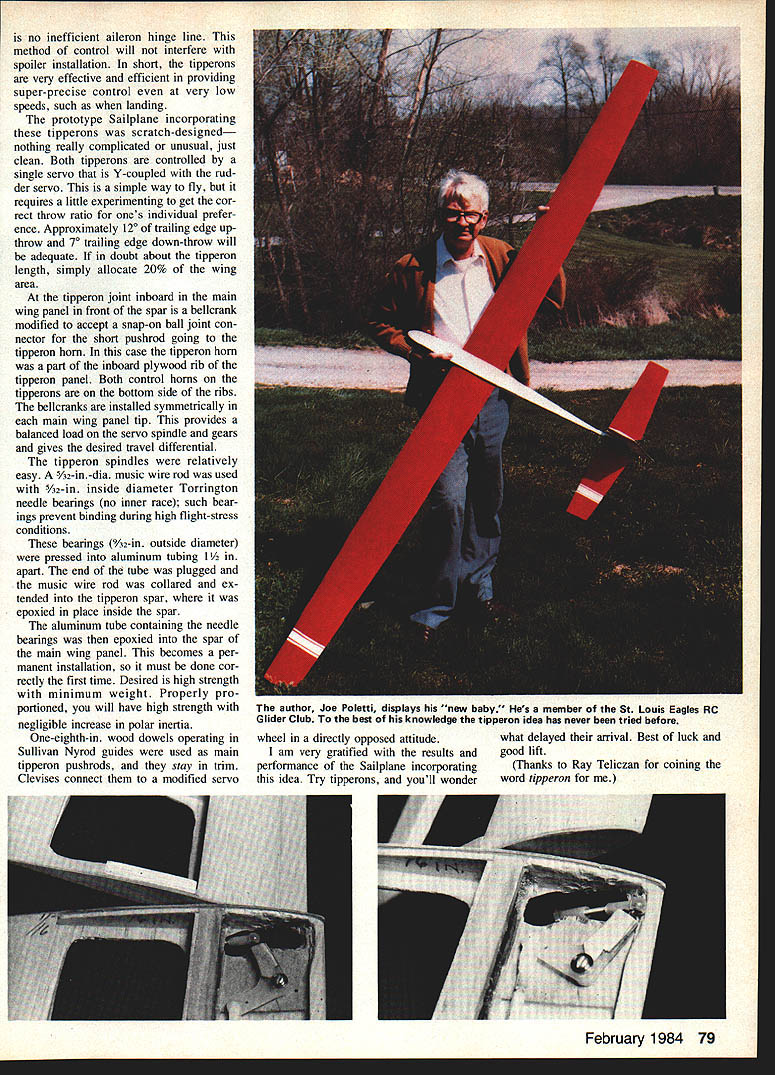
The prototype sailplane incorporating these tipperons was scratch-designed—nothing really complicated or unusual, just clean. Both tipperons are controlled by a single servo that is Y-coupled with the rudder servo. This is a simple way to fly, but it requires a little experimenting to get the correct throw ratio for one's individual preference.
Suggested throws:
- Approximately 12° trailing-edge up-throw.
- Approximately 7° trailing-edge down-throw.
Mechanical details and construction
At the tipperon joint inboard in the main wing panel, in front of the spar, is a bellcrank modified to accept a snap-on ball joint connector for the short pushrod going to the tipperon horn. In this case the tipperon horn was a part of the inboard plywood rib of the tipperon panel. Both control horns on the tipperons are on the bottom side of the ribs. The bellcranks are installed symmetrically in each main wing panel tip. This provides a balanced load on the servo spindle and gears and gives the desired travel differential.
The tipperon spindles were relatively easy. A 5/32 in. dia. music‑wire rod was used with Torrington needle bearings (no inner race); such bearings prevent binding during high flight‑stress conditions. These bearings were pressed into aluminum tubing spaced 1 1/2 in. apart. The end of the tube was plugged and the music‑wire rod was collared and extended into the tipperon spar, where it was epoxied in place inside the spar.
The aluminum tube containing the needle bearings was then epoxied into the spar of the main wing panel. This becomes a permanent installation, so it must be done correctly the first time. The goal is high strength with minimum weight. Properly proportioned, you will have high strength with negligible increase in polar inertia.
One-eighth‑inch wood dowels operating in Sullivan Nyrod guides were used as main tipperon pushrods, and they stay in trim. Clevises connect them to a modified servo wheel in a directly opposed attitude.
Results and closing
I am very gratified with the results and performance of the sailplane incorporating this idea. Try tipperons, and you'll wonder what delayed their arrival.
Best of luck and good lift.
(Thanks to Ray Teleczan for coining the word "tipperon" for me.)
Transcribed from original scans by AI. Minor OCR errors may remain.

