
The TIPSY Junior
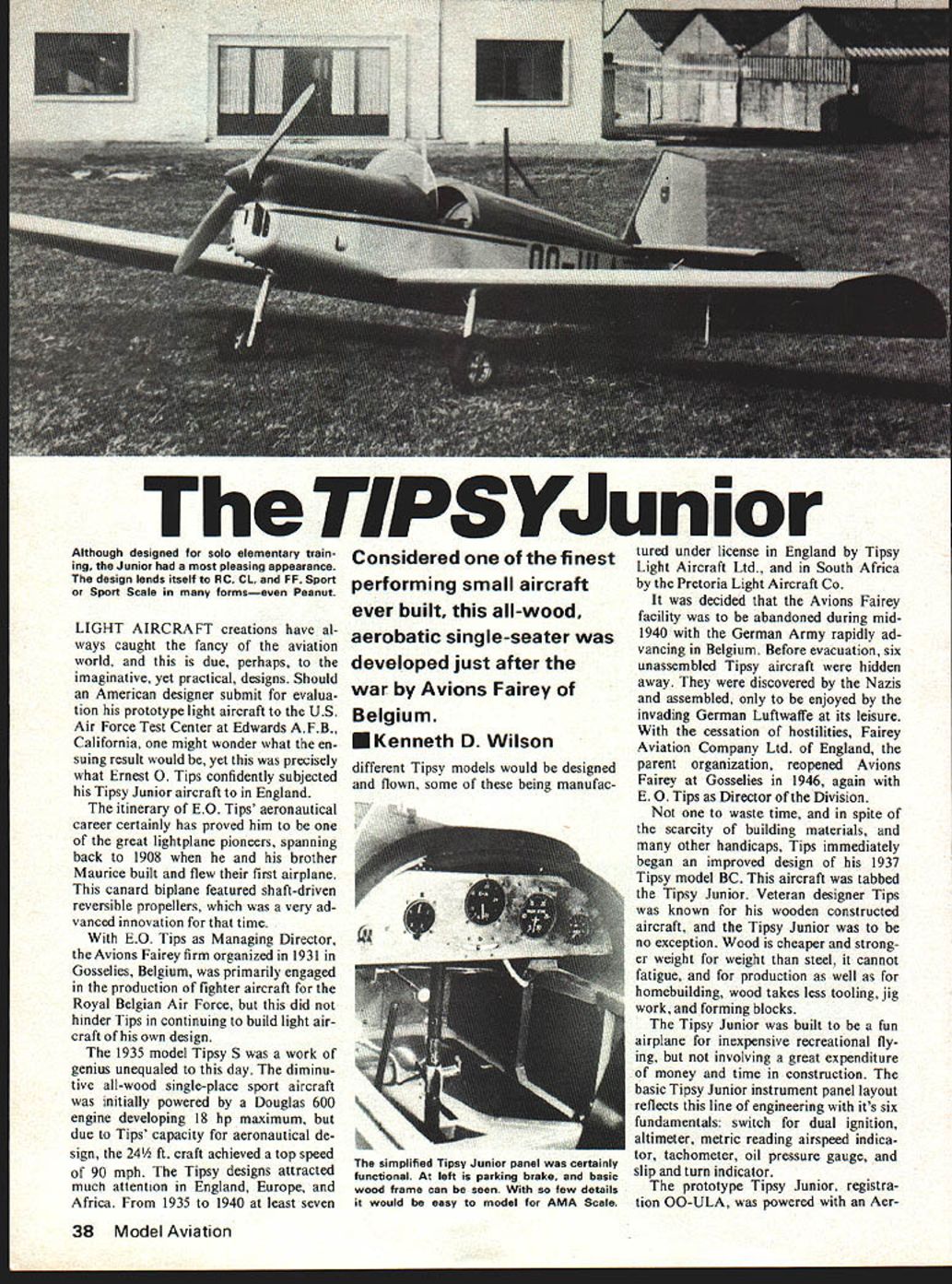
Although designed for solo elementary training, the Junior had a most pleasing appearance. The design lends itself to RC, CL and FF. Sport or Sport Scale in many forms—even Peanut.
Considered one of the finest performing small aircraft ever built, this all-wood, aerobatic single-seater was developed just after the war by Avions Fairey of Belgium.
Kenneth D. Wilson
LIGHT AIRCRAFT creations have always caught the fancy of the aviation world, and this is due, perhaps, to the imaginative, yet practical, designs. Should an American designer submit for evaluation his prototype light aircraft to the U.S. Air Force Test Center at Edwards A.F.B., California, one might wonder what the ensuing result would be, yet this was precisely what Ernest O. Tips confidently subjected his Tipsy Junior aircraft to in England.
The itinerary of E.O. Tips' aeronautical career certainly has proved him to be one of the great lightplane pioneers, spanning back to 1908 when he and his brother Maurice built and flew their first airplane. This canard biplane featured shaft-driven reversible propellers, which was a very advanced innovation for that time.
With E.O. Tips as Managing Director, the Avions Fairey firm, organized in 1931 in Gosselies, Belgium, was primarily engaged in the production of fighter aircraft for the Royal Belgian Air Force, but this did not hinder Tips in continuing to build light aircraft of his own design.
The 1935 model Tipsy S was a work of genius unequaled to this day. The diminutive all-wood single-place sport aircraft was initially powered by a Douglas 600 engine developing 18 hp maximum, but due to Tips' capacity for aeronautical design, the 24½ ft. craft achieved a top speed of 90 mph. The Tipsy designs attracted much attention in England, Europe, and Africa. From 1935 to 1940 at least seven different Tipsy models would be designed and flown, some of these being manufactured under license in England by Tipsy Light Aircraft Ltd., and in South Africa by the Pretoria Light Aircraft Co.
It was decided that the Avions Fairey facility was to be abandoned during mid-1940 with the German Army rapidly advancing in Belgium. Before evacuation, six unassembled Tipsy aircraft were hidden away. They were discovered by the Nazis and assembled, only to be enjoyed by the invading German Luftwaffe at its leisure. With the cessation of hostilities, Fairey Aviation Company Ltd. of England, the parent organization, reopened Avions Fairey at Gosselies in 1946, again with E.O. Tips as Director of the Division.
Not one to waste time, and in spite of the scarcity of building materials, and many other handicaps, Tips immediately began an improved design of his 1937 Tipsy model BC. This aircraft was tabbed the Tipsy Junior. Veteran designer Tips was known for his wooden constructed aircraft, and the Tipsy Junior was to be no exception. Wood is cheaper and stronger weight for weight than steel, it cannot fatigue, and for production as well as for homebuilding, wood takes less tooling, jig work, and forming blocks.
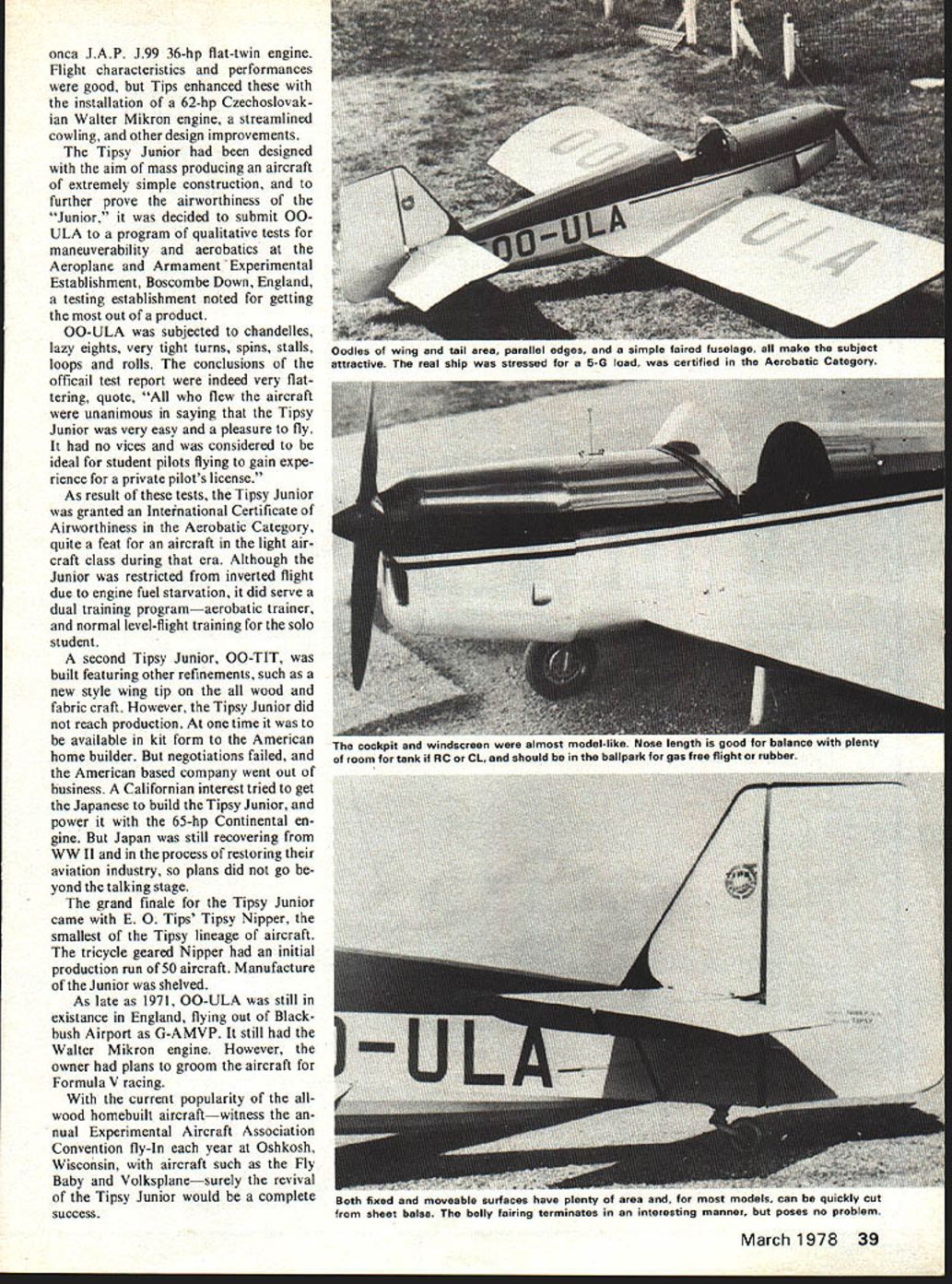
The Tipsy Junior was built to be a fun airplane for inexpensive recreational flying, but not involving a great expenditure of money and time in construction. The basic Tipsy Junior instrument panel layout reflects this line of engineering with its six fundamentals: switch for dual ignition, altimeter, metric reading airspeed indicator, tachometer, oil pressure gauge, and slip and turn indicator.
The prototype Tipsy Junior, registration OO-ULA, was powered with an Aer... on a J.A.P. J.99 36-hp flat-twin engine. Flight characteristics and performances were good, but Tips enhanced these with the installation of a 62-hp Czechoslovakian Walter Mikron engine, a streamlined cowling, and other design improvements.
The Tipsy Junior had been designed with the aim of mass producing an aircraft of extremely simple construction, and to further prove the airworthiness of the "Junior," it was decided to submit OO-ULA to a program of qualitative tests for maneuverability and aerobatics at the Aeroplane and Armament Experimental Establishment, Boscombe Down, England, a testing establishment noted for getting the most out of a product.
OO-ULA was subjected to chandelles, lazy eights, very tight turns, spins, stalls, loops and rolls. The conclusions of the official test report were indeed very flattering. "All who flew the aircraft were unanimous in saying that the Tipsy Junior was very easy and a pleasure to fly. It had no vices and was considered to be ideal for student pilots flying to gain experience for a private pilot's licence."
As a result of these tests, the Tipsy Junior was granted an International Certificate of Airworthiness in the Aerobatic Category, quite a feat for an aircraft in the light aircraft class during that era. Although the Junior was restricted from inverted flight due to engine fuel starvation, it did serve a dual training program— aerobatic trainer, and normal level-flight training for the solo student.
A second Tipsy Junior, OO-TIT, was built featuring other refinements, such as a new style wing tip on the all wood and fabric craft. However, the Tipsy Junior did not reach production. At one time it was to be available in kit form to the American home builder. But negotiations failed, and the American based company went out of business. A Californian interest tried to get the Japanese to build the Tipsy Junior, and power it with the 65-hp Continental engine. But Japan was still recovering from WWII and in the process of restoring their aviation industry, so plans did not go beyond the talking stage.
The grand finale for the Tipsy Junior came with E. O. Tips' Tipsy Nipper, the smallest of the Tipsy lineage of aircraft. The tricycle-geared Nipper had an initial production run of 50 aircraft. Manufacture of the Junior was shelved.
As late as 1971, OO-ULA was still in existence in England, flying out of Blackbushe Airport as G-AMVP. It still had the Walter Mikron engine. However, the owner had plans to groom the aircraft for Formula V racing.
With the current popularity of the all-wood homebuilt aircraft—witness the annual Experimental Aircraft Association convention fly-in each year at Oshkosh, Wisconsin, with aircraft such as the Fly Baby and Volksplane—surely the revival of the Tipsy Junior would be a complete success. AVIONS FAIREY, S.A.
DIVISION TIPSY
AERODROME, GOSSELIES
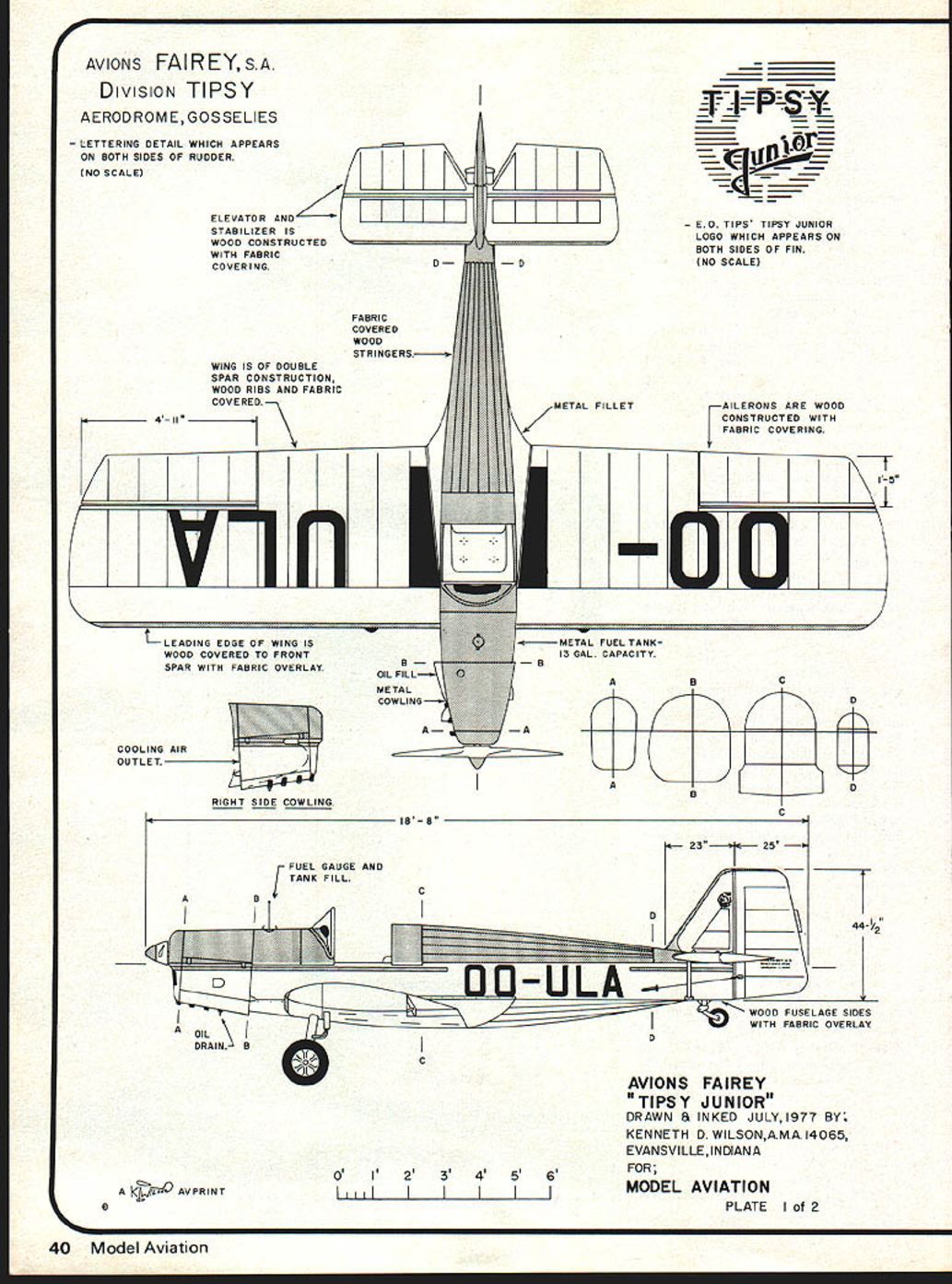
LETTERING DETAIL WHICH APPEARS ON BOTH SIDES OF RUDDER. (NO SCALE)
ELEVATOR AND STABILIZER IS WOOD CONSTRUCTED WITH FABRIC COVERING.
FABRIC COVERED WOOD STRINGERS.
TIPSY Junior
E. O. TIPS' TIPSY JUNIOR LOGO WHICH APPEARS ON BOTH SIDES OF FIN. (NO SCALE)
WING IS OF DOUBLE SPAR CONSTRUCTION, WOOD RIBS AND FABRIC COVERED.
METAL FILLET
AILERONS ARE WOOD CONSTRUCTED WITH FABRIC COVERING.
LEADING EDGE OF WING IS WOOD COVERED TO FRONT SPAR WITH FABRIC OVERLAY.
METAL FUEL TANK - 13 GAL. CAPACITY.
METAL COWLING
OIL FILL
COOLING AIR OUTLET.
RIGHT SIDE COWLING
18'-8"
FUEL GAUGE AND TANK FILL.
OO-ULA
OIL DRAIN.
WOOD FUSELAGE SIDES WITH FABRIC OVERLAY.
0' 1' 2' 3' 4' 5' 6'
AVIONS FAIREY "TIPSY JUNIOR" DRAWN & INKED JULY, 1977 BY: KENNETH D. WILSON, A.M.A. 14065, EVANSVILLE, INDIANA FOR; MODEL AVIATION PLATE 1 OF 2 — YELLOW. — BLUE. — BLACK.
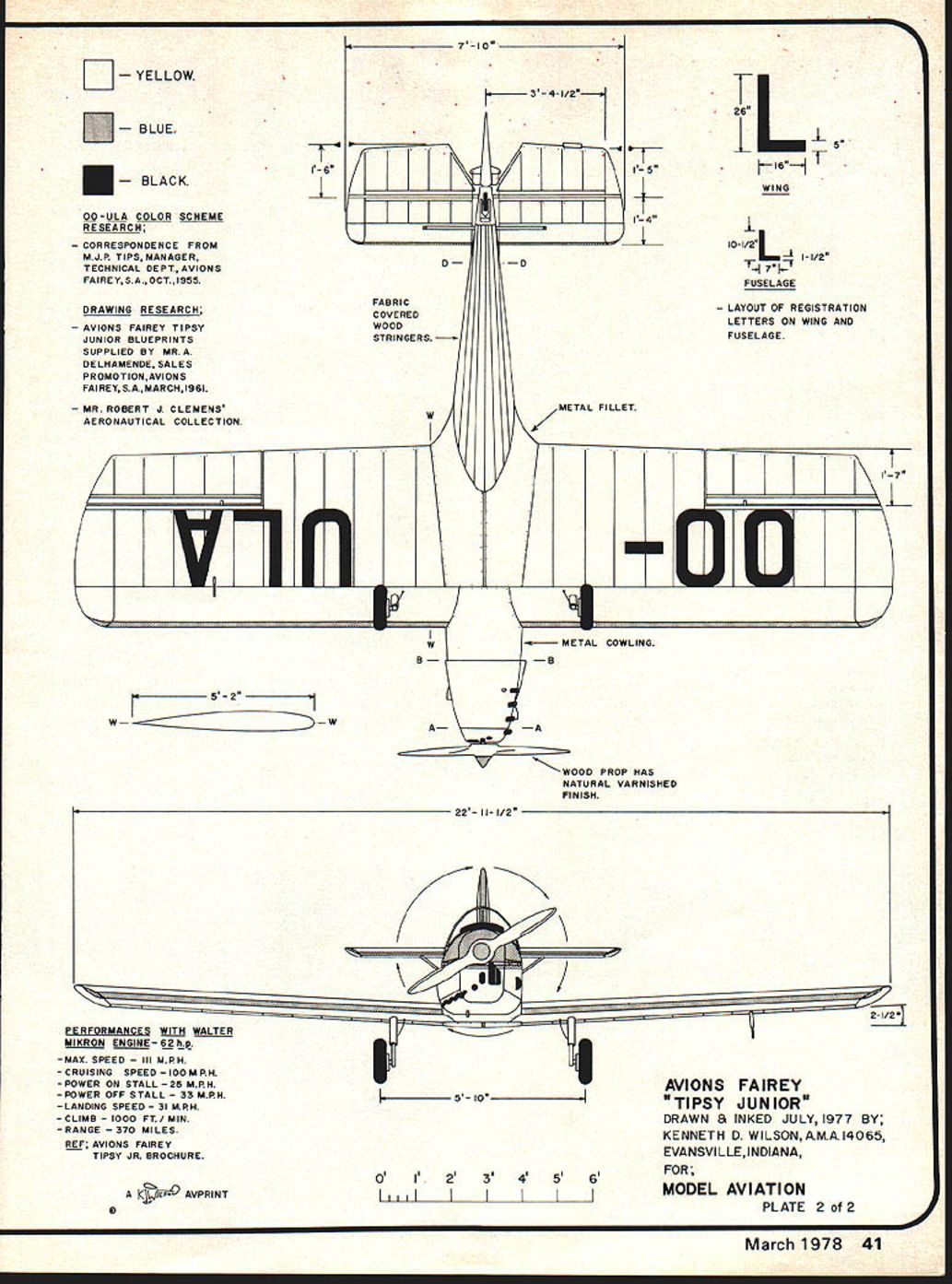
OO-ULA COLOR SCHEME RESEARCH;
— CORRESPONDENCE FROM M.J.P. TIPS, MANAGER, TECHNICAL DEPT., AVIONS FAIREY, S.A., OCT., 1955.
DRAWING RESEARCH;
— AVIONS FAIREY TIPSY JUNIOR BLUEPRINTS SUPPLIED BY MR. A. DELHAMENDE, SALES PROMOTION, AVIONS FAIREY, S.A., MARCH, 1961.
— MR. ROBERT J. CLEMENS' AERONAUTICAL COLLECTION.
FABRIC COVERED WOOD STRINGERS.
METAL FILLET.
METAL COWLING.
WOOD PROP HAS NATURAL VARNISHED FINISH.
22'-11-1/2"
LAYOUT OF REGISTRATION LETTERS ON WING AND FUSELAGE.
PERFORMANCES WITH WALTER MIKRON ENGINE - 62 h.p.
- MAX. SPEED - 111 M.P.H.
- CRUISING SPEED - 100 M.P.H.
- POWER ON STALL - 25 M.P.H.
- POWER OFF STALL - 33 M.P.H.
- LANDING SPEED - 31 M.P.H.
- CLIMB - 1000 FT./MIN.
- RANGE - 370 MILES.
REF: AVIONS FAIREY TIPSY JR. BROCHURE.
AVIONS FAIREY "TIPSY JUNIOR" DRAWN & INKED JULY, 1977 BY; KENNETH D. WILSON, A.M.A.14065, EVANSVILLE, INDIANA, FOR: MODEL AVIATION
PLATE 2 OF 2
Transcribed from original scans by AI. Minor OCR errors may remain.

