
Toasting Toledo
Fred Berman
Report on the Weak Signals R/C Expo — a stellar show.
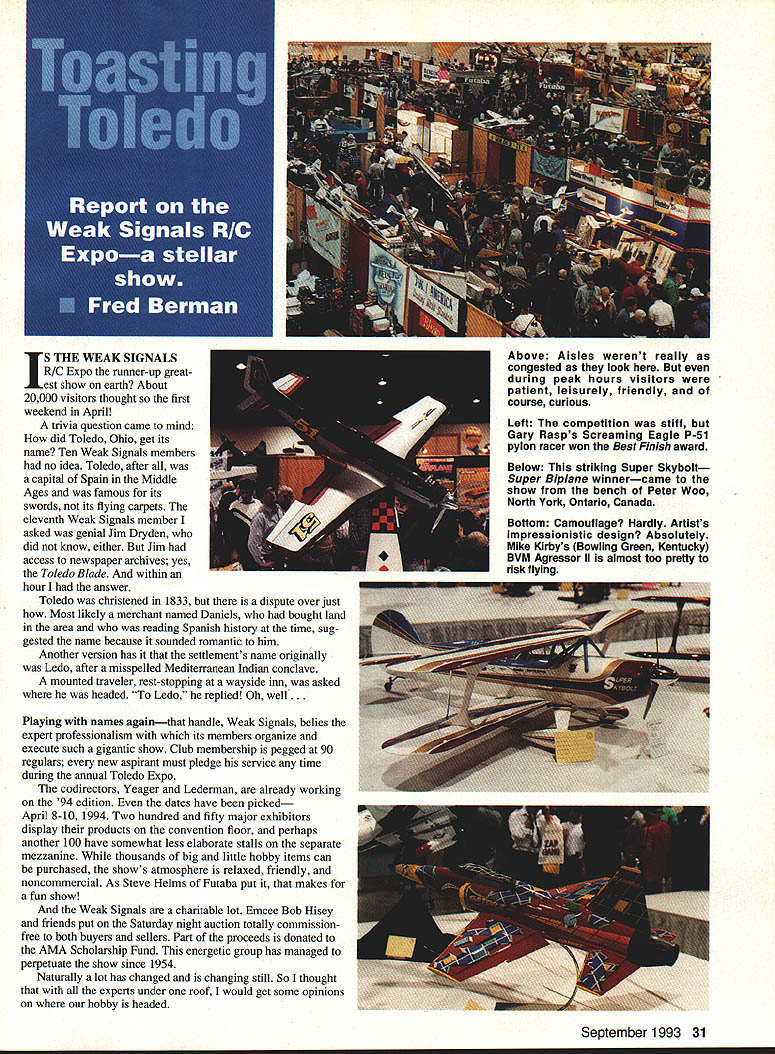
Is the Weak Signals R/C Expo the runner-up greatest show on earth? About 20,000 visitors thought so the first weekend in April.
A trivia question came to mind: how did Toledo, Ohio, get its name? Ten Weak Signals members had no idea. Toledo, after all, was a capital of Spain in the Middle Ages and was famous for its swords, not its flying carpets. The eleventh Weak Signals member I asked was genial Jim Dryden, who did not know either. But Jim had access to newspaper archives — yes, the Toledo Blade — and within an hour I had the answer.
Toledo was christened in 1833, but there is a dispute over just how. Most likely a merchant named Daniels, who had bought land in the area and who was reading Spanish history at the time, suggested the name because it sounded romantic to him. Another version has it that the settlement's name originally was Ledo, after a misspelling of a Mediterranean place. A mounted traveler, rest-stopping at a wayside inn, was asked where he was headed. "To Ledo," he replied.
Playing with names again — that handle, Weak Signals, belies the expert professionalism with which its members organize and execute such a gigantic show. Club membership is pegged at 90 regulars; every new aspirant must pledge his service any time during the annual Toledo Expo.
The Show and the Club
- The codirectors, Yeager and Lederman, are already working on the '94 edition. Even the dates have been picked — April 8–10, 1994.
- Two hundred fifty major exhibitors display their products on the convention floor, and perhaps another 100 have somewhat less elaborate stalls on the separate mezzanine.
- While thousands of big and little hobby items can be purchased, the show's atmosphere is relaxed, friendly, and noncommercial. As Steve Helms of Futaba put it, that makes for a fun show.
- The Weak Signals are a charitable lot. Emcee Bob Hisey and friends put on the Saturday night auction totally commission-free to both buyers and sellers. Part of the proceeds is donated to the AMA Scholarship Fund.
- This energetic group has managed to perpetuate the show since 1954.
Where the Hobby Is Headed
Oversimplifying, aeromodeling has two elements — building and flying. Hobby participation overall is rising, but the percentage of builders is feared to be declining. Concerns include:
- Youngsters in school are no longer being taught handicrafts and shop, a change attributed in part to the country's liability and litigation phobia.
- Modern aviation has gravitated toward automated systems; video games may siphon off interest from potential new hobbyists who prefer hands-on aerobatics. After all, starships and rockets require computerized robot pilots.
- Still, there appears to be demand for ever more sophisticated equipment such as synthesized multichannel radios, telemetering, higher-efficiency airfoils, and pure-jet engines.
- What impact does a sluggish economy have on the hobby? With unemployment and reduced income, the hobby would have to take a backseat to such paltry matters as grocery money.
Visitor Sampling
I conducted an unofficial, very raw sampling: I polled show visitors by standing at the gate and estimating the ages of 100 successive persons passing the ticket taker. Simple averaging yielded a mean age of 42.6 years. According to AMA statistics, this signifies the hobby is getting older — fewer young people are coming. If this trend were prolonged, aeromodeling's future would be in jeopardy.
Opinions from Exhibitors and Experts
- Frank Garcher (chief of Midwest Products): Sponsors an educational program called "Grow A Modeler." Although U.S. modeling activity remains strong, he believes youngsters' interest is no longer self-generating and needs to be stimulated.
- Dave Patrick (senior VP of Carl Goldberg Models): Believes the hobby is continuing to expand and that interest is shifting toward newer models — not necessarily ARFs. He is optimistic that the current frequency turmoil will be resolved.
- John Brodbeck (AMA Hall-of-Famer and engine manufacturer): Notes that only two major engine producers remain out of the 40 that once were. The .82-cubic-inch ducted-fan engine he was showing attests to K&B's march of progress. He also observed that California's defense downsizing is hurting the hobby in that state.
- Bob Walker (Robart Manufacturing): Developing a seven-cylinder radial engine, an exact miniature replica of the 225-hp Jacobs engine. Priced at about $3,500 per copy, an initial run of 300 engines is planned. He has also acquired a French T-240 Turbocadet jet engine to test-fly in a Violet T-33 model and expects to experiment with fuels other than propane.
- Lewis Polk (Polk's Model Craft Hobbies): First to offer a narrow-band 50-channel radio control system, the Valiant 8, allowing model fliers to tune to any of 50 aircraft channels. The transmitter can double as a scanner to detect interference or prior use of channels. Polk believes modeling represents the best entertainment value for the money even in depressed times.
- Ricardo Calero (Balsa Trading, U.S.A.): Born and raised in Ecuador, he provided insight into balsa production: trees grow wild and usually mature in three years; one tree in four may be suitable for logging; about 50% of a log's weight is water that must be kiln-dried; about 40% of what is left is wasted when the log is trimmed. Wood near the center is harder and denser than wood closer to the surface. The British began using balsa in the 1930s for the Mosquito bomber.
- Leroy (prominent lawyer and retired Speaker of the Pennsylvania House of Representatives): Fears the hobby is getting too intricate (computer radios), too expensive, and not attractive enough for today's youngsters. He encourages and teaches young people and is a staunch member of SAM (Society of Antique Modelers).
- Tom Atwood (editor of Model Airplane News): Sees the hobby growing in number of participants and in the size of their models. He credits the Discovery Channel's Wings series with helping create interest, but concedes the average modeler's age is increasing. He suggests early retirees are turning to modeling as a fulfilling avocation.
- Dick Kidd (editor of RCM): A former tail gunner and bush pilot, now a designer and builder of models. He believes magazines, manufacturers, older modelers, and enlightened schoolteachers can rekindle youngsters' interest in flight.
- Hazel Sig-Hester: Does not think aeromodeling is declining. She promotes the Glenn Sig Scholarship Fund for promising modelers (Glenn Sig was Hazel's first husband, who perished in an air show accident) and hosts an annual RC fly-in at her private airstrip in Montezuma, Iowa.
- Ted and Tim Schoonard: Produce model helicopters and report that model helicopter enthusiasm is on the rise. Their father, the late Walt Schoonard, founded Miniature Aircraft.
- Stan Czaja (mezzanine exhibitor): Showed mini-electric motors made from camera film transport motors, ideal for ultralight power plants; total price around $3. E.H. Yost & Co. markets small cutters; light lithium batteries serve as energy sources for micromobiles — lilliputian electric free flight or R/C.
- Steve Helms (Futaba marketing manager and TOC pattern competitor): Observes a definite age split. Those under 40 love new computer radios; those over 40 fear them. Futaba's T9ZAP system is a digital-synthesized transmitter/receiver combo that can tune to any of the 50 R/C channels and displays frequency, trims, battery voltage, and more. Receivers offer decimal tuning. Flyers still need frequency flags to comply with flying-site rules.
Balsa Wood — From Ecuador to Models
- Balsa trees in Ecuador mature in about three years; one in four trees may be suitable for logging.
- About 50% of a log's weight is water and must be removed by kiln-drying.
- Roughly 40% of the remaining wood is wasted when trimming the log.
- Core wood is denser and heavier than outer wood.
- Balsa has industrial uses beyond models — e.g., as insulating cores for tanker vessels and laminated with fiberglass for pleasure boat hulls.
The Toledo Model Beauty Contest — Winners
The Toledo show traditionally sponsors a beauty contest for model airplanes with very nice prizes. Best of Show and category winners this year included:
- Best of Show and Precision Scale: Robert S. Cooper, Savannah, Georgia — Avro D (WW I vintage biplane)
- Nonmilitary Sport Scale: Mike Barbee, Columbus, Ohio — Beechcraft T-34C
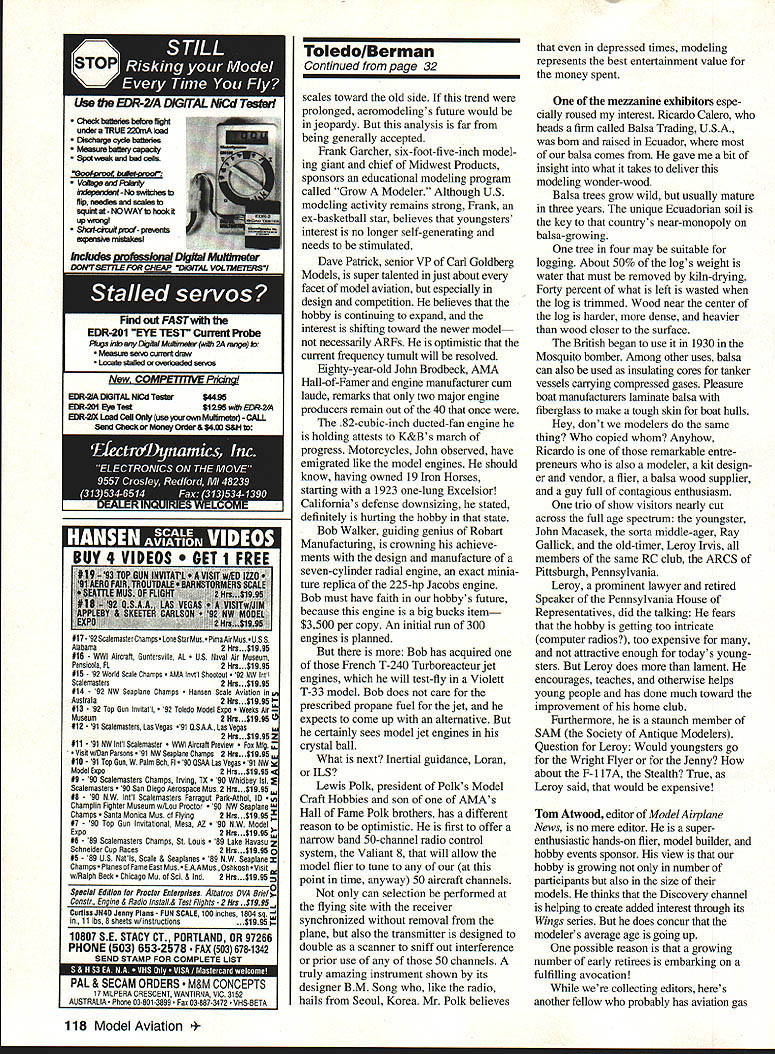
- Sport Biplane: Peter Woo, North York, Ontario, Canada — Steen Super Skybolt
- Sport Monoplane: Faye Stilley, Wilton, Connecticut — Deweyville Special
- Military Sport Scale: Terry Nitsch, Columbus, Ohio — modified Violett F-86 (aluminum-clad, 1,500 hours to build)
- Old-Timer RC: Brian Beck, Mt. Clemens, Michigan — 1940 RC-1
- Pattern: Kent Landerfeld, Claremore, Oklahoma — Malibu
- Sport Sailplane: Jim Young, Novi, Michigan — Legend
- Helicopter: Robin Cooper, Dowagiac, Michigan — camouflage-painted UH-60
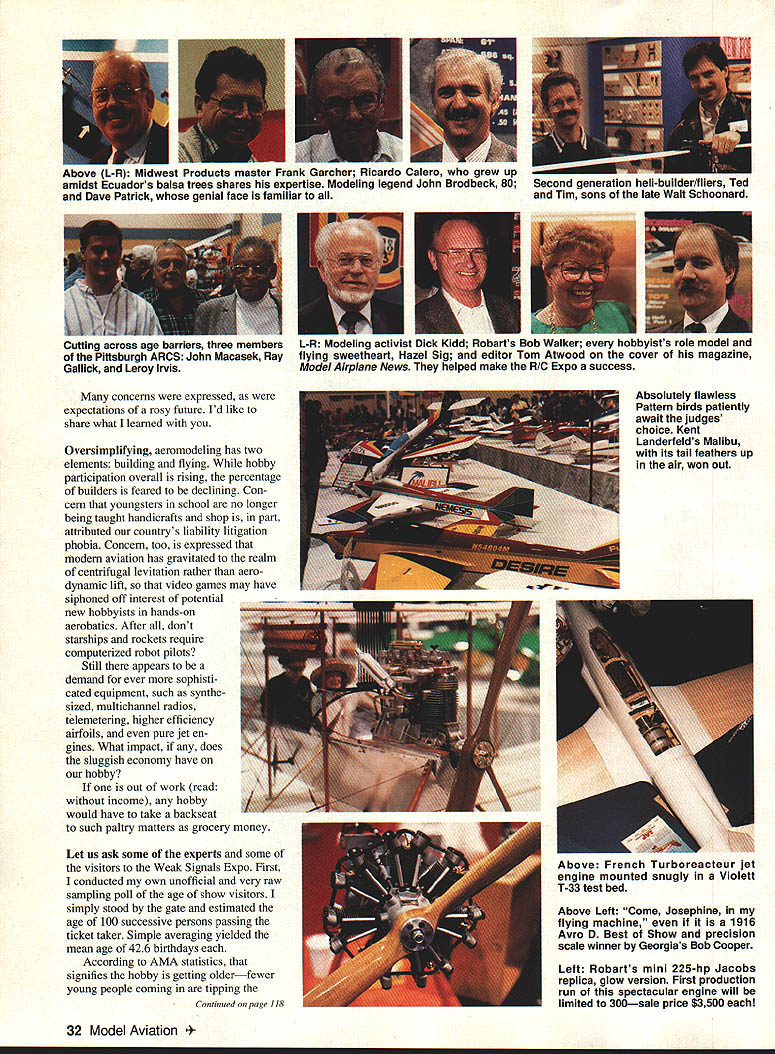
- Best Finish: Gary Rasp, E. Aurora, Illinois — P-51 Cleveland pylon racer (mounted on a revolving pedestal)
Conclusion
Toledo continues to be an ever-new, stellar attraction. Hobby stuff becomes three-dimensional — you can touch, feel, compare, talk, and get answers. Just about all hobby-item purveyors are modelers themselves, and they are accessible. If you can, try the Toledo Weak Signals Expo in April '94 — you'll like it.
Transcribed from original scans by AI. Minor OCR errors may remain.

