
Toledo 1994
Weak Signals' Endeavor Has Become a Modelers' Mecca
Fred Berman
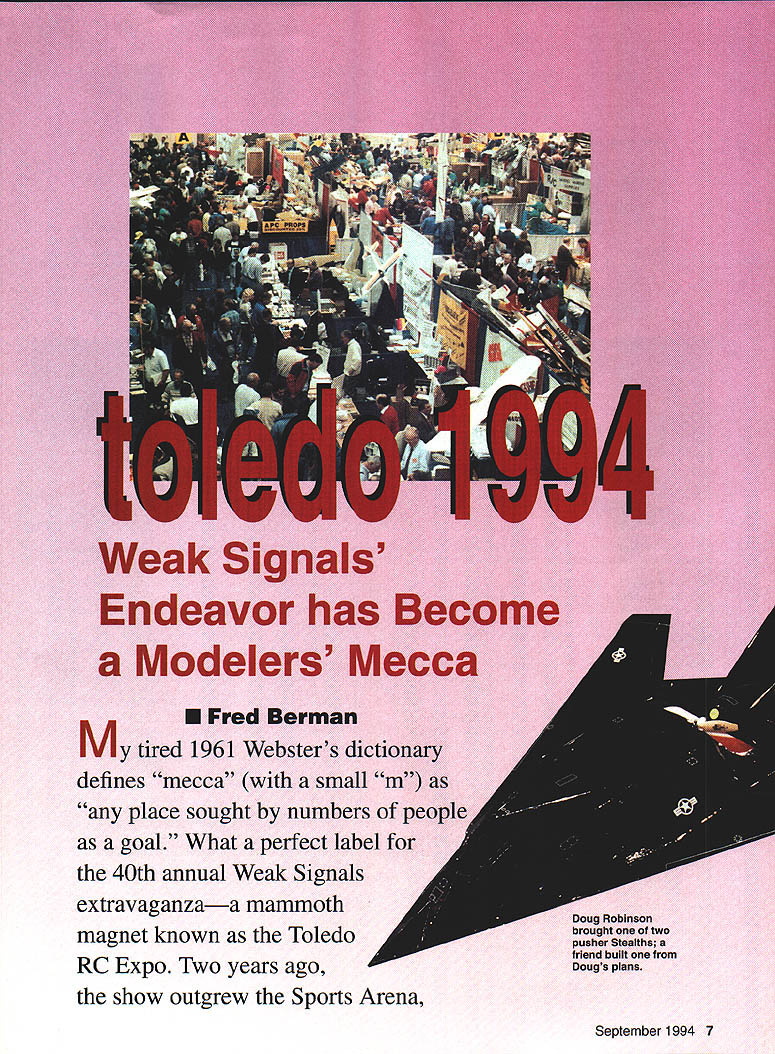
My tired 1961 Webster's dictionary defines "mecca" (with a small "m") as "any place sought by numbers of people as a goal." What a perfect label for the 40th annual Weak Signals extravaganza—a mammoth magnet known as the Toledo RC Expo. Two years ago, the show outgrew the Sports Arena and was transplanted to the larger, brand-new SeaGate Centre.
From the size of this year's crowd, it's apparent that attendance is growing faster than available space. If ticket statistics mean anything, our hobby is alive and well. The Weak Signals deserve one heck of a lot of credit for rejuvenating the faithful.
What's in a name? The "Weak" in Weak Signals surely must be an antonym, because as a club, they are super strong! These are amateurs promoting a trade show that is the envy of the seasoned pros.
The Weak Signals Club
Here is a bit of insight into this amazing club: their regular membership is capped at 90. Initiation fee: yes. Dues: no. (Well, almost no. You could put a dollar value on obligatory service during the Toledo Expo.) Management and/or labor: Weak Signals members do it all, but as in any club, some do more than others.
Think of the necessary planning: lining up those 245 exhibitors, advertising, tickets, programs, contests, arranging and executing hall and parking leases, providing for security, and cash-flowing the finances. The Weak Signals practically take over an entire hotel.
They set up the Swap Shop, which is really a huge group of small, independent vendors. They contract shuttle-bus service to distant parking lots, procure prizes for 55 contest categories, and provide competent model judges. They negotiate with concessionaires, and of course, hire Miss Weak Signals (no shortage of volunteers there!).
Weak Signals prepare and staff the AMA scholarship raffle, and schedule Weak Signals members for service tasks. Last, but not least, they organize the Saturday-night auction. For a few, such as co-directors Rick Lederman and Wayne Yeager, the Expo is a yearlong endeavor.
Club-owned facilities include:
- 35 acres of real estate and a luxurious clubhouse
- Paved runways and super-safe pylon cages
- Glider-launch equipment
Membership includes a number of national and regional champions in various branches of R/C. This year is a culmination of 40 years of evolution—from a wooden shed to the finest convention hall Toledo has to offer.
At the Show
What happens at Toledo is similar to those TV commercials where a drab sketch is transformed into an animated scene. Manufacturers' names from catalog pages turn into flesh-and-blood people from whom one can ask questions—people like Lou Polk, Tony Frackowiak, Bob Violett, and Tom Runge.
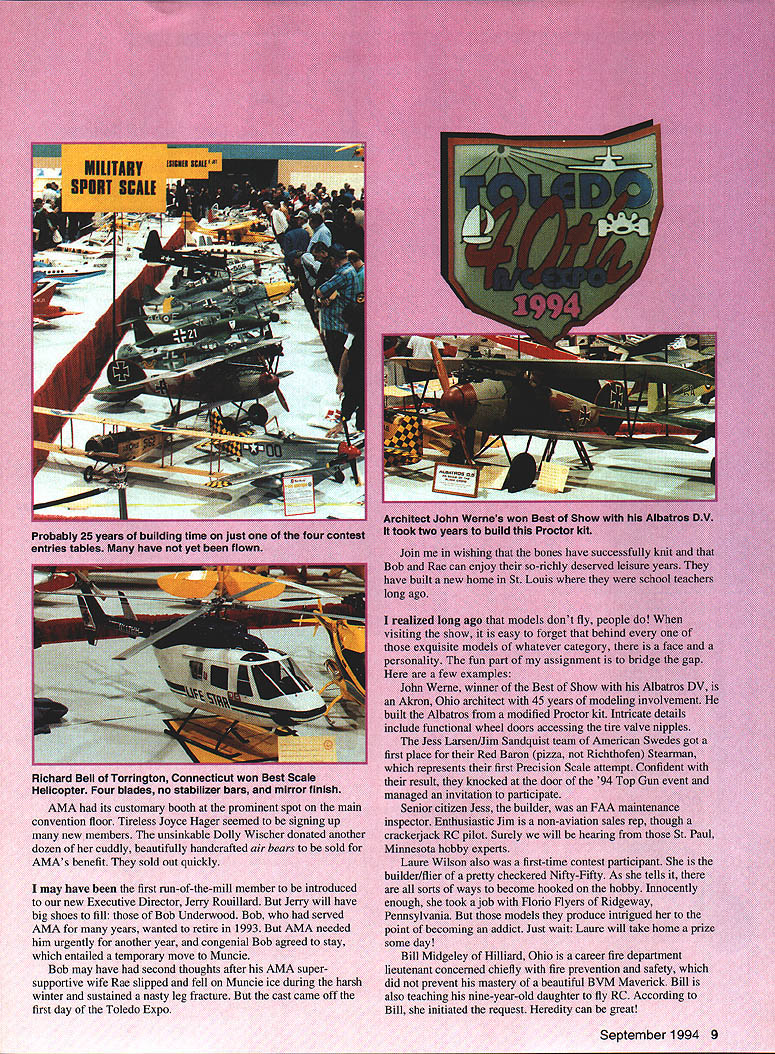
Those hobby products that have stacked up in one's mind can be seen and handled (for possible acquisition, of course). Also at Toledo are new items, perhaps seen for the first time. One item was an American-made model aircraft turbine that eclipsed the French Turbo-Reactor powerplant. Jeff Seymour and crew had us peek at a flight-tested, kerosene-fueled turbine mounted on the Yellow Aircraft Hornet. (The May 1994 issue of MAN had a very nice write-up on the Seymour Advantage.)
Everybody's favorite, of course, are the elaborate exhibits in the main hall; many of these—such as the magazine booths—offer freebies. Then there is what is termed the "swap shop," or, better put, the "balcony scene."
SeaGate Centre has an enclosed, three-sided, elevated balcony with rooms, corridors, and a few windows overlooking the main convention floor. It is here that the lower-budget entrepreneurs do a teeming trade with their wares stacked on simple tables.
Balsa wood, batteries, new and pre-owned model engines, electronic components, current and dated model kits, finished and unfinished models, and hobby flea-market items of all sorts contribute to this modelers' mecca. The balcony becomes a main street with a hundred hobby shops side by side.
AMA and Staff Notes
AMA had its customary booth at a prominent spot on the main convention floor. Tireless Joyce Hager seemed to be signing up many new members. The unsinkable Dolly Wischer donated another dozen of her cuddly, beautifully handcrafted air bears to be sold for AMA's benefit. They sold out quickly.
I may have been the first run-of-the-mill member to be introduced to our new Executive Director, Jerry Rouillard. But Jerry will have big shoes to fill: those of Bob Underwood. Bob, who had served the AMA for many years, wanted to retire in 1993. But AMA needed him urgently for another year, and congenial Bob agreed to stay, which entailed a temporary move to Muncie.
Bob may have had second thoughts after his AMA super-supportive wife Rae slipped and fell on Muncie ice during the harsh winter and sustained a nasty leg fracture. But the cast came off the first day of the Toledo Expo. Join me in wishing that the bones have successfully knit and that Bob and Rae can enjoy their so-richly deserved leisure years. They have built a new home in St. Louis where they were school teachers long ago.
People and Prize Winners
I realized long ago that models don't fly, people do! When visiting the show, it is easy to forget that behind every one of those exquisite models of whatever category, there is a face and a personality. The fun part of my assignment is to bridge the gap. Here are a few examples:
- John Werne, winner of Best of Show with his Albatros D.V., is an Akron, Ohio architect with 45 years of modeling involvement. He built the Albatros from a modified Proctor kit. Intricate details include functional wheel doors accessing the tire valve nipples.
- The Jess Larsen and Jim Sandquist team of American Swedes got first place for their Red Baron (pizza, not Richthofen) Stearman, which represents their first Precision Scale attempt. Confident with their result, they knocked on the door of the '94 Top Gun event and managed an invitation to participate. Senior citizen Jess, the builder, was an FAA maintenance inspector. Enthusiastic Jim is a non-aviation sales rep, though a crackerjack RC pilot.
- Laure Wilson was a first-time contest participant. She is the builder/flyer of a pretty checkered Nifty-Fifty. As she tells it, there are all sorts of ways to become hooked on the hobby. Innocently enough, she took a job with Florio Flyers of Ridgeway, Pennsylvania. But those models they produce introduced her to the point of becoming an addict. Just wait—Laure will take home a prize someday.
- Bill Midgley of Hilliard, Ohio, is a career fire department lieutenant concerned chiefly with fire prevention and safety, which did not prevent his mastery of a beautiful BVM Maverick. Bill is also teaching his nine-year-old daughter to fly RC. According to Bill, she initiated the request. Heredity can be great!
- Hal Parenti of Westchester, Illinois, is a perennial winner. When you're that good at crafting models, you just can't get out of the winner's circle. No Ryan FR Fireball ever looked as spotless as Hal's. His choice of the Fireball is an intriguing one—the plane was the Navy's cautious transition from piston engines to turboprops. Versions of the Fireball were built both ways.
- Jerry Worth is a body-and-fender expert from Griffith, Indiana. His brilliant, superbly painted, fire-red BVM Nemesis is his eighth ducted fan, so he won't be afraid to fly it. Jerry culls his inventory by selling some of his fleet; with such fine craftsmanship, one might want to get on Jerry's waiting list.
- Knox Hawksaw somehow ferried in that gorgeous, scratch-built PBY-5A Canso from Brampton, Ontario. He owns a string of high-tech academic credentials for his full-scale aviation advisory work. However, it all started with control line flying 45 years ago.
- Mike Barbee is a charming construction contractor from Columbus, Ohio. He compulsively builds one new model a year. His new Tiger Moth was built from English plans published by Duncan Hutson. The photo could not do justice to the clever, fully operational wing slats. The authentic clock-spring airspeedometer probably would ice up more slowly than the pilot's eyelids! Away from his workbench, Mike is a certified contest director as well as a mean Pattern flier.
I didn't connect with the builders of some of the other fabulous models, as with the creator of the intricate Maurice Farman M.F.11 Pusher. Bernard Atlas somehow got it to Toledo undamaged all the way from Sun City, Arizona.
There were two museum-worthy Curtiss Jennys, one of which was built by David George of Riverview, Michigan. The question becomes why some of these exquisite models were not winners. I had an enlightening chat with Dave Leach, Weak Signals' designated Scale judge and GM quality-control engineer. Judges, he said, cannot afford to have a nostalgic eye. First, adequate documentation of the full-scale plane being modeled is a must. Then comes the microscopic comparison, right down to the burnt paint near the engine exhaust.
Rick Lederman chooses competent jurists for each category, and they begin judging at the close of the show on Saturday (6 p.m.), finishing up in the wee hours of Sunday morning. What a job to rank all those contestants! And the not-so-Weak Signals do it all.
Judging and the Saturday Night Auction
The Saturday Night Auction was almost like a rock concert. The Radisson ballroom was overflowing; the ushers were having to shoo people sitting in the aisles. Refreshments were available in the foyer.
Bob Hisey started off the proceedings by having his four Weak Signals assistants trot out one model at a time. The crowd oohed and aahed when the plane coming in through the stage door was especially pretty, well done, or unique. The crowd would applaud when the bidding rose to a hefty sum.
This year's "price support level" (bargains) seemed a bit less generous than last year's. Some very substantial four-figure deals were consummated. I don't believe anything was left unsold. Buyer and seller settle their deal in front of the stage or in the foyer, with the buyer carting off a new treasure. Auction service is free—no commission or service charge. Another hobby contribution by those Weak Signals.
From the moment that the electric cherry picker helps the exhibitors set up until the show closes after the awards ceremony on Sunday afternoon, Toledo is an unforgettable experience. There are, of course, commercial motives. But amateur promoters organize a show for amateur hobbyists with that comfortable, low-key, no-pressure climate that is surely the reason for Expo's ever-rising popularity. What a mesmerizing, broadband transmission those Weak Signals radiate!
The April 7–9, 1995 program is already on the launchpad. Make your reservations early!
Transcribed from original scans by AI. Minor OCR errors may remain.

