
Toledo-'91
Abstract
Club and show history, RC systems news, 1991 show review, 1992 location.
Introduction
More than three decades after its humble beginnings in an Ohio log cabin, the annual Toledo Exposition is where RC modelers go to find out what's new. This year the variety of industry response to the realities of 1991 was clearly in evidence.
Weak Signals RC Club — History and Facilities
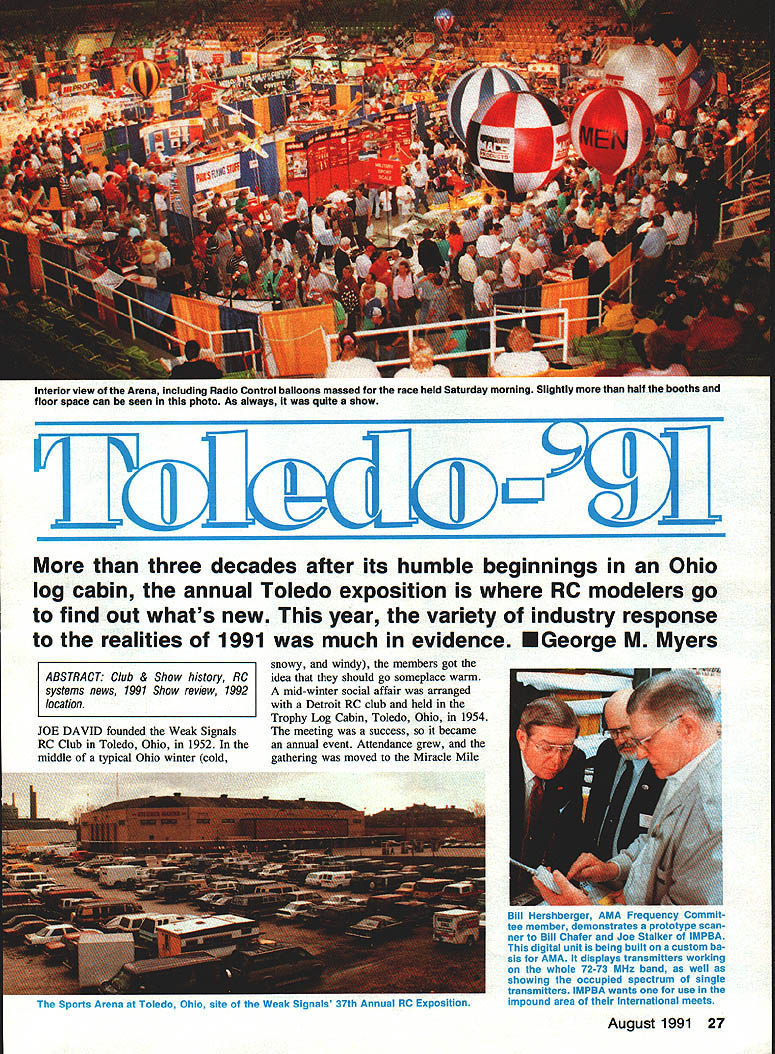
Joe David founded the Weak Signals RC Club in Toledo, Ohio, in 1952. In the middle of a typical Ohio winter, members arranged a mid-winter social with a Detroit RC club, held at the Trophy Log Cabin in 1954. The meeting was a success and became an annual event. Attendance grew and the gathering moved through several venues:
- Miracle Mile Ballroom
- Sunnydale Golf Club
- Champion Spark Plug hangar at Toledo Airport (1964)
- Lucas County Recreation Center (1965–1975)
- Sports Arena (from 1976 onward)
At its peak the exposition counted some 320 booths; it has often run out of room.
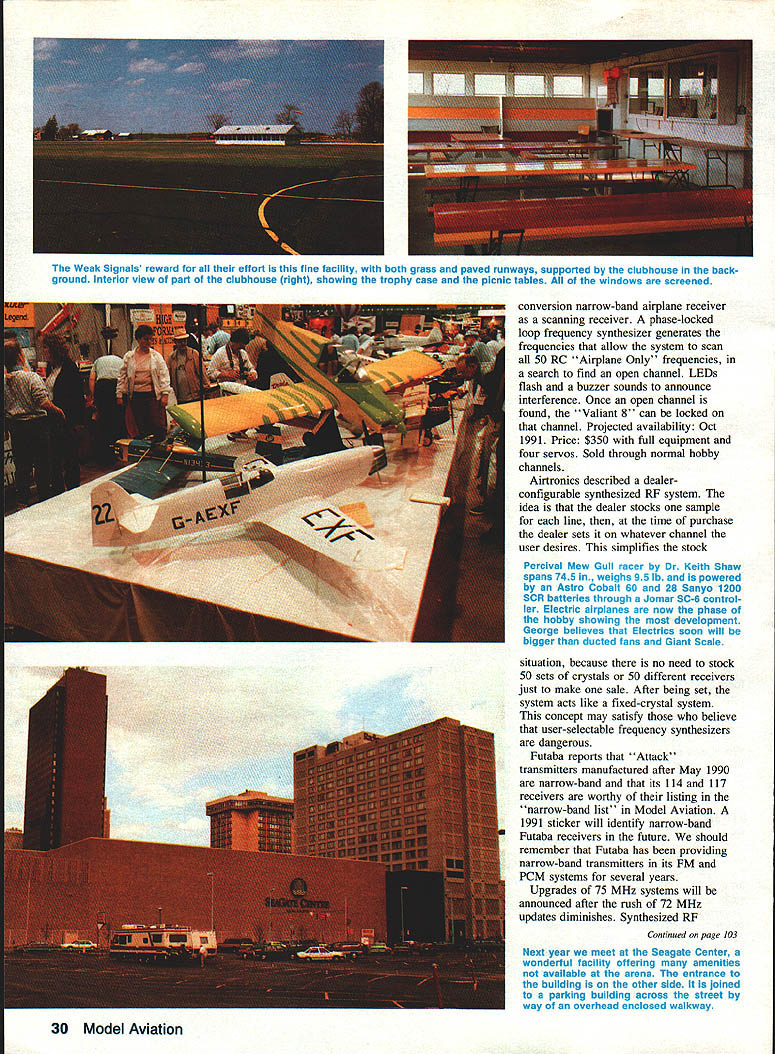
The club purchased a clubhouse in 1980: a facility with electricity, water, and phone at a nearby site in Lascille, Michigan. Through the club's efforts there is a 40-acre flying field with 100 × 400 ft paved runways, a gravel driveway, and parking area.
Membership and Club Rules
Weak Signals membership and responsibilities are structured and enforced:
- Members are scheduled to work to support the annual show. Adequate excuses are accepted, but failure to appear as scheduled can result in loss of status, relegation to Associate Member, or dismissal.
- Associate Members may not vote on club matters nor hold office.
- Members are required to fly in at least one club contest per year or re-qualify (demonstrate pilot proficiency) to maintain full membership; failure to do so can drop one to Associate status.
- Points are accumulated in each contest toward a year-end club championship.
- Members with keys have regular access to the field and clubhouse; visitors are welcome and treated with courtesy.
Present membership figures reported: approximately 90 Regular members, 30 Life or Associate members, and 15 prospective members.
Meetings are held at the clubhouse May through September. The club hosts three or four AMA‑sanctioned contests a year, plus club contests on other weekends.
The Exposition and 1992 Location
The Toledo Exposition continues to attract national attendance and competitive entries. The 38th Annual RC Exposition (1992) was announced for the Seagate Center, 101 Summit Street, diagonally across the bridge from the river and the Sports Arena.
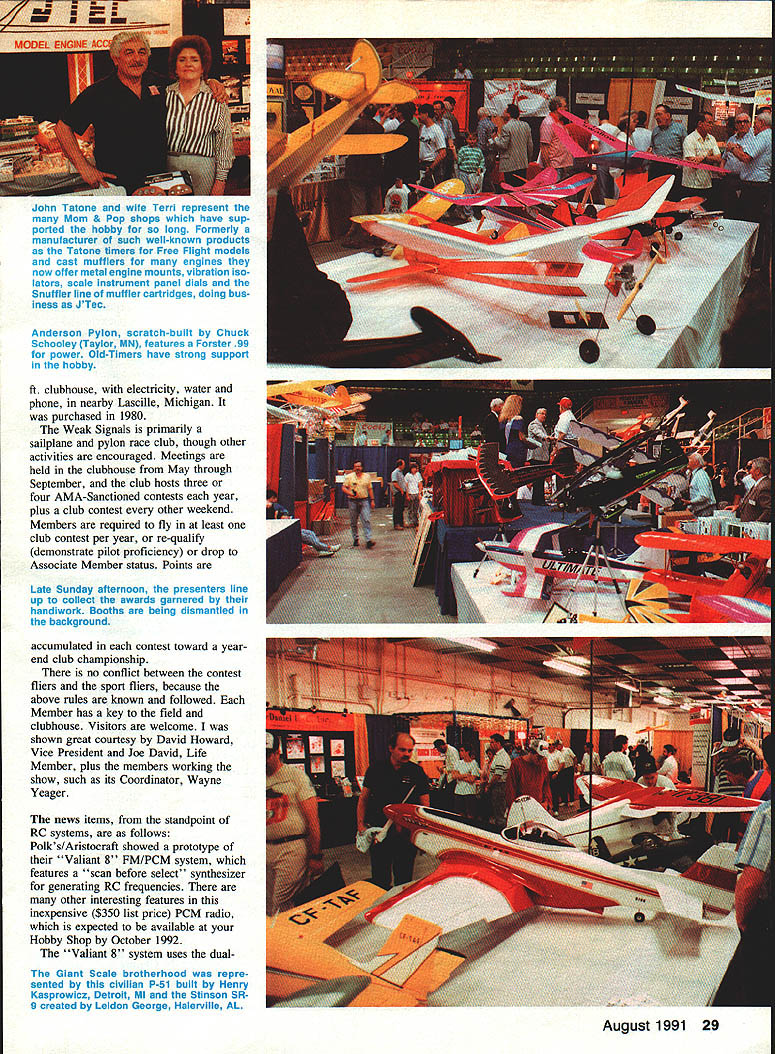
Late Sunday afternoon at the show, presenters line up to collect awards; booths are then dismantled while accumulated contest points are applied toward the year-end club championship.
Notable Models and Entries
Examples of high-level competition and display at the show included:
- Travel Air Mystery Ship — Jamie Feacain, Akron, OH
- Gee Bee Z — Ron Dehlinger, Michigan City, IN
- DC-3 — M. Madrigal, Miami, FL
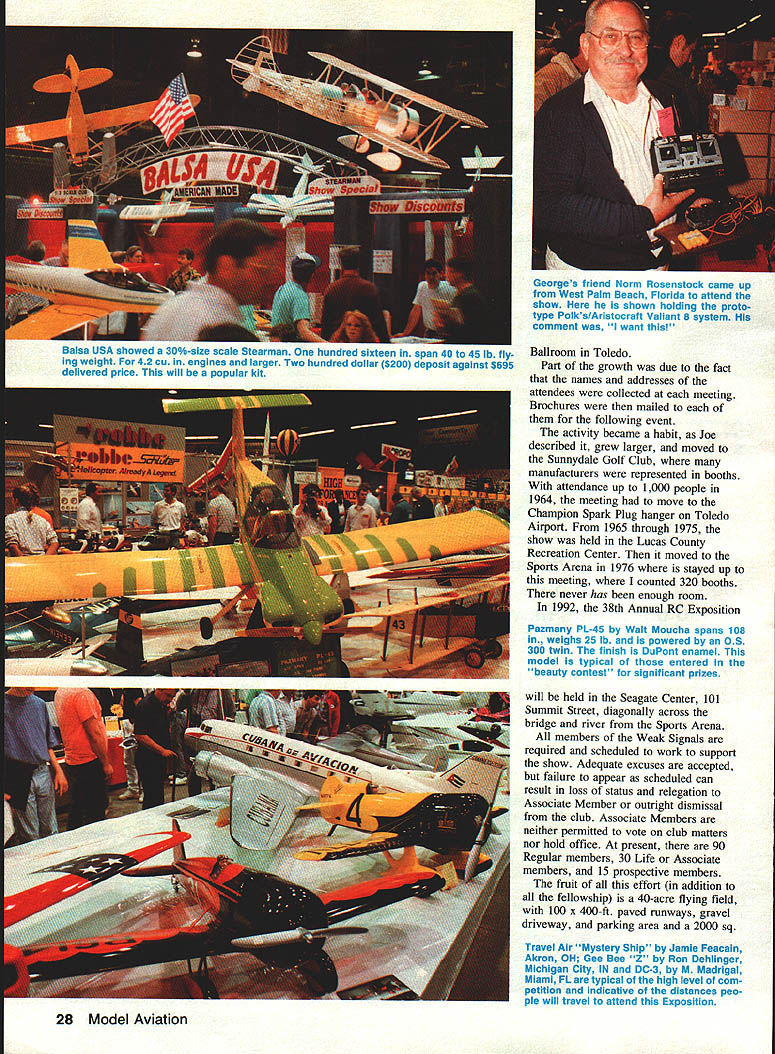
- Pazmany PL-45 (Walt Moucha): 108 in. span, 25 lb., twin engines, finished in DuPont enamel — typical beauty-contest entry
- Scratch-built model by Chuck Schooley, Taylor, MN — Forster .099 power
Model Aviation / Balsa USA showed a 30%-size scale Stearman with a 116-in. span; a $200 deposit against a $695 delivered price was quoted for a popular kit.
Georges’s friend Norm Rosenstock (West Palm Beach, FL) was shown holding a prototype Polks/Aristocraft Valiant 8 system at the show.
News Items — RC Systems and Equipment
Key announcements and product demonstrations at the show included:
Polks/Aristocraft — Valiant 8
- Prototype FM/PCM system with features including a "scan-before-select" synthesizer that generates RC frequencies and scans the 50 airplane-only frequencies to find an open channel.
- Uses a dual-conversion narrow-band airplane receiver as the scanning receiver.
- LEDs flash and a buzzer sounds to indicate interference; once an open channel is found the system can lock on it.
- Projected availability: October 1991. Price: $350 list with full equipment and four servos. Sold through normal hobby channels.
Airtronics
- Described a dealer-configurable synthesized RF system: dealers stock one sample and set it to the buyer’s desired channel at purchase. After setting, the system behaves like a fixed-crystal system. This reduces the need for dealers to stock many crystal pairs.
Futaba
- “Attack” transmitters manufactured after May 1990 are narrow-band; Futaba’s 114 and 117 receivers qualify for the narrow-band list in Model Aviation.
- Futaba will continue to sell crystal pairs for both 72 MHz and 75 MHz; upgrades for 75 MHz systems are expected after the 72 MHz update rush.
- Synthesized RF modules are expected for both 72 MHz and 75 MHz.
Hobby Shack — Excell Line
- New addition to the Cirrus line: described as a digitized FM/PCM system with a 512‑bit code. Dual-conversion, narrow-band receiver accepts either 512 or 1024‑bit code. PCM and PPM versions available.
- Made by Futaba; prices range from $110 (three-servo, four-channel FM set) to $230 (four-servo, seven-channel PCM).
Cox Hobbies
- Showed prototypes of a dual-conversion narrow-band AM receiver for their "Cobra" line; the line now includes bean-shaped narrow-band two- and three-channel transmitters.
- A $35 upgrade announced for older wideband versions.
- Cox radios are often used in high-production RTF airplanes and may find favor with sailplane pilots.
75 MHz Frequency Sanctioning (IMPBA Decision)
Users of 75 MHz systems have had difficulty sanctioning all 30 channels because many 75 MHz AM systems are not modified to narrow-band performance. The International Model Power Boat Association (IMPBA), meeting at Toledo during the show, voted to sanction use of all 30 of the 75 MHz channels with the proviso that odd-channel radios must be FM.
This decision allows wideband radios to continue in use while narrow-band equipment is phased in. Narrow-band FM on odd channels is not likely to interfere with decent wideband receivers on even channels; narrow-band FM receivers on odd channels should ignore decent wideband transmitters on even channels. There was discussion of creating an RCMA/IMPBA sticker system for 75 MHz radios, but no final decision was reached.
Show Staff and Acknowledgments
Members who worked the show included David Howard (Vice President), Joe David (Life Member), and other club members. Wayne Yeager served as show coordinator. The author noted exemplary courtesy from the club and its members.
Photos
The original coverage referenced pictures of the show.
Transcribed from original scans by AI. Minor OCR errors may remain.

