
Tools: To Make Your Modeling Life Simpler/Better
I'm building a "Sam Sailplane"!
This article describes a number of useful tools that you can make, modify, or purchase to improve your modeling proficiency and enjoyment. Some of the ideas aren't new, but good ideas are worth repeating. — Red Costlow
TOOLS TO BUILD model airplanes range from simple to exotic. Most modelers start with a knife, some pins, glue, and sandpaper. Over time they add items that enable them to build faster and better. (Costlow's Law: you will never have all the right tools you need.)
After building models for 40 years, I'm still looking for that elusive right tool. The items described here were bought, built, or borrowed (the idea) from someone else. Hopefully some of them may be of help to you.
Cutting and ripping balsa sticks
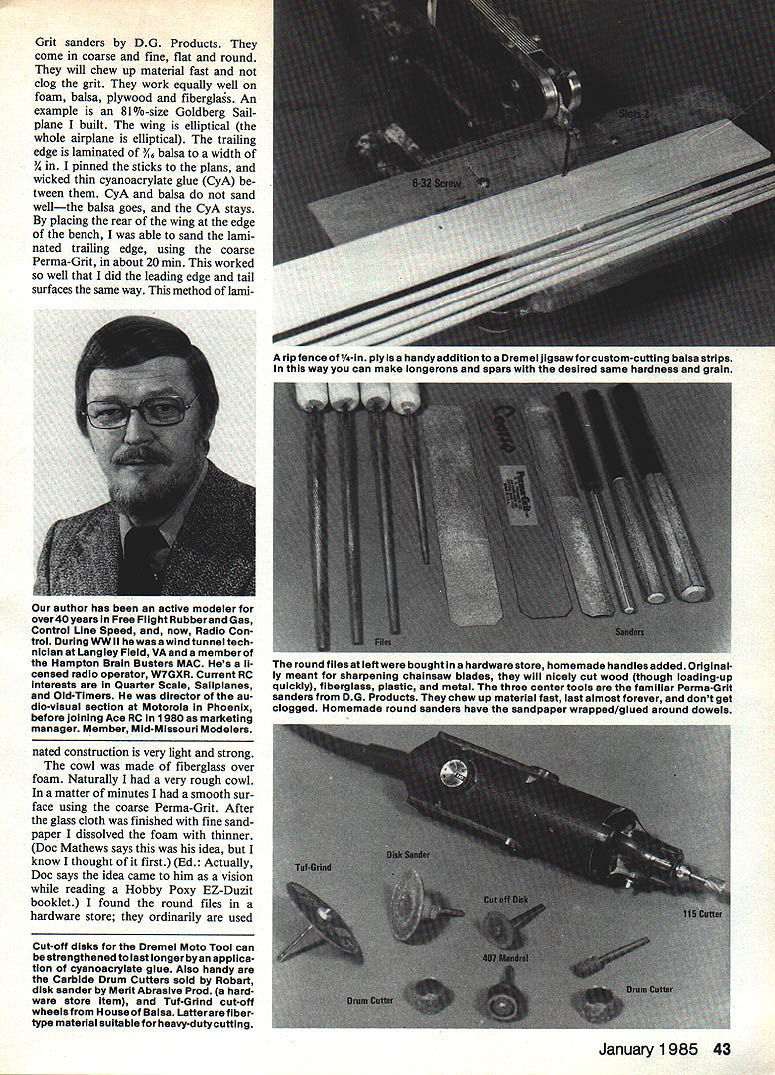
When building in the traditional style you invariably need odd-sized sticks. I cut balsa sticks with a Dremel jigsaw using a simple jig:
- Use a piece of 1/4-in. plywood as a rip fence. Cut two slots in the ply to clear 6-32 screws (screw size is not critical).
- Drill and tap two holes in the saw table to match the slots.
- Set the blade so cutting is from the side of the table; this lets you cut any length.
- Measure the distance from the blade to the ply fence for the thickness you need. Run test cuts with scrap.
- The fence will often have to be angled since the blade is rarely perfectly straight—check widths and adjust.
- Rip the number of sticks you need.
Lay the strips on a flat surface with the sawed edges up. Using a sanding block with 150-grit, lightly stroke the sawed edges to knock off fuzz from the jigsaw and get perfect strips. The strips will be uniform in hardness and grain—great for longerons and spars.
Sanding: Perma-Grit and related tools
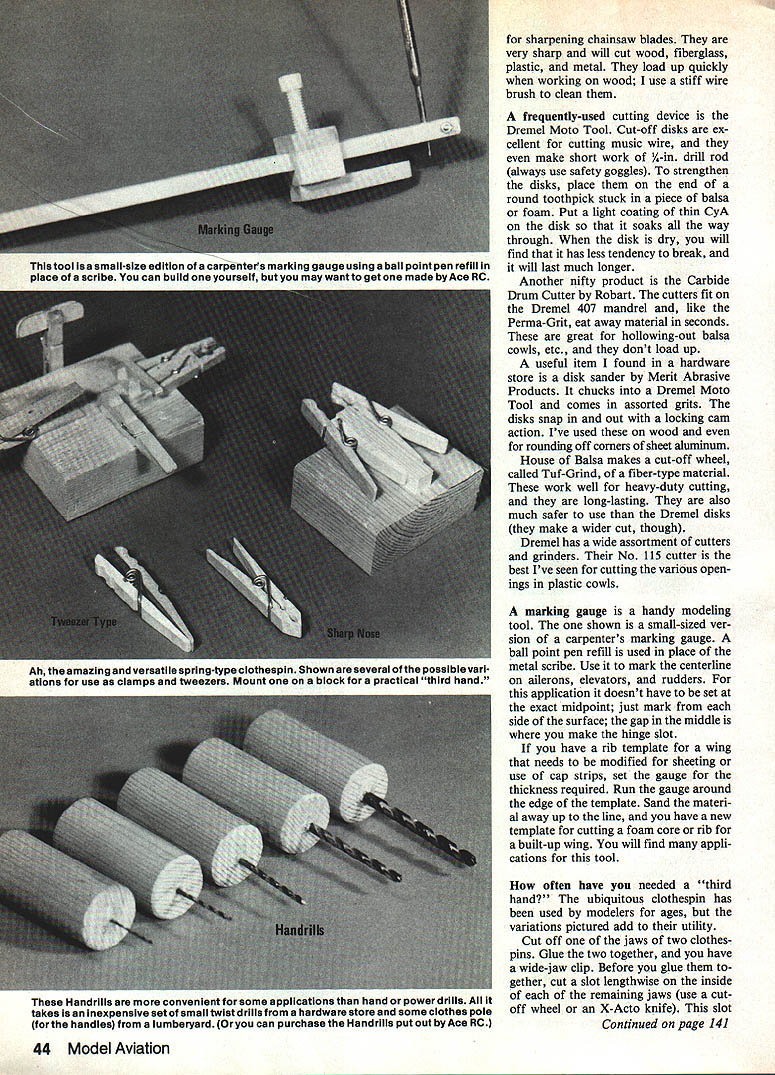
Every modeler should have Perma-Grit sanders. DG Products' Perma-Grit comes coarse to fine, flat to round, and will chew up material fast without clogging. It works well on foam, balsa, plywood, and fiberglass.
Example: on an 81%-size Goldberg sailplane with an elliptical wing, I laminated the elliptical trailing edge from 3/16-in. balsa (about 3/4 in. wide), pinned and wicked with thin cyanoacrylate (CyA) between laminations. Balsa sands well and the CyA stays. Placing the rear wing edge on the bench, I sanded the laminated trailing edge using coarse Perma-Grit (about 20-grit). I did the leading edge and tail surfaces the same way. This laminated construction is very light and strong.
I made a cowl of fiberglass over foam. After rough shaping, coarse Perma-Grit produced a smooth surface in minutes. After finishing the cloth with fine sandpaper, I dissolved the foam with thinner to leave a hollow fiberglass cowl. (A number of modelers have claimed this trick; it's a handy technique.)
Round files found in hardware stores (used for sharpening chainsaw blades) will nicely cut wood (though they load up quickly), fiberglass, plastic, and metal. Homemade round sanders can be made by wrapping glue-backed sandpaper around dowels.
Dremel and rotary-tool accessories
The Dremel Moto-Tool and its accessories are indispensable:
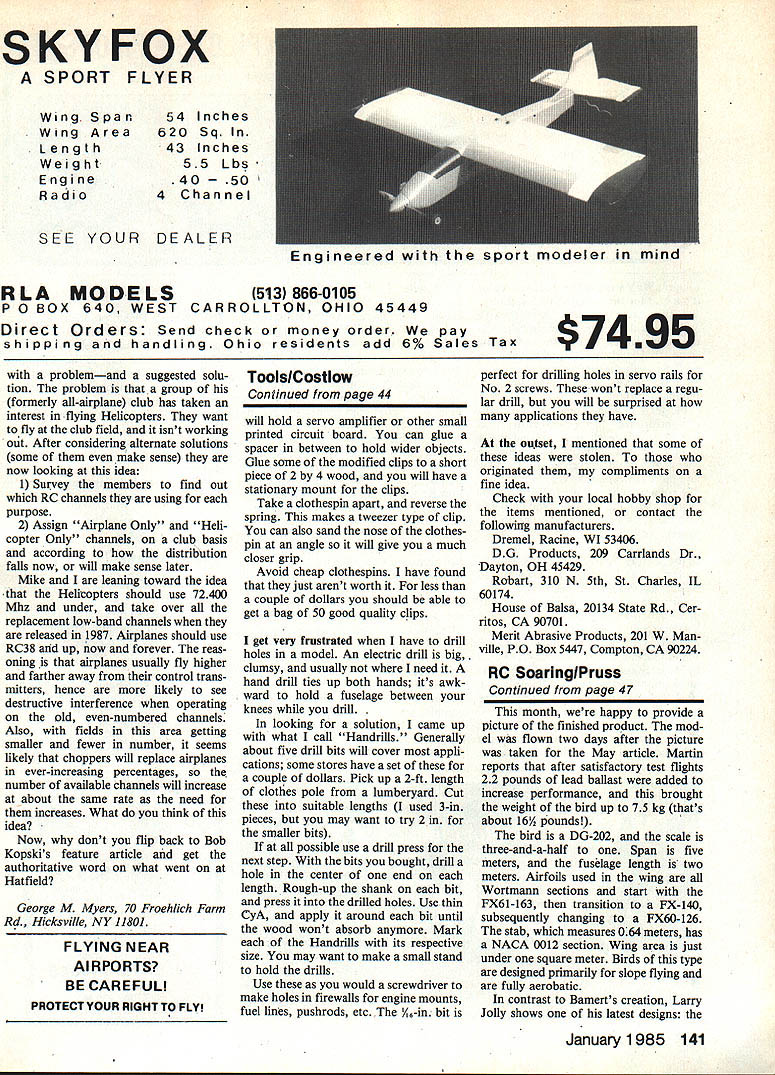
- Cut-off disks: excellent for cutting music wire and 1/16-in. drill rod. Always wear safety goggles.
- To strengthen small cut-off disks and reduce breakage, place a short round toothpick or a small piece of balsa in the disk hole, and apply a light coat of thin CyA so the glue soaks through. When dry the disk is less likely to break and will last longer.
- Carbide Drum Cutters (Robart): fit the Dremel 407 mandrel; eat away material in seconds and are great for hollowing out balsa cowls. They are very sharp and will cut wood, fiberglass, plastic, and metal; clean them with a stiff wire brush when they load up.
- Merit Abrasive disk sander: chucks into a Dremel and comes in assorted grits; disks snap in and out with a locking cam action—useful on wood and for rounding sheet aluminum corners.
- House of Balsa Tuf-Grind cut-off wheel: a fiber-type material suitable for heavy-duty cutting; long-lasting and safer than thin Dremel disks (they make a wider cut).
- Dremel No. 115 cutter: excellent for cutting openings in plastic cowls.
Marking gauge and templates
A marking gauge is a handy modeling tool. Build a small-sized version of a carpenter's marking gauge and use a ballpoint pen refill in place of the metal scribe.
- Use it to mark centerlines on ailerons, elevators, and rudders: mark from each side of the surface and the small gap in the middle is where you make the hinge slot.
- If you have a rib template that needs modification for sheeting or cap strips, set the gauge for the thickness required and run it around the template edge. Sand the material away up to the line to create a new template for cutting foam cores or built-up wing ribs. You'll find many other applications for this tool.
Clothespin "third hand" variations
A clothespin can be a simple third hand. A few modifications expand its usefulness:
- Wide-jaw clip: cut off one jaw from two clothespins, glue the two together to make a wider jaw.
- PCB or small part holder: before gluing, cut a slot lengthwise inside each remaining jaw (use a cut-off wheel or X-Acto knife). This slot will hold a servo amplifier or other small printed circuit board. Add a spacer between the pins to hold wider objects. Glue some modified clips to a short piece of 2x4 to make a stationary mount.
- Tweezer-style clip: take a clothespin apart and reverse the spring. Sand the nose at an angle for a closer grip.
- Avoid cheap clothespins; a bag of 50 good-quality clips is worth the small extra cost.
Handrills — small, handy manual drills
Drilling holes in a model can be awkward with an electric drill or a hand drill. A set of simple "Handrills" solves many small drilling needs:
- Buy a set of small drill bits (five sizes will cover most applications).
- Pick up a 2-ft. clothes pole or broom handle and cut into suitable lengths (I used 3-in. pieces; 2-in. works for smaller bits).
- If possible use a drill press: center-drill one end of each wooden length for the bit shank.
- Roughen the bit shank, press it into the drilled hole, and apply thin CyA around the bit until the wood stops absorbing it.
- Mark each Handrill with its respective size. Make a small stand to hold them if desired.
Use these like screwdrivers to make holes in firewalls for engine mounts, fuel lines, pushrods, etc. A 1/16-in. Handrill is perfect for drilling holes in servo rails for No. 2 screws. They won't replace a regular drill but are surprisingly useful.
Acknowledgments and sources
Many of the ideas here were borrowed from other modelers — credit to those who originated them.
Check with your local hobby shop for the items mentioned, or contact these manufacturers:
- Dremel, Racine, WI 53406
- D.G. Products, 209 Carrlands Dr., Dayton, OH 45429
- Robart, 310 N. 5th St., St. Charles, IL 60174
- House of Balsa, 2014 State Rd., Cerritos, CA 90701
- Merit Abrasive Products, 201 W. Manville, P.O. Box 5447, Compton, CA 90224
Transcribed from original scans by AI. Minor OCR errors may remain.

