
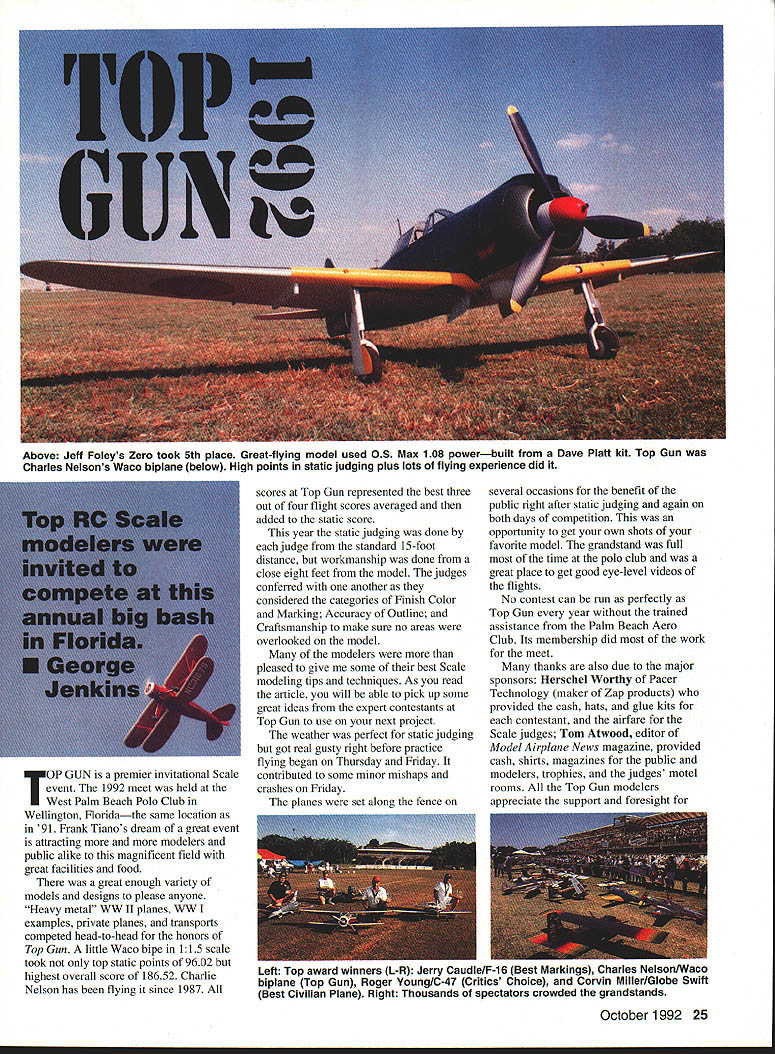
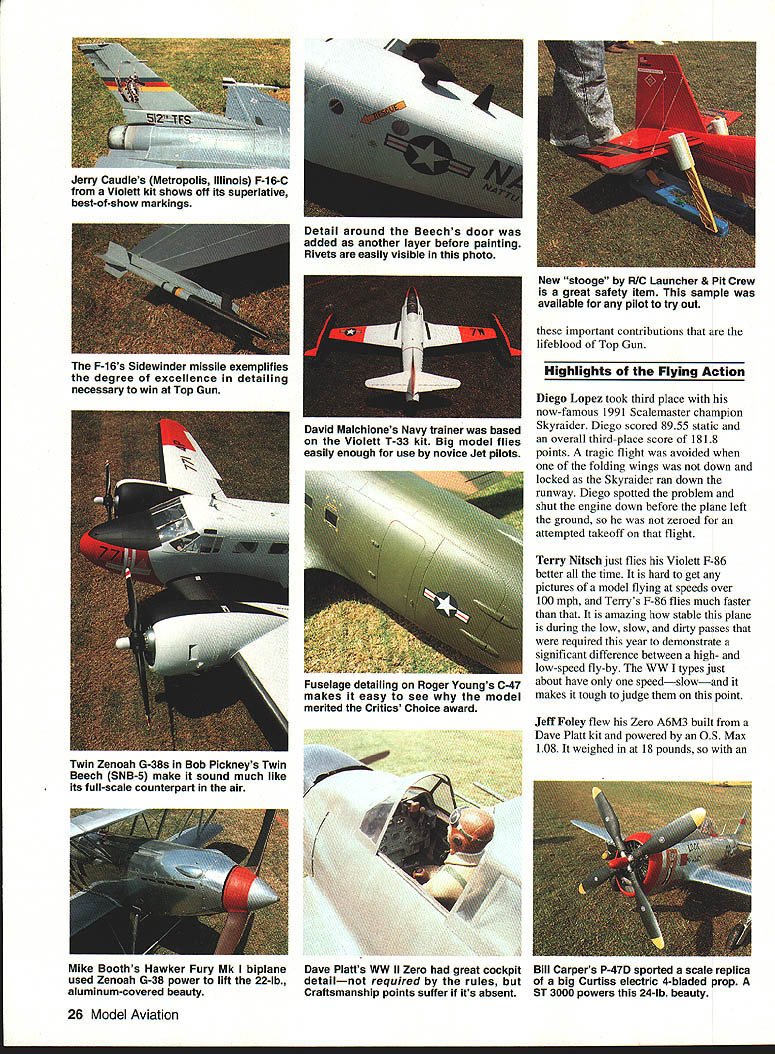
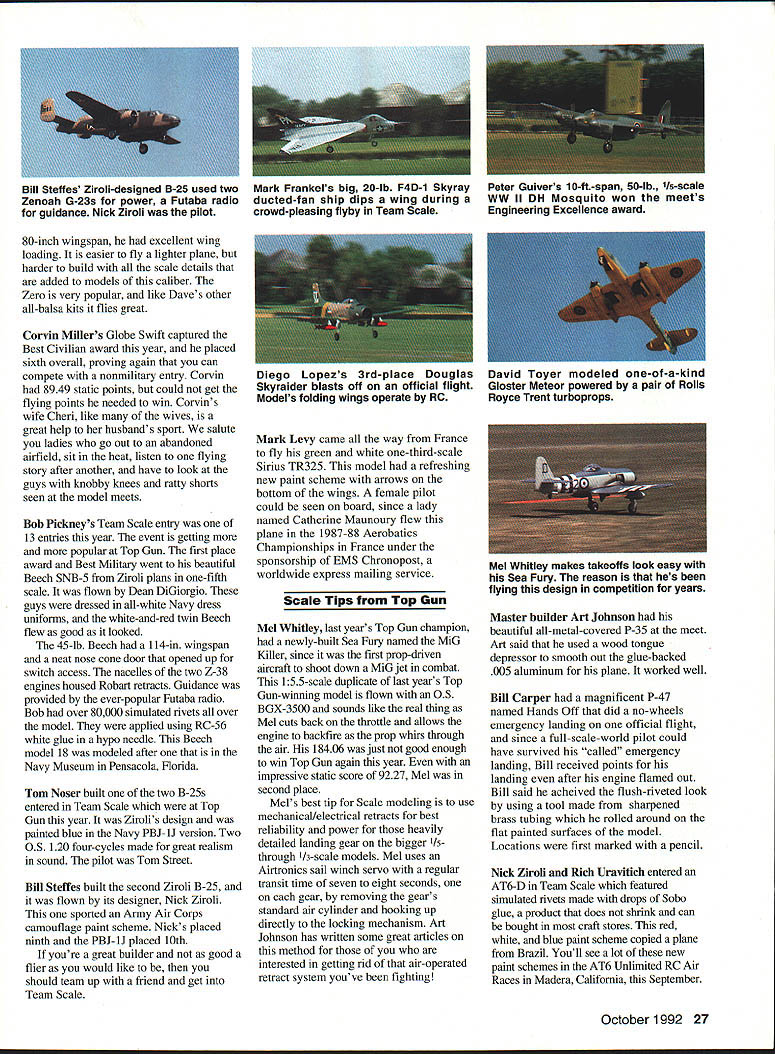
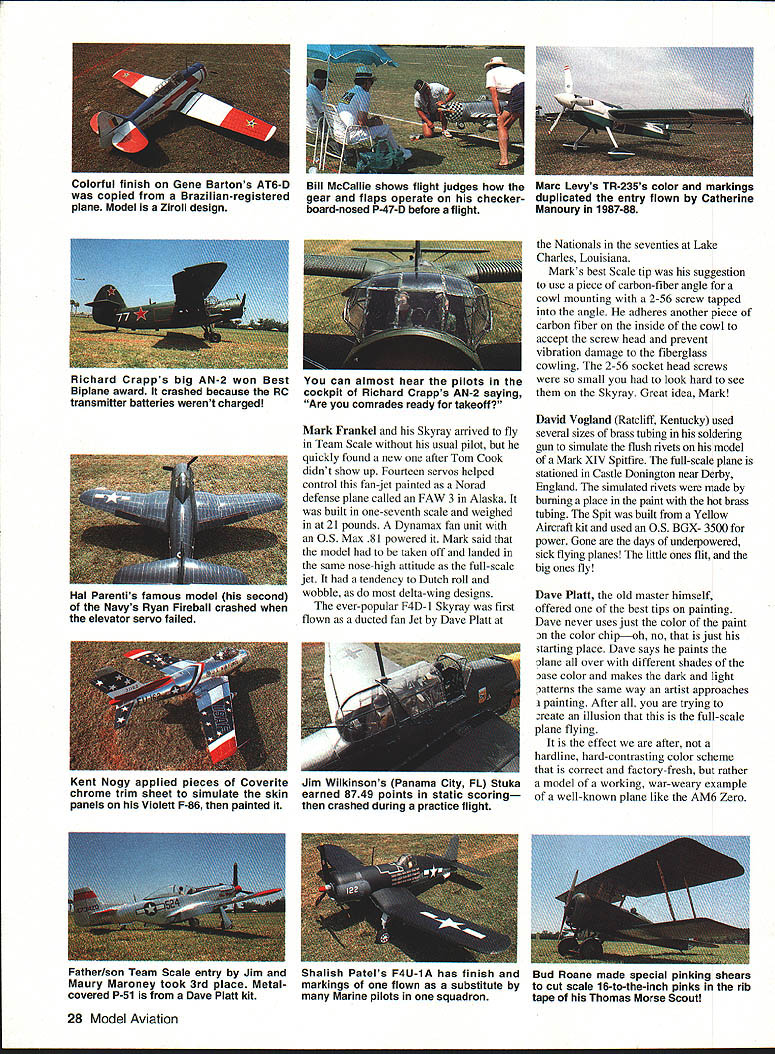
Top Gun 1992
Top RC scale modelers were invited to compete at this annual big bash in Florida. TOP GUN is a premier invitational Scale event. The 1992 meet was held at the West Palm Beach Polo Club in Wellington, Florida — the same location as in 1991. Frank Tiano's dream of a great event continues to attract more and more modelers and public alike to this magnificent field with great facilities and food.
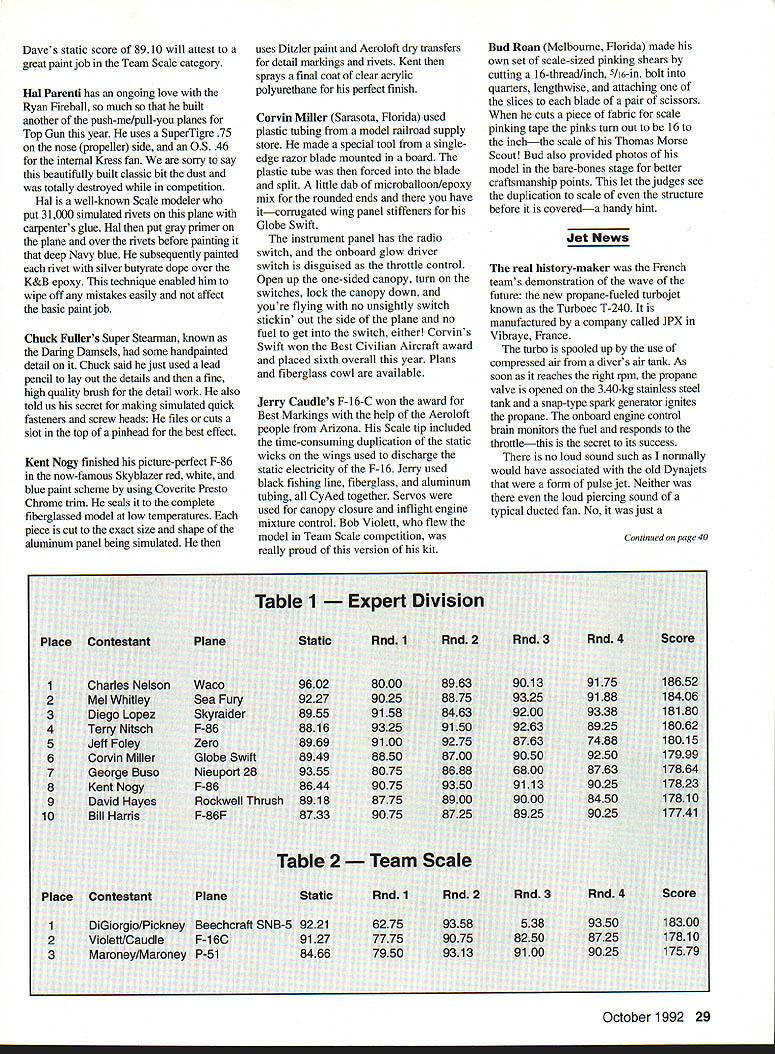
There was a great variety of models and designs to please anyone: heavy-metal WWII planes, WWI examples, private planes, and transports all competed head-to-head for Top Gun honors. A little Waco biplane in 1:15 scale took top static points (96.02) and the highest overall score (186.52). Charlie Nelson has been flying since 1987. All scores at Top Gun represented the best three out of four flight scores averaged and then added to the static score.
Static judging was done from the standard 15-foot distance, with workmanship judged from a close eight feet. Judges conferred with one another while considering Finish Color and Marking, Accuracy of Outline, and Craftsmanship to ensure no areas were overlooked.
The weather was perfect for static judging but got gusty just before practice flying on Thursday and Friday, contributing to some minor mishaps and crashes on Friday. After static judging and on both competition days, the planes were displayed along the fence for the benefit of the public — a great opportunity to take photos and videos. The grandstand was full most of the time and provided excellent eye-level views of the flights.
No contest of this size can run without the trained assistance of the Palm Beach Aero Club; its membership did most of the work for the meet. Many thanks are also due to major sponsors: Herschel Worthy of Pacer Technology (maker of Zap products) provided cash, hats, glue kits for each contestant, and airfare for the scale judges; Tom Atwood of Model Airplane News provided cash, shirts, magazines, trophies, and the judges' motel rooms. All the Top Gun modelers appreciate those important contributions that are the lifeblood of Top Gun.
Highlights of the Flying Action
Diego Lopez took third place with his now-famous 1991 Scalemaster champion Skyraider. Diego scored 89.55 static and an overall third-place score of 181.80 points. A tragic flight was avoided when a folding wing did not lock as the Skyraider ran down the runway; Diego spotted the problem and shut the engine down before the plane left the ground, so he was not zeroed for that flight.
Terry Nitsch flew Bob Violett's F-86 and continues to improve with it. The model flies well over 100 mph and remained amazingly stable during the low, slow passes required to demonstrate differences between high- and low-speed fly-bys. WWI types, with only one slow speed, are tougher to judge on that point.
Jeff Foley flew a Zero A6M3 built from a Dave Platt kit and powered by an O.S. Max 1.08. It weighed 18 pounds with an 80-inch wingspan, giving excellent wing loading. The Zero is popular; Dave Platt’s all-balsa kits fly great and allow detailed scale work.
Corvin Miller's Globe Swift captured the Best Civilian award and placed sixth overall, proving a nonmilitary entry can compete. Corvin had 89.49 static points but fell short on flying points. His wife Cheri was noted as a great help — a salute to the many spouses who support this sport.
Team Scale was popular, with 13 entries. Bob Pickney’s Team Scale entry won first place and Best Military with a beautiful Beech SNB-5 from Zirolli plans in one-fifth scale, flown by Dean DiGiorgio. The white-and-red twin Beech (Model 18) flew as good as it looked; the 45-lb Beech had a 114-inch wingspan, Z-38 engines, Robart retracts, Futaba radio, and over 80,000 simulated rivets applied with RC-56 white glue via a hypo needle. It was modeled after a Navy Museum aircraft in Pensacola.
Two B-25s were entered in Team Scale. Tom Noser built a Zirolli PBJ-1J (Navy) flown by Tom Street, powered by two O.S. 1.20 four-cylinder engines. Bill Steffes built the second Zirolli B-25, flown by designer Nick Zirolli in an Army Air Corps camouflage scheme; Nick’s plane placed ninth and the PBJ-1J placed tenth.
Mark Levy came from France with a one-third-scale Sirius TR325 painted green and white with arrows under the wings. The full-scale aircraft was flown by Catherine Maunoury in aerobatics championship competition and sponsored by EMS Chronopost.
Other notable entries and displays:
- Roger Young’s C-47 won the Critics’ Choice award.
- Bill Carper’s P-47D (“Hands Off”) performed a no-wheels emergency landing on one official flight; he still received points for the controlled off-field landing after an engine flameout. The P-47 used a Curtiss-style 4-bladed electric prop and was powered by an ST 3000.
- David Maichione’s Navy trainer, based on a Violett T-33 kit, is a large model with an 80-inch wingspan that flies easily for novice jet pilots.
Turbojet Demonstration
A small turbojet demonstration drew attention. The unit produced a distinctive whoosh of air and about nine pounds of static thrust; the quiet running of the unit during the demonstration stopped the crowd. The jet stayed up for five to six minutes on its maiden flight, close to its maximum endurance. These turbojet units weigh about nine pounds, can generate temperatures up to 350° C at the thrust tip, and require an oil-misting feature to protect the rear turbine shaft bearing. At the time of the meet there were roughly 40 units available at about $3,500 each (delivery three to four weeks) and 12 flying. Once the AMA sets rules and safety guidelines, these turbojets will be able to enter AMA-approved meets.
The British Bunch
A British team made a strong showing with four aircraft shipped (Antonov AN-2 Russian transport, DH.98 Mosquito, Trent Meteor, and Hawker Fury biplane). United Parcel Service sponsored transportation for Richard Crapp, Peter and Jean Guiver, pilot Richard Rawle of Practical Scale UK, Dave Troyer, and Mike Booth, covering freight of about $2,000.
- Richard Crapp entered an Antonov AN-2.
- The Guivers brought a one-fifth-scale DH.98 Mosquito flown by Richard Rawle; it earned the Engineering Excellence award at the banquet.
- Dave Troyer flew the little Trent Meteor, an early turboprop design.
- Mike Booth flew the Hawker Fury biplane.
Frank Tiano indicated Top Gun was invited back to the West Palm Beach Polo Grounds for 1993.
Scale Tips from Top Gun
Mel Whitley (last year’s Top Gun champion) flew a newly built Sea Fury dubbed the “MIG Killer,” a 1:5.5-scale duplicate of his previous winning model, powered by an O.S. BGX-3500. Mel’s 184.06 overall score and static 92.27 placed him second. His best tip: use mechanical/electrical retracts for reliability and power on large 1/5–1/3-scale models. Mel uses an Airtronics sail winch servo (7–8 second travel) on each gear by removing the standard air cylinder and hooking the servo to the locking mechanism. Articles by Art Johnson describe this approach for those wanting to replace air-operated retract systems.
Art Johnson (master builder) brought a beautiful all-metal-covered P-35 and recommended using a wood tongue depressor to smooth glue-backed .005 aluminum.
Bill Carper achieved a flush-riveted look by rolling a tool made from sharpened brass tubing over flat painted surfaces; locations were first marked with pencil.
Nick Zirolli and Rich Uravitch used drops of Sobo glue to simulate rivets on an AT-6 Team Scale entry. Sobo doesn’t shrink and is available in craft stores. Nick’s white-and-blue paint scheme copied a Brazilian example.
Mark Frankel’s Skyray (fan-jet) was built in one-seventh scale, weighed 21 pounds, and used a Dynamax fan with an O.S. Max .81. It required nose-high takeoff and landing attitudes and showed the delta-wing tendency to Dutch roll. Mark’s best tip: use a piece of carbon-fiber angle for cowl mounting with a 2-56 screw tapped into the angle; adhere another carbon-fiber piece inside the cowl to accept the screw head and prevent vibration damage to the fiberglass cowl.
David Vogland used several sizes of brass tubing heated in a soldering gun to simulate flush rivets on a Mark XIV Spitfire, burning small marks in the paint. The Spitfire was built from a Yellow Aircraft kit and powered by an O.S. BGX-3500.
Dave Platt offered painting advice: start with the color chip as a base, then paint the plane using different shades of the base color, creating dark and light patterns as an artist would. The goal is to create the illusion of a working, weathered full-scale aircraft rather than a factory-fresh hard-contrasting scheme. Dave’s static score of 89.10 in Team Scale reflected a great paint job.
Hal Parenti built another Ryan Fireball push-pull biplane using a SuperTigre .75 on the nose and an O.S. .46 for the internal Kress fan. Hal applied 31,000 simulated rivets using carpenter’s glue, primed over them, then painted and highlighted each rivet with silver butyrate dope over K&B epoxy; this method allows wiping off mistakes without damaging the base paint. Unfortunately, this beautifully built plane was destroyed during competition.
Chuck Fuller’s Super Stearman (“Daring Damsels”) featured handpainted details laid out with a pencil and painted with a fine brush. For simulated quick fasteners and screw heads, Chuck files or cuts a slot in the top of a pinhead for the best effect.
Kent Nogy finished a picture-perfect F-86 in the Skyblazer red, white, and blue scheme using Coverite Presto Chrome trim sealed at low temperatures. He cuts each piece to the exact panel shape, uses Ditzler paint and Aeroloft dry transfers for markings and rivets, and finishes with a clear acrylic polyurethane spray.
Corvin Miller used plastic tubing from a model railroad supply store and made a tool from a single-edge razor blade mounted in a board to split the tubing into corrugated wing panel stiffeners. He added microballoon/epoxy mix for rounded ends. Corvin’s instrument panel disguise included the radio switch and an onboard glow driver switch disguised as the throttle control. His Globe Swift won Best Civilian and placed sixth overall.
Jerry Caudle’s F-16C won Best Markings with help from Aeroloft. He duplicated static wick details using black fishing line, fiberglass, and aluminum tubing CA’d together. Servos controlled canopy closure and in-flight engine mixture control; Bob Violett flew this Team Scale entry.
Bud Roan made scale-sized pinking shears by cutting a 16-thread-per-inch, 5/16-inch bolt into quarters lengthwise and attaching a slice to each scissor blade; this produced 16 pinks per inch for scale pinning tape (perfect for his Thomas Morse Scout). Bud also provided photos of his model in the bare-structure stage to help judges see scale duplication of structure before covering.
Manufacturers' Displays
- Aviation Heritage (Terre Haute, Indiana) displayed Scale documentation, including volumes 1 and 2 of Paul Matt’s three-view collection.
- Model Aviation Technology showed a new six-volt gel-cell battery and a new 1/3-scale fiberglass fuselage for the Extra 300.
- Robinair Retracts featured gear for the Globe Swift and attractive P-51 struts.
- JPX (Vibraye, France) showed the Turbotech T-240 turbojet engine.
- Gene Barton Machine displayed various scale items and custom parts.
- M&M Models (Port Richey, Florida) offered a wide selection of colors.
- Top Gun Tees sold embroidered T-shirts with P-51s.
- Prop Wash Videos displayed past videotapes and took orders for this year’s Top Gun video.
- Custom Electronics (associated with Hitec R/C USA, Inc.) showed a universal servo connector to work with any servo.
- Newman Optics (Ogden, Utah) provided Zurich International polycarbonate wrap-around glasses; Boyd Newman let judges use them and they proved popular.
Prizes
Manufacturers donating prizes for the 1992 Top Gun event included:
- Ace R/C — Micro Pro 8000 radio.
- Bob Violett Models — $300 gift certificate.
- Dave Platt — announced the event and donated an FW-190 kit with retracts.
- Airtronics — latest eight-channel radio.
- Frank Tiano Enterprises — cash, trophies, modelers' knife sets for every contestant, and significant organizational support; FTE also owns the Hobby Super Store in West Palm Beach, Florida.
- Futaba Corporation of America — a nine-channel PCM and a six-channel FM radio with an Aerostar ARF kit.
- Gene Barton — custom Sea Fury and Corsair wheels.
- Hobby Dynamics — JR-347 radio and a Webra Speed 1.20 engine.
- House of Basala — Best Jet trophy (awarded to Mark Frankel’s Skyraider) and Tuffrinders for every Top Gun pilot.
- McDaniel R/C — 12 NyStarters and two onboard ignition systems.
- R/C Reports magazine — cash, free subscriptions; Best Biplane trophy awarded to Richard Crapp (England).
- Robart — cash and the Engineering Excellence trophy (won by the Mosquito).
- Sig Manufacturing Co., Inc. — 1992 catalogs and a Spacewalker kit won by Corvin Miller.
- Yellow Aircraft — $250 gift certificate.
Top Gun was a well-diversified, exciting show where the best in scale were invited to compete in sunny Florida. Videos of the event are available from companies such as Prop Wash Videos that capture the action.
Transcribed from original scans by AI. Minor OCR errors may remain.

