
TOP GUN 1994
Stan Alexander
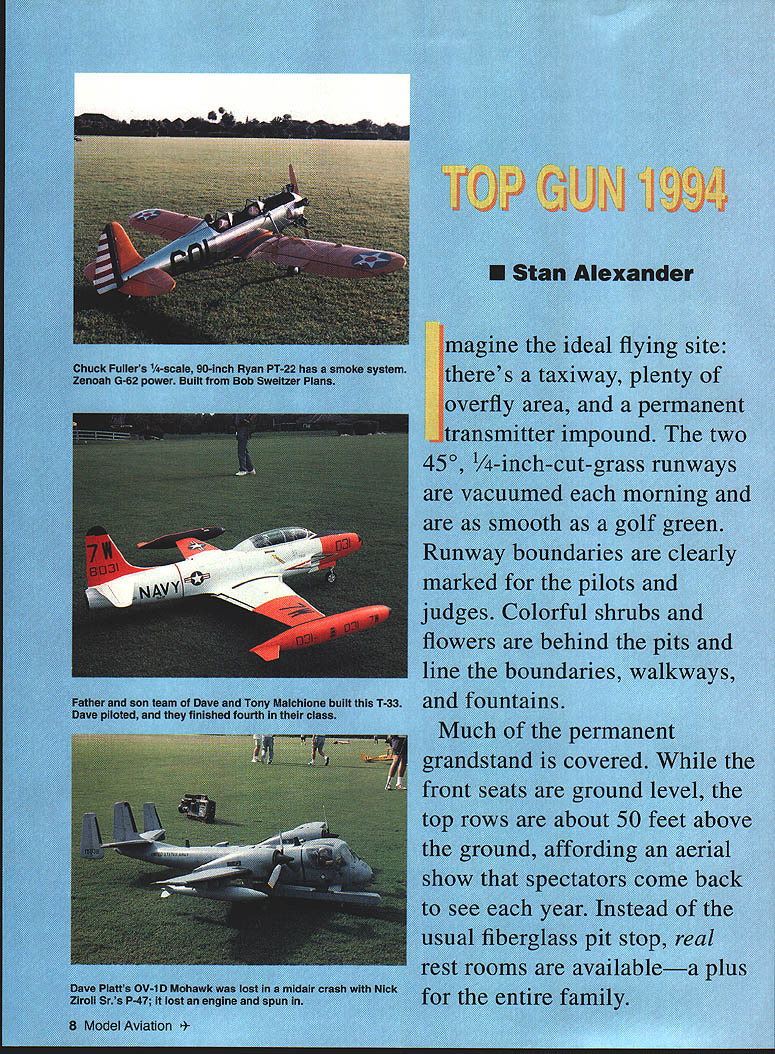
Imagine the ideal flying site: there's a taxiway, plenty of overfly area, and a permanent transmitter impound. The two 45° 1/4-inch-cut-grass runways are vacuumed each morning and are as smooth as a golf green. Runway boundaries are clearly marked for pilots and judges. Colorful shrubs and flowers are behind the pits and line the boundaries, walkways, and fountains. Much of the permanent grandstand is covered; while the front seats are ground level, the top rows are about 50 feet above the ground, affording an aerial show that spectators return to see each year. Instead of the usual fiberglass pit stop, real rest rooms are available—a plus for the entire family.
There are hobby vendors, the Polo gift shops, food vendors, and the Polo Clubhouse offers a buffet. Anything from the old stand-by hotdog to grilled steak and chicken is available. Champagne, iced mixed fruit, and bottled water are served. This field isn't imaginary: Florida's West Palm Beach Polo Club is the setting for one of the most prestigious aeromodeling events in the world today—the Top Gun Invitational Tournament.
Top Gun was in its sixth year in 1994 and had been held at the West Palm Beach Polo Club for the last four years. With help from longtime sponsors Pacer Technology (Zap glue), Frank Tiano Enterprises, Model Airplane News, and the West Palm Beach Polo Club, Top Gun has found a permanent home. To Scale promoters, competitor Frank Tiano, and many Scale pilots around the world, this is their field of dreams.
Frank Tiano wanted a meet of international scope that would showcase the sport and the "best of the best" in Scale modeling. An invitational guarantees a roster of contestants who are experts in their fields, bringing subjects that range from the dawn of aviation to the cutting edge of aerospace and aeromodeling today. Pilots from England, Germany, Canada, and the United States participated in the April 28–May 1, 1994 competition; the meet's international scope increases each year.
Weather and Field
Thunderstorms and heavy rain early in the week made the Polo Field unusable for most of Thursday practice. It was quite windy on Friday, but the rain had ceased. Saturday was also windy, though the wind diminished by noon. Sunday was a sunny, beautiful day with much lighter winds.
Because the runway was wet, the field was cut closer than usual; this helped the heavy models and those with smaller wheels. The field was vacuumed before the competition on Saturday and Sunday. The two runways were used for lightly loaded models and World War I types.
For safety and to facilitate landing approaches to the main runway, the grounds crew removed the palm trees at the north end of the field; the trees were replaced after the meet. The Polo Club wants Top Gun and the modelers to come, and the Polo Club's management and host club Palm Beach Aero make it a pleasure to be there.
Judges and Officials
- Chief Judge: George Lou
- Chief Static Judge: Tim Farrell
- Static Judges: Bill DeVerna, Bob Curry, Lee Henderson
- Flight Judges: Wayne Fredrick, Darlene Fredrick, Bob Campbell, Jim Semonian, Jim Parker, Stan Alexander, John Smith, Tom Kozel
- Head Scorekeeper: Rosella Curry
Static judging was held at the center of the field on Thursday and Friday. The static judges had their hands full with more than 58 models to judge. In static competition, craftsmanship is judged from close range—judges can eyeball the model as close as possible but may not touch it.
Results
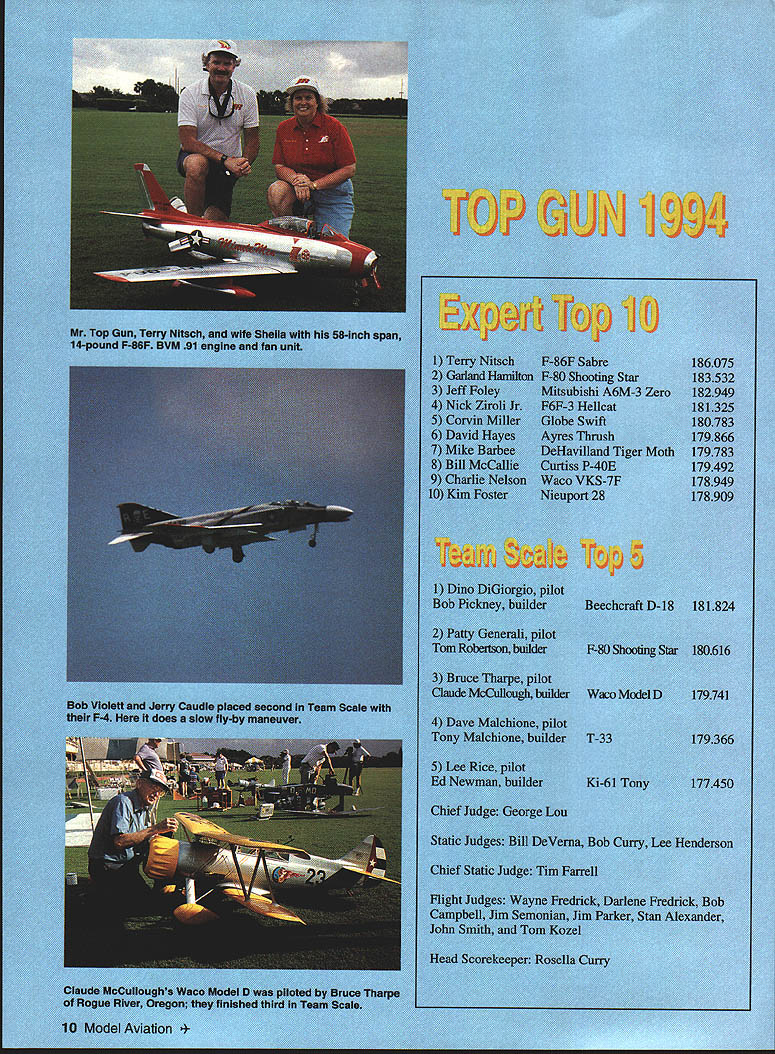
Expert Top 10
- Terry Nitsch — F-86F Sabre — 186.075
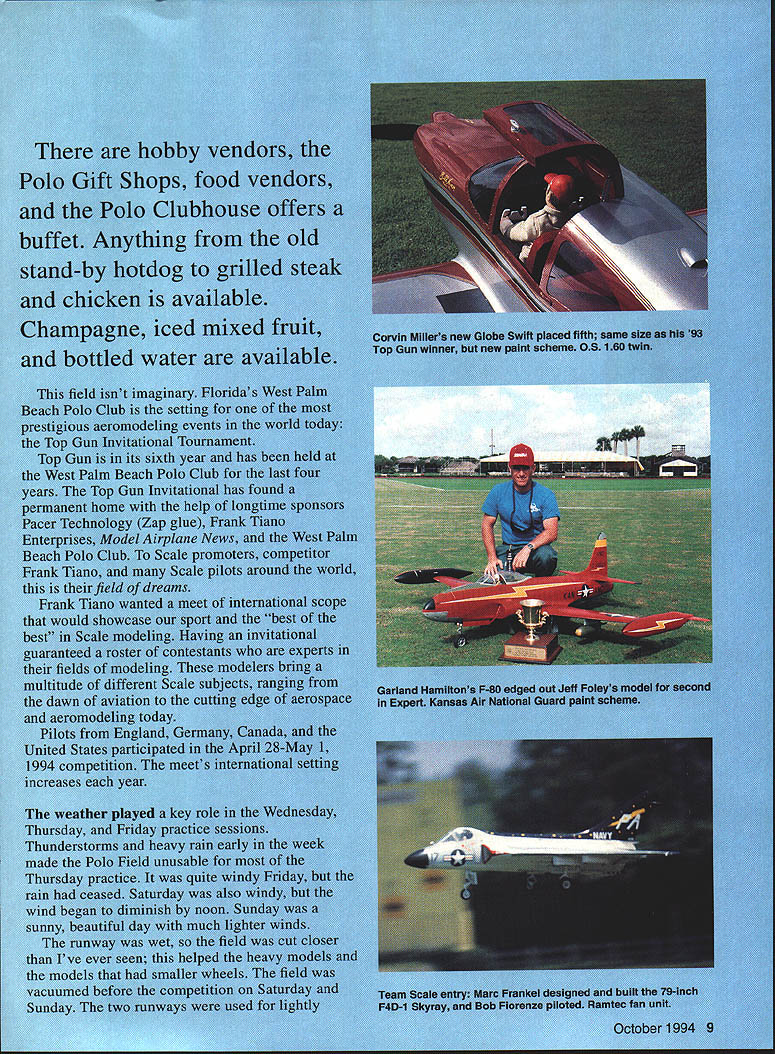
- Garland Hamilton — F-80 Shooting Star — 183.532
- Jeff Foley — Mitsubishi A6M-3 Zero — 182.949
- Nick Ziroli Jr. — F6F-3 Hellcat — 181.325
- Corvin Miller — Globe Swift — 180.783
- David Hayes — Ayres Thrush — 179.866
- Mike Barbee — de Havilland Tiger Moth — 179.783
- Bill McCallie — Curtiss P-40E — 179.492
- Charlie Nelson — Waco JKS-7F — 178.949
- Kim Foster — Nieuport 28 — 178.909
Terry Nitsch was the Expert class winner with his Violett F-86 Sabre Minute Man. He also won the Highest Cumulative Flight Score award, which included $200 and a set of Bulldog Retracts from Glenn Torrance Models. The difference between second and third in Expert was only 0.582 point; Garland Hamilton's higher static nudged Jeff Foley to third.
Team Scale Top 5
- Dino DiGiorgio (pilot), Bob Pickney (builder) — Beechcraft D-18 — 181.824
- Patty Generali (pilot), Tom Robertson (builder) — F-80 Shooting Star — 180.616
- Bruce Tharpe (pilot), Claude McCullough (builder) — Waco Model D — 179.741
- Dave Malchione (pilot), Tony Malchione (builder) — T-33 — 179.366
- Lee Rice (pilot), Ed Newman (builder) — Ki-61 "Tony" — 177.450
Dino DiGiorgio and Bob Pickney won first place in Team Scale, including two trophies, $1,000, and a seven-channel PCM radio supplied by Futaba Corporation. Bob Violett and Jerry Caudle finished second in Team Scale, earning $700 and a six-channel radio from Hitec, Inc.
Highlights and Notable Models
- Cliff Tacie opened Saturday's competition with his World War II–vintage Savoia-Marchetti S.M.81 tri-motor bomber. Cliff is a past FAI Scale World Championships competitor.
- Kim Foster and Ramon Torres were two of the three F4C USA Scale Team members representing the U.S. at the 1994 FAI World Scale Championships in the Netherlands. Kim flew his Proctor Nieuport 28 to a tenth-place finish; Ramon had gear problems during the landing of his Cessna O-2A on its first flight.
- Jeff Foley finished third flying a Dave Platt A6M3 Zero he had flown in "contest weather" many times—more than 300 flights on the machine. Regular use and practice with the same routine showed dividends.
- Corvin Miller returned with another Globe Swift and finished fifth; his metallic crimson and silver finish was a work of art.
- Charlie Nelson brought a new Waco JKS-7F (a larger version of his 1992 winner) with a Seidel seven-cylinder radial and a Zinger prop; the model featured flaps, retracting landing lights, and full navigational lighting.
- David Hayes placed sixth in Expert flying his Ayres Thrush crop duster, which sprayed liquid from an onboard tank to nozzles behind the wing. The model has an 82-inch wingspan and is powered by an O.S. .91 four-stroke. Hayes plans to fly the Ayres Thrush at the AMA Nats in Designer Scale Class.
- Bill McCallie flew a P-40E built from Jerry Bates plans and won Best Graphics and Markings (sponsored by Aerolift) with a $200 gift certificate. His P-40 spanned 80 inches and was powered by an Enya V-240 twin.
Jets, Turbine Power and the Future
A first for the Scale record books: Kent Nogy flew the first turbine jet–powered Scale model in competition. The Violett T-33 was powered by the JPX turbine jet engine, fueled by propane. The performance was astounding, accompanied by a deafening whoosh; flight noise level was measured at 72 dBA. While turbine reliability wasn't 100% for this entry, other jets in the half-time shows performed well.
Engine details (JPX turbine): designed for 14–18-pound models, engine weight 3.75 lb, available thrust 8.83 lb at 120,000 rpm, centrifugal-flow alloy single-stage compressor, refractory-alloy radial-inflow turbine rotor, mean tailpipe temperature about 600°C, self-feeding oil mist lubrication. The gas turbine engine was available from Violett Models (circa 1994) for approximately $4,300.
Bob Violett noted turbine installs are sophisticated and that Kent Nogy flew with a special waiver from the AMA. Prospective buyers must be experienced with ducted-fan engines and aircraft and must obtain an individual permit; the waiver requires the turbine-powered model to fly at specific sites.
Ducted-fan jet models and larger prop-driven Scale models continue to evolve. Jets can dominate on speed and sound, but accurate detailing and finish remain vital in static judging.
Crashes and Incidents
Two midair collisions occurred during practice and competition:
- Bill Carper's new P-47 "Little Demon" and Mel Whitley's Douglas SBD-5 collided; both models were lost. Bill's P-47G was an 80-inch-span, 24-pound Yellow Aircraft model powered by a G-38; Bill had switched to a Zenoah Quartz gasoline engine for reliability after prior radio problems. He had invested roughly 2,000 hours into building the model.
- Dave Voglund's Grumman Mohawk OV-1D twin (scratch-built, 84-inch span, powered by two Enya .53 four-strokes) became the third victim of a midair collision with Nick Ziroli Sr.'s P-47. Nick saved his P-47, but the OV-1D lost an engine and spun in.
Mel Whitley's SBD-5 was scratch-built with an 84-inch wingspan powered by an O.S. 300 twin. Jerry Bates now has plans for this dive-bomber. Mel's transmitter included a switch that combined dive brakes and flaps; when dive brakes were actuated the bomb had a three-second delay before release.
Team Scale Details and Special Techniques
- The Beechcraft D-18 (Dino DiGiorgio/Bob Pickney) is a 114-inch-span twin powered by two Quartz G-38s. Plans are by Nick Ziroli Sr.; Model Works offers wood kits.
- Claude McCullough's Waco Model D (piloted by Bruce Tharpe) is a 99-inch-span, 32-pound biplane that finished third in Team Scale. Claude received $200 for Best Biplane (sponsored by R/C Report). Claude described his method for applying the Indian head emblem: enlarge a photo to trace outlines, reduce photographically, create outline decals via Aeroloft, paint between the lines with a frisket, and apply additional black decals over color areas. He uses a careful system of dusting light coats of dope so decals are not dissolved; for the tail he used Dry-Set Decals that are impervious to dope. Claude spent more than five years on documentation research, with help from a friend in Cuba to obtain photos.
- Bob Violett had a new twin ducted-fan F-4 Phantom kit in competition, powered by two BVM .91s with BVM retracts and a fan unit.
- Bob Fiorenze and Mark Frankel teamed with Mark's F4D-1 Skyray in Team Scale; the Skyray was 79 inches long, 18 pounds, powered by an O.S. .91 with a Ramtec fan unit, Dave Platt retracts, Robart struts, and sequencing doors—design by retired IBM engineer Tony Cresiacanha. Molds were developed using actual Douglas factory drawings.
Other interesting entries included:
- Mike Barbee's 1/4-scale de Havilland Tiger Moth (Duncan Hutson plans), powered by a Laser .150 four-stroke; operational slats; clock-spring wire flying wires; Base Coat-Clear Coat-Deltron finish. Mike won seventh place in Expert and received a JR Sport Radio as the Top Gun "Hussies" Best Buns Award.
- Mike Kulczyk's large scratch-built F-84G, modeled after the full-scale aircraft he flew in service; the model weighs 21 pounds and is powered by a BVM .91 engine with fiberglass fuselage and foam-core wings.
- Dave Voglund's 1/5-scale SNJ-5 built from Ziroli plans featured Gene Barton retracts and a Zenoah Quartz G-62 engine.
- Bill Fuori and John Tozer entered a 1930 Fleet in Team Scale with a Randolph black and yellow dope finish; muslin pinked tape details and castings for a Kinner radial engine were formed by the pilot and builder.
- Mark Frankel's Skyray and Nick Ziroli Jr.'s Hellcat (94-inch span, Sachs 5.2 engine) were notable Expert entries; Nick's Hellcat used Robart retracts and D-Day black and white markings.
- Germany's Stephan Dürrsteln flew a Fiberglass Classics DC-3 ("Sentimental Journeys") with two O.S. 90 four-strokes and retracts.
Free Flight Scale Mass Launch
A Free Flight Scale Mass Launch was held with qualifying flights on Friday and Saturday and a flyoff early Sunday. Wayne Siewert won with a Larry Kruse–designed Centennial Ford 100; Dave Malchione finished second with a Cessna Airmaster, and Steve Sauger was third with a de Havilland Puss Moth.
Social Events, Halftime, Vendors and Awards
Friday night featured a formal cocktail party and a buffet at the Polo Clubhouse—a tradition at this international meeting. Saturday night held the formal dinner and dance; Frank Tiano handed out awards for Best Static Score, Best Civil Aircraft, Best Military Aircraft, Best Graphics and Markings, Critics Choice Awards, and others. The high static score went to Dennis Crooks for his Learjet 35; his model had takeoff problems but excelled in static.
Halftime shows thrilled the crowd—estimated at 15,000—entertained by the Cloud Dancers Air Show Team, including Don Muddiman's Flying Machine and a "Flying Witch" act for children. Chip Hyde (three-time world Pattern champion) made his Scale debut in Team Scale, flying a Fiorenzo Yellow Aircraft F-18 in Blue Angels colors and doing half-time aerobatics.
During halftime on Friday, Saturday, and Sunday, the audience was allowed into the pits to view models up close, take photos, and talk with contestants. Vendors on row included Robart, Bob Violett Models, Scale Plans and Photo Service, Scale Model Research, The Model Works, Don Smith Plans, Zurich Sunglasses, and others. The AMA had a booth manned by Bob and Rae Underwood.
Sponsors for 1994 included Pacer Technology, Model Airplane News, Frank Tiano Enterprises, Airtronics, Aeroloft, Aeroplane Works, Appian Inc., Bob Violett Models, Byron Originals, Dave Platt Models, Dryset Inc., Eagle Editions, Futaba, Fiber Classics, Glenn Torrance Models, Hitec Inc., Horizon Hobby Distributors, ISC/Indy RC, R&B Manufacturing, Lanier RC, Madden Model Supply, Midwest Products, Moki/Gerard Enterprises, Nick Ziroli Models, Prowash Video, R/C Report, Robart Manufacturing, Saito Engines, JR Radios, Scale Model Research, the Top Gun "Hussies," and the Zap Gang.
Closing
Scale modelers take tremendous pride in their work. The competition, social events, and vendor support make Top Gun more than a contest—it's a gathering of friends, competitors, and craftsmen. From contestants and officials to sponsors and the Polo Club, a hearty thank you was extended to everyone involved in making Top Gun 1994 a memorable event.
Transcribed from original scans by AI. Minor OCR errors may remain.

