
Top Gun Tournament
By Dirk DeYoung
By invitation only, the best-of-the-best in scale aeromodeling came together in Mesa, Arizona to compete, to display, and to fly some of the finest examples of craftsmanship in existence. The major networks and over 10,000 spectators attended this four-day extravaganza.
About the Top Gun Invitational
Top Gun is an all-scale, by-invitation-only model competition for propeller and jet aircraft alike. Unlike most other championships, there is no qualifying or open registration. A stringent rule book is sent with the invitation, and the invitee may accept or decline after reading it. The rule book emphasizes that while Top Gun is certainly not for the average competitor, it employs no rules that give any particular airplane an advantage over another.
I agreed with the rule book's intent, though I would remind the Top Gun Committee that weather conditions beyond their control can favor or hurt a given model's performance. During the event competitors did have to contend with some difficult crosswinds.
The 1990 Event — Site and Organization
The Top Gun flying site in 1990 was hard to beat. The runway was about 650 ft long and 75 ft wide. A covered ramada kept at least 40 aircraft out of the sun and sheltered a few hundred pit people.
My calculations indicate over 10,000 people attended the meet over four days. The Arizona Model Aviators executed the event with only about 45 members, led by five or six committee leaders. I met Contest Director Jim Deming and contest managers Terry Voirin and Mike Fleming — I have rarely seen such dedication before, during, and after an event.
Bob Sortor aligned the flight lines, and I didn't hear of a single frequency problem over the four days. Dr. Francis Olix served as chief judge, with Kent Walters as his assistant. From what I overheard, judging — both static and flying — proved to be very tough but extremely fair.
Incidents and Weather Effects
A few aircraft were lost before the first round of flying competition on Saturday due to mistakes, overrun engines, and radio failures. These included:
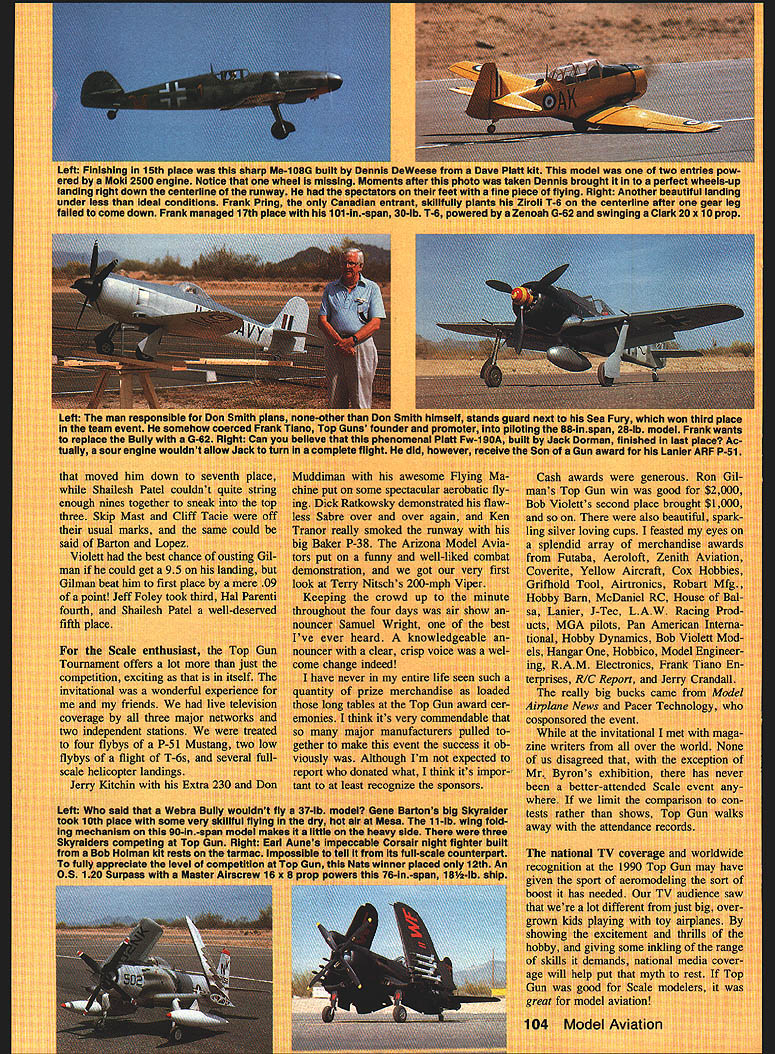
- Dave Platt's Zero (lean engine)
- Ronald Kemp's beautiful F-4 built by Yellow Aircraft (lost a battery pack)
- Steve Sauger's world-class Stinson Trimotor (reversed ailerons on a new radio installation)
Later in the event, Larry's aircraft rolled itself up into a ball immediately after takeoff due to a premature forced lift-off, insufficient speed, and a severe angle of attack. It was a shame — Larry had the high static score in the expert group, and a good flying score surely would have landed him in the top 10.
Entries, Duplications, and Classes
This year's contest combined about 45 expert-class pilots with six team-scale entries. The classes flew together, but scores were posted separately — a commendable step that gave some excellent builders a chance to see their machines do well in competition.
Some designs were represented multiple times:
- Three Dave Platt Zeros
- Three P-47 Thunderbolts (two Bert Baker-designed)
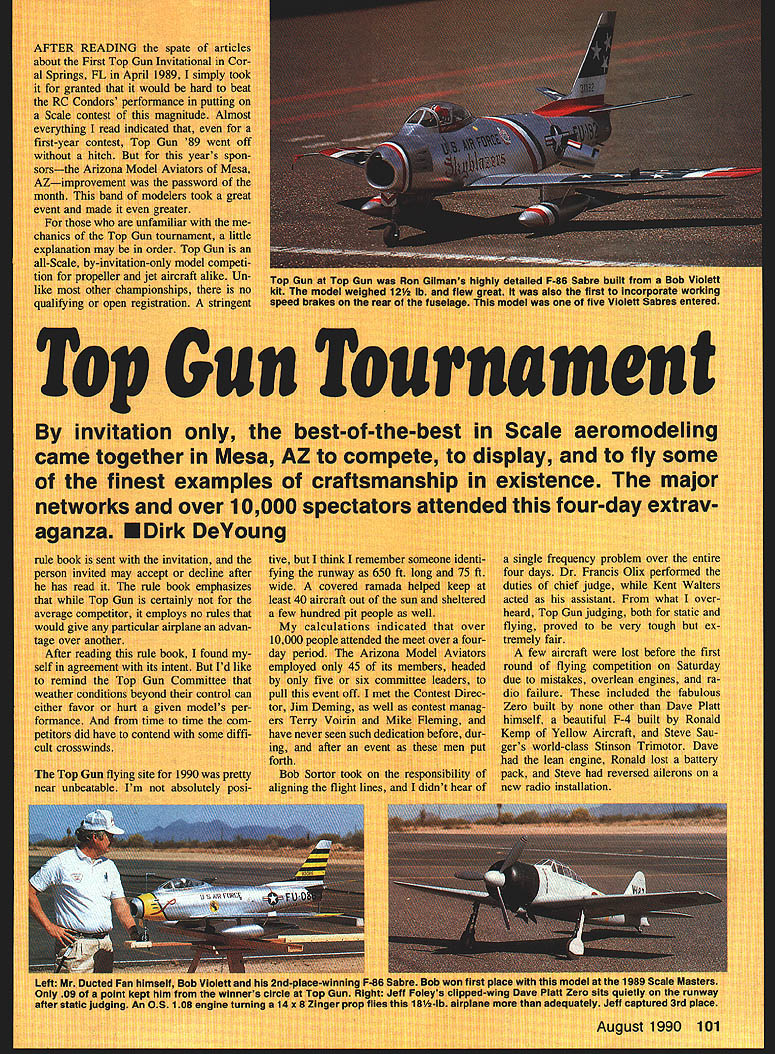
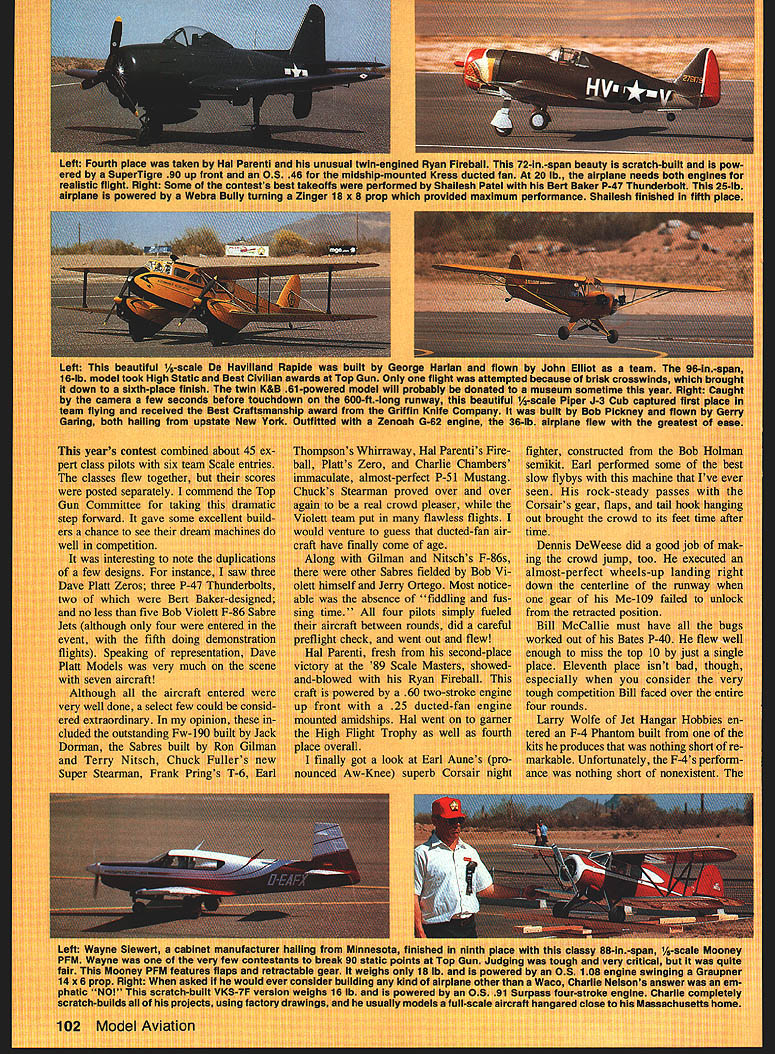
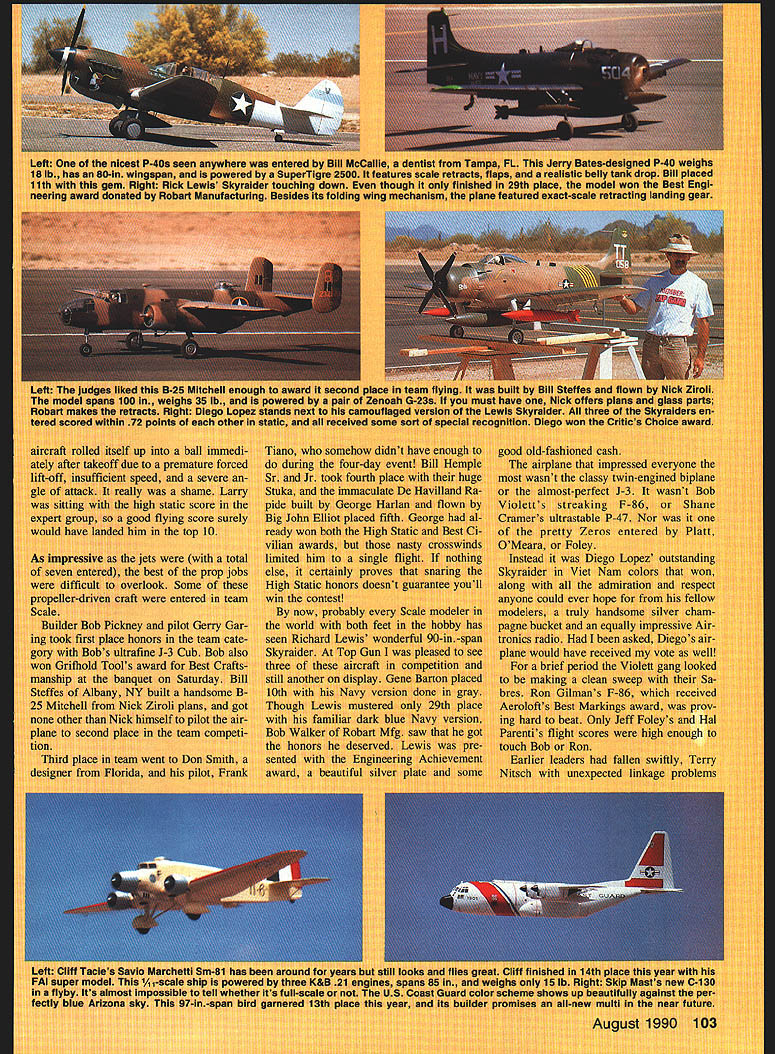
- Five Bob Violett F-86 Sabres (four entered, a fifth used for demonstrations)
Dave Platt Models was well represented with seven aircraft.
Notable Aircraft and Performances
A select few aircraft stood out as extraordinary:
- Jack Dorman — FW-190
- Ron Gilman and Terry Nitsch — F-86 Sabres
- Chuck Fuller — new Super Stearman (a crowd pleaser)
- Frank Pring — T-6
- Earl Thompson — Whirraway
- Hal Parenti — Ryan Fireball
- Dave Platt — Zero
- Charlie Chambers — immaculate P-51 Mustang
The Violett team put in many flawless flights. There was noticeably less “fiddling and fussing” time than usual — many pilots simply fueled between rounds, did careful preflight checks, and flew.
Special Performances
- Hal Parenti (fresh from second place at the ’89 Scale Masters) flew his Ryan Fireball — powered by a .60 two-stroke up front and a .25 ducted fan amidships — to the High Flight Trophy and fourth place overall.
- Earl Aune (pronounced Aw-Knee) flew a superb Corsair night fighter (Bob Holman semi-kit) that drew repeated standing ovations for rocket-steady slow flybys with gear, flaps, and tail hook hanging.
- Dennis DeWeese executed an almost-perfect wheel-up landing down the centerline when one gear of his Me-109 failed to unlock.
- Bill McCallie flew a clean Bates P-40 and missed the top 10 by a single place, finishing eleventh in very tough competition.
Although seven jets were entered, many propeller-driven models were equally impressive. Some prop entries competed in team Scale.
Team Scale Results
- Bob Pickney (builder) and Gerry Garring (pilot) — 1st place, ultrafine J-3 Cub
- Bob also won Griffith Tool's award for Best Craftsmanship.
- Bill Steffes (builder) — handsome B-25 Mitchell; piloted by Nick Ziroli — 2nd place
- Don Smith (designer) and Frank Tiano (pilot) — 3rd place
- Bill Hemple Sr. and Jr. — large Stuka — 4th place
- George Harlan (builder) and Big John Elliot (pilot) — De Havilland Rapide — 5th place
George Harlan also won High Static and Best Civilian awards, but fast crosswinds limited him to a single flight. This proves that high static honors don't guarantee a contest win.
Skyraiders and Engineering Award
Richard Lewis' 90-in. span Skyraider drew wide attention; I saw three in competition and another on display. Gene Barton placed 10th with a Navy gray version. Richard Lewis finished 29th with his dark blue Navy version, but he received the Engineering Achievement award — a beautiful silver plate and a cash prize presented by Bob Walker of Robert Mfg.
Diego Lopez' outstanding Skyraider in Vietnam colors impressed virtually everyone and garnered great admiration from his fellow modelers.
Final Placings and Awards
Competition for the top spots was intense. The final expert standings placed:
- Ron Gilman — Top Gun winner
- Bob Violett — second place
- Jeff Foley — third place
- Hal Parenti — fourth place
- Shailesh Patel — fifth place
Ron Gilman's Top Gun win earned a $2,000 cash prize; Bob Violett's second place brought $1,000. The awards table was extensive, with many sparkling silver loving cups and a massive selection of merchandise.
Sponsors and Prizes
Major sponsors and contributors included (among many):
- Futaba
- Aerobat
- Zenith
- Coverite
- Yellow Aircraft
- Cox Hobbies
- Griffith Tool
- Airtronics
- Robart Mfg.
- Hobby Barn
- McDaniel R/C
- House of Balsa
- Lanier
- J-Tec
- L.A.W. Racing Products
- MGA Pilots
- Pan American International
- Hobby Dynamics
- Bob Violett Models
- Hangar One
- Hobbico
- Model Engineer
- R.A.M. Electronics
- Frank Tiano Enterprises
- R/C Report
- Jerry Crandall
The biggest cash sponsors were Model Airplane News and Pacer Technology, who cosponsored the event.
Media, Demonstrations, and Public Response
Top Gun provided excellent exposure for model aviation:
- Live television coverage by all three major networks and two independent stations
- Flybys: four P-51 passes, two low flybys of a flight of T-6s, and several full-scale helicopter landings
- Aerobatic demonstrations by Jerry Kitchin (Extra 230) and Don Muddiman (Flying Machine)
- Repeated demonstrations by Dick Rakowsky (Sabre) and Ken Tranor (Baker P-38)
- A comic and well-received combat demonstration by the Arizona Model Aviators
- First public look at Terry Nitsch's 200-mph Viper
Air-show announcer Samuel Wright kept the crowd informed throughout the four days; his clear, knowledgeable commentary was a welcome change.
Conclusion
For scale enthusiasts, the Top Gun Tournament offered more than competition — it was a showcase of craftsmanship, flying skill, and the wide appeal of model aviation. The national TV coverage and worldwide recognition the 1990 Top Gun brought to the sport were invaluable. By showing the excitement, precision, and skill involved, the event helped counter the stereotype of "overgrown kids playing with toy airplanes." Top Gun was not only good for scale modelers — it was great for model aviation.
Transcribed from original scans by AI. Minor OCR errors may remain.

