
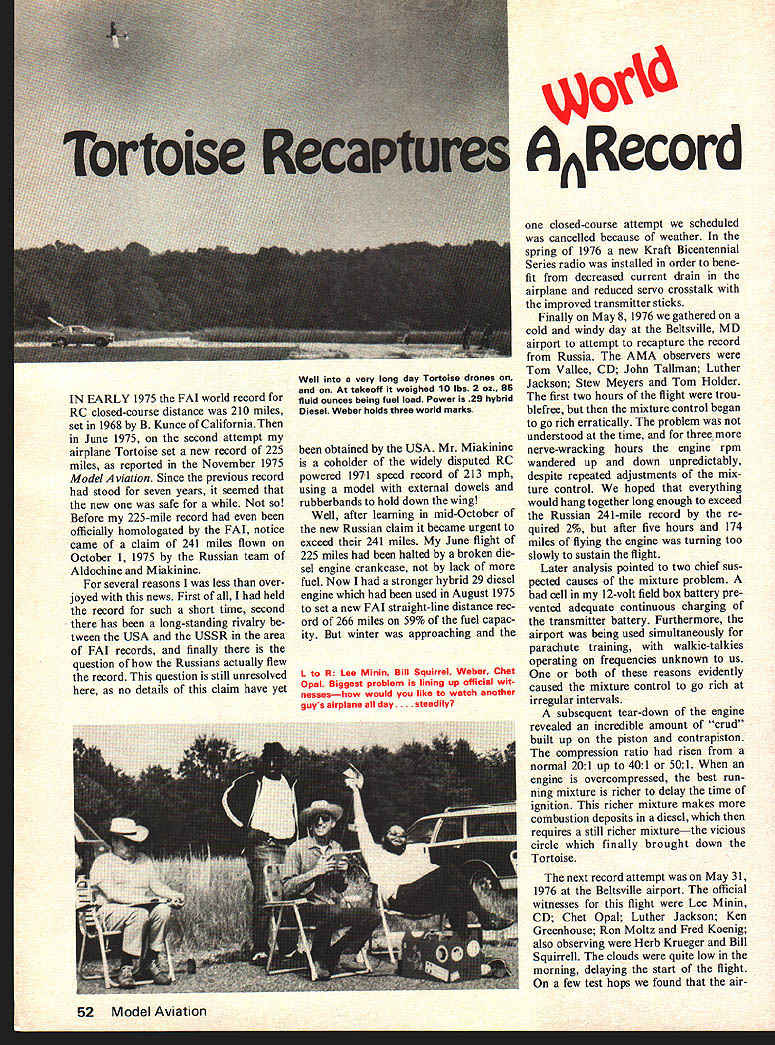

Tortoise Recaptures a World Record
IN EARLY 1975 the FAI world record for RC closed-course distance was 210 miles, set in 1968 by B. Kunce of California. Then in June 1975, on the second attempt my airplane Tortoise set a new record of 225 miles, as reported in the November 1975 Model Aviation. Since the previous record had stood for seven years, it seemed that the new one was safe for a while. Not so! Before my 225-mile record had even been officially homologated by the FAI, notice came of a claim of 241 miles flown on October 1, 1975 by the Russian team of Aldochine and Miakinine.
For several reasons I was less than overjoyed with this news. First of all, I had held the record for such a short time, second there has been a long-standing rivalry between the USA and the USSR in the area of FAI records, and finally there is the question of how the Russians actually flew the record. This question is still unresolved here, as no details of this claim have yet been obtained by the USA. Mr. Miakinine is a coholder of the widely disputed RC powered 1971 speed record of 213 mph, using a model with external dowels and rubberbands to hold down the wing!
Well, after learning in mid-October of the new Russian claim it became urgent to exceed their 241 miles. My June flight of 225 miles had been halted by a broken diesel engine crankcase, not by lack of more fuel. Now I had a stronger hybrid 29 diesel engine which had been used in August 1975 to set a new FAI straight-line distance record of 266 miles on 59% of the fuel capacity. But winter was approaching and the one closed-course attempt we scheduled was cancelled because of weather. In the spring of 1976 a new Kraft Bicentennial Series radio was installed in order to benefit from decreased current drain in the airplane and reduced servo crosstalk with the improved transmitter sticks.
Finally on May 8, 1976 we gathered on a cold and windy day at the Beltsville, MD airport to attempt to recapture the record from Russia. The AMA observers were Tom Vallee, CD; John Tallman; Luther Jackson; Stew Meyers and Tom Holder. The first two hours of the flight were trouble-free, but then the mixture control began to go rich erratically. The problem was not understood at the time, and for three nerve-wracking hours the engine rpm wandered up and down unpredictably, despite repeated adjustments of the mixture control. We hoped that everything would hang together long enough to exceed the Russian 241-mile record by the required 2%. After five hours and 174 miles of flying the engine was turning too slowly to sustain flight.
Later analysis pointed to two chief suspected causes: bad cell in my 12-volt field box battery prevented adequate continuous charging of the transmitter battery. Furthermore, the airport was being used simultaneously for parachute training, with walkie-talkies operating on frequencies unknown to us — both reasons evidently caused the mixture control to go rich at irregular intervals.
A subsequent tear-down of the engine revealed an incredible amount of "crud" built up on the piston and contrapiston. The compression ratio had risen from a normal 20:1 up to 40:1 or 50:1. When an engine is overcompressed, the best running mixture is richer to delay the time of ignition. This richer mixture makes more combustion deposits in a diesel, which then requires a still richer mixture — the vicious circle which finally brought down the Tortoise.
The next record attempt was on May 31, 1976 at the Beltsville airport. The official witnesses for this flight were Lee Minin, CD; Chet Opal; Luther Jackson; Ken Greenhouse; Ron Moltz and Fred Koenig; also observing were Herb Krueger and Bill Squirrell. The clouds were quite low in the morning, delaying the start of the flight. On a few test hops we found that the air- airplane disappeared when it went above 100 feet altitude, and it landed with wet wings. By 10:00 a.m. the haze had lifted enough for the official record attempt to begin. The Tortoise was weighed in at 10 lbs. 2 oz. before takeoff, including about 85 fluid ounces of fuel on board. The tanks were not completely filled since the late start meant that there would not be enough daylight to empty them. A Power Prop 11-7½ was fitted to the hybrid 29 diesel.
The course flown consisted of two pylons separated by 502.9 ± 0.4 meters, exceeding the necessary 500 meters, so that each lap counted one kilometer (0.621 mile). The contest director, a caller and I were located midway between the two pylons. A flagman at each pylon signalled for turns and acted as pylon judge. The two flagmen and the CD each had a mechanical counter to keep track of the laps completed. On the first takeoff attempt the Tortoise ground-looped, as it does so often when loaded with fuel. The second try was successful, and the heavy plane lumbered into the sky at 10:06 a.m., after a 450-foot ground run. Lap times for the first several hours averaged 57 seconds, for a speed around the course of about 39 mph. But then, as we were beginning to approach our magic number of 396 laps (2% above the 241-mile Russian record), the engine slowed down somewhat. Lap times increased to 60–66 seconds, but we hesitated to adjust the mixture much for fear of killing the engine. At lap 396, 6¼ hours after takeoff, there was joy in Beltsville: we had recaptured our record from the Russians!
But the day was not over; lots of fuel remained to extend the record. Now the mixture was adjusted and we found that it had been rather rich. Either the fuel pressure regulator had changed setting, perhaps from a speck of dirt in the valve, or the linkage to the needle valve had slipped. Maximum lean setting on the transmitter, which normally stopped the engine, provided nearly the correct mixture. The lap times returned to 56–58 seconds. The hours went by surprisingly rapidly. It was a continuing challenge to put in good lap times and make the most distance in the time available. Only during the last two or three hours, when the plane was much lighter, did we notice a significant improvement in lap times. They were running 52–54 seconds, aided by more adventurous low-level
Tortoise/Weber continued from page 53
flying and crisper turns.
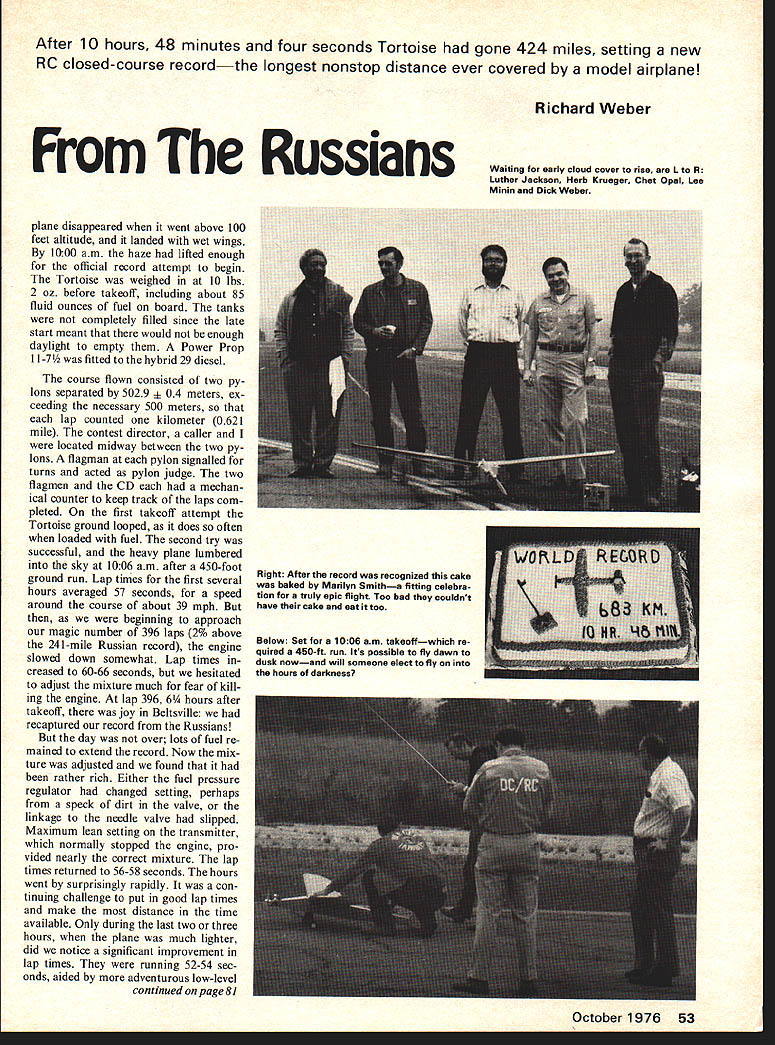
As the cloudy darkness descended, flying altitude was raised to improve visibility. Then it became difficult to see the flagmen at the pylons nearly three football fields away, so they abandoned flags in favor of auto headlights to signal the turns. It got harder to see the airplane near the ends of the course. Just after a turn I could not see it at all as it was approaching me. I relied on the Doppler shift of the engine sound for a few seconds to tell me that the Tortoise was headed my way, keeping in mind one of the FAI rules: the plane must land within 500 meters of the release point. If it should crash more than 500 meters away, the entire flight would be negated and the record lost. Finally, it was decided that wisdom was the better part of valor. After flying 683 kilometers (424 miles) the engine was killed by holding the nose straight up. We had achieved two objectives: the immediate one of regaining the record from the Russians, surpassing theirs by 76%, and an old goal of doubling Kunce's record of 210 miles.
The Tortoise glided in and out of sight on its dark approach, and at 8:54 p.m. it landed just ten feet from the release point. After a few photos and a weigh-in, we removed the wing to find that only one-half ounce of fuel remained! The hour or two of rich running earlier in the day had evidently been burning fuel at 2–3 times the normal rate, because I had expected to have enough fuel on board for 13 hours. The actual flight time was 10 hours 48 minutes 04 seconds; average speed 39.3 mph.
The flight of 424 miles is the longest nonstop distance flight ever, in any category of model aviation. To set such records several ingredients are essential. The first is the dream to reach higher and further, to extend your understanding into new horizons. Then must come the long hours of work and frustration necessary to turn the dream into reality. But the most important ingredient is people. People like those mentioned earlier who are willing to give up a day of their own flying to witness an official record attempt. People like Dean Smith and Ed Smigocki who supplied critical engineering and talents for those special parts you can't get at any store. And, finally, my patient wife, Carol Jean, who not only stifles comments about things like weeds in our grass, but always supplies a mountain of sandwiches and other goodies to sustain the crew and pilot.
There are lots of FAI records out there, for RC, FF, CL and for engines, rubber power and gliders. Get one for the USA!
Transcribed from original scans by AI. Minor OCR errors may remain.

