
Tournament of Champions
By Don Lowe
A further page of accomplishment in this great hobby/sport was the 1982 Tournament of Champions. Started in 1974 when Bill Bennett (chairman of the board of the Circus Circus Hotel/Casino) and Walt Schroder conceived the event, it has continued to add spectacle and development to model aviation.
From the beginning, the driving desire was to create an event that would eventually emulate, in model form, the same spectacle of aerobatics as the manned full-scale craft flown by our brothers. It has taken much foresight and development over the years, but this year one could truly say that this theme has come of age. Both aircraft and equipment used in the tournament represented the most advanced concepts in aircraft design, engine development, and accessories currently in use. The combination of an evolutionary change in aircraft requirements, patterns flown, and other competition rules has created a class of model aircraft that can be said to be truly representative of its full-scale counterpart.
Flying an aerobatic model "in the box," Aresti style, requires a reasonably slow aircraft with low wing loading and high power loading. The large amount of vertical maneuvering requires a lot of thrust at low airspeed and minimum weight.
If a composite aircraft could be drawn from this year's competition, it would be something like the following:
- 18-lb. monoplane
- 1,600 sq. in. wing area
- 20 x 10 prop
- two-cylinder engine of at least 3 hp
- balsa framework
- MonoKote covering
Aircraft and Designers
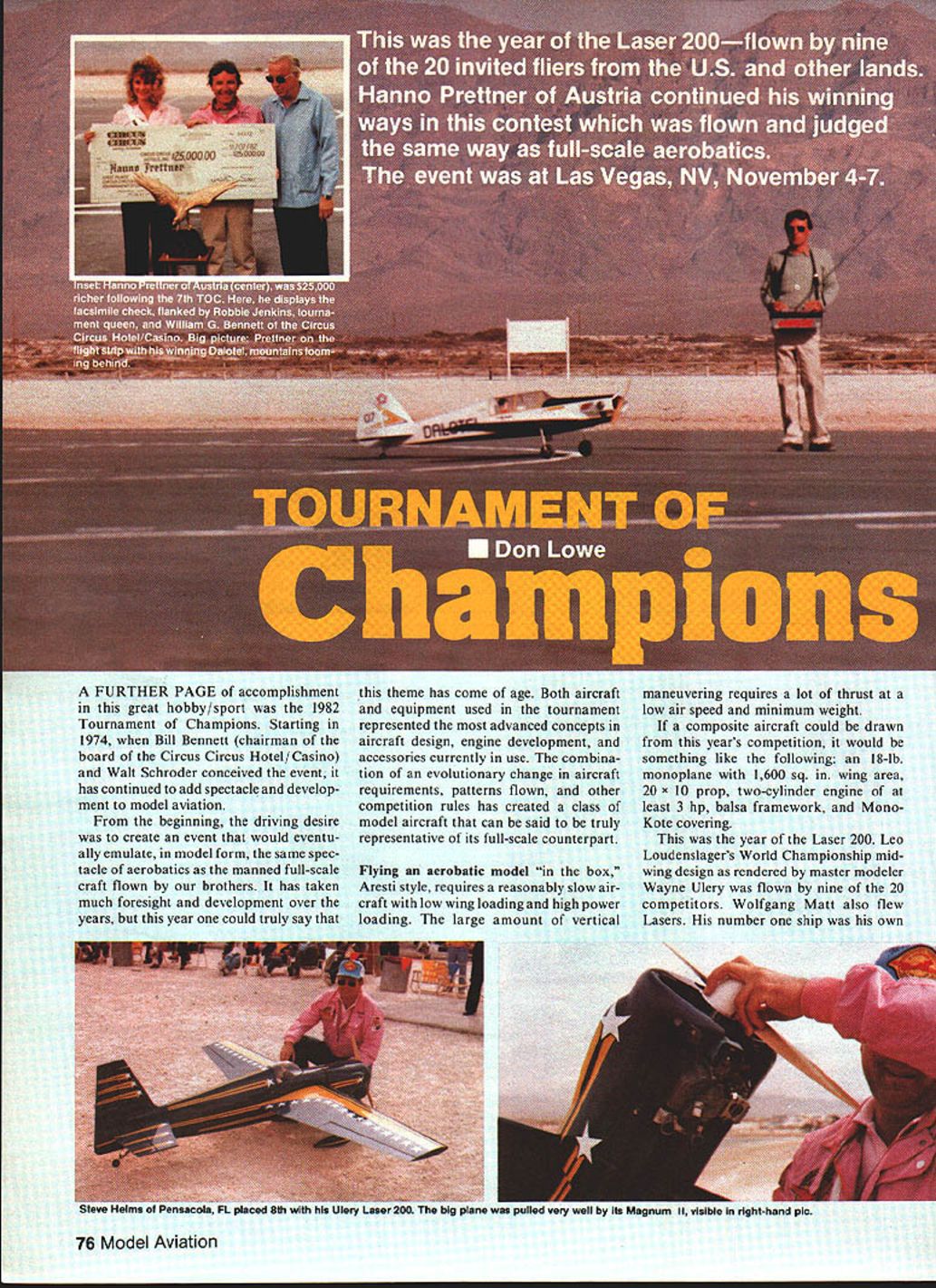
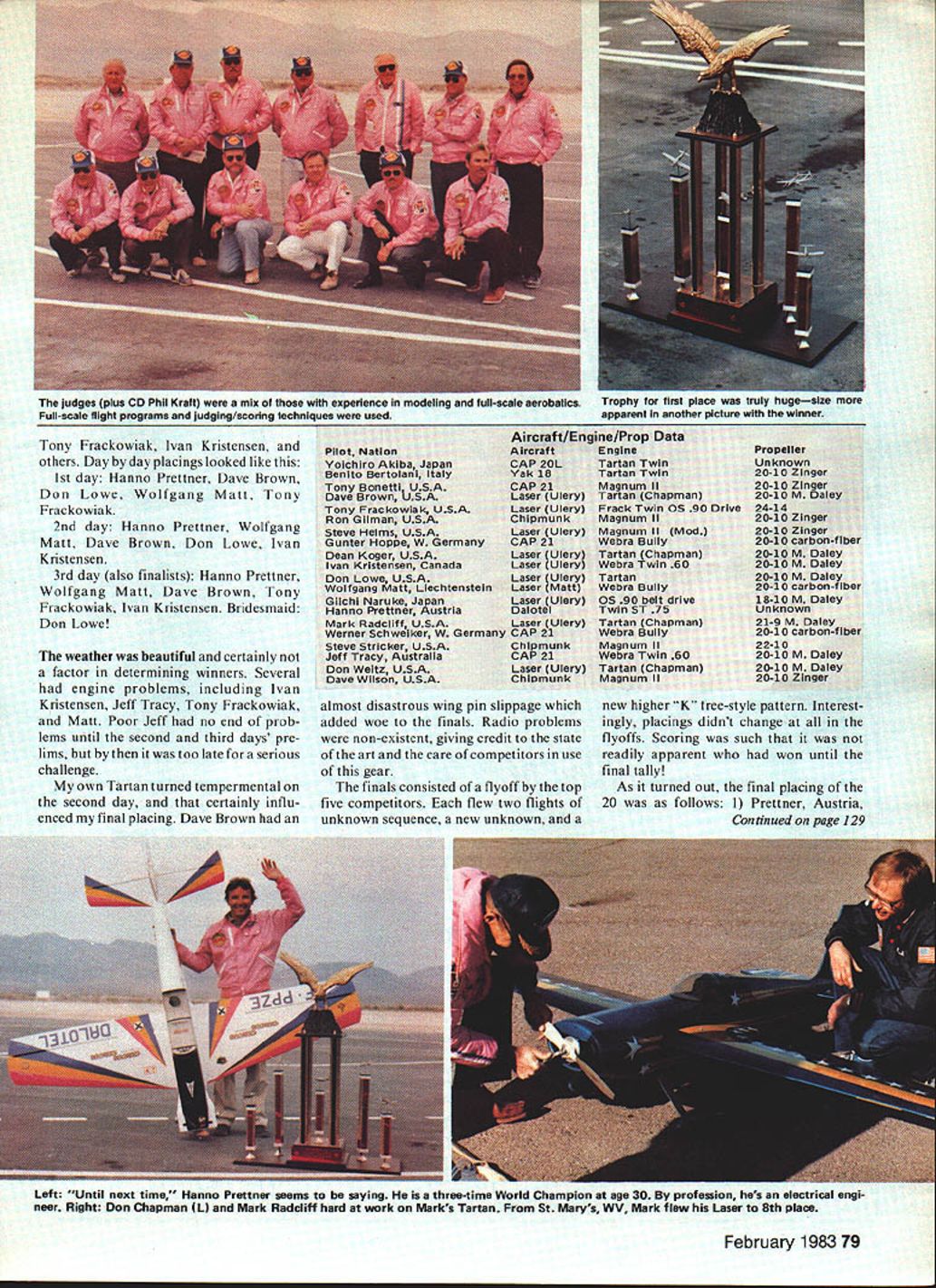
This was the year of the Laser 200. Leo Loudenslager's World Championship midwing design, as rendered by master modeler Wayne Ulery, was flown by nine of the 20 competitors. Wolfgang Matt also flew Lasers—his primary ship was his own design, and his backup was Ulery's. One could truly say that Wayne Ulery has had a tremendous influence on aircraft design. Other designs included Jeff Tracy's CAP 21, Prettner's Dalotel, Bertolani's Yak 18, and Gilman's Chipmunk. I must show my own prejudice when I say that the Laser was the superior aircraft design. In fact, I have never flown a better, more honest model than my Ulery Laser. It's a pure joy to fly.
Engines and Propulsion
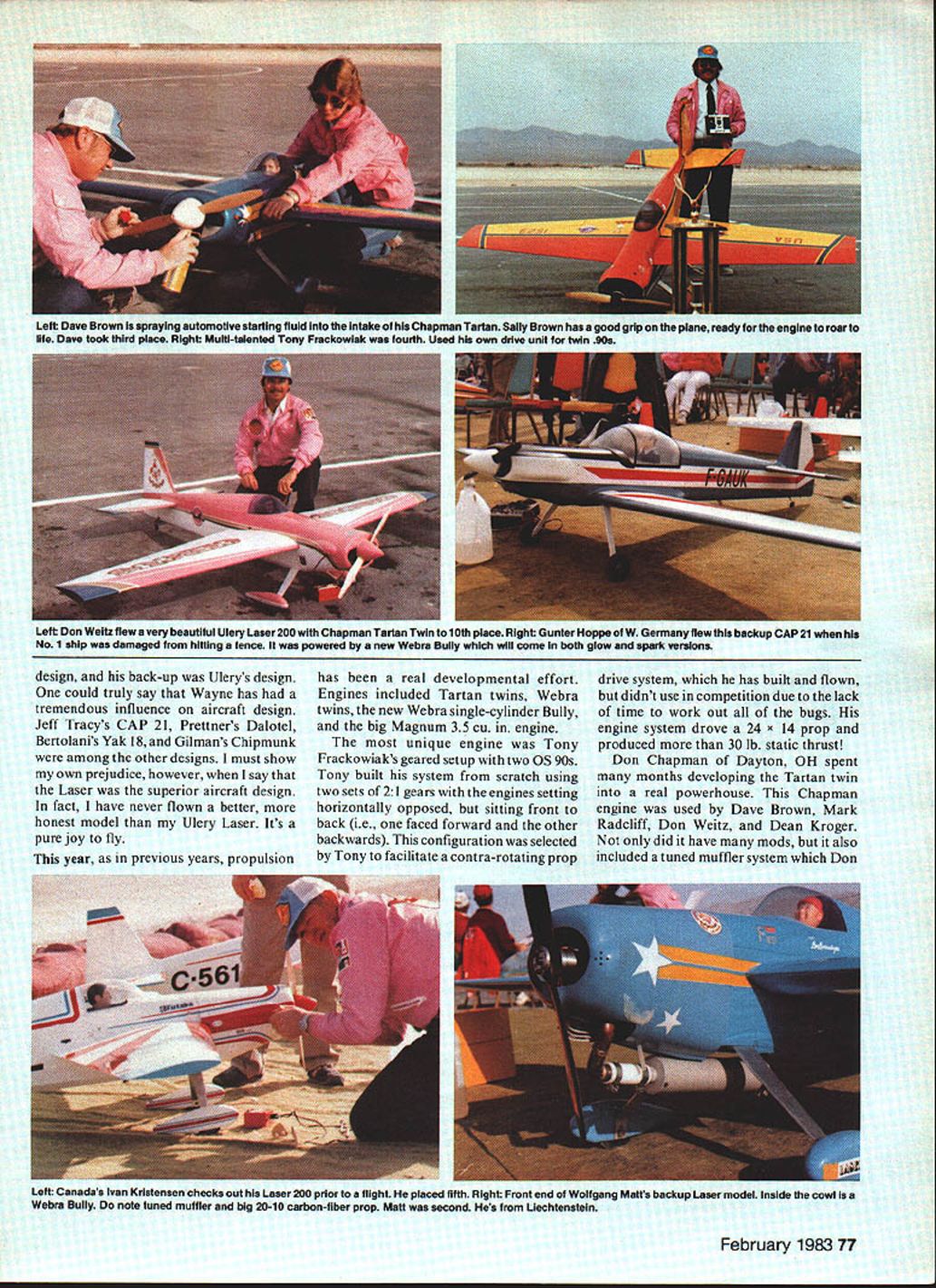
This year, as in previous years, propulsion was a real developmental effort. Engines included Tartan twins, Webra twins, the new Webra single-cylinder Bully, and the big Magnum 3.5 cu. in. engine.
The most unique engine was Tony Frackowiak's geared setup with two OS 90s. Tony built his system from scratch using two sets of 2:1 gears with the engines mounted in a horizontally opposed arrangement but oriented front-to-back (one faced forward, the other backward). This configuration was selected to facilitate a contra-rotating prop drive system, which he built and flew but didn't use in competition due to lack of time to work out all the bugs. His engine system drove a 24 x 14 prop and produced more than 30 lb. static thrust.
Don Chapman of Dayton, OH spent many months developing the Tartan twin into a real powerhouse. This Chapman engine was used by Dave Brown, Mark Radcliff, Don Weitz, and Dean Kroger. Not only did it have many modifications, but it also included a tuned muffler system developed by Don.
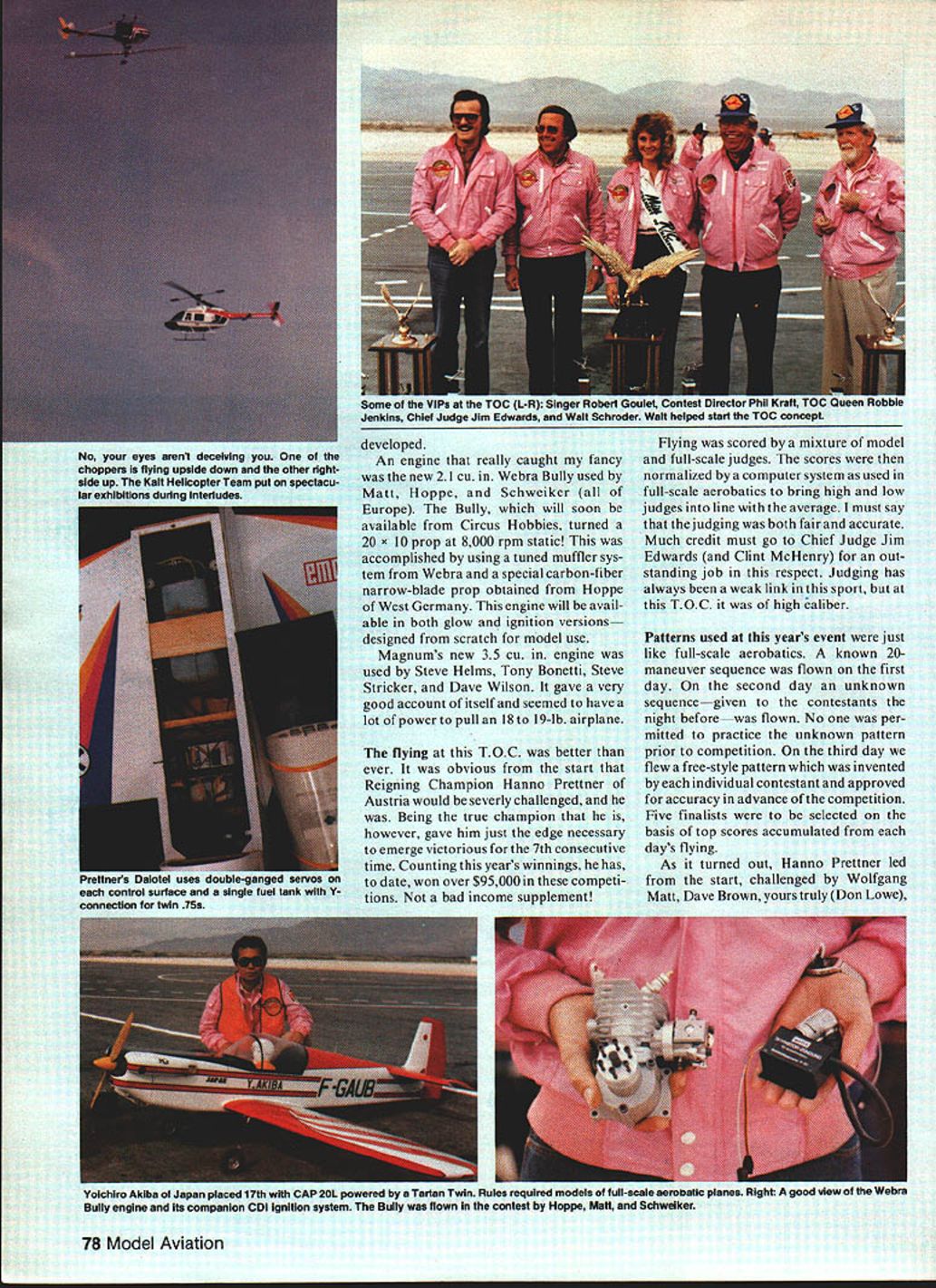
An engine that really caught my fancy was the new 2.1 cu. in. Webra Bully used by Matt, Hoppe, and Schweiker (all of Europe). The Bully, which will soon be available from Circus Hobbies, turned a 20 x 10 prop at 8,000 rpm static. This was accomplished by using a tuned muffler system from Webra and a special carbon-fiber narrow-blade prop obtained from Hoppe of West Germany. The engine will be available in both glow and ignition versions—designed from scratch for model use.
Magnum's new 3.5 cu. in. engine was used by Steve Helms, Tony Bonetti, Steve Stricker, and Dave Wilson. It gave a very good account of itself and seemed to have a lot of power to pull an 18- to 19-lb. airplane.
Flying, Judging, and Patterns
The flying at this T.O.C. was better than ever. It was obvious from the start that reigning champion Hanno Prettner of Austria would be severely challenged, and he was. Being the true champion that he is, however, gave him just the edge necessary to emerge victorious for the 7th consecutive time. Counting this year's winnings, he has, to date, won over $95,000 in these competitions—not a bad income supplement!
Flying was scored by a mixture of model and full-scale judges. Scores were normalized by a computer system as used in full-scale aerobatics to bring high and low judges into line with the average. I must say that the judging was both fair and accurate. Much credit must go to Chief Judge Jim Edwards (and Clint McHenry) for an outstanding job in this respect. Judging has always been a weak link in this sport, but at this T.O.C. it was of high caliber.
Patterns used at this year's event were just like full-scale aerobatics. A known 20-maneuver sequence was flown on the first day. On the second day an unknown sequence—given to the contestants the night before—was flown. No one was permitted to practice the unknown pattern prior to competition. On the third day we flew a freestyle pattern invented by each contestant and approved for accuracy in advance of the competition. Five finalists were selected on the basis of top scores accumulated from each day's flying.
Day-by-day Placings
As it turned out, Hanno Prettner led from the start, challenged by Wolfgang Matt, Dave Brown, myself (Don Lowe), Tony Frackowiak, Ivan Kristensen, and others. Day-by-day placings were:
- Day 1: Hanno Prettner; Dave Brown; Don Lowe; Wolfgang Matt; Tony Frackowiak.
- Day 2: Hanno Prettner; Wolfgang Matt; Dave Brown; Don Lowe; Ivan Kristensen.
- Day 3 (also finalists): Hanno Prettner; Wolfgang Matt; Dave Brown; Tony Frackowiak; Ivan Kristensen.
Bridesmaid: Don Lowe!
The weather was beautiful and not a factor in determining winners. Several had engine problems, including Ivan Kristensen, Jeff Tracy, Tony Frackowiak, and Matt. Poor Jeff had no end of problems until the second and third days' prelims, but by then it was too late for a serious challenge.
My own Tartan turned temperamental on the second day, and that certainly influenced my final placing. Dave Brown had an almost disastrous wing-pin slippage which added woe to the finals. Radio problems were non-existent, giving credit to the state of the art and the care of competitors in use of this gear.
The finals consisted of a flyoff by the top five competitors. Each flew two flights of an unknown sequence, a new unknown, and a new higher "K" tree-style pattern. Interestingly, placings didn't change at all in the flyoffs. Scoring was such that it was not readily apparent who had won until the final tally!
Final Standings and Prizes
As it turned out, the final placing of the 20 was as follows:
- Hanno Prettner, Austria — $25,000
- Wolfgang Matt, Liechtenstein — $12,000
- Dave Brown, Hamilton, OH — $9,000
- Tony Frackowiak, Cincinnati, OH — $6,000
- Ivan Kristensen, Canada — $5,000
- Don Lowe, Altamonte Springs, FL — $4,250
- Mark Radcliff, St. Mary's, WV — $4,000
- Steve Helms, Pensacola, FL — $3,500
- Hoppe, West Germany — $3,250
- Don Weitz, Henderson, NV — $3,000
- Gilman, Bakersfield, CA — $2,500
- Dean Kroger, Papillion, NE — $2,500
- Schweiker, West Germany — $2,500
- Steve Stricker, Baltimore, MD — $2,500
- Tony Bonetti, Emerson, NJ — $2,500
- Naruke, Japan — $2,500
- Akiba, Japan — $2,500
- Benito Bertolani, Italy — $2,500
- Dave Wilson, Fountain Valley, CA — $2,500
- Jeff Tracy, Australia — $2,500
Acknowledgements and Closing
The effort in preparing for competition in Las Vegas is tremendous, both for management and the fliers. Special thanks must go to Bill Bennett for making it all possible; to Mel Larson and his staff at Circus Circus for their great effort to make it so pleasant; to Phil Kraft (Contest Director) and Jim Edwards (Chief Judge); and to the many who worked behind the scenes at the tournament, such as Sam Crawford, Marty Barry, Phil Rumbold, Betty and Suzy Stream, Pat Godfrey, Jackie Edwards, and many others.
Great performances by the Eagles Aerobatic Team, the Kalt Factory Helicopter Team, and the West German Peter-Stuyvesant RC Formation Team added icing to the cake.
To me, the greatest enjoyment came from renewing acquaintances with old friends and making new ones—spending time with people like Jeff Tracy who, in spite of mechanical trials, was the epitome of good humor and fellowship. Communicating with Benito Bertolani and his wife was a source of much fun through sign language and limited English/Italian. Helping a few to sort out problems; technical discussions with modelers from all over the world; talking with twice World Champion Doc Brooke (now blind)—all were great joys. To me this was Vegas, and I hope it never ends!
Transcribed from original scans by AI. Minor OCR errors may remain.

