
Tournament of Champions
The premier money event in all of aeromodeling is back with a style and flair that marks the way things are done in Las Vegas. Thousands of spectators got a chance to see the world's best at flying radio-control aerobatics go head to head for the $118,000 in prize money. — John Oldenkamp
DATELINE, Las Vegas, Nevada, November 10–13: The ninth edition of the International Tournament of Champions took place under the benevolent aegis of Circus Circus Enterprises at the RC Model Airfield in the North Las Vegas Regional Park. For this prestigious event, stir together the following exotic recipe:
- 20 internationally noted aerobatic fliers and two alternates representing 10 nations
- About 40 specially designed state-of-the-art airplanes
- A first-rate site and generous accommodations
- A four-day competition schedule
- $118,000 in prize money plus trophies
- Thousands of appreciative spectators
A more illustrious group of fliers than the 1988 Tournament of Champions competitors would be difficult to find. Collectively, they held no fewer than 66 current and past championships, both national and world. What resulted was a truly grand spectacle in the traditional Circus Circus manner.
As head of the largest corporation in Nevada, Circus Circus Enterprises Chairman William G. Bennett has steadfastly pursued excellence in aeromodeling since 1974. That same year, longtime Model Airplane News editor Walt Schroeder originated the idea of a meet of scale aerobatic models and became the architect of the now-traditional Tournament of Champions. Schroeder's concept was a gathering of top-caliber pilots from around the world flying scale replicas of full-size aerobatic airplanes, simulating the maneuvers performed by the manned craft. The idea proved exciting and practical. The models seen at today's TOC are capable of performing virtually any maneuver listed in the Aresti book, with a few exceptions. Schroeder and Bill Bennett both made the rounds this year, greeting old friends and witnessing the remarkable progress the sport/hobby has achieved.
The site for this year's TOC was first-rate: a smooth macadam runway (100 by 600 ft.), huge pits, safety fencing, and generous grass borders. It was flanked by soothing mountain views from a level plain roughly 15 miles northwest of downtown Las Vegas. The horizon was clear of buildings or other distracting obstacles and there was no sun glare to interfere with flying and judging. Directly behind the enclosed field was the mammoth Circus Circus hospitality tent featuring hot and cold food and beverages, a souvenir shop, and room for hundreds to sit and chat. There were perhaps 20 acres of parking and clean amenities. The city of North Las Vegas deserves thanks for building the complex, as does the Las Vegas Radio Control Club, who use and maintain it — and the Nevada Air National Guard, who helped solve any traffic issues. Creature comfort has always been a big deal in Las Vegas, so this major event had its A-pluses in place well ahead of time.
Contest Director Phil Kraft and his blue-ribbon corps of scorers, judges, and technical designates oversaw four days of marathon competition among the 20 invited participants. These included the current RC World Champion, current national champions, the five finalists from the last TOC (1984), and other pilots of certified promise.
Competition format
- Flying tasks: "known" compulsory, "unknown" compulsory, free-style, and three-minute "anything goes" programs.
- Judges scored according to criteria identical to full-scale aerobatics competition.
- Scores were added cumulatively from the three-day preliminaries; the top five pilots advanced to the finals.
- K-factors and criteria for versatility, continuity, rhythm, execution, and harmony were applied.
- After the known compulsory programs, each flier received an unknown program from the Aresti book; no practice was allowed for the unknowns.
- Free programs allowed pilots to present maneuvers of their own choice; pilots were ranked only after all had completed their segment.
The watchword for the week became "beware the odd wobble." The free programs permitted pilots to be as maverick as they dared — and several perfect 10s were recorded. The feats accomplished were mind-boggling; only those pilots who had practiced a virtual photographic memory of the sequences could hope to survive the final cull.
To everyone's credit, the entire week proceeded smoothly — no drips, no runs, no errors, no smudges.
Aircraft and rules
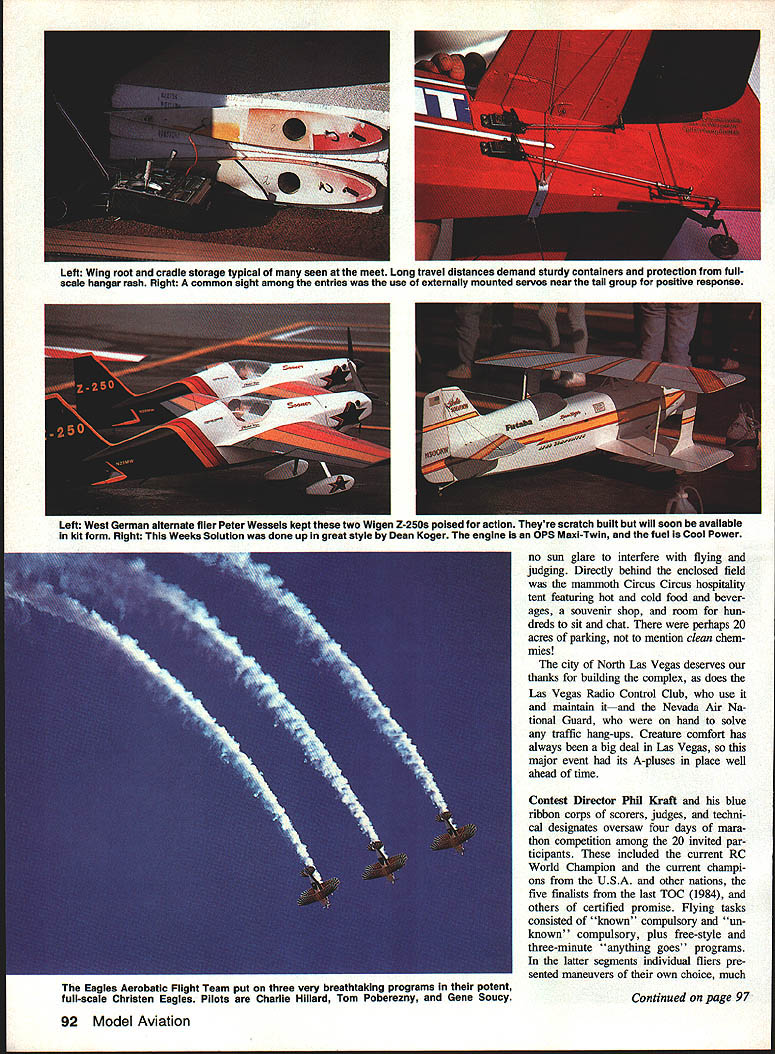
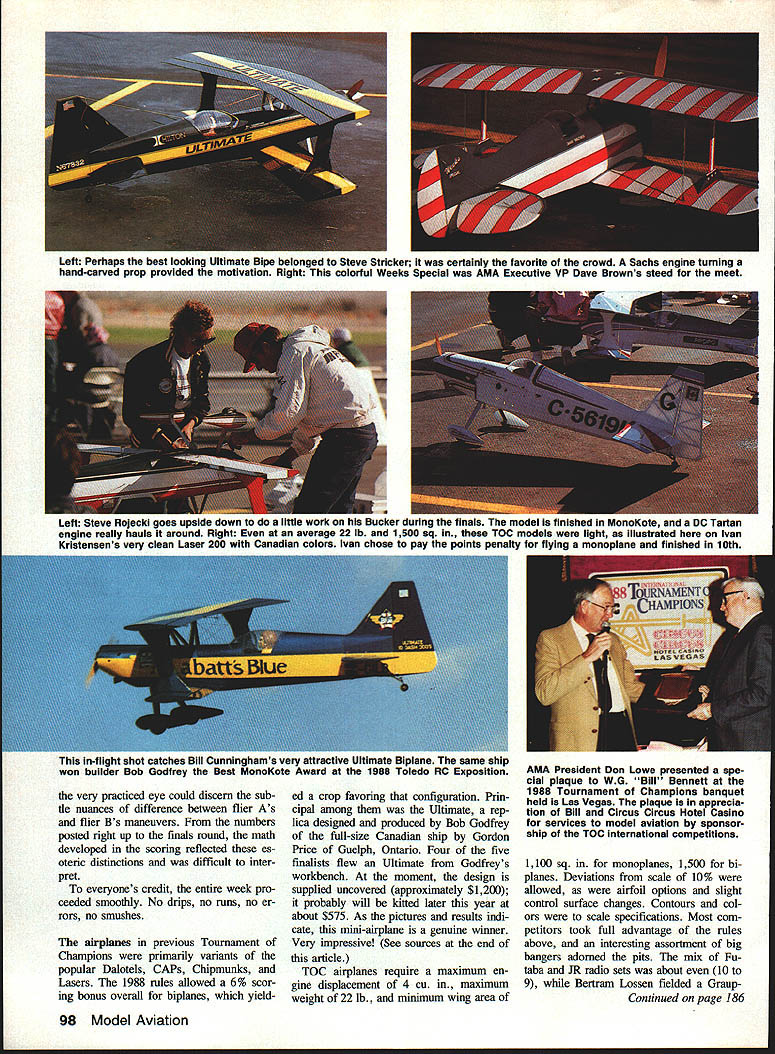
The airplanes in previous Tournaments of Champions were primarily variants of popular types such as Dallots, CAPs, Chipmunks, and Lasers. The 1988 rules allowed a 6% scoring bonus overall for biplanes, which produced a crop favoring that configuration. Principal among them was the Ultimate, a replica designed and produced by Bob Godfrey based on the full-size Canadian ship by Gordon Price of Guelph, Ontario. Four of the five finalists flew an Ultimate from Godfrey's workbench. At the moment, the design is supplied uncovered (approximately $1,200); it will probably be kitted later at about $575. As the results indicate, this mini-airplane is a genuine winner.
TOC airplane specifications:
- Maximum engine displacement: 4 cu. in.
- Maximum weight: 22 lb.
- Minimum wing area: 1,100 sq. in. for monoplanes, 1,500 sq. in. for biplanes
- Deviations from scale up to 10% allowed; airfoil options and slight contour surface changes permitted
- Contours and colors to scale specifications
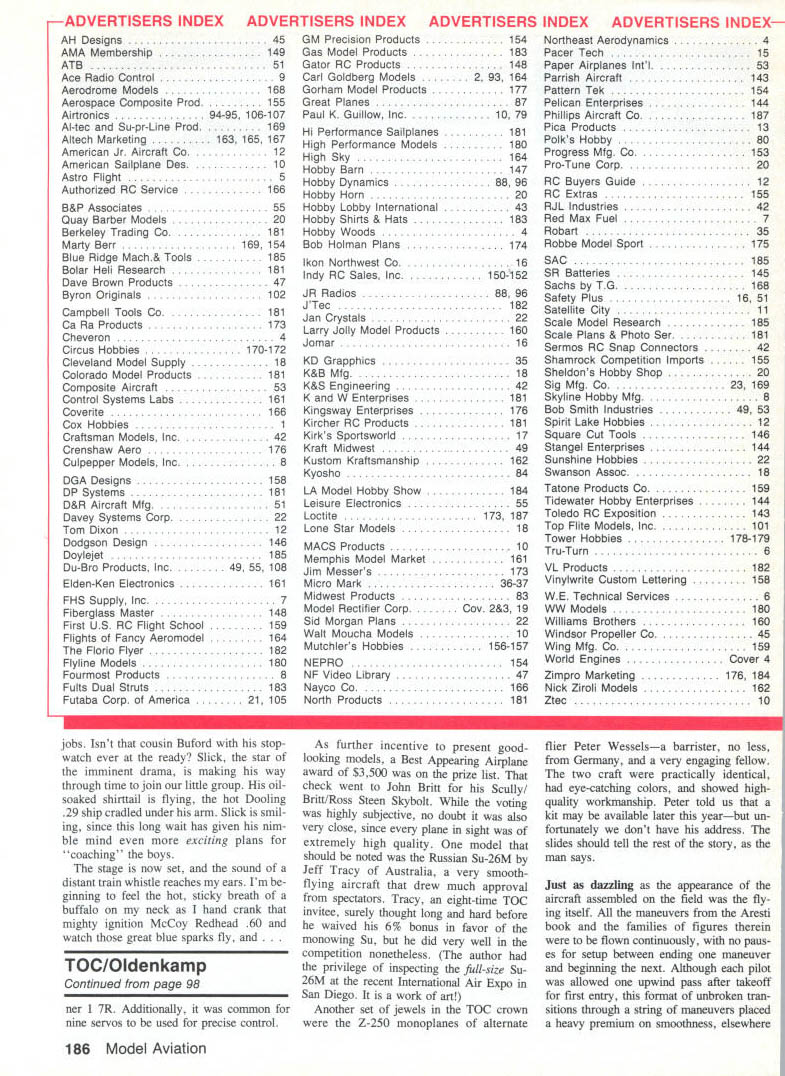
Most competitors took full advantage of the rules, producing an interesting assortment of high-performance models in the pits. The mix of Futaba and JR radio sets was about even (10 to 9), while Bertram Lossen fielded a Graupner set.
As further incentive to present good-looking models, a Best Appearing Airplane award of $3,500 was on the prize list. That check went to John Britt for his Scully/Britt/Ross Steen Skybolt. Voting was highly subjective but very close, since every plane in sight was of extremely high quality. Notable among other models was the Russian Su-26M flown by Jeff Tracy of Australia — a very smoothly flying aircraft that drew much spectator approval. Tracy, an eight-time TOC invitee, waived his 6% biplane bonus in favor of the monowing Su and did very well in the competition nonetheless. Another highlight were the Z-250 monoplanes of alternate flier Peter Wessels of Germany: practically identical, eye-catching, and showing top workmanship. A kit may be available later.
Flying highlights
Just as dazzling as the appearance of the aircraft was the flying itself. All the maneuvers from the Aresti book and the families of figures therein were flown continuously, with no pauses for setup between figures. Although each pilot was allowed one upwind pass after takeoff for first entry, the format of unbroken transitions placed a heavy premium on smoothness — described as "harmony and rhythm."
Each presentation was done solo so the judges could give it full attention. After each flight, the next contestant had three minutes to prepare, start, and take off. Those two features alone created enormous pressure for the fliers, in addition to the exercises themselves. Most flights were on track, displaying spectacular knife-edges, verticals, slow passes with majestic snaps and rolls, and tremendously skillful outside 360s with snaps thrown in.
The weather was generally excellent, although high, gusting winds preceding an invading cold front on Sunday caused some drifting in vertical maneuvers during the finals and delayed stall entry reference to position parameters. With plenty of power on board, most fliers overcame the adversity. Landings were a bit dicey in the crosswind. Hanno Prettner and Chip Hyde seemed least affected.
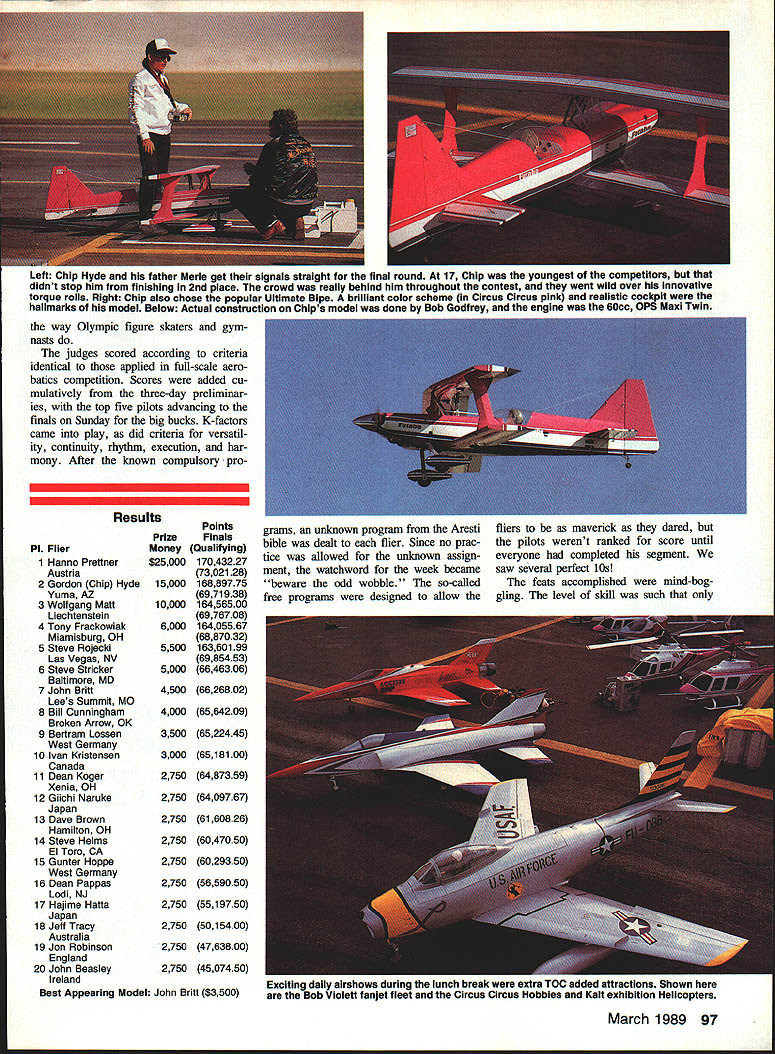
The first day of competition saw Chip Hyde, Dean Koger, Wolfgang Matt, Hanno Prettner, and Steve Rojecski walking away with top honors. Closely following were several high-performance types, among them Tony Frackowiak, who displaced Koger to make the finals. Frackowiak was clearly determined to break the inner circle and did so. Chip Hyde also practiced frequently with what appeared to be a balsa-store hand-launched glider. Many others worked off the tension in quiet conversation and short tent breaks. Given all that was at stake, the pressure was obvious.
The three-minute "free" programs were crowd favorites, with generous applause after each. These impromptu segments gave pilots a chance to loosen up. Dean Koger drew cheers with straight-line and vertical multiple snaps. Chip Hyde executed torque/anticorque vertical rolls, closely matched by Frackowiak's daring knife-edge stunts.
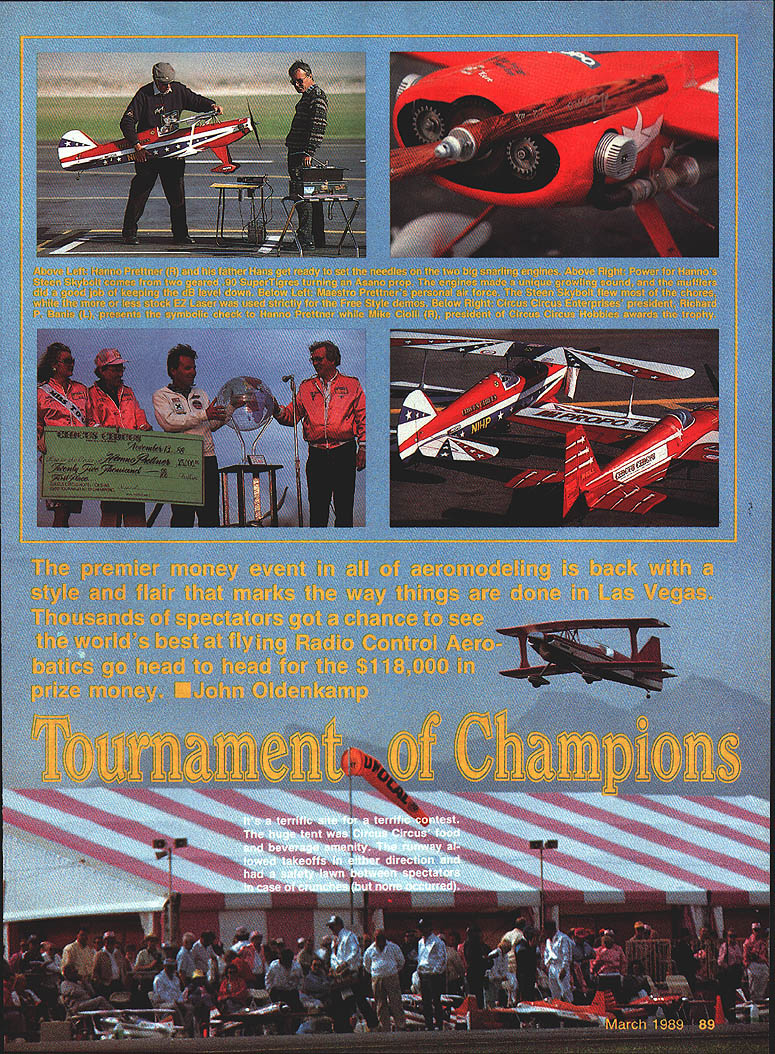
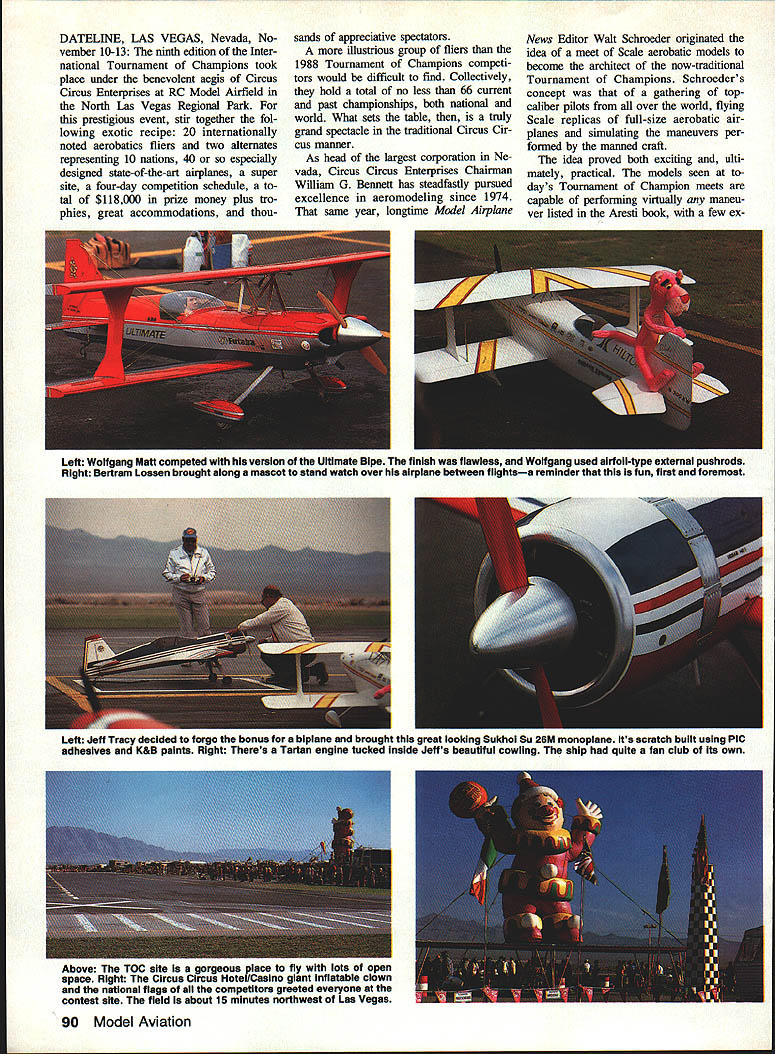
Oddly enough, Hanno Prettner, the eventual TOC champion, flew a largely stock EZ Laser in the free program rather than his customary Steen Skybolt. Rumor was that he had a tenth servo aboard the Laser that pulled a piece of ballast back and forth, permitting some virtuoso maneuvers — truly awesome, consistent flat spins, a full-scale "wiggler" in the half-and-rolled mode, and a figure resembling a falling maple seedpod. For the thousands of spectators, many attending their first aeromodeling meet, the Ferrari-like growl of Prettner's twin-geared SuperTigre engines and his fine hand on the throttle were added frills. (Circus Circus thoughtfully provided hourly bus shuttles between casino and field; hundreds took the trip.)
Finals and results
The finals were anything but ho-hum. Gusting winds and ground turbulence made conditions difficult. One high and one low round were to be thrown out, giving everyone an even crack at the prize pot. Steve Rojecski was a near-casualty, shortening a prop on takeoff but landing safely.
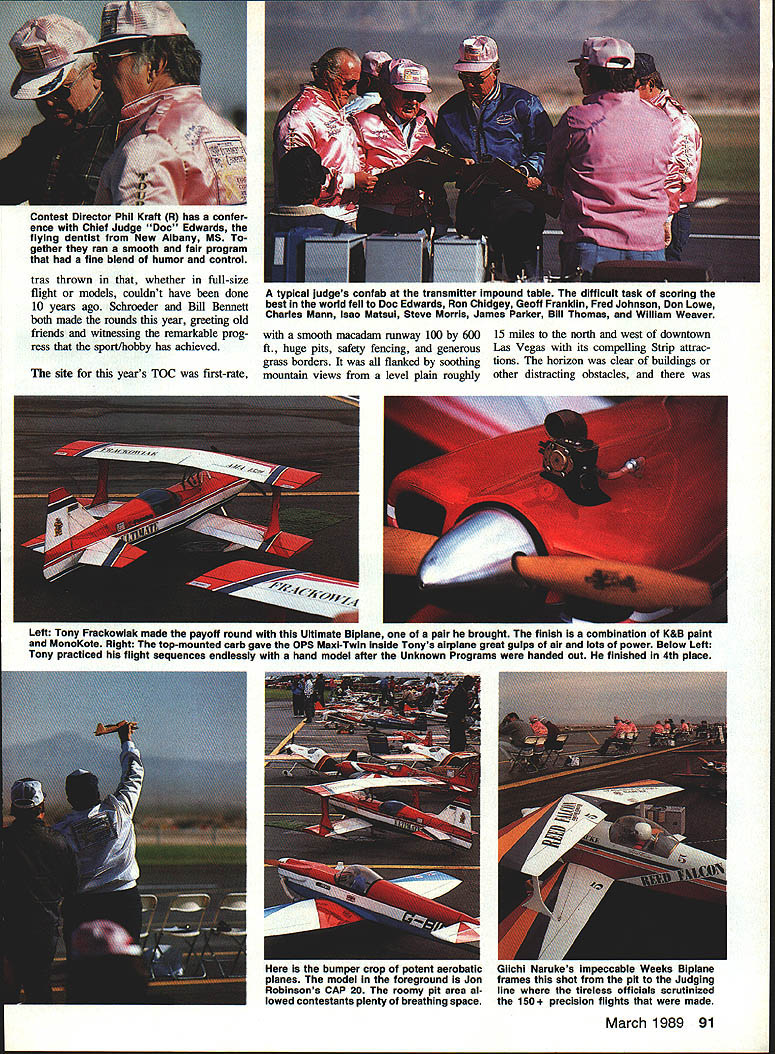
About 2 p.m. the winds peaked and lenticular clouds appeared overhead. It was decided to eliminate the last of the three-minute free programs. Since the outcome was already evident by that time, the top five lined up for speeches, trophies, and substantial checks drawn on the Circus Circus account.
- Champion: Hanno Prettner — $25,000 Circus Circus prize plus $15,000 from JR Radios (total $40,000)
- 2nd place: Chip Hyde — $15,000
- 3rd place: Wolfgang Matt — $10,000
- 4th place: Tony Frackowiak — $6,000
- 5th place: Steve Rojecski — $5,500 plus a $10,000 bonus for flying an JR Radio
Additional awards from the Circus Circus coffers went to the alternates (22nd place). There was a total of $118,000 in prize money and a minimum of $2,750 for every flier involved. The organizers and staff deserve many thanks; in a city known for big winners and big losers, the TOC broke the mold: everyone went home with a bundle.
Best Appearing Airplane: John Britt — $3,500 (Scully/Britt/Ross Steen Skybolt)
Looking ahead
The future of the International Tournament of Champions is assured. During the awards presentation Circus Circus Marketing Director Mel Larson announced there would be a 10th TOC in 1990, staged at the same high level. First invitations will go to the 1988 top five trophy winners; the remaining 15 qualifiers will be top-notch. Adding even more enjoyment will be the 4,000-room Excalibur Resort/Casino being developed by Circus Circus and expected to be ready in time for the 10th annual championships.
Sources:
- TOC and Circus Circus information, souvenir programs, patches, jackets, caps, etc.; Mel Larson, Circus Circus Director of Marketing, 2880 Las Vegas Boulevard South, Las Vegas, NV 89109.
- Ultimate Biplane, prebuilt and kits: Bob Godfrey, Precision Built, 1822 6th Avenue West, Bradenton, FL 34205.
- Video cassette, '88 TOC, $21.95 from Air Time Productions, 6311 North O'Connor, Lockbox 148, Irving, TX 75039.
Transcribed from original scans by AI. Minor OCR errors may remain.

