
Tournament of Champions
Ron Van Putte
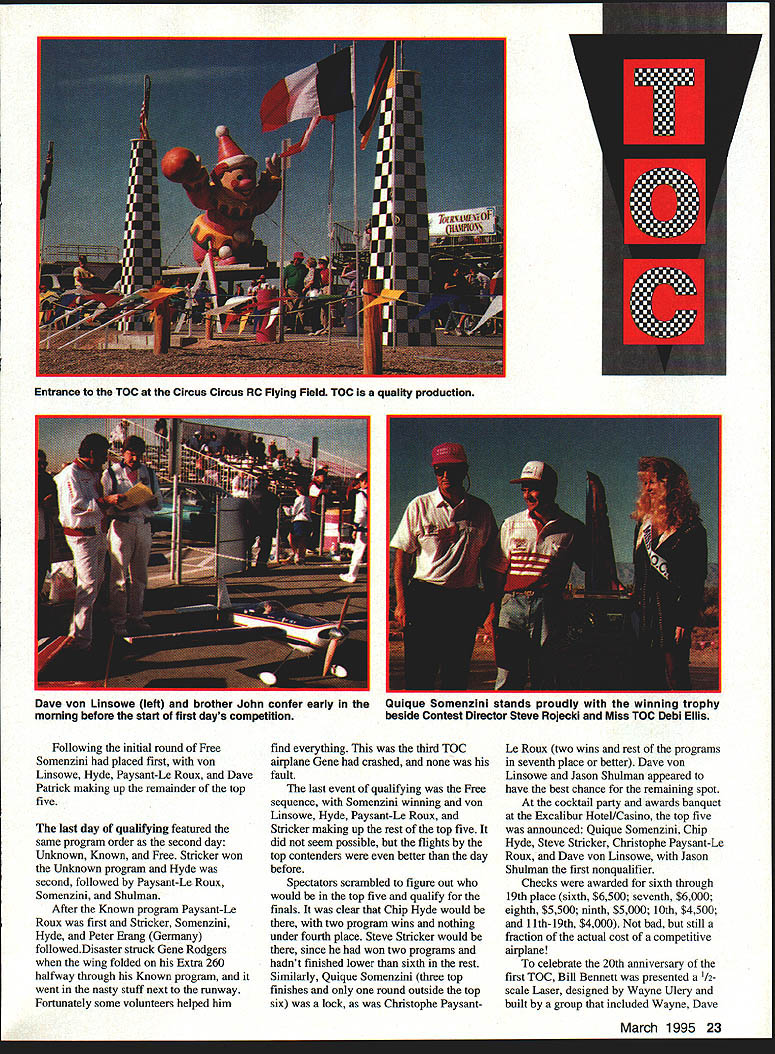
Argentina's Quique Somenzini won the 12th International Tournament of Champions (TOC) at Las Vegas, Nevada. Quique won four of the six Finals flights to win going away. It was a popular win with the many spectators who filled the large bleachers and left many standing to watch.
Sponsored by the Circus Circus Hotel/Casino, TOC is the unique creation of Bill Bennett and Walt Schroder. Bill (Mr. Bill) Bennett is the former Director of Circus Circus Enterprises, and Walt Schroder (deceased) was publisher of Model Airplane News for many years.
TOC began in 1974 and was held annually through 1978, when it went to a biennial schedule (except for a break in 1986) to avoid years in which there was a World Championships. The event brings together the best U.S. fliers in competition with top fliers from the rest of the world. Eleven U.S. fliers and eight foreign fliers competed in 1994.
Competition was held October 27–30 at the Circus Circus R/C Field, adjacent to the Silver Bowl (where the University of Nevada–Las Vegas plays football). The first three days were devoted to qualifying flights, with the finals on the last day.
TOC Format and Equipment Rules
TOC's format is unique: the fliers compete using aircraft representative of full-scale aerobatic aircraft. The trademark of the TOC is the challenge — both in aircraft design and aerobatic flying — and that challenge has increased with each TOC. The 12th TOC featured an exceptional leap in that challenge.
Contest Director Steve Rojecki decreed new size and engine limits:
- Minimum wing area: monoplanes 1,400 sq in; biplanes 1,600 sq in.
- Wing-area bonuses:
- Monoplanes > 2,200 sq in and biplanes > 2,500 sq in: 1% flight-score bonus.
- Monoplanes > 3,200 sq in and biplanes > 3,300 sq in: 2% flight-score bonus.
- Maximum engine displacement for the large airplanes: 8.8 cubic inches.
Several top foreign competitors chose not to accept the challenge because the obstacles were too great.
Flight Types and Scoring
Competitors flew three types of aerobatic flights:
- Known Compulsory Program: a sequence of maneuvers published months in advance for practice.
- Unknown Compulsory Programs: sequences revealed the evening before flying; no practice allowed.
- Four-Minute Free Program: entirely up to the competitor (subject to safety restrictions and a strict four-minute time limit; penalties for times more than five seconds above or below target).
Qualifying format and weighting:
- During qualifying each competitor flew:
- Known program: 4 times (drop worst).
- Free program: 2 times (drop worst).
- Unknown programs: 3 of 5, flown once each (drop worst).
- Qualifying score weighting: 30% Known, 50% Unknown, 20% Free.
Finals format and weighting:
- Finals qualifiers flew:
- Known program: twice.
- The last two of the five Unknown programs: twice each.
- Free program: two Four‑Minute Free flights.
- Final placing used the same 30/50/20 weighting as qualifying.
Event Summary and Highlights
Like many spectators, I was struck by the size of the airplanes. After watching them assembled it was still surprising to see how cleanly they could fly; virtually every airplane could perform the required maneuvers well. Some had to work at specific figures, such as the vertical 12‑point roll or the 8‑point roll straight up, but most got through them.
Weather was almost perfect: clear skies and light winds. Morning temperatures were in the 60s, rising into the 70s and 80s by early afternoon. Winds picked up just after noon on a couple of days.
First-day highlights
- Geoff Combs (big Extra 300S) took off at 8 a.m. flying an Unknown program he had seen only at dusk the previous evening.
- Scores after the first Unknown round: Christophe Paysant‑Le Roux (France) led, followed by Steve Stricker, Dave von Linsowe, Chip Hyde, and Jason Shulman.
- Quique Somenzini appeared to have radio problems and aborted his first flight, placing 13th in that round.
- After the first Known round, top finishers were Hyde, Stricker, von Linsowe, Chris Lakin, and Shulman.
- Colin Campbell's airplane disintegrated during a vertical down snap roll and crashed; wreckage had to be retrieved by helicopter due to dense undergrowth.
Second day and demonstrations
- Chip Hyde won the Unknown program on day two, followed by von Linsowe, Somenzini, Stricker, and Mike McConville.
- Bill Cunningham retired after a crankshaft/keyway failure that could not be repaired.
- Midday featured helicopter demonstrations by K. Sensui and Curtis Youngblood (the latter’s aerobatic helicopter displays were extraordinary), followed by an aerobatic display by Christen Eagles models.
Free program and dramatic maneuvers
- The Free programs were spectacular: almost every competitor used music, smoke, and streamers. Many performed rolling circles, rolling cloverleafs, and other complex figures timed to music.
- Notable maneuvers:
- Quique Somenzini performed a rolling cloverleaf to a Viennese waltz and executed an extreme torque roll, backing down until the tail was nearly in the scrub before accelerating vertically out.
- Chip Hyde performed an extremely low torque roll: he pulled to vertical near center-box, throttled back to idle (spectators feared engine failure), then sustained a torque roll at roughly 25 feet before accelerating out.
Final qualifying day
- Top contenders for the finals were evident: Chip Hyde (two program wins with no finish lower than fourth), Steve Stricker (two wins and consistently high finishes), Quique Somenzini (three top finishes), and Christophe Paysant‑Le Roux (strong finishes).
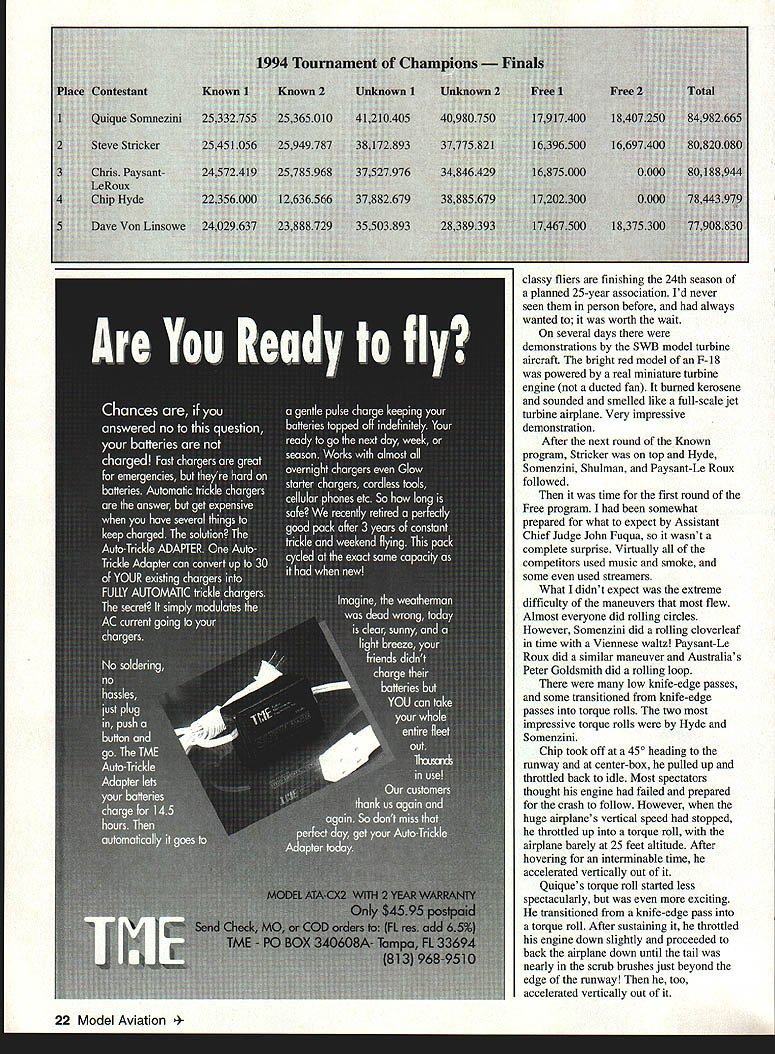
- The top five announced at the cocktail party and awards banquet were: Quique Somenzini, Chip Hyde, Steve Stricker, Christophe Paysant‑Le Roux, and Dave von Linsowe. Jason Shulman was the first non-qualifier.
Prizes and special presentations
- Prize checks for 6th–11th place were awarded (6th $6,500; 7th $6,000; 8th $5,500; 9th $5,000; 10th $4,500; 11th–12th $4,000).
- To celebrate the 20th anniversary of the first TOC, Bill Bennett was presented a 1/2‑scale Laister designed by Wayne Ulery and built by a group including Wayne, Dave Scully, Frank Noll Sr., and Frank Noll Jr. Dean Koger was to fly a duplicate in the competition, but the airplane was destroyed by a tuned‑pipe fire during practice.
Finals (Sunday, October 30)
- Finals began at 9 a.m. with all finalists even. Each competitor flew six flights — two each of Unknown, Known, and Free — keeping one score from each program with the same 30/50/20 weighting.
- Round-by-round highlights:
- First Unknown: Somenzini led, followed by Hyde, Stricker, Paysant‑Le Roux, and von Linsowe.
- First Known: Stricker won; Somenzini second.
- First Free: Somenzini first, von Linsowe second.
- Second Unknown: Somenzini, Hyde, Stricker, Paysant‑Le Roux, von Linsowe.
- Second Known: Stricker won again. Chip Hyde suffered an engine failure and was forced to retire from competition after being unable to isolate the problem.
- Final Free: Somenzini, von Linsowe, Stricker. Christophe Paysant‑Le Roux's engine failed just after takeoff and he scored zero points in that round.
Scoring and results processing
- Mike and Vickie Lauman handled the demanding scoring task despite a power surge killing their optical scoresheet reader early in the competition. They entered scores by hand until a replacement reader arrived by Federal Express, then verified and completed scoring.
1994 Tournament Results
- Quique Somenzini — Argentina — Extra 300S — Bob Godfrey — Scale 37% — Wing area 2,295 sq in
- Steve Stricker — USA — Extra 300S — Geoff Combs — Scale 43.7% — Wing area 3,061 sq in
- Christophe Paysant‑Le Roux — France — CAP 231 EX — ZN Line — Scale 32% — Wing area 1,601 sq in
- Chip Hyde — USA — Ultimate — Merle Hyde — Scale 42.1% — Wing area 3,310 sq in
- Dave von Linsowe — USA — Extra 300S — Geoff Combs — Scale 43.7% — Wing area 3,061 sq in
- Jason Shulman — USA — Extra 260 — Bob Godfrey — Scale 35% — Wing area 1,891 sq in
- Peter Goldsmith — Australia — CAP 231 EX — self — Scale 37.8% — Wing area 2,268 sq in
- Mike McConville — USA — Extra 300S — Bob Godfrey — Scale 37% — Wing area 2,295 sq in
- Greg Marsden — Canada — Extra 300 — HAFU — Scale 30% — Wing area 1,450 sq in
- Chris Lakin — USA — Sukhoi SU 26MX — self — Scale 40% — Wing area 3,058 sq in
- Mike Klein — USA — Ultimate — McConville/self — Scale 30% — Wing area 1,685 sq in
- Peter Erang — Germany — Extra 300 — self — Scale 30% — Wing area 1,502 sq in
- Peter Wessels — Germany — Extra 300S — Lagemann — Scale 31.8% — Wing area 1,515 sq in
- Dean Koger — USA — Laser 200 — Wayne Ulery — Scale 33% — Wing area 1,492 sq in
- Geoff Combs — USA — Extra 300S — self — Scale 43.7% — Wing area 3,061 sq in
- Dave Patrick — Canada — Buckner Jungman — self — Scale 37% — Wing area 3,400 sq in
- Gene Rodgers — USA — Extra 260 — unknown — Scale 32.6% — Wing area 1,516 sq in
- Bill Cunningham — USA — Extra 260 — Pirate Models — Scale 38% — Wing area 2,223 sq in
- Colin Campbell — Canada — Extra 300S — Geoff Combs — Scale 43% — Wing area 3,061 sq in
Final prizes awarded:
- 1st: Quique Somenzini — $25,000
- 2nd: Steve Stricker — $15,000
- 3rd: Christophe Paysant‑Le Roux — $10,000
- 4th: Chip Hyde — $8,500
- 5th: Dave von Linsowe — $7,500
Closing
What the future holds for TOC was uncertain at the close of this event. This was the last TOC sponsored by Circus Circus Hotel/Casino. Estimated event costs are about $50,000 — a substantial sum — and there was discussion about potential future sponsorship, but nothing definite. I hope there will be a 13th Tournament of Champions, and I hope I'm there.
Transcribed from original scans by AI. Minor OCR errors may remain.

