
Tournament of Champions
Rick Allison
Summary
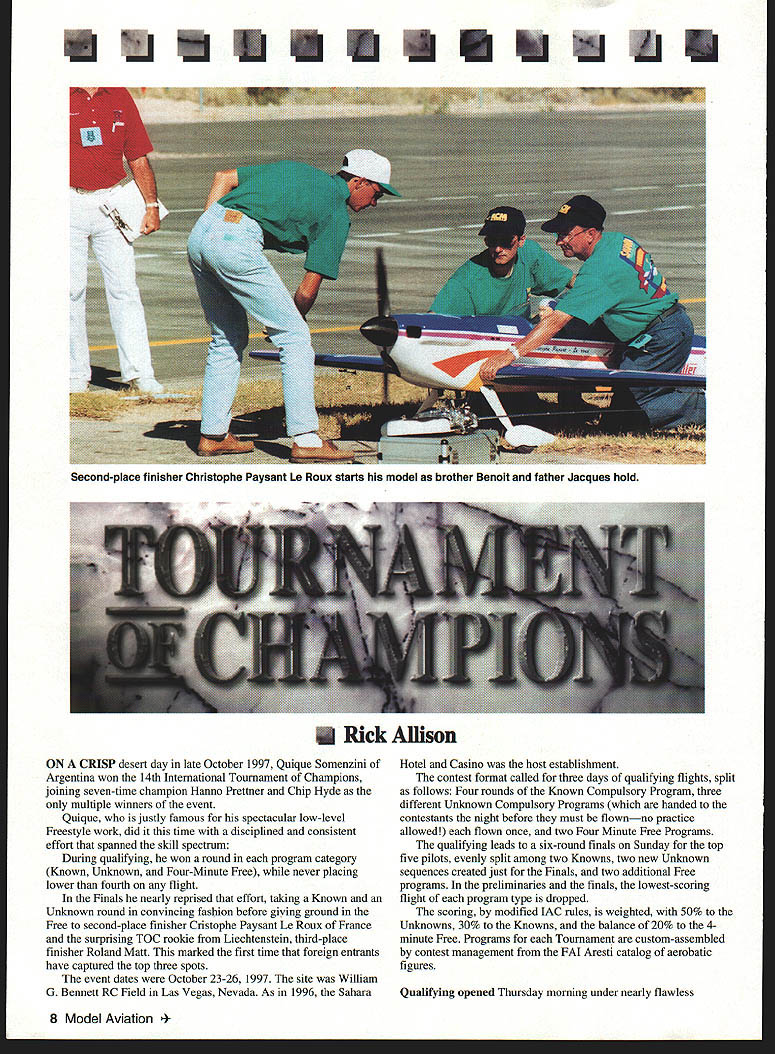
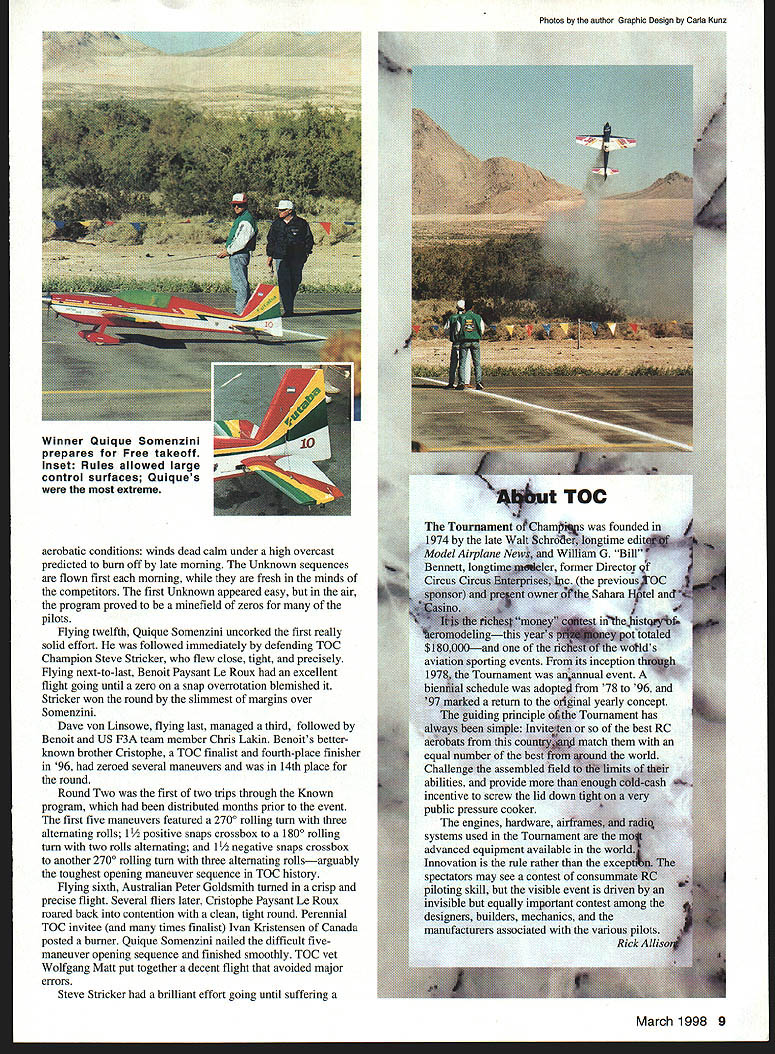
On a crisp desert day in late October 1997, Quique Somenzini of Argentina won the 14th International Tournament of Champions, joining seven-time champion Hanno Prettner and Chip Hyde as the only multiple winners of the event. Quique, famed for spectacular low-level Freestyle work, won with a disciplined and consistent effort across the skill spectrum. During qualifying he won a round in each program category (Known, Unknown, and Four-Minute Free) and never placed lower than fourth on any flight. In the Finals he took a Known and an Unknown round before finishing second in the Free to Christophe Paysant Le Roux of France and third to rookie Roland Matt of Liechtenstein. This marked the first time foreign entrants captured the top three spots.
Event details
- Dates: October 23–26, 1997
- Site: William G. Bennett RC Field, Las Vegas, Nevada
- Host establishment: Sahara Hotel and Casino
Contest format
- Qualifying: three days, split as follows:
- Four rounds of the Known Compulsory Program (two of which were actually flown in 1997 due to weather)
- Three different Unknown Compulsory Programs (handed out the night before each must be flown — no practice allowed)
- Two Four-Minute Free Programs
- Finals: six-round finals on Sunday for the top five pilots:
- Two Knowns, two new Unknown sequences created for the Finals, two additional Frees
- In preliminaries and finals the lowest-scoring flight of each program type is dropped
- Scoring (modified IAC rules):
- Unknowns: 50% weight
- Knowns: 30% weight
- Four-minute Free: 20% weight
- Programs are custom-assembled from the FAI Aresti catalog of aerobatic figures.
Qualifying and competition narrative
Thursday — Qualifying, Unknown #1 and Known sequence
Qualifying opened Thursday morning under nearly flawless conditions: calm winds under a high overcast. Unknown sequences were flown first each morning while fresh in competitors' minds. The first Unknown proved difficult in the air and produced many zeros.
- Flying twelfth, Quique Somenzini produced the first really solid effort. He was followed closely by defending champion Steve Stricker, who flew close, tight, and precise lines.
- Benoit Paysant Le Roux nearly had an excellent flight but a snap overrotation blemished it.
- Stricker won the round by the slimmest margin over Somenzini. Dave von Linsowe (flying last) took third, followed by Benoit and Chris Lakin. Christophe Paysant Le Roux zeroed several maneuvers and finished 14th in the round.
Round Two was the first Known program (distributed months earlier). The opening five maneuvers formed an extremely tough sequence (270° rolling turn with three alternating rolls and a 1½ positive snap, crossbox; 180° rolling turn with two alternating rolls and 1½ negative snaps, crossbox; another 270° rolling turn with alternating rolls).
- Peter Goldsmith (AUS) flew a crisp and precise round. Christophe Paysant Le Roux roared back into contention with a clean round. Ivan Kristensen (CAN) posted a burner. Quique nailed the difficult opening sequence and finished smoothly. Wolfgang Matt avoided major errors.
- Steve Stricker suffered radio interference/range problems that caused breaks in his routine. Rookie Roland Matt (Wolfgang's son) finished strong.
- Round results: 1) Quique Somenzini, 2) Roland Matt, 3) Christophe Paysant Le Roux, 4) Ivan Kristensen, 5) Wolfgang Matt. Steve Stricker slid to seventh amid radio problems.
Round Three (second Known pass): Christophe hung up a gold-standard flight. Quique had a good round with minor flaws. Stricker scratched late with a broken elevator servo. Roland and Benoit Matt put in convincing flights; Dave von Linsowe pushed past Christophe with solid high-K maneuvers.
As the day closed, the US Weather Service predicted high winds for Friday (and perhaps Saturday), recalling the previous year when flying was lost to high winds.
Friday — High winds, cancellations, and format change
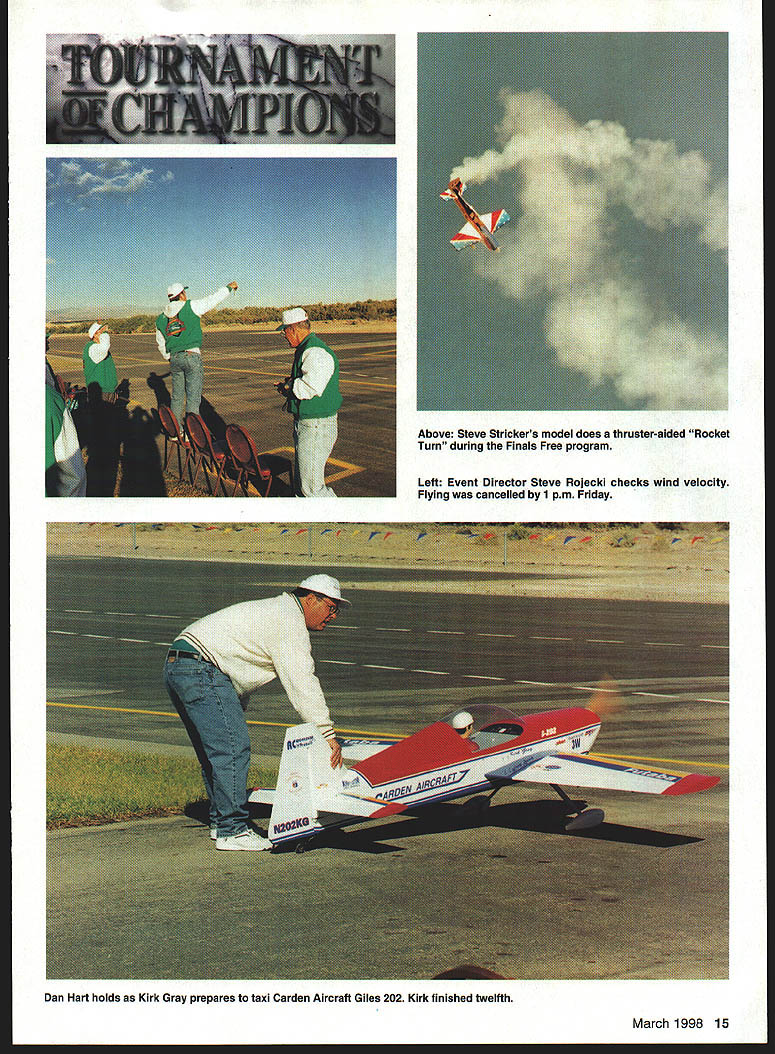
Morning conditions proved chilly and very windy (around 20 mph); Tournament rules allow a pilot vote if sustained winds exceed 20 knots (~26 mph). Event Director Steve Rojecki elected to proceed without a vote. Higher winds were predicted before noon.
To preserve the event structure, at least two rounds of each program type needed to be completed. Unknown #2, flown in the morning into a 15–20 mph 90° blow-in, proved challenging: long vertical and 45° lines, multiple rolls, a crossover spin, and a particularly troublesome Horizontal Eight entered and exited from the top. Precision gave way to survival; most pilots scored low on that maneuver.
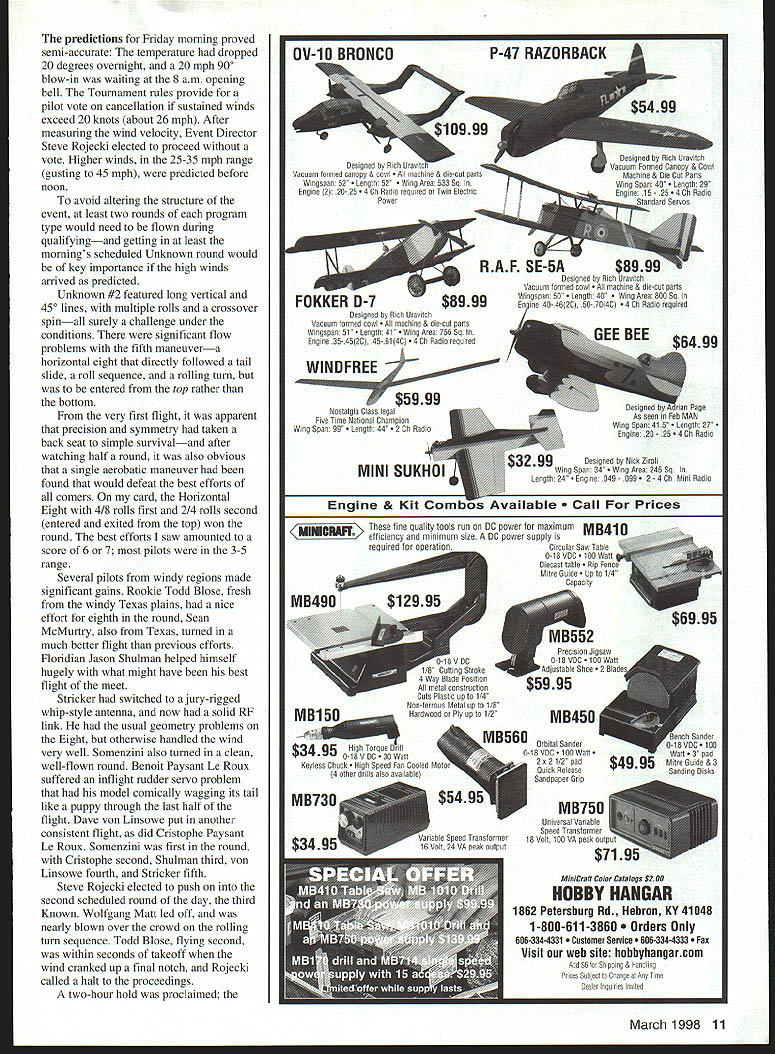
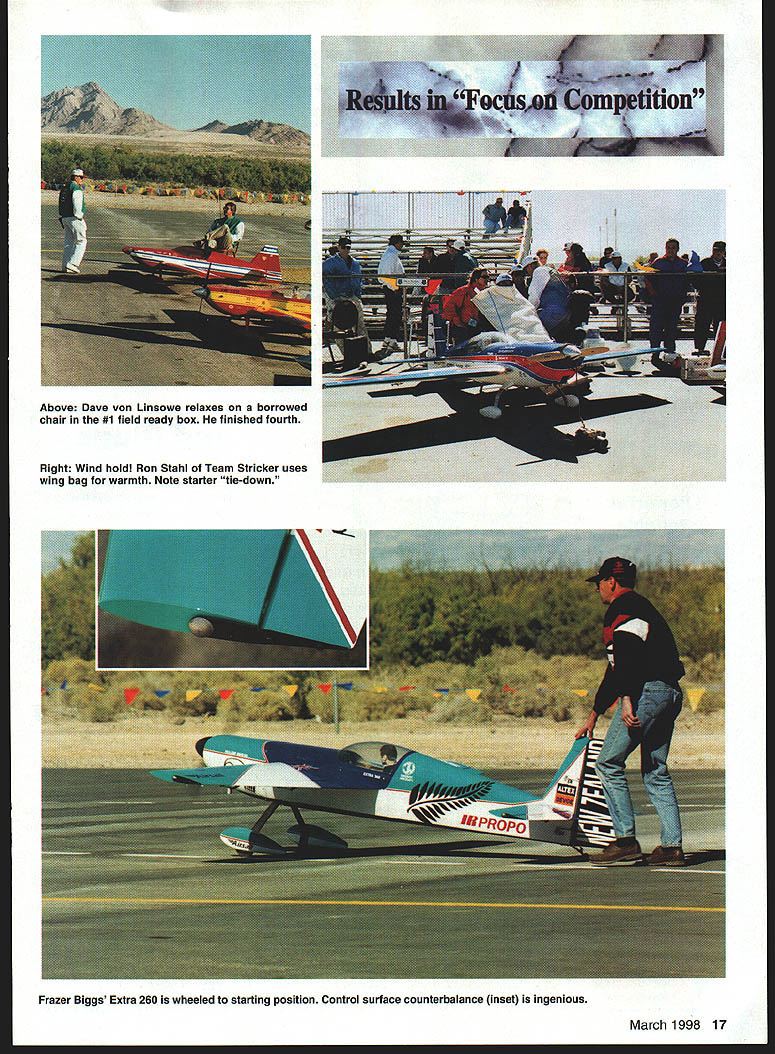
- Pilots from windy regions made gains: rookie Todd Blose (Texas) and Sean McMurtry improved noticeably. Jason Shulman (Florida) posted perhaps his best flight.
- Stricker had jury-rigged a whip antenna and regained a solid RF link; he handled the wind well otherwise. Somenzini flew cleanly. Benoit suffered an inflight rudder servo problem that caused severe tail wagging.
- Rojecki attempted the third Known later in the morning but halted operations as the wind intensified; a two-hour hold was called. Conditions worsened and flying was canceled for the day.
Qualifying was restructured: the two remaining scheduled Known rounds were dropped. The plan became to fly the third Unknown on Saturday morning followed by two Four-Minute Frees. With two Knowns, three Unknowns, and two Frees flown, the drop-score rule would still allow one dropped round per program type. This increased the importance of the Unknowns (50% of total score), making Unknown #3 make-or-break for many pilots.
Saturday — Unknown #3 and Frees
Qualifying resumed Saturday morning in clear but still windy conditions (15–20 mph). Stricker suffered another major problem and landed dead-stick after snapping in the wrong direction and flaming out. Benoit and Christophe Paysant Le Roux flew well under pressure. Shulman, von Linsowe, Roland Matt, and Somenzini had clean, solid efforts. Todd Blose flew well but his flight did not grade out strongly.
Round results: 1) Christophe Paysant Le Roux, 2) Jason Shulman, 3) Quique Somenzini, 4) Roland Matt, 5) Benoit Paysant Le Roux.
The two Four-Minute Free programs were flown after a lunch break, demonstrations (helicopter, turbine jet), and a full-scale airshow by Wayne Handley and The Raven. Frees are scored on Originality, Variety, Harmony and Rhythm, and Showmanship and are often crowd-pleasers; they count for only 20% of the total score but can influence Finals selection when totals are tight.
- The 1997 Frees emphasized Harmony and Rhythm more than previous years; less pure 3-D flash and more graceful, rhythmic maneuvering was evident among top scorers.
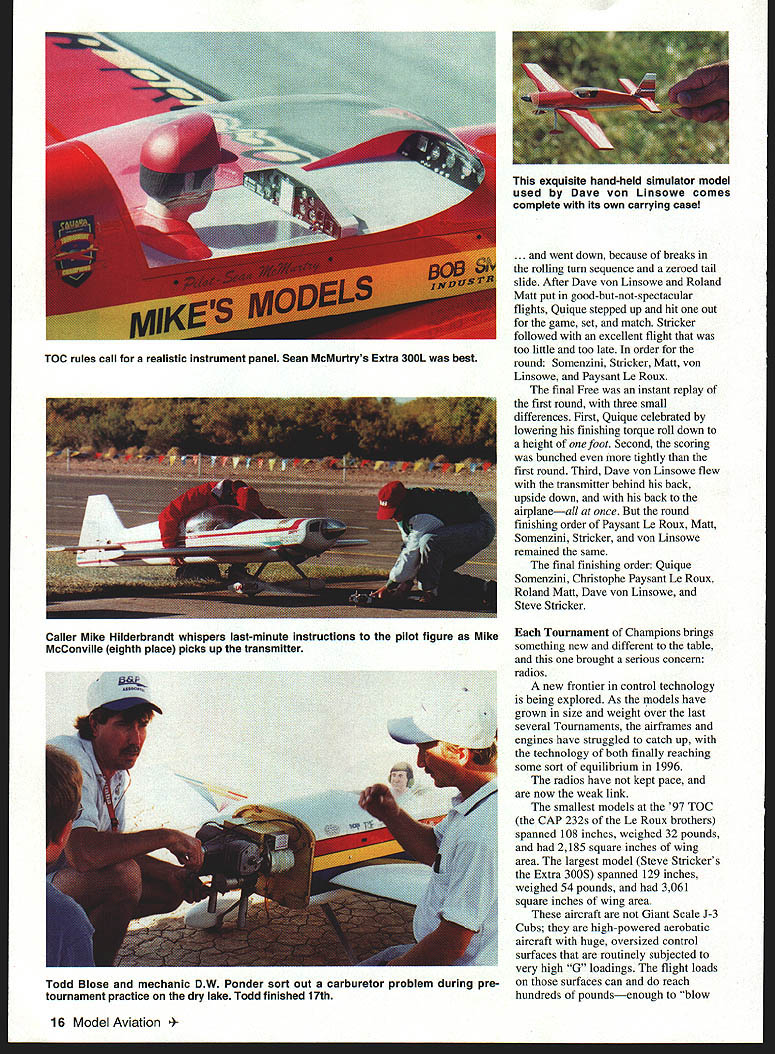
- Typical crowd-pleasing gimmicks were used (transmitter-in-funny-positions, no-look sequences, strobe lights, a small tail-mounted inflight thruster).
- Notable Frees: Steve Stricker won the Informal Accessories division; Roland Matt showed surprising skill; Benoit’s routine resembled his brother’s; Sean McMurtry also performed well.
After the Frees the qualifying concluded. At the banquet that evening, prime rib and speeches preceded prize checks. The top three qualifiers were essentially decided: Somenzini, Christophe Paysant Le Roux, and Dave von Linsowe. The remaining two Finals spots came down to the Free scores. Benoit Paysant Le Roux narrowly missed the Finals, edged out by Roland Matt; a strong Free pulled 1996 winner Steve Stricker into the Finals.
For the finalists, qualifying scores no longer counted.
Sunday — Finals and results
Sunday dawned calm and clear — perfect conditions.
Finals sequence and highlights:
- First Finals Unknown: Dave von Linsowe had problems on up-and-down snaps. Roland Matt flew decently. Quique Somenzini delivered the flight of the contest — assertive, precise, and textbook clean. Stricker had a major mistake, doing a maneuver out of sequence. Round finishers: 1) Somenzini, 2) Paysant Le Roux, 3) Stricker, 4) von Linsowe, 5) Matt (bunched closely).
- Second Finals Known: Stricker recovered to win the Known round with an excellent flight. Paysant Le Roux was a close second; Matt, von Linsowe, and Somenzini followed.
- First Four-Minute Free of Finals: Execution was generally hotter and crisper. Quique lowered a finishing torque roll to under three feet; Christophe cut his "hard deck" down to about six feet. Paysant Le Roux won the round, Matt second, Somenzini third, Stricker fourth, von Linsowe fifth — scoring was tight.
- Second Finals Unknown: Stricker, needing a big win to defend his title, suffered another flameout midway through his flight. Roland Matt won the round, Somenzini was second, Paysant Le Roux third, von Linsowe fourth, Stricker fifth.
- Second Finals Known: Christophe led off but clipped a snap late and finished second. Quique flew a safe, solid program to clinch the title. Round order: 1) Somenzini, 2) Paysant Le Roux, 3) Roland Matt, 4) Dave von Linsowe, 5) Steve Stricker.
- Final Four-Minute Free: A replay of the earlier Free with three differences — Somenzini lowered his finishing torque roll to one foot, scoring bunching tightened, and von Linsowe performed an extreme transmitter-behind-the-back/upside-down/back-to-airplane routine. Finishing order remained Paysant Le Roux, Matt, Somenzini, Stricker, von Linsowe.
Final standings (top five):
- Quique Somenzini
- Christophe Paysant Le Roux
- Roland Matt
- Dave von Linsowe
- Steve Stricker
Radios and equipment concerns
Each Tournament brings technical and organizational issues; 1997 raised a serious concern about radio systems.
- Airframes and engines have grown in size and capability, but radio and control technology have lagged and become the weak link.
- Models at the '97 TOC:
- Smallest: CAP 232s (Le Roux brothers) — 108" span, 32 lb, 2,185 sq in wing area
- Largest: Stricker's Extra 300S — 129" span, 54 lb, 3,061 sq in wing area
- Large aerobatic models impose very high G-loading and flight loads on control surfaces (hundreds of pounds). Standard servos are often ganged (3–4 per surface). Long leads (up to six feet), high current draw, and the need for amplifiers and noise traps complicate installations.
- Most receivers are not designed to handle more than two servos per channel. Gyros on primary controls introduce cross-talk problems in crowded radio bays.
- Common failure modes reported: radio failure, servo arm failure from excessive loads. Several manufacturer reps suggested asking pilots to sign liability waivers if model size increases continue.
- Practical current upper limit for competition RC aerobatic models seems to be about 110–115" span, 2,300 sq in area, and 35–40 lb dry weight. At the ’97 TOC, the average finalist model size was close to these limits: average span 116", weight 40 lb, area 2,420 sq in. Excluding Stricker’s Extra, averages drop to 113", 37 lb, 2,259 sq in.
Other items of note
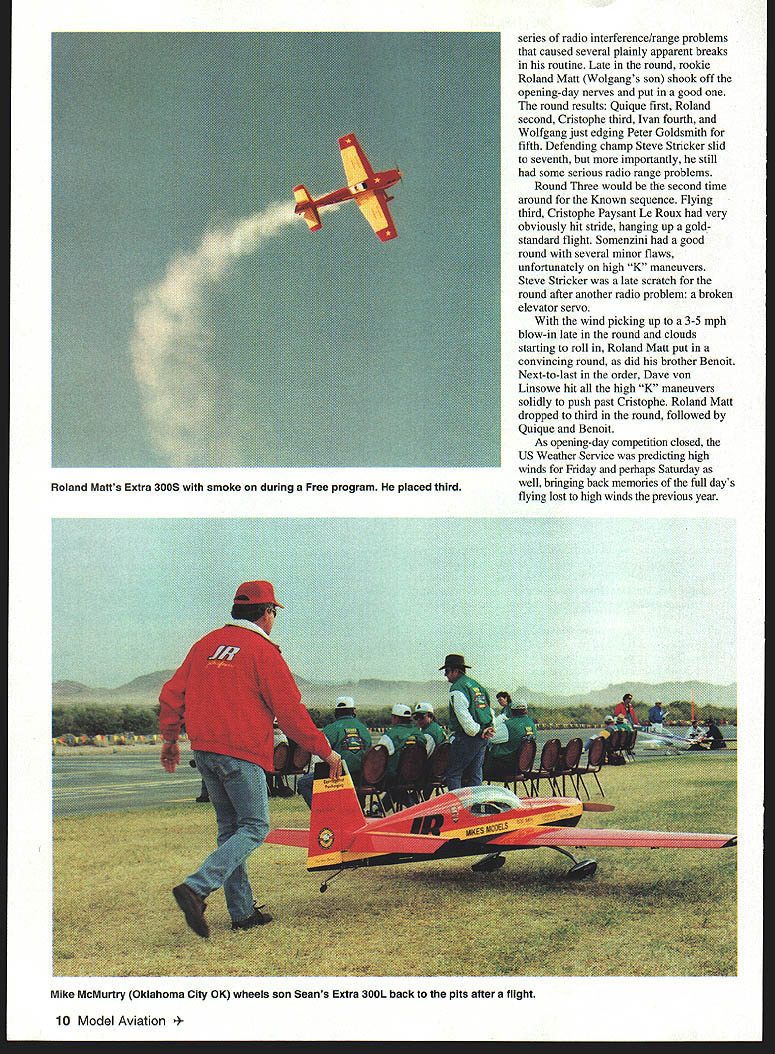
- Wolfgang and Roland Matt became the first father-and-son team to fly at the Tournament; Roland captured top-rookie honors with third place.
- Aircraft represented among competitors: nine Extras (various types), seven Giles 202s, one Sukhoi, and two CAPs.
- Gyros: seven pilots used gyros, eleven did not, one did not provide information. The top three finishers did not use gyros; they were also the top three in the Four-Minute Free.
- Props: eight Menz, eight Bolly, two Top Model Mejzlik, one APC — none broke.
- Radios: six JR radios, thirteen Futabas.
- Engines (19 models): fourteen 3W120 twins, one 3W160 quad, two A Cubed 8.5s, and two Team 7.0s — almost all engines ran well; problems were mainly carburation-related. No models appeared underpowered.
Looking ahead
Much has been made of the TOC’s return to an annual schedule and its potential impact on other sanctioned competition, particularly F3A. The effect will take time to determine. Sanctioned competition structure is expected to survive and prosper, though some pilots will face attendance choices. The return to an annual schedule may reduce the biennial event’s perceived specialness and reduce preparation time, but the 1998 Tournament will be watched closely.
Rick Allison 15618 NE 56th Way Redmond, WA 98052
Transcribed from original scans by AI. Minor OCR errors may remain.

