
Tournament of Champions
by Bob Noll
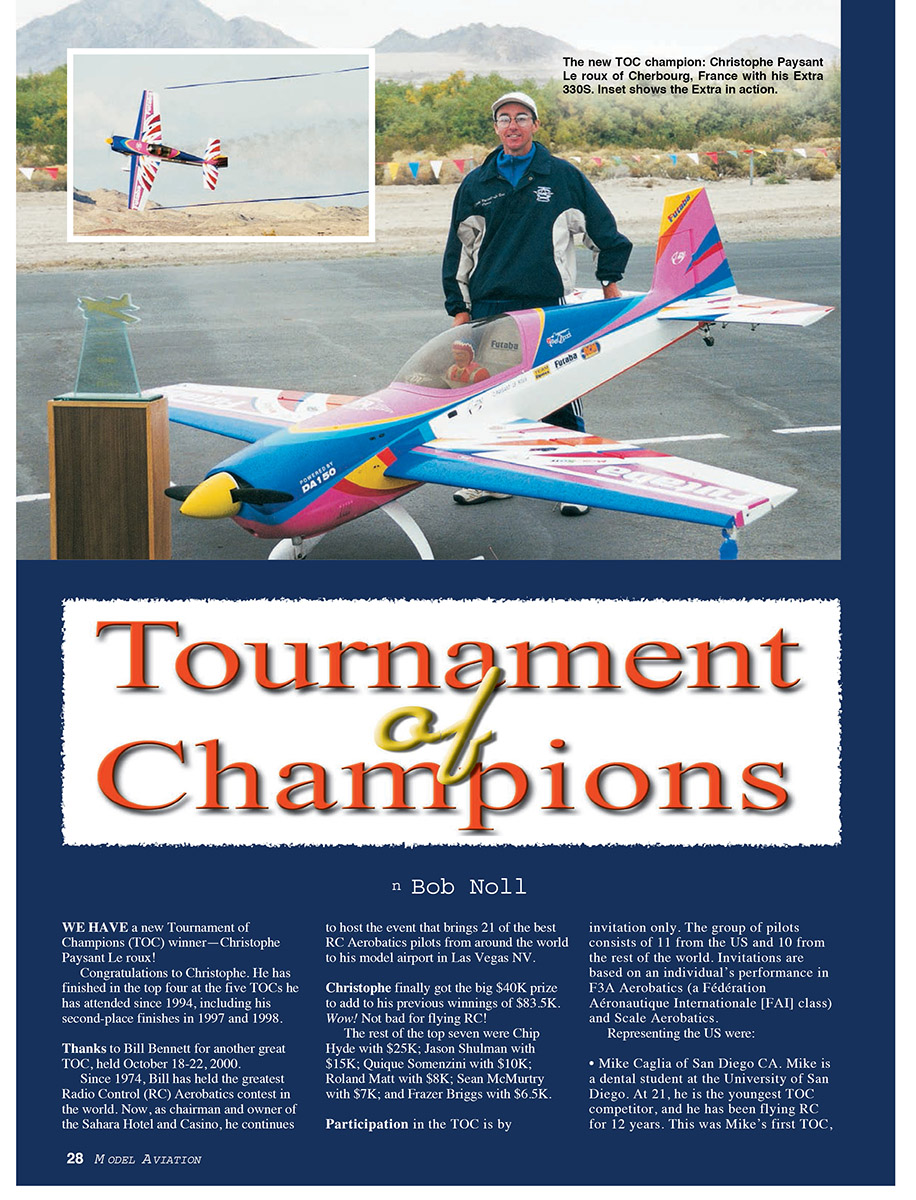
We have a new Tournament of Champions (TOC) winner — Christophe Paysant Le Roux! Congratulations to Christophe. He has finished in the top four at the five TOCs he has attended since 1994, including second-place finishes in 1997 and 1998. Thanks to Bill Bennett for another great TOC, held October 18–22, 2000.
Since 1974, Bill has held the greatest Radio Control (RC) Aerobatics contest in the world. Now, as chairman and owner of the Sahara Hotel and Casino, he continues to host the event that brings 21 of the best RC aerobatics pilots from around the world to his model airport in Las Vegas, NV.
Christophe finally got the big $40,000 prize to add to his previous TOC winnings of $43,500, bringing his total TOC earnings to $83,500. Not bad for flying RC!
The rest of the top seven were:
- Chip Hyde — $25,000
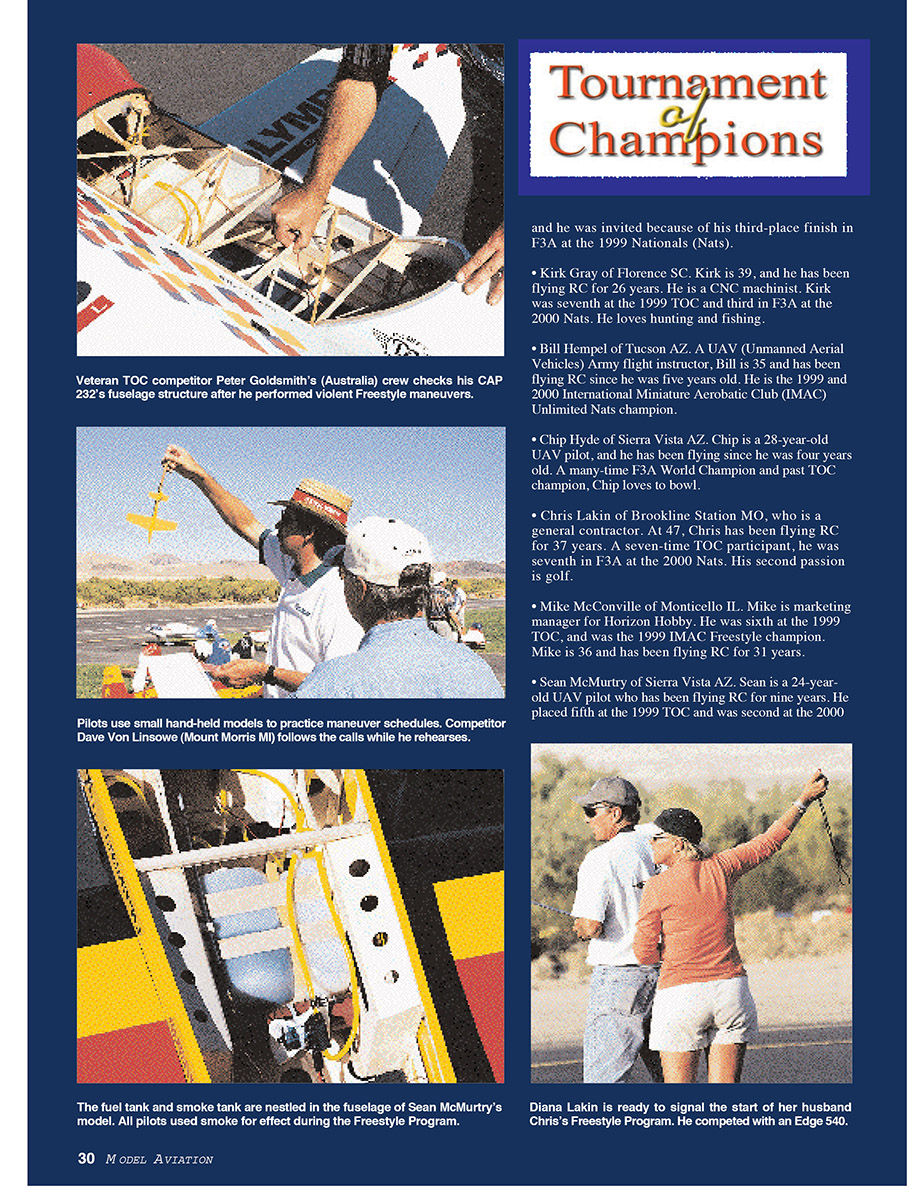
- Jason Shulman — $15,000
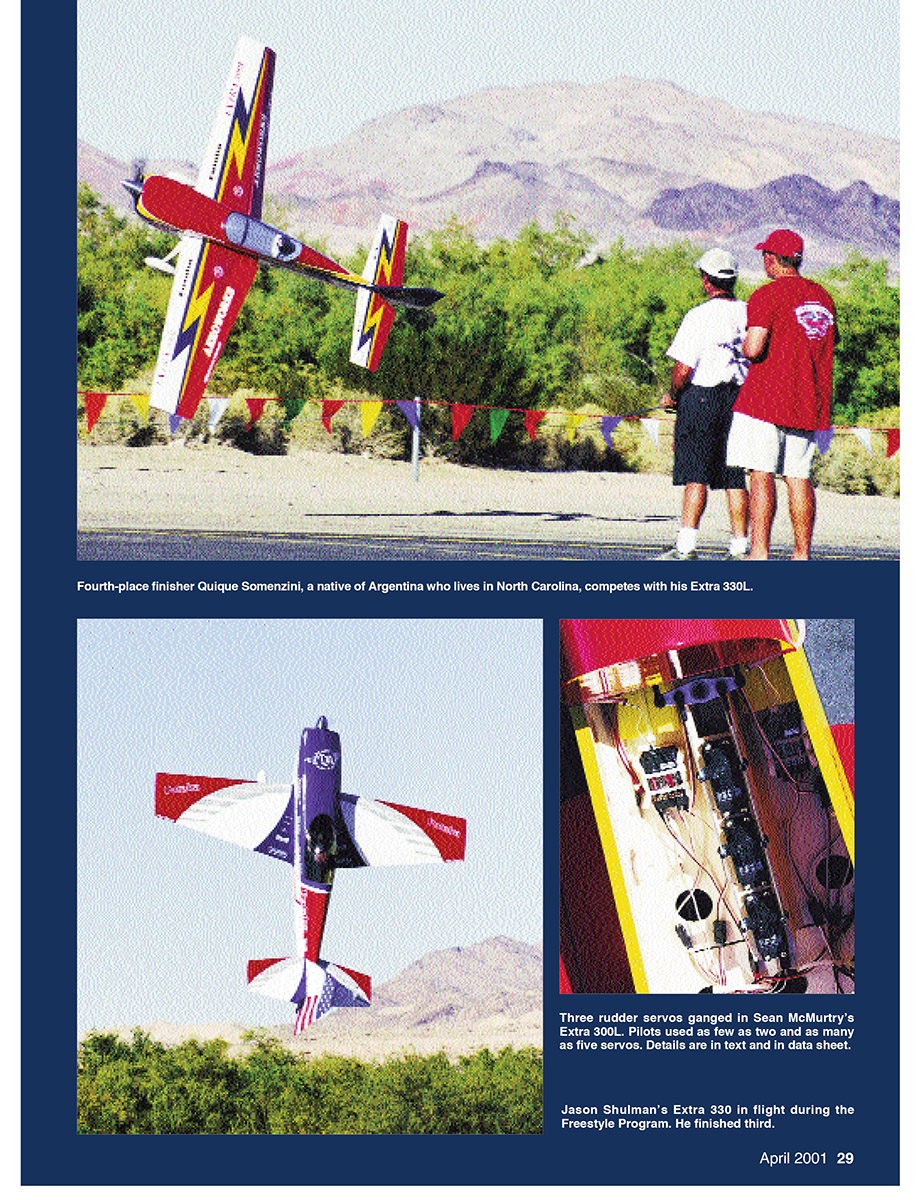
- Quique Somenzini — $10,000
- Roland Matt — $8,000
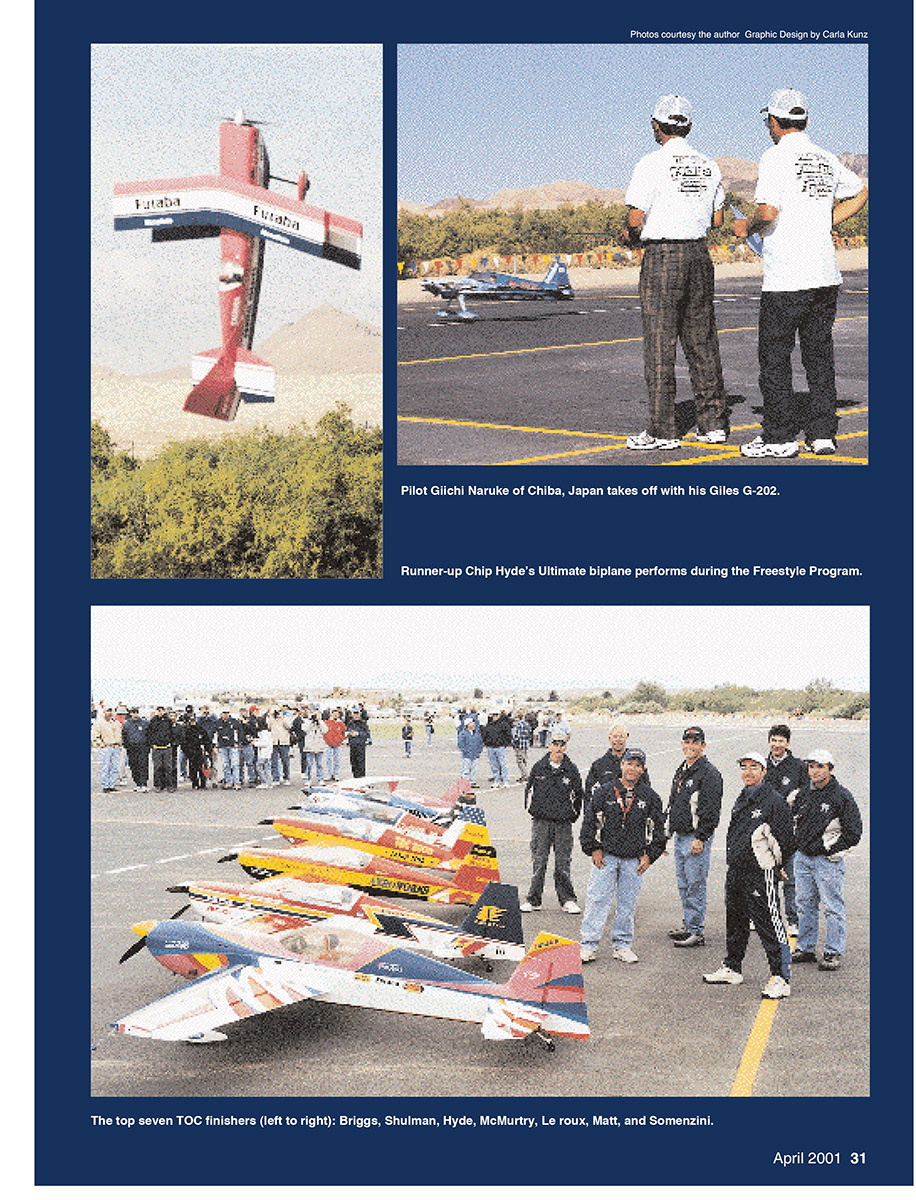
- Sean McMurtry — $7,000
- Frazer Briggs — $6,500
Participation in the TOC is by invitation only. The group of pilots consists of 11 from the U.S. and 10 from the rest of the world. Invitations are based on an individual’s performance in F3A Aerobatics (a Fédération Aéronautique Internationale [FAI] class) and Scale Aerobatics.
Representing the U.S. were:
- Mike Caglia (San Diego, CA). Mike is a dental student at the University of San Diego. At 21, he is the youngest TOC competitor and has been flying RC for 12 years. This was Mike’s first TOC. He was invited because of his third-place finish in F3A at the 1999 Nationals (Nats).
- Kirk Gray (Florence, SC). Kirk is 39 and has been flying RC for 26 years. He is a CNC machinist. Kirk was seventh at the 1999 TOC and third in F3A at the 2000 Nats. He loves hunting and fishing.
- Bill Hempel (Tucson, AZ). A UAV (Unmanned Aerial Vehicle) Army flight instructor, Bill is 35 and has been flying RC since he was five years old. He is the 1999 and 2000 International Miniature Aerobatic Club (IMAC) Unlimited Nats champion.
- Chip Hyde (Sierra Vista, AZ). Chip is a 28-year-old UAV pilot and has been flying since he was four. A many-time F3A World Champion and past TOC champion, Chip loves to bowl.
- Chris Lakin (Brookline Station, MO). Chris is a general contractor. At 47, he has been flying RC for 37 years. A seven-time TOC participant, he was seventh in F3A at the 2000 Nats. His second passion is golf.
- Mike McConville (Monticello, IL). Mike is marketing manager for Horizon Hobby. He was sixth at the 1999 TOC and was the 1999 IMAC Freestyle champion. Mike is 36 and has been flying RC for 31 years.
- Sean McMurtry (Sierra Vista, AZ). Sean is a 24-year-old UAV pilot who has been flying RC for nine years. He placed fifth at the 1999 TOC and was second at the 2000 Nats.
- Gerald Neel (Mooresville, NC). Gerald is a landscape contractor and was fifth at the 1999 Masters World Aerobatic Championships. Gerald is 39 and has been flying RC since he was four. He loves golf, hunting, and fishing.
- Jason Shulman (Tucson, AZ). Jason is 26 and is a test pilot for Desert Aircraft. He has been flying RC since he was three. Jason was ninth at the 1999 TOC and third at the 2000 F3A team trials.
- Don Szczur (Chantilly, VA). Don is a 33-year-old manufacturing engineer who has been flying RC for 21 years. He was sixth at the 2000 F3A team trials and sixth at the 1999 Masters World Aerobatic Championships.
- Dave Von Linsowe (Mount Morris, MI). Dave is a model-maker for the automotive industry and is 44 years old. He has been flying RC for 36 years and was seventh at the 1997 TOC. When Dave's not flying RC, he's flying his Pitts S-2A.
International competitors were:
- Frazer Briggs (Hamilton, New Zealand). Frazer is 25 and is a software developer. He has been flying RC since he was five and finished fourth at the 1999 TOC. Golf and rugby are his other pastimes.
- Stephan Fink (Wackersdorf, Germany). Stephan works in computer science. He is 39 and has been flying RC for 26 years. He was 11th at the 1999 F3A World Championships. He likes to ski and play soccer.
- Peter Goldsmith (Sydney, Australia / recently moved to Monticello, IL). Peter is art director at Horizon Hobby. He is 37 and has been flying RC for 26 years. Peter placed 10th at the 1999 TOC. He calls bowling and golf his non-RC hobbies.
- Ivan Kristensen (Guelph, Ontario, Canada). A 16-time TOC competitor, Ivan has been flying RC for 34 years and is a corporate pilot. He is 53, making him the oldest TOC competitor. Ivan was 10th at the 1999 F3A World Championships.
- Laurent Lombard (Paris, France). Laurent is a composer and guitarist. He is 35 and has been flying RC for 17 years. Laurent was 12th at the 1999 F3A World Championships. His other hobby is music.
- Roland Matt (Mauren, Liechtenstein). Roland is a banker and is 30 years old. He has been flying RC for 20 years and was fifth at the 1999 F3A World Championships. He enjoys skiing and scuba diving.
- Giichi Naruke (Chiba, Japan). Giichi is a sales engineer for Futaba Corporation. He is 51 and has been flying RC for 36 years. Giichi was second at the 1999 F3A World Championships and he drives sports cars.
- Christophe Paysant Le Roux (Cherbourg, France). Christophe works in the nuclear reprocessing business. He is 31 and has been flying RC for 21 years. He is the 1999–2000 F3A World Champion. His non-RC hobby is badminton.
- Silvestri Sebastiano (Trento, Italy). Silvestri is a college student and is 26. He has been flying RC for 16 years and is the 1999 F3A Italian Champion. Silvestri is a 9k runner.
- Quique Somenzini (Rio Cuarto, Argentina / Summerfield, NC). Quique is a consultant for Futaba. He is 26 and has been flying RC for 16 years. Quique is a four-time TOC champion and was second in F3A at the 1999 Nats. He is a 10k runner when he's not flying RC.
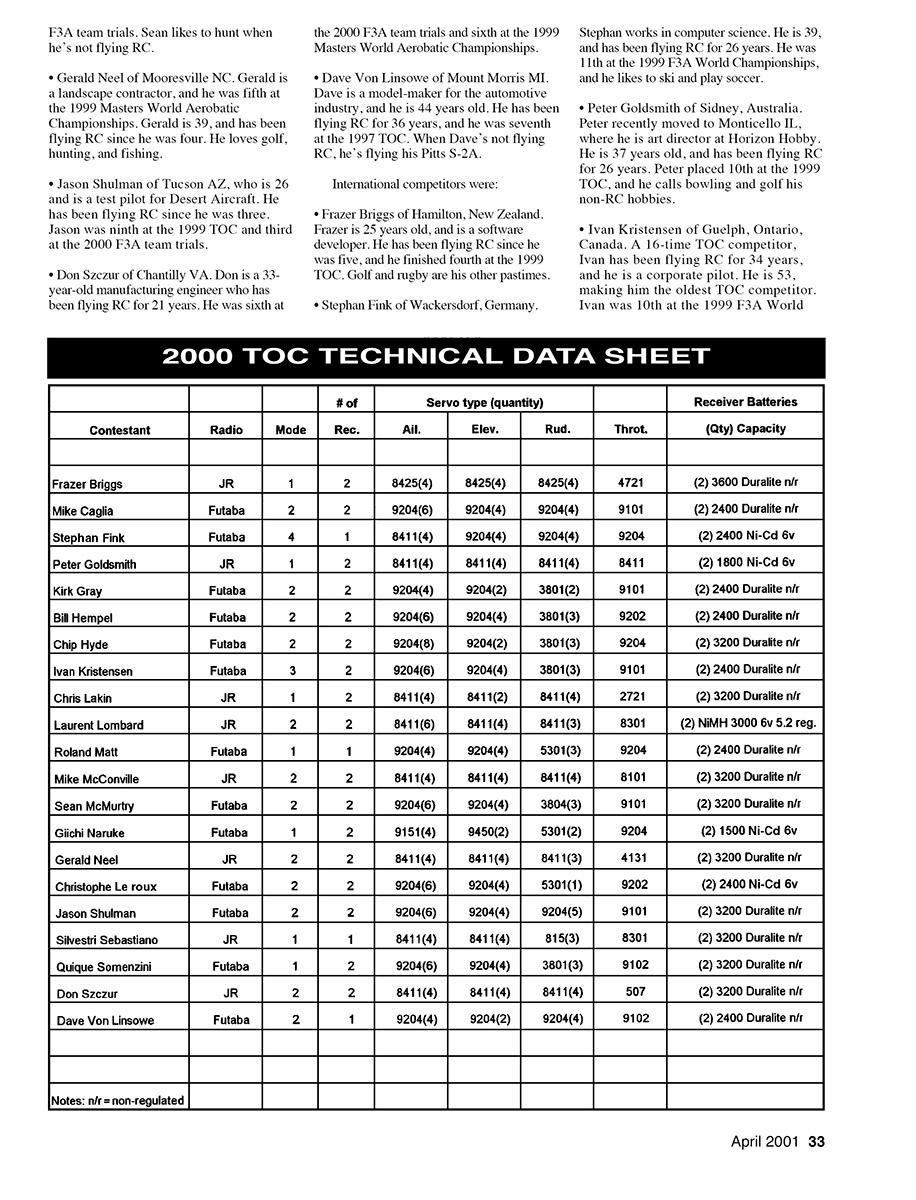
2000 TOC TECHNICAL DATA SHEET
- Frazer Briggs — Radio: JR; Mode: 1; # Receivers: 2; Servos: Ail. 8425(4), Elev. 8425(4), Rud. 8425(4), Throt. 4721; Receiver Batteries: (2) 3600 Duralite n/r
- Mike Caglia — Radio: Futaba; Mode: 2; # Receivers: 2; Servos: Ail. 9204(6), Elev. 9204(4), Rud. 9204(4), Throt. 9101; Receiver Batteries: (2) 2400 Duralite n/r
- Stephan Fink — Radio: Futaba; Mode: 4; # Receivers: 1; Servos: Ail. 8411(4), Elev. 9204(4), Rud. 9204(4), Throt. 9204; Receiver Batteries: (2) 2400 Ni-Cd 6V
- Peter Goldsmith — Radio: JR; Mode: 1; # Receivers: 2; Servos: Ail. 8411(4), Elev. 8411(4), Rud. 8411(4), Throt. 8411; Receiver Batteries: (2) 1800 Ni-Cd 6V
- Kirk Gray — Radio: Futaba; Mode: 2; # Receivers: 2; Servos: Ail. 9204(4), Elev. 9204(2), Rud. 3801(2), Throt. 9101; Receiver Batteries: (2) 2400 Duralite n/r
- Bill Hempel — Radio: Futaba; Mode: 2; # Receivers: 2; Servos: Ail. 9204(6), Elev. 9204(4), Rud. 3801(3), Throt. 9202; Receiver Batteries: (2) 2400 Duralite n/r
- Chip Hyde — Radio: Futaba; Mode: 2; # Receivers: 2; Servos: Ail. 9204(8), Elev. 9204(2), Rud. 3801(3), Throt. 9204; Receiver Batteries: (2) 3200 Duralite n/r
- Ivan Kristensen — Radio: Futaba; Mode: 3; # Receivers: 2; Servos: Ail. 9204(6), Elev. 9204(4), Rud. 3801(3), Throt. 9101; Receiver Batteries: (2) 2400 Duralite n/r
- Chris Lakin — Radio: JR; Mode: 1; # Receivers: 2; Servos: Ail. 8411(4), Elev. 8411(2), Rud. 8411(4), Throt. 2721; Receiver Batteries: (2) 3200 Duralite n/r
- Laurent Lombard — Radio: JR; Mode: 2; # Receivers: 2; Servos: Ail. 8411(6), Elev. 8411(4), Rud. 8411(3), Throt. 8301; Receiver Batteries: (2) NiMH 3000 6V (5.2 V reg)
- Roland Matt — Radio: Futaba; Mode: 1; # Receivers: 1; Servos: Ail. 9204(4), Elev. 9204(4), Rud. 5301(3), Throt. 9204; Receiver Batteries: (2) 2400 Duralite n/r
- Mike McConville — Radio: JR; Mode: 2; # Receivers: 2; Servos: Ail. 8411(4), Elev. 8411(4), Rud. 8411(4), Throt. 8101; Receiver Batteries: (2) 3200 Duralite n/r
- Sean McMurtry — Radio: Futaba; Mode: 2; # Receivers: 2; Servos: Ail. 9204(6), Elev. 9204(4), Rud. 3804(3), Throt. 9101; Receiver Batteries: (2) 3200 Duralite n/r
- Giichi Naruke — Radio: Futaba; Mode: 1; # Receivers: 2; Servos: Ail. 9151(4), Elev. 9450(2), Rud. 5301(2), Throt. 9204; Receiver Batteries: (2) 1500 Ni-Cd 6V
- Gerald Neel — Radio: JR; Mode: 2; # Receivers: 2; Servos: Ail. 8411(4), Elev. 8411(4), Rud. 8411(3), Throt. 4131; Receiver Batteries: (2) 3200 Duralite n/r
- Christophe Le Roux — Radio: Futaba; Mode: 2; # Receivers: 2; Servos: Ail. 9204(6), Elev. 9204(4), Rud. 5301(1), Throt. 9202; Receiver Batteries: (2) 2400 Ni-Cd 6V
- Jason Shulman — Radio: Futaba; Mode: 2; # Receivers: 2; Servos: Ail. 9204(6), Elev. 9204(4), Rud. 9204(5), Throt. 9101; Receiver Batteries: (2) 3200 Duralite n/r
- Silvestri Sebastiano — Radio: JR; Mode: 1; # Receivers: 1; Servos: Ail. 8411(4), Elev. 8411(4), Rud. 815(3), Throt. 8301; Receiver Batteries: (2) 3200 Duralite n/r
- Quique Somenzini — Radio: Futaba; Mode: 1; # Receivers: 2; Servos: Ail. 9204(6), Elev. 9204(4), Rud. 3801(3), Throt. 9102; Receiver Batteries: (2) 3200 Duralite n/r
- Don Szczur — Radio: JR; Mode: 2; # Receivers: 2; Servos: Ail. 8411(4), Elev. 8411(4), Rud. 8411(4), Throt. 507; Receiver Batteries: (2) 3200 Duralite n/r
- Dave Von Linsowe — Radio: Futaba; Mode: 2; # Receivers: 1; Servos: Ail. 9204(4), Elev. 9204(2), Rud. 9204(4), Throt. 9102; Receiver Batteries: (2) 2400 Duralite n/r
Notes: n/r = non-regulated
The Models
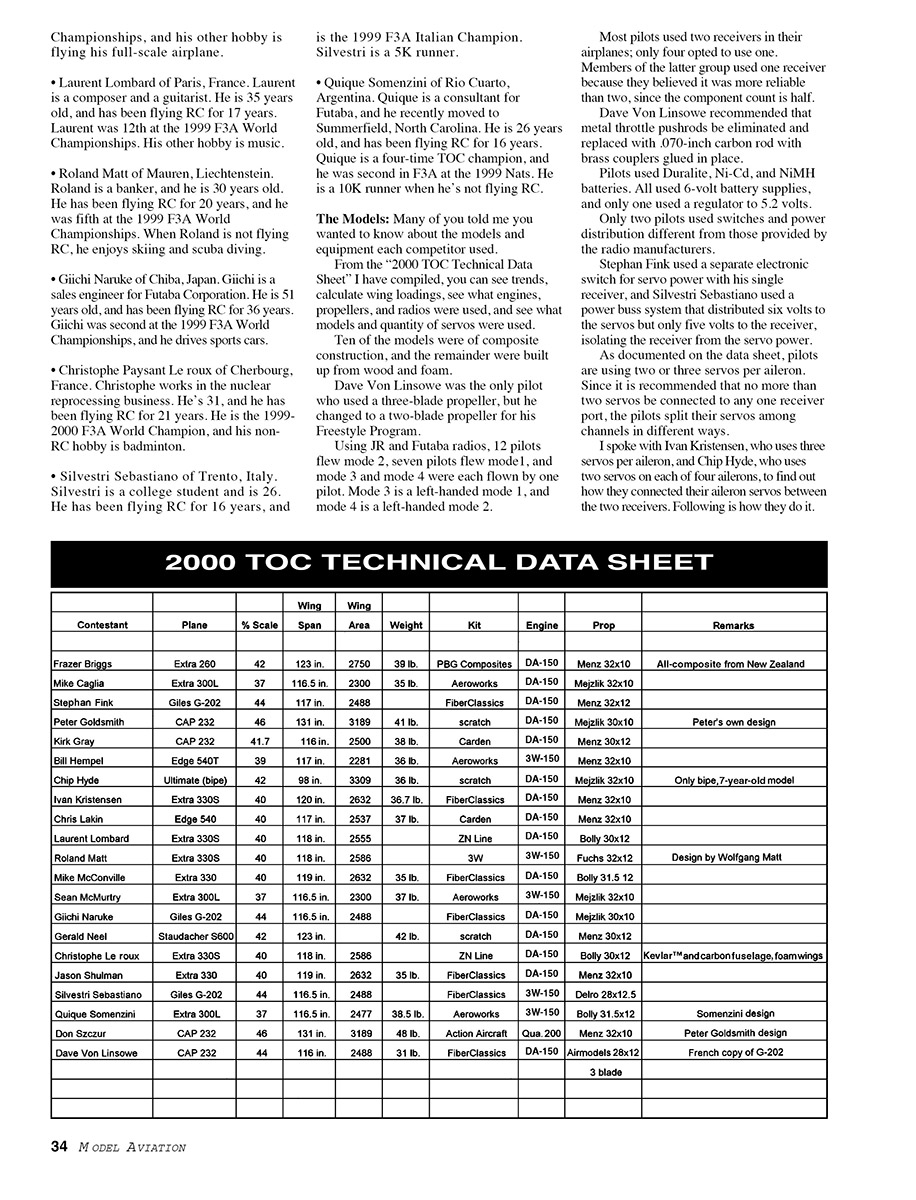
Many readers asked about the models and equipment each competitor used. From the 2000 TOC Technical Data Sheet, you can see trends, calculate wing loadings, and see what engines, propellers, radios, and numbers of servos were used.
- Ten of the models were composite construction; the remainder were built up from wood and foam.
- Dave Von Linsowe was the only pilot who used a three-blade propeller, although he changed to a two-blade propeller for his Freestyle Program.
- Using JR and Futaba radios, 12 pilots flew Mode 2, seven pilots flew Mode 1, and Modes 3 and 4 were each flown by one pilot. (Mode 3 is a left-handed Mode 1, and Mode 4 is a left-handed Mode 2.)
- Most pilots used two receivers in their airplanes; only four pilots used one receiver. Members of the latter group believed one receiver was more reliable than two because the component count is half.
- Dave Von Linsowe recommended eliminating metal throttle pushrods and replacing them with .070-inch carbon rod with brass couplers glued in place.
- Pilots used Duralite, Ni-Cd, and NiMH batteries. All used 6-volt battery supplies; only one used a regulator to 5.2 volts.
- Only two pilots used switches and power distribution different from those provided by the radio manufacturers: Stephan Fink used a separate electronic switch for servo power with his single receiver, and Silvestri Sebastiano used a power buss system that distributed six volts to the servos but only five volts to the receiver (isolating the receiver from servo power).
- Pilots are using two or three servos per aileron. It is recommended that no more than two servos be connected to any one receiver port, so pilots split their servos among channels in different ways.
I spoke with Ivan Kristensen, who uses three servos per aileron, and Chip Hyde, who uses two servos on each of four ailerons, to find out how they connected their aileron servos between the two receivers. Here is how they do it:
- Ivan's Extra 330S:
- Left receiver — two servos to Channel 7, one servo to Channel 1.
- Right receiver — two servos to Channel 1, one servo to Channel 7.
- Chip's Ultimate:
- Left receiver — top left servos to Channel 1, top right servos to Channel 6.
- Right receiver — bottom left servos to Channel 1, bottom right servos to Channel 6.
The only pilot who used as few as two servos on the rudder was Giichi Naruke, who used digital servos. The majority used three or four servos, and Jason Shulman used five. The pilots recognized the tremendous loads on their models' rudders and the need to ensure the rudders held position during demanding rolling turns.
The Competition
All pilots fly in the qualifying rounds the first three days. The top 14 pilots score the Semi-Finals on Day Four, and the top seven advance to the Finals on Day Five.
Each day each pilot flies an Unknown Program and a Known Program, which they are given the previous evening. No practice-flying is allowed. Computer simulations are not allowed, and only hand-held models may be used to practice the programs. A four-minute Freestyle is also flown each day.
At past TOCs there was only one Known Program, sent to the pilots early in the year. In 2000, a list of 21 maneuvers was distributed to the pilots in advance, from which three Known Programs were developed — you might call these "unknown Knowns."
Weather was delightful the first four days, with temperatures in the 80s and very little wind. The flying was superb despite the lack of prior practice.
Before the official flights each day, warmup pilot Warren Thomas flew the Unknown and Known Programs for the judges. The judges did not receive the programs until the evening before, at the same time as the contestants, so they had to prepare call sheets and do some homework.
Warren performed the warmups with precision and never had to "bail out." Early in the week he experienced a control problem and, realizing he had only throttle and aileron, coolly landed using throttle to control altitude and attitude. A faulty crystal in one of his receivers was later identified as the culprit. A large round of applause followed his safe landing.
There were three unscheduled events during the first two days of competition:
- A propeller broke on Stephan Fink's Giles G-202 during his first maneuver. The vibration was intense; the fuselage tail post fractured and other structural failures occurred. Stephan used his backup model for the rest of the contest.
- Kirk Gray parked his CAP 232 in a tree during a low flat spin in his Freestyle routine. With help from about 10 pilots and crew members, Kirk's airplane was retrieved virtually unscathed. The only repairs needed were small leading edge replacements and MonoKote covering.
- Silvestri Sebastiano scuffed a wingtip during a slow, too-low knife-edge pass in his Freestyle. The tail couldn't keep up with nose rotation and the fuselage broke just in front of the tail. Thanks to Mike McConville, who loaned Silvestri his backup model, Silvestri was able to continue in the competition.
A sad event was the theft of wings, stabilizers, servos, and other equipment from Bill Hempel's truck while it was parked in the Sahara lot. The fuselages of Bill's airplanes were not stolen and there were no clues. Thanks to Ivan Kristensen, who loaned Bill his backup Edge 540, Bill was able to compete. The "TOC Sportsmanship Awards" go to Mike McConville and Ivan Kristensen for their outstanding help to Silvestri and Bill.
The first seven pilots were cut from the field Friday afternoon, and the remaining 14 returned to work on the programs for the Semi-Finals.
In the Semi-Finals, the highest Known score from the previous three days was carried forward; each pilot flew two different Unknown Programs and two Freestyle Programs. Results of the Semi-Finals, using the best Unknown score, the best Freestyle score, and the carried Known score, were as follows:
- Christophe Paysant Le Roux — 9,986.84
- Chip Hyde — 9,852.39
- Frazer Briggs — 9,673.15
- Quique Somenzini — 9,630.45
- Roland Matt — 9,553.57
- Jason Shulman — 9,549.39
- Sean McMurtry — 9,542.20
- Kirk Gray — 9,287.91
- Mike Caglia — 9,274.01
- Mike McConville — 9,160.16
- Dave Von Linsowe — 9,138.95
- Laurent Lombard — 8,930.12
- Chris Lakin — 8,916.22
- Silvestri Sebastiano — 8,506.71
The top seven pilots went to Sunday's Finals. It was like a new contest since no previous scores were carried forward. Each finalist flew two Known Programs from earlier in the week, two new Unknown Programs, and two Freestyle Programs.
Christophe Paysant Le Roux won the Finals and the Tournament of Champions, taking the $40,000 first prize. The rest of the top seven and their prize money were:
- Chip Hyde — $25,000
- Jason Shulman — $15,000
- Quique Somenzini — $10,000
- Roland Matt — $8,000
- Sean McMurtry — $7,000
- Frazer Briggs — $6,500
The winner was determined by adding each pilot's highest score in each program. Known is weighted 30%, Unknown 50%, and Freestyle 20%.
Sunday's weather changed: temperatures dropped to the 60s and a 15–20 mph crosswind developed. These conditions persisted throughout the competition. Early flyers lacked the benefit of watching earlier flights to size up wind velocity and direction, so competitors used their trim pass to determine crab angle. Crosswind management likely accounted for a sizable difference between fourth and fifth place.
Highlights from Sunday:
- Jason and Christophe each won a Known flight for 3,000 points.
- Chip and Jason each won an Unknown flight for 5,000 points.
- Christophe won both four-minute Freestyle flights for 2,000 points.
- Second place in Freestyle went to Roland Matt with 1,901.32 points.
The importance of the four-minute Freestyle Program cannot be overlooked.
Final results (Finals scores):
- Christophe Paysant Le Roux — 9,929.48
- Chip Hyde — 9,874.12
- Jason Shulman — 9,863.42
- Quique Somenzini — 9,720.29
- Roland Matt — 9,152.12
- Sean McMurtry — 9,134.99
- Frazer Briggs — 9,121.21
The 17th Tournament of Champions is in the books. There was no announcement regarding future TOCs, so we will have to wait to hear from Bill Bennett. On behalf of those of us fortunate enough to attend a TOC and those pilots fortunate enough to be invited, thanks to Mr. Bennett and the staff at the Sahara Hotel and Casino for giving us a great show!
Bob Noll 2317 Acorn Dr. Vestal, NY 13850
Transcribed from original scans by AI. Minor OCR errors may remain.

