
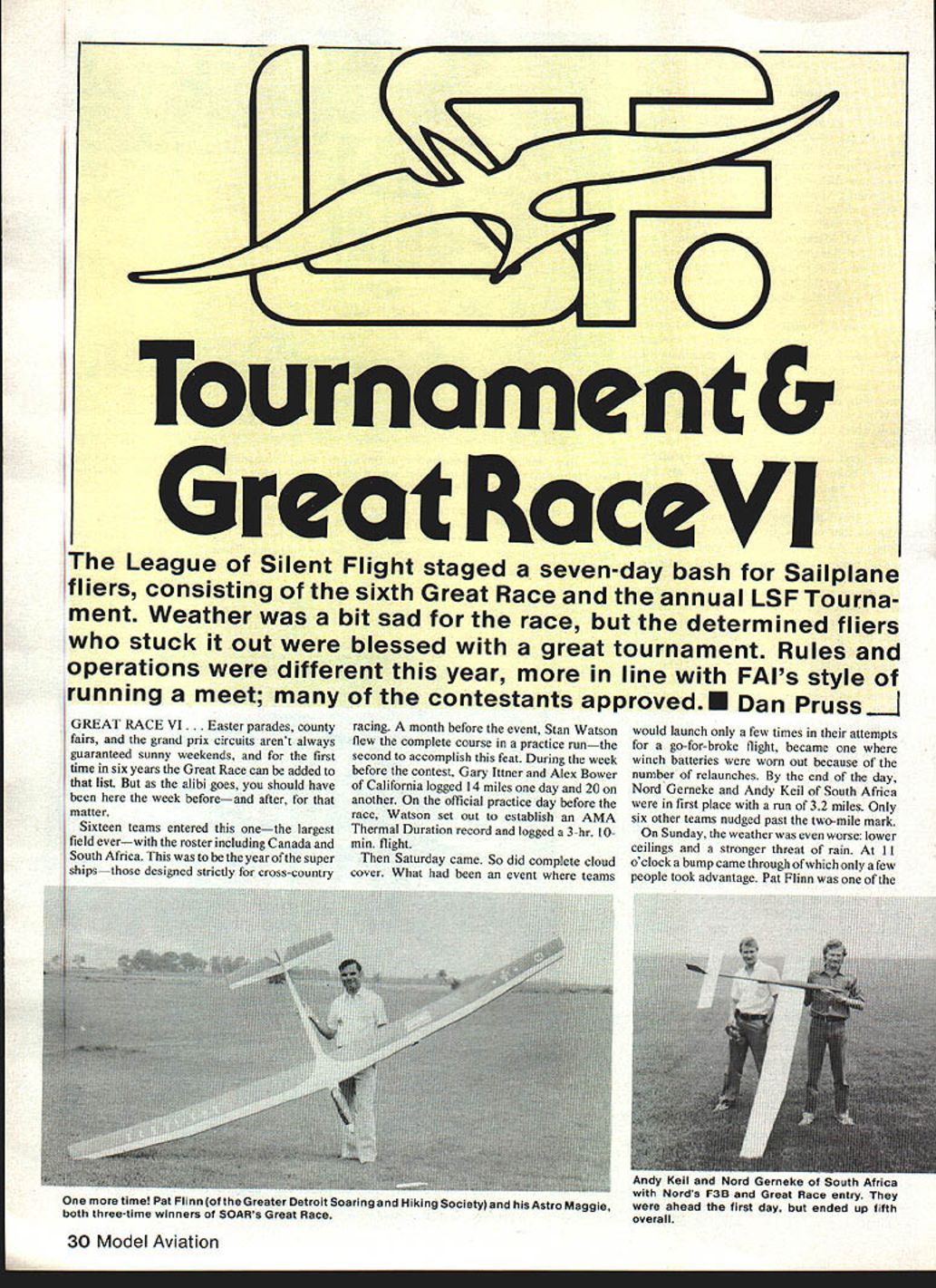
Tournament & Great Race VI
The League of Silent Flight staged a seven-day bash for sailplane fliers, consisting of the sixth Great Race and the annual LSF Tournament. Weather was a bit sad for the race, but the determined fliers who stuck it out were rewarded with a great tournament. Rules and operations were different this year, more in line with FAI-style running of a meet; many of the contestants approved. — Dan Pruss
Great Race VI
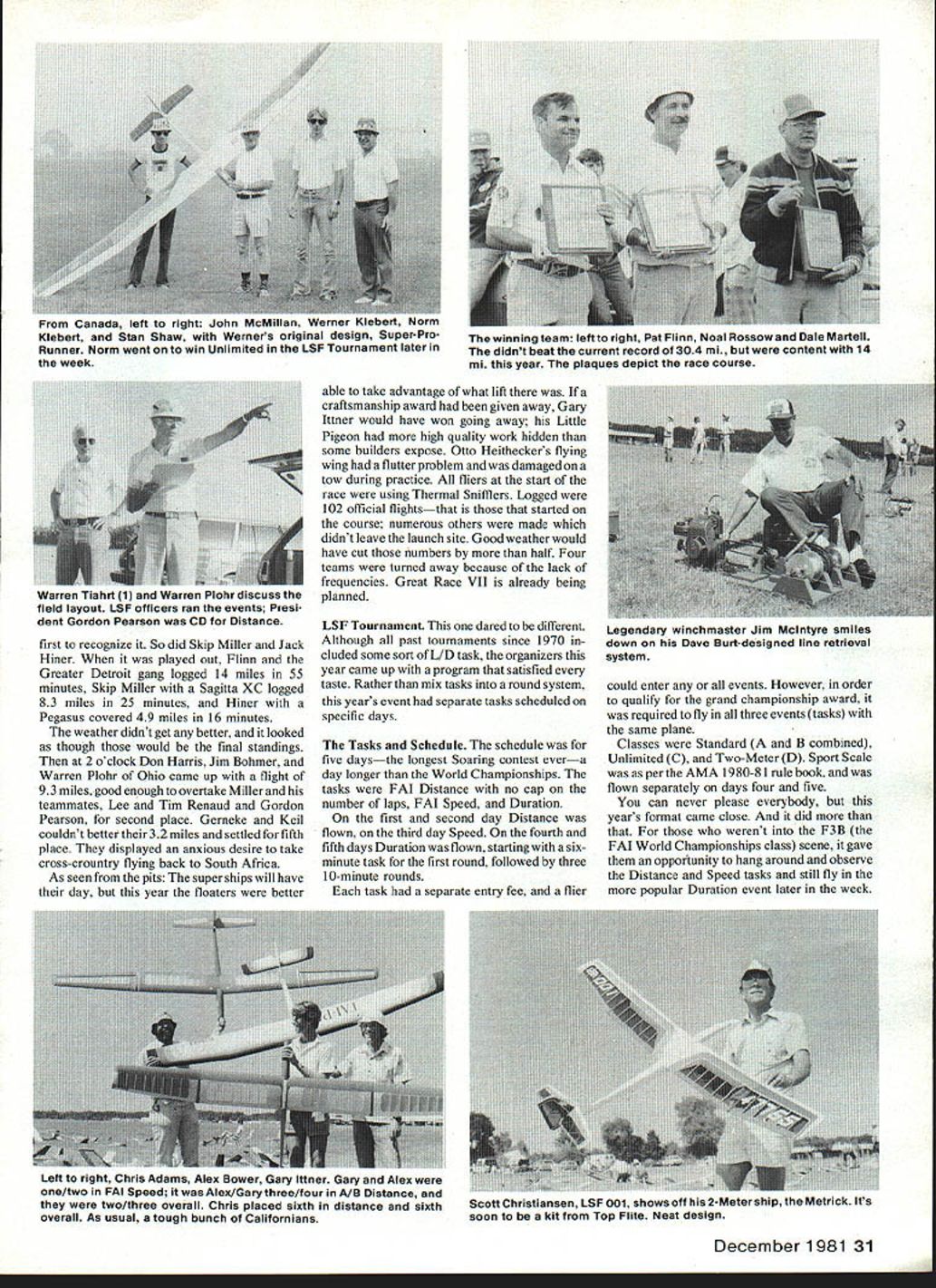
For the first time in six years the Great Race encountered uncooperative weather. Sixteen teams entered—the largest field ever—including teams from Canada and South Africa. This was to be the year of the “super ships,” aircraft designed strictly for cross-country racing.
In the weeks before the contest there were notable practice performances. Stan Watson flew the complete course in a practice run, the second person to accomplish this feat. Gary Ittner and Alex Bower of California logged 14 miles one day and 20 on another. On the official practice day Watson attempted an AMA Thermal Duration record and logged a 3-hour, 10-minute flight.
Saturday brought complete cloud cover. What had been an event where teams would launch only a few times in hopes of a go-for-broke flight became one of many relaunches that wore out winch batteries. By the end of the day Nord Gerneke and Andy Keil of South Africa led with a 3.2-mile run. Only six other teams exceeded the two-mile mark.
Sunday’s weather was worse—lower ceilings and a stronger threat of rain. An 11 o’clock bump produced lift that only a few took advantage of; Pat Flinn was one of them. At 2 p.m., Don Harris, Jim Bomber, and Warren Plohr of Ohio produced a flight long enough to overtake earlier leaders. Gerneke and Keil could not improve on their 3.2 miles and settled into fifth place, but they showed an enthusiastic desire to develop cross-country flying in South Africa.
A total of 102 official flights started the course; numerous others made attempts but didn’t leave the launch site. Good weather would have cut the number of launches significantly. Four teams were turned away because of lack of frequencies. Great Race VII is already being planned.
LSF Tournament
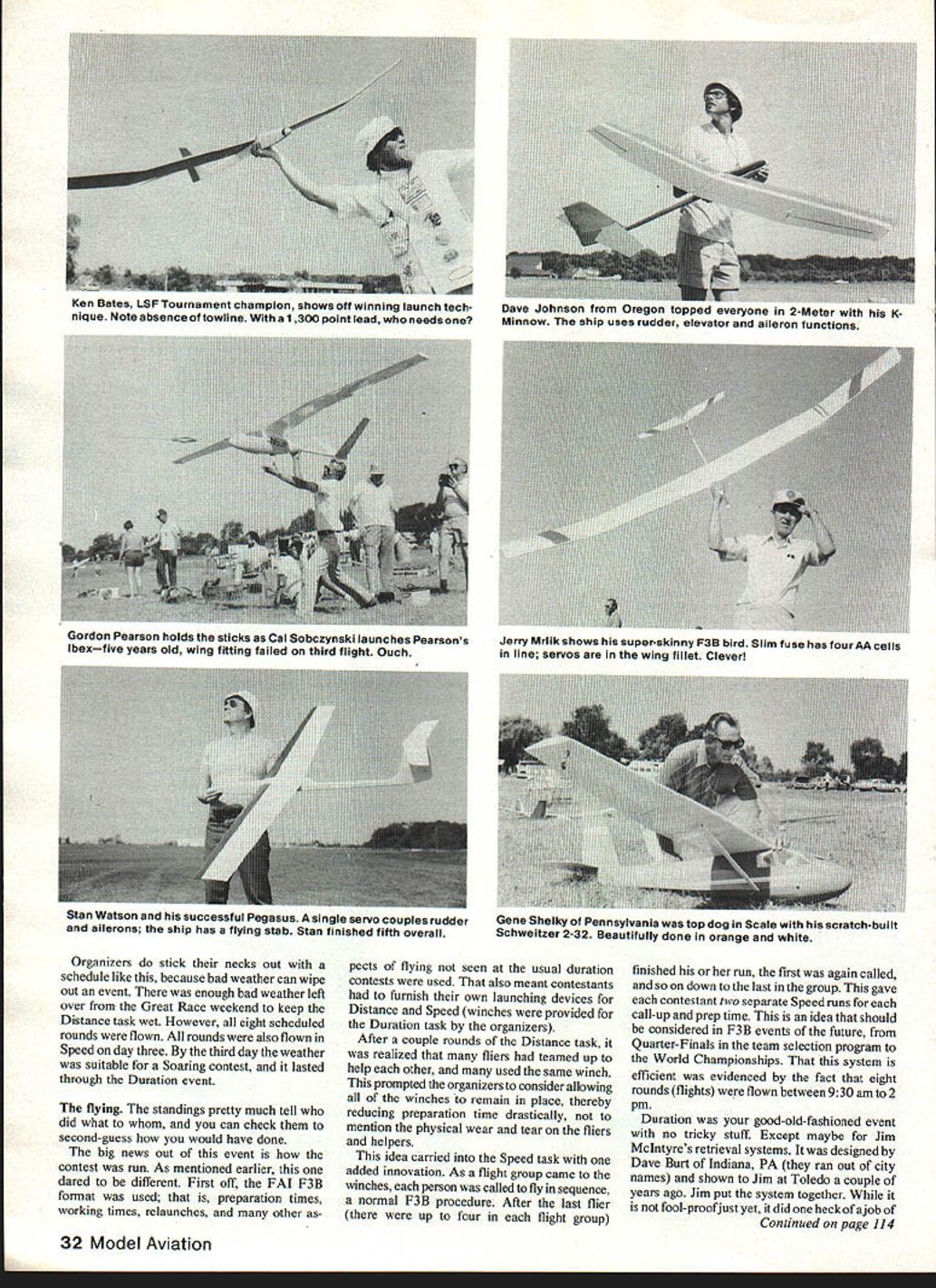
This year’s LSF Tournament dared to be different. Rather than mixing tasks into a round-robin system, separate tasks were scheduled on specific days. The format followed FAI F3B procedures more closely—preparation times, working times, relaunches, and many other elements not usually seen at the typical duration contests. Contestants had to furnish their own launching devices for Distance and Speed; organizers provided winches for the Duration task.
Organizers learned and adapted during the event. After a couple rounds of the Distance task it was noted that many fliers had teamed up and were sharing winches. To reduce preparation time and physical wear, the organizers allowed winches to remain in place between flights. A similar approach in the Speed task added an innovation: flight groups were called in sequence, and after the last flier finished a run the sequence repeated so each contestant had two separate Speed runs per call-up. That system proved highly efficient—eight Speed rounds were flown between 9:30 a.m. and 2 p.m.
Duration was run as a conventional event, with the notable appearance of Jim McIntyre’s retrieval system (designed by Dave Burt of Indiana, PA). While not yet foolproof, the system did an excellent job of retrieving models.
The Tasks and Schedule
- Five-day schedule—the longest Soaring contest ever, one day longer than the World Championships.
- Day 1–2: FAI Distance (no cap on number of laps).
- Day 3: FAI Speed.
- Day 4–5: Duration—first round a six-minute task, followed by three 10-minute rounds.
Each task had a separate entry fee; a flier could enter any or all events. To qualify for the grand championship award, a competitor was required to fly in all three events (Distance, Speed, Duration) with the same plane.
Classes
- Standard (A and B combined)
- Unlimited (C)
- Two-Meter (D)
- Sport Scale (flown separately on days four and five, per AMA 1980–81 rule book)
This format appealed to a wide range of participants. For those not into the F3B/FAI World Championships class scene, it allowed them to observe Distance and Speed tasks earlier in the week and still participate in the popular Duration event later on. Despite leftover bad weather from the Great Race weekend, all eight scheduled Distance rounds and all Speed rounds were flown; the weather improved by the third day and stayed favorable through the Duration event.
The flying
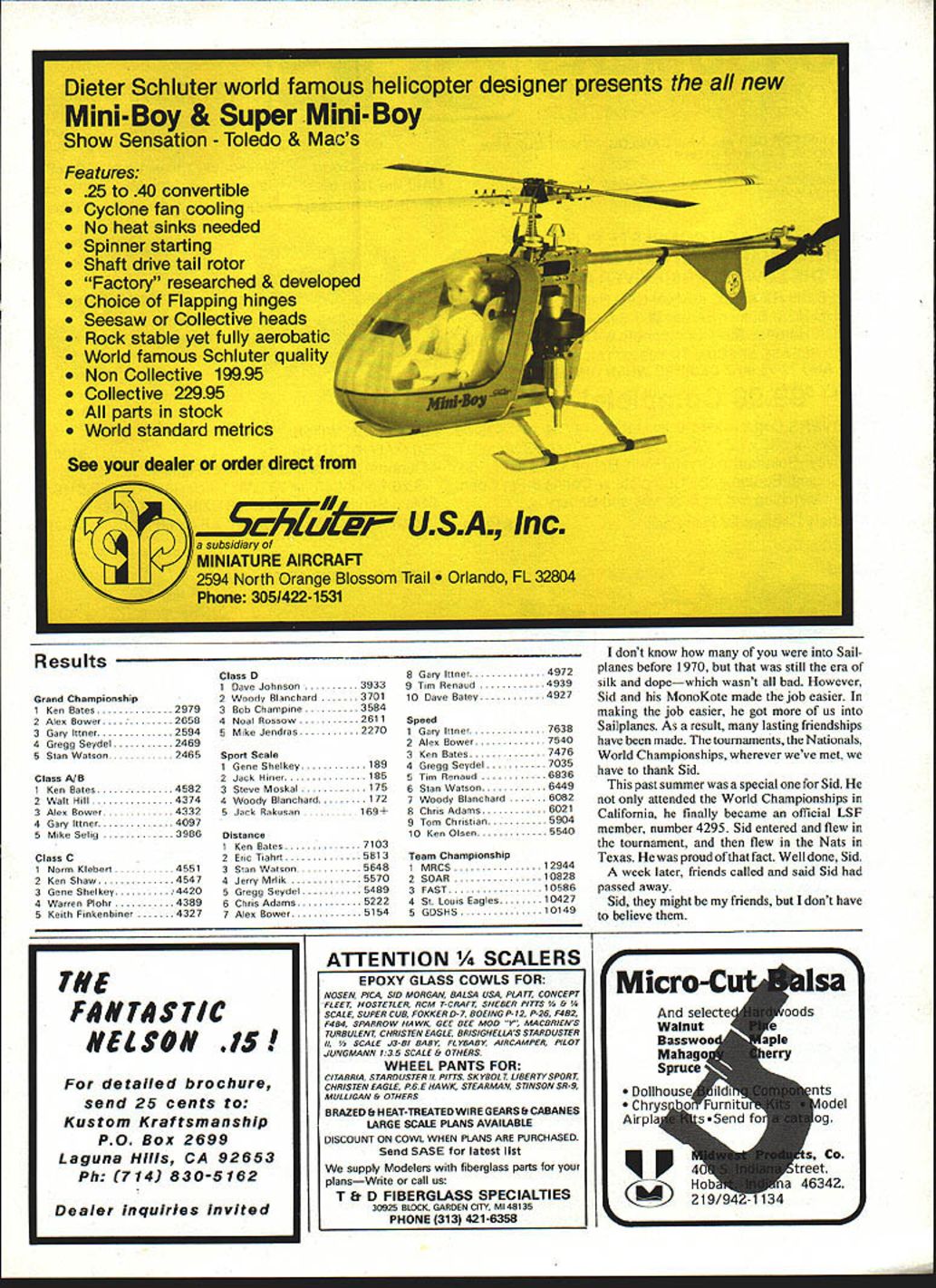
The standings reflect the performances; they show who did what to whom and let you second-guess how you might have done. The major change at this event was procedural: using the FAI F3B format for tasks and introducing operational efficiencies (shared winches, sequential Speed runs with repeat call-ups) that reduced prep time and physical strain on fliers and helpers. These ideas worked well and are worth considering for future F3B events, from team selection quarters to World Championships.
Duration remained straightforward competition, while innovations such as McIntyre’s retrieval system proved useful in practice.
In Memoriam: Sid
I don’t know how many of you were into sailplanes before 1970, but that was still the era of silk and dope—which wasn’t all bad. Sid and his MonoKote made the job easier, and by making the job easier he got more of us into sailplanes. As a result many lasting friendships have been made: the tournaments, the Nationals, the World Championships—wherever we’ve met, we have to thank Sid.
This past summer was special for Sid. He attended the World Championships in California, became an official LSF member (number 4295), entered and flew in the tournament, and then flew in the Nats in Texas. He was proud of that. A week later, friends called and said Sid had passed away.
Transcribed from original scans by AI. Minor OCR errors may remain.

