
Toys For Tots: Marine Corps Reserve
By Dennis Adamisin
America is in the midst of a celebration of gratitude and of awe for the men and women of Desert Storm and their dedication. Three years ago my club, the Fort Wayne (Indiana) Flying Circuits, first got involved with another group of military heroes, the U.S. Marine Reserves and the Toys for Tots program.
Since 1947 a dedicated group of Marines has been collecting and distributing toys for needy families in their communities. The program has grown from an annual Los Angeles–area project to a nationwide campaign. By now, virtually anywhere you find Marines you will also find them involved in helping their communities.
Our involvement
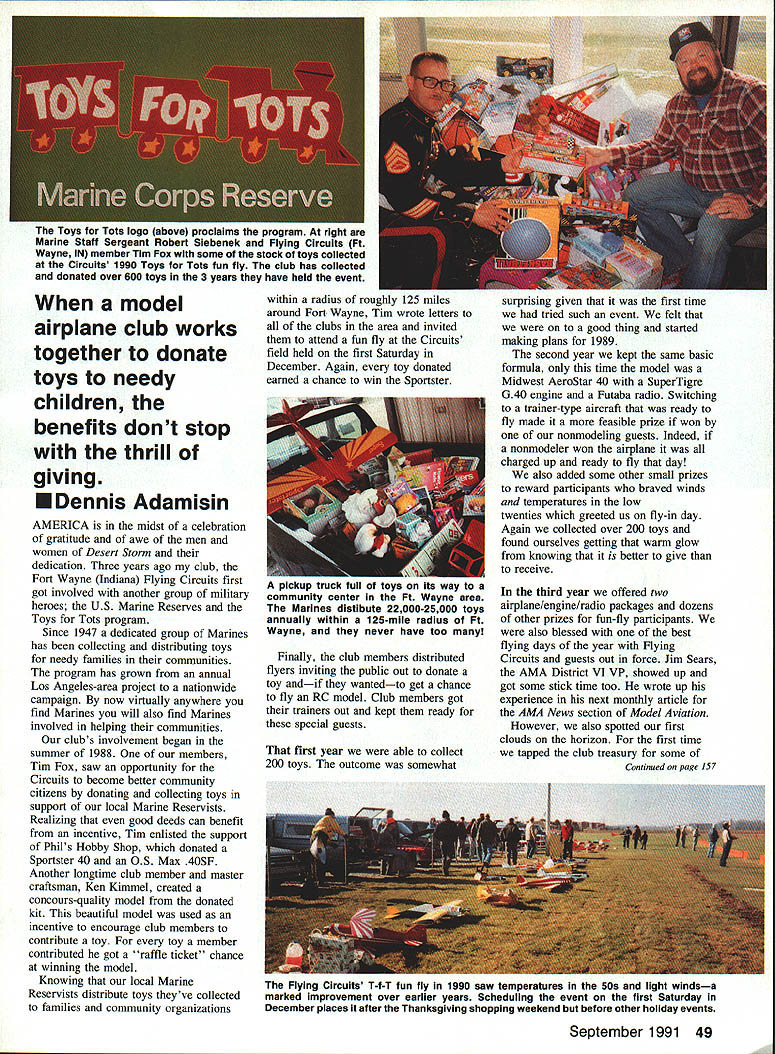
Our club's involvement began in the summer of 1988. One of our members, Tim Fox, saw an opportunity for the Circuits to become better community citizens by donating and collecting toys in support of our local Marine Reservists. Realizing that even good deeds can benefit from an incentive, I enlisted the support of Phil's Hobby Shop, which donated a Sportster .40 and an O.S. Max .40SF. Another longtime club member and master craftsman, Ken Kimmel, created a concours-quality model from the donated kit. This beautiful model was used as an incentive to encourage club members to contribute a toy. For every toy a member contributed he received a raffle ticket for a chance to win the model.
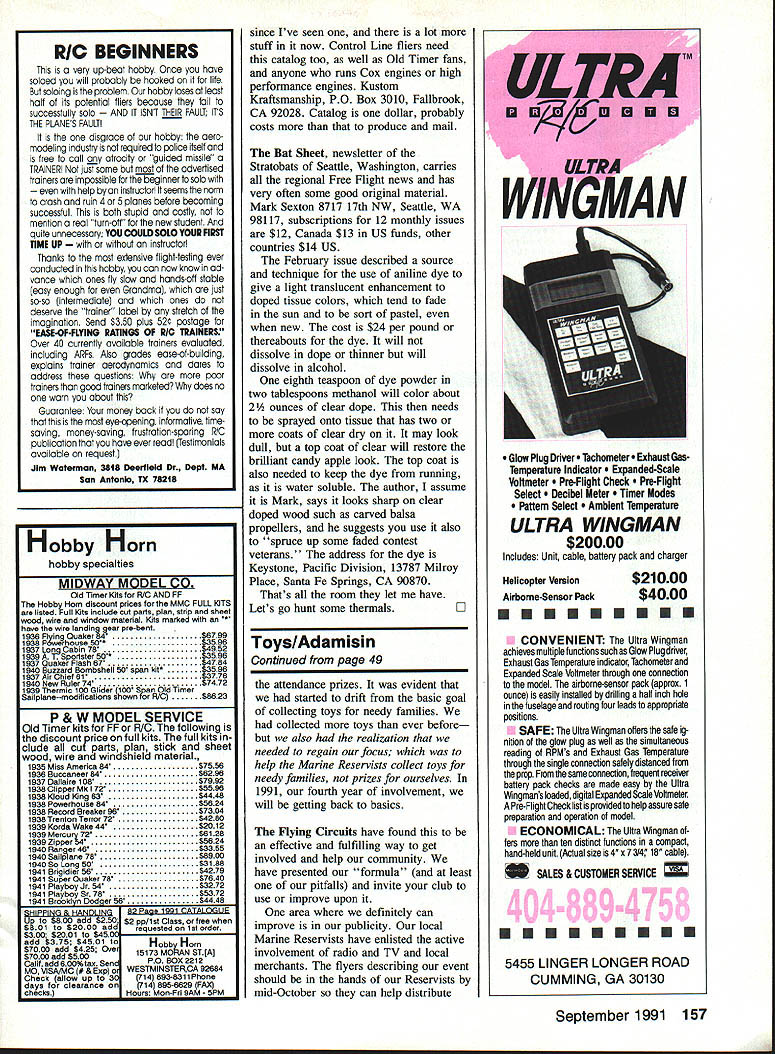
Knowing that our local Marine Reservists distribute toys they've collected to families and community organizations within a radius of roughly 125 miles around Fort Wayne, Tim wrote letters to all of the clubs in the area and invited them to attend a fun fly at the Circuits' field held on the first Saturday in December. Again, every toy donated earned a chance to win the Sportster.
Finally, club members distributed flyers inviting the public to donate a toy and—if they wanted—to get a chance to fly an R/C model. Members got their trainers out and kept them ready for these special guests.
That first year we collected 200 toys. The outcome was somewhat surprising given that it was our first time running such an event. We felt that we were on to a good thing and started making plans for 1989.
The second year we kept the same basic formula, only this time the model was a Midwest AeroStar .40 with a SuperTigre G.40 engine and a Futaba radio. Switching to a trainer-type aircraft that was ready to fly made it a more feasible prize for nonmodeling guests. Indeed, if a nonmodeler won the airplane it was all charged up and ready to fly that day!
We also added some other small prizes to reward participants who braved winds and temperatures in the low twenties that greeted us on fly-in day. Again we collected over 200 toys and found ourselves getting that warm glow from knowing that it is better to give than to receive.
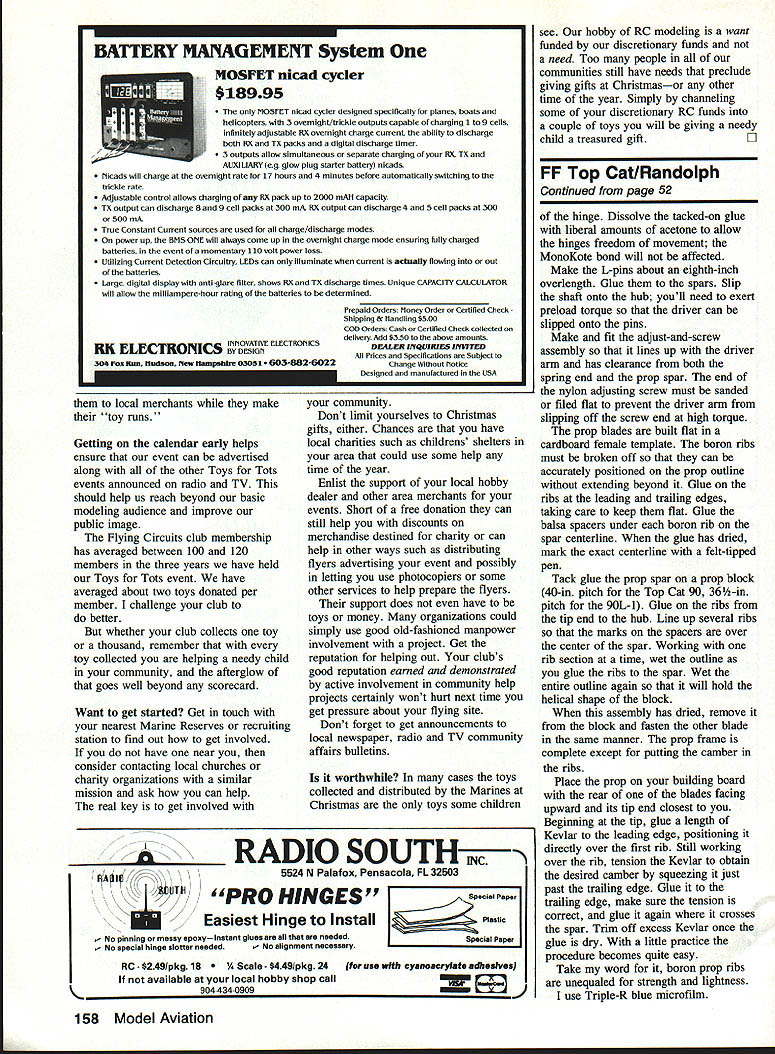
In the third year we offered two airplane/engine/radio packages and dozens of other prizes for fun-fly participants. We were also blessed with one of the best flying days of the year with Flying Circuits and guests out in force. Jim Sears, the AMA District VI VP, showed up and got some stick time; he wrote up his experience in the next monthly AMA News section of Model Aviation.
However, we also spotted our first clouds on the horizon. For the first time we tapped the club treasury for some of the attendance prizes. It was evident that we had started to drift from the basic goal of collecting toys for needy families. We had collected more toys than ever before — but we also realized we needed to regain our focus: to help the Marine Reservists collect toys for needy families, not to provide prizes for ourselves. In 1991, our fourth year of involvement, we planned to get back to basics.
The Flying Circuits have found this to be an effective and fulfilling way to get involved and help our community. We have presented our "formula" (and at least one of our pitfalls) and invite your club to use or improve upon it.
Publicity and timing
One area where we definitely can improve is publicity. Our local Marine Reservists have enlisted the active involvement of radio, TV, and local merchants. The flyers describing our event should be in the hands of our Reservists by mid-October so they can help distribute them to local merchants while they make their "toy runs."
Getting on the calendar early helps ensure that our event can be advertised along with all of the other Toys for Tots events announced on radio and TV. This should help us reach beyond our basic modeling audience and improve our public image.
The Flying Circuits club membership has averaged between 100 and 120 members in the three years we have held our Toys for Tots event. We have averaged about two toys donated per member. I challenge your club to do better. But whether your club collects one toy or a thousand, remember that with every toy collected you are helping a needy child in your community, and the afterglow of that goes well beyond any scoreboard.
Getting started — how your club can help
- Get in touch with your nearest Marine Reserves or recruiting station to find out how to get involved.
- If you do not have a Marine Reserve nearby, contact local churches or charity organizations with a similar mission and ask how you can help. The real key is to get involved with your community.
- Don't limit yourselves to Christmas gifts. Local charities such as children's shelters often need help year-round.
- Enlist the support of your local hobby dealer and other area merchants. Short of a free donation they can help with discounts on merchandise destined for charity, distribute flyers, or provide services such as photocopying. Their support doesn't have to be toys or money; many organizations can use manpower as well.
- Get the reputation for helping out. A strong community reputation earned by active involvement in charitable projects can help when site or zoning issues arise.
- Don't forget to send announcements to the local newspaper and radio and TV community affairs bulletins.
Is it worthwhile?
In many cases the toys collected and distributed by the Marines at Christmas are the only toys some children see. Our hobby of R/C modeling is funded by discretionary income and is a want, not a need. Too many people in our communities still have needs that preclude giving gifts at Christmas—or any other time of the year. Simply by channeling some of your discretionary hobby funds into a couple of toys you can give a needy child a treasured gift.
We encourage your club to get involved and help your community.
Transcribed from original scans by AI. Minor OCR errors may remain.

